
Filing a Breach of Contract Case in Ohio Courts
Learn which Ohio court hears breach of contract disputes, how to file a claim, and the deadlines and remedies that can affect your case.
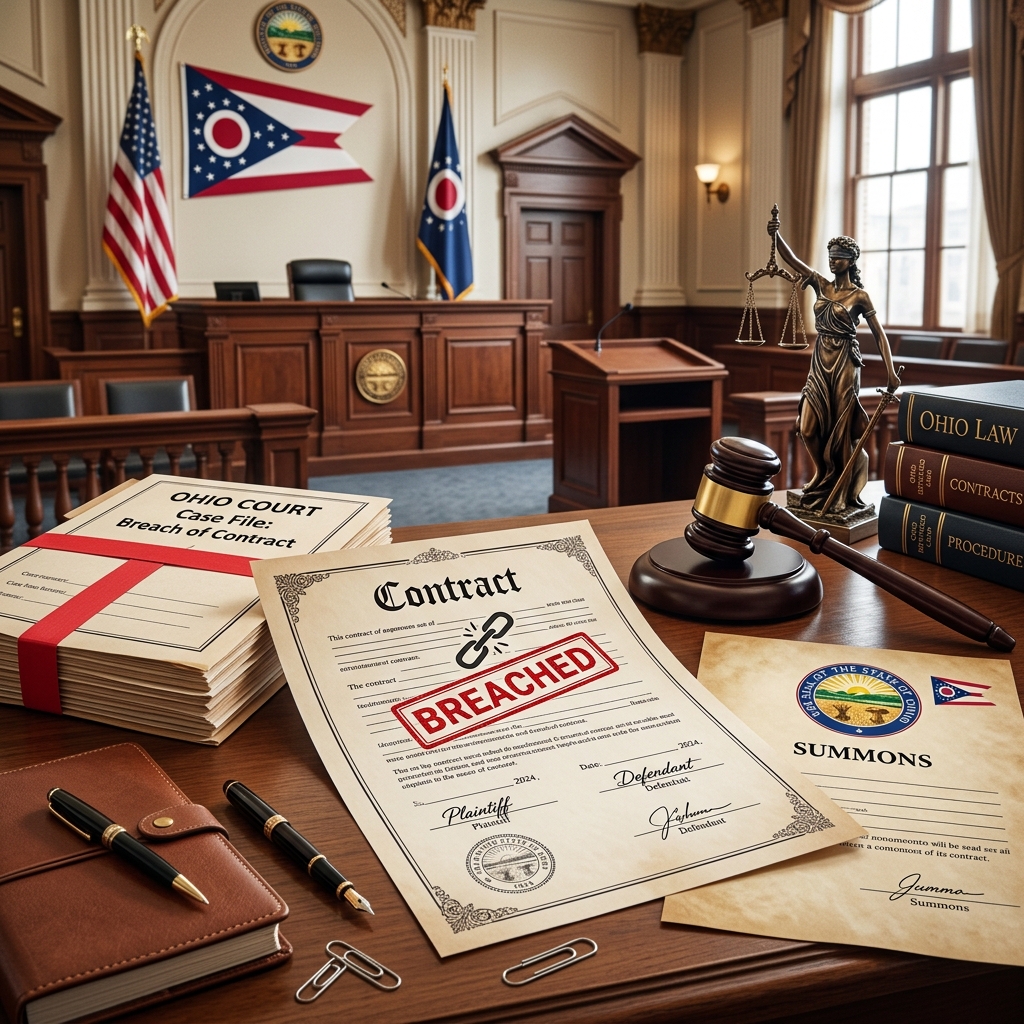
When an agreement goes wrong in Ohio and one party fails to keep their promises, the dispute often turns into a breach of contract claim. Understanding which court can hear your case and how to file properly is critical to protecting your rights under Ohio law.
This guide explains how breach of contract disputes are handled in Ohio, from choosing the right court and meeting filing deadlines to understanding available remedies and practical steps to prepare your claim.
1. How Ohio Law Views Breach of Contract Disputes
A contract dispute in Ohio arises when one party alleges the other failed to perform as promised, either by not performing at all or by performing poorly. Ohio courts generally distinguish between:
- Written contracts – Agreements documented in writing and signed or otherwise authenticated. These include leases, service contracts, loan agreements, and many business deals.
- Oral contracts – Agreements made verbally. While enforceable in many situations, they are subject to shorter time limits and evidentiary challenges.
- Consumer transactions – Contracts for goods or services primarily for personal, family, or household use, which Ohio treats distinctly for limitation periods.
Ohio statutes set clear deadlines for filing contract claims, and courts carefully evaluate whether the claim fits within those rules before allowing a lawsuit to proceed.
2. Which Ohio Court Handles Breach of Contract Cases?
In Ohio, the appropriate court for a breach of contract claim depends mainly on two factors: who the defendant is and how much money is at stake.
2.1 General Overview of Court Options
| Court Type | Typical Use in Contract Cases | Key Features |
|---|---|---|
| Court of Common Pleas | Most standard contract lawsuits between private parties in a county. | General jurisdiction; can award damages and equitable remedies; formal litigation process. |
| Municipal Court | Lower-value civil disputes within a city or local area, including some contract claims. | Limited monetary jurisdiction; more streamlined than Common Pleas. |
| Small Claims Division | Smaller contract disputes seeking modest amounts of money. | Simplified procedures; parties often represent themselves; no complex equitable relief. |
| Ohio Court of Claims | Claims for money damages against the State of Ohio or its agencies. | Exclusive jurisdiction over many claims involving state government; specialized rules. |
2.2 Court of Common Pleas
For most breach of contract matters between individuals or businesses, the Court of Common Pleas in the county where the contract was formed or performed is the primary forum.
- Handles disputes involving substantial sums or complex legal issues.
- Has authority to award both money damages and equitable remedies such as specific performance.
- Follows the Ohio Rules of Civil Procedure, including formal discovery and motion practice.
Common Pleas courts are often chosen when the dispute involves business contracts, real estate deals, or significant long-term agreements.
2.3 Municipal Courts and Small Claims
When the amount in controversy is more modest, parties may proceed in a municipal court or its small claims division. Ohio law allows a streamlined small claims process in municipal courts up to a specified monetary threshold.
- Municipal courts hear civil actions, including contract disputes, within their jurisdictional limits.
- Small claims divisions provide an accessible forum for relatively low-value claims, with simplified rules and less formal procedure.
Small claims can be appealing for straightforward disputes such as unpaid invoices, minor construction issues, or simple service contracts where the primary remedy sought is monetary damages.
2.4 Ohio Court of Claims
If the defendant is the State of Ohio or certain state agencies, the case may fall under the Ohio Court of Claims rather than local courts.
- The Court of Claims has original jurisdiction over civil lawsuits for money damages filed against the State of Ohio.
- Claims against private parties do not go to this court; they remain in Common Pleas or municipal courts.
Before filing, it is essential to determine whether your dispute involves a state entity, as this may change both the court and the procedural requirements.
3. Time Limits: Ohio Statute of Limitations for Contracts
Ohio imposes strict deadlines by which breach of contract cases must be filed. Missing these statute of limitations periods usually results in dismissal of the claim, regardless of its merits.
3.1 Written Contracts
For written agreements, Ohio Revised Code Section 2305.06 provides that an action on a written contract must be filed within six years after the cause of action accrues.
- A cause of action generally accrues when the breach occurs—typically when performance is due and not rendered or when defective performance is discovered.
- After legislative changes effective June 14, 2021, previously longer periods were reduced; written contracts now follow this six-year rule prospectively.
3.2 Oral Contracts
For oral (non-written) contracts, Ohio Revised Code Chapter 2305 provides a shorter filing deadline. Section 2305.07 states that actions upon contracts not in writing must be filed within four years after accrual.
- The shorter period reflects the evidentiary challenges of oral agreements.
- Parties relying on verbal promises should act promptly if a breach occurs.
3.3 Consumer Transactions
Certain consumer transactions—contracts primarily for personal, family, or household purposes—have a specific limitation period.
Under Ohio law, actions arising out of consumer transactions based on any contract or agreement must be commenced within six years after the cause of action accrues, with accrual defined relative to the last charge or payment.
3.4 Why Filing on Time Matters
Courts generally enforce these statutory limits strictly. Once the relevant period expires:
- Your complaint can be dismissed before any evidence is heard.
- You lose leverage in negotiations, as the other side knows you cannot sue.
- Even strong claims become unenforceable due solely to lateness.
For this reason, calculating the correct accrual date and filing within the applicable timeframe is one of the most important steps in pursuing a breach of contract case.
4. Preparing to File a Breach of Contract Case in Ohio
Before drafting a complaint, parties should assess the dispute carefully. A well-prepared case is more likely to be successful and less costly to pursue.
4.1 Clarify What Was Promised and What Went Wrong
- Identify the specific terms of the contract: payment amounts, deadlines, performance standards, and any special clauses.
- Determine which obligations allegedly were breached—non-payment, late performance, poor workmanship, or failure to deliver goods.
- Note any relevant limitation or waiver of liability clauses that may affect the claim.
Reviewing the written agreement, correspondence, and invoices can clarify how the dispute aligns with Ohio contract law standards.
4.2 Gather Evidence
Strong documentation helps courts evaluate the merits of a breach of contract claim:
- Signed contracts, amendments, and written confirmations.
- Emails, letters, or text messages showing negotiations and notice of problems.
- Invoices, receipts, and payment records.
- Photographs, inspection reports, or expert assessments, especially for construction or repair disputes.
- Notes from conversations and timelines of key events.
This evidence not only supports the existence and terms of the contract, but also the nature and impact of the alleged breach.
4.3 Consider Alternative Dispute Resolution
Ohio law recognizes mediation and arbitration as common methods of resolving contract disputes without full-scale litigation.
- Mediation uses a neutral third party to help the parties reach a voluntary agreement. It is non-binding unless a settlement is signed.
- Arbitration can be binding or non-binding, depending on the clause and rules. Many Ohio contracts include arbitration provisions enforceable under the Ohio Arbitration Act.
Some contracts require mediation or arbitration before filing in court, so it is important to review dispute resolution clauses in the agreement carefully.
5. Step-by-Step: Filing a Breach of Contract Lawsuit in Ohio
Once you decide court action is necessary and the limitation period has not expired, the filing process generally follows several key steps.
5.1 Choose the Proper Court and Venue
- Determine whether your case belongs in the Court of Common Pleas, a municipal court, small claims, or the Court of Claims (if suing the state).
- Confirm the appropriate county or district. Venue often lies where the contract was formed, performed, or where the defendant resides.
Filing in the wrong court can result in delays or dismissal, so venue and jurisdiction should be analyzed carefully.
5.2 Draft the Complaint
An Ohio breach of contract complaint typically includes:
- Identification of the parties and their relationship.
- Allegations showing the existence of a valid contract.
- A description of the defendant’s specific breach.
- An explanation of how the breach caused damages.
- A demand for specific relief—money damages, specific performance, or other remedies.
The complaint must comply with Ohio’s pleading rules and should attach or reference the contract when possible.
5.3 File and Serve the Complaint
- Submit the complaint and required filing fee to the clerk of the appropriate court within the statute of limitations.
- Arrange for proper service of process on the defendant, following Ohio rules for personal service, certified mail, or other approved methods.
Service ensures the defendant has official notice of the lawsuit, a prerequisite for the court to proceed.
5.4 Participate in Litigation or Settlement
After filing and service:
- The defendant may answer the complaint, raise defenses, or file counterclaims.
- Parties engage in discovery, exchanging documents and taking depositions.
- Courts may encourage settlement, mediation, or pretrial conferences.
- If no settlement is reached, the case proceeds to motion practice and potentially trial.
Throughout this process, the court interprets the contract according to Ohio law and decides whether a breach occurred and what remedy is appropriate.
6. Remedies Available in Ohio Breach of Contract Cases
If a breach is proven, Ohio courts may award different types of relief designed to address the harm and enforce the parties’ bargain.
6.1 Monetary Damages
- Compensatory (expectation) damages – Aim to place the non-breaching party in the position they would have occupied had the contract been performed.
- Consequential damages – Additional losses that were reasonably foreseeable at the time of contracting, such as lost profits in some circumstances.
- Liquidated damages – Pre-agreed amounts stated in the contract, enforceable if they reasonably estimate harm and are not punitive.
Punitive damages are rarely awarded in pure contract cases and are typically reserved for conduct involving fraud or similar wrongdoing.
6.2 Equitable Remedies
Where money damages cannot adequately fix the situation, Ohio courts—especially Courts of Common Pleas—may grant equitable relief:
- Specific performance – An order requiring the breaching party to carry out their contractual obligations, often used in real estate or unique goods cases.
- Rescission – Canceling the contract and restoring the parties to their pre-contract positions.
- Restitution – Returning benefits unjustly retained by the breaching party.
Equitable remedies are discretionary and depend on the circumstances, including the nature of the contract and whether monetary damages would be sufficient.
7. Practical Tips for Ohio Contract Disputes
Whether you are a business owner, consumer, or professional, certain practices can reduce the risk of dispute and strengthen your position if litigation becomes necessary.
- Use written agreements whenever possible. Written contracts benefit from clearer terms and longer limitation periods.
- Include dispute resolution clauses specifying mediation, arbitration, or a particular county’s courts as the venue.
- Track performance and payments with organized records, invoices, and receipts.
- Address problems early through communication or informal negotiation before they escalate.
- Monitor deadlines to ensure any necessary lawsuit is filed before the statute of limitations runs.
Taking these steps not only helps avoid litigation, but also prepares you to act effectively if a breach occurs.
8. Frequently Asked Questions About Ohio Breach of Contract Cases
8.1 Can I sue in Ohio for a contract made in another state?
It depends on factors such as where the contract was performed, where the parties are located, and any jurisdiction clause in the agreement. Many contracts designate which state’s courts have jurisdiction; if your contract specifies Ohio, the dispute is often heard in an Ohio court consistent with that clause.
8.2 Do I always need a lawyer to file a breach of contract case?
In small claims court, individuals often represent themselves due to simplified procedures. For more complex or higher-value disputes in Common Pleas or municipal courts, legal counsel is strongly recommended to navigate procedural rules, evidence, and potential defenses.
8.3 What if the other party partially performed the contract?
Ohio law may distinguish between material and minor breaches. A material breach substantially undermines the contract and may excuse the non-breaching party from further performance, while a minor breach may lead only to partial damages. Courts consider the extent of harm, the possibility of cure, and other factors in evaluating materiality.
8.4 How long will my Ohio breach of contract case take?
The timeline varies by court, complexity, and whether the parties reach settlement. Small claims cases may be resolved relatively quickly, while Common Pleas litigation involving discovery and motions can take many months or longer.
8.5 Can contract terms limit my ability to sue in Ohio?
Yes. Some contracts include shortened limitation periods, waivers, or arbitration clauses that affect how and when you can bring claims. Courts in Ohio may enforce such provisions if they are reasonable and consistent with statutory requirements.
References
- Section 2305.06 – Ohio Revised Code — State of Ohio. 2021-06-16. https://codes.ohio.gov/ohio-revised-code/section-2305.06
- Chapter 2305 – Ohio Revised Code — State of Ohio. 2021-06-16. https://codes.ohio.gov/ohio-revised-code/chapter-2305
- Ohio Shortens Statute of Limitations for Claims Based on Contracts — Frantz Ward LLP. 2021-03-17. https://www.frantzward.com/ohio-shortens-statute-of-limitations-for-claims-based-on-contracts/
- Court of Claims Defense — Ohio Attorney General. 2024-01-01 (last updated, approximate). https://www.ohioattorneygeneral.gov/About-AG/Service-Divisions/Court-of-Claims-Defense
- Ohio Contract Law: Formation, Enforcement, and Breach Remedies — Ohio Legal Services Authority. 2023-05-01 (approximate). https://ohiolegalservicesauthority.com/ohio-contract-law-fundamentals/
- Contract Disputes and Drafting Under Ohio Law — Joseph & Joseph Co., LPA. 2025-07-31. https://josephandjoseph.com/2025/07/31/contract-disputes-and-drafting-under-ohio-law/
- Oh, THAT Contract: Ohio Court Bars Plaintiff’s Negligence Claim — White and Williams LLP. 2015-02-24. https://www.whiteandwilliams.com/resources-alerts-7720
Similar Articles








Read full bio of medha deb


