
Understanding Felony Drug Charges in New York
Learn how New York treats felony drug offenses, the penalties you may face, and the legal strategies that can protect your future.
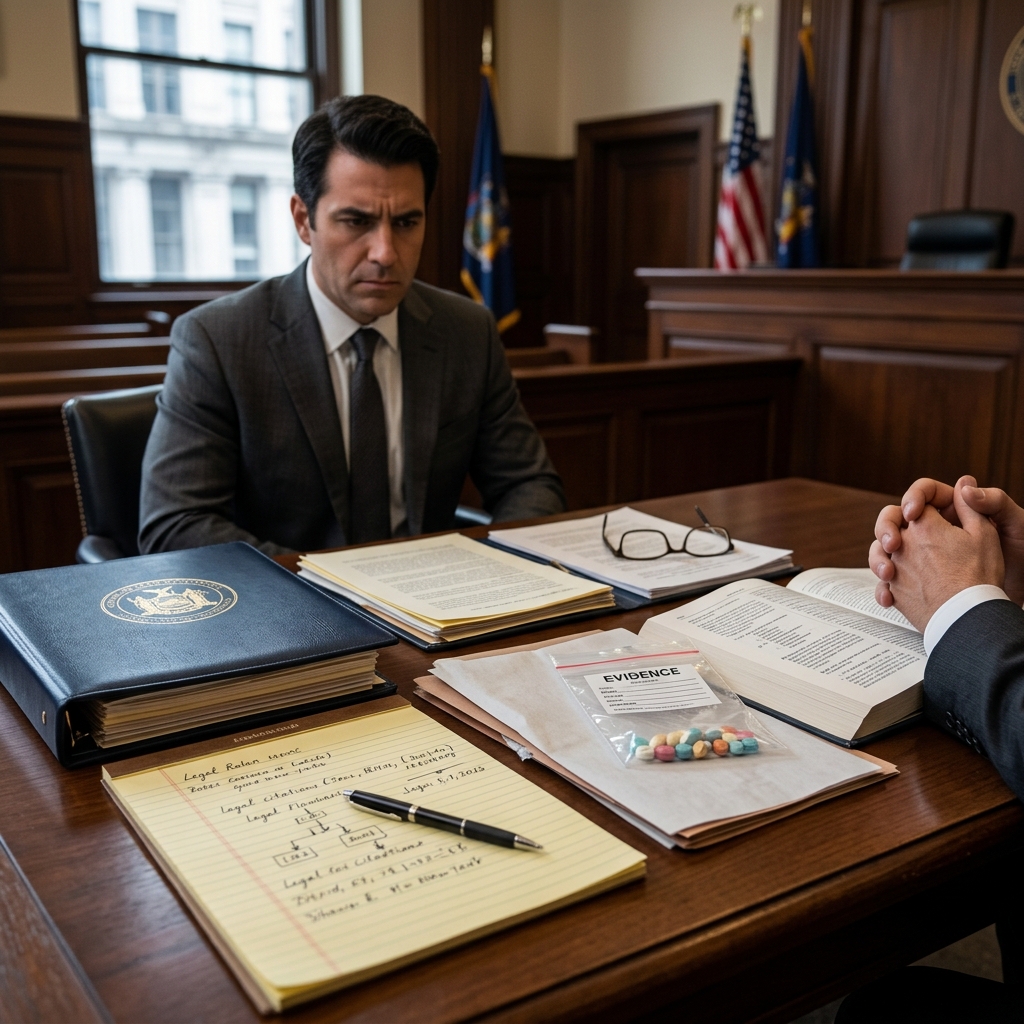
New York’s drug laws are among the most complex in the United States, and felony drug charges can expose a person to years in prison, high fines, and lasting damage to their personal and professional life. Anyone investigated or arrested for a drug offense in New York should understand the difference between misdemeanors and felonies, how the law classifies controlled substances, and what steps they can take to protect their rights.
This guide offers a clear overview of felony drug charges in New York, focusing on possession and sale offenses, potential sentencing ranges, collateral consequences, and common defense strategies. It is designed for informational purposes and is not a substitute for individualized legal advice.
How New York Classifies Drug Crimes
New York Penal Law divides drug crimes into offenses involving possession of controlled substances, sale or distribution, and, separately, certain cannabis-related offenses. The seriousness of a charge generally depends on:
- The type of substance (for example, heroin, cocaine, methadone, PCP, cannabis)
- The quantity or aggregate weight of the substance
- Whether there is alleged intent to sell or actual sale
- The defendant’s prior criminal history
Drug offenses are graded as misdemeanors or felonies and further categorized into classes (A, B, C, D, E). More serious classes carry higher potential prison terms and fines.
Felony vs. Misdemeanor Drug Charges
At a basic level, New York distinguishes felony and misdemeanor drug offenses by both the penalty range and the conduct involved.
- Misdemeanor drug offenses typically involve smaller quantities, simple possession, or certain cannabis offenses. They often carry up to one year in jail and fines of up to several thousand dollars.
- Felony drug offenses typically involve larger quantities, possession with intent to sell, sale or distribution, or high-weight cannabis offenses. These can result in multi-year prison sentences, substantial fines, and long-term supervision.
While a misdemeanor is serious, a felony conviction has far broader consequences, affecting employment, housing, immigration status, and voting rights.
Overview of Felony Drug Possession in New York
New York Penal Law Article 220 governs criminal possession of a controlled substance. Felony possession charges usually arise when the amount of a controlled substance exceeds a statutory threshold, or when the type of substance is considered especially dangerous.
Common Felony Possession Classes and Penalties
Felony drug possession is organized into degrees, each tied to specific quantities and substances. While exact thresholds are defined by statute, the following table highlights typical classes and penalty ranges drawn from New York practice and commentary.
| Felony Class | Example Conduct (Controlled Substances) | Typical Prison Range | Possible Fine |
|---|---|---|---|
| Class E Felony | Lower felony thresholds; certain cannabis possession between 5 and 10 pounds or similar quantities of concentrated cannabis. | Approximately 1 to 4 years in prison. | Up to about $5,000–$15,000, depending on the statute. |
| Class D Felony | Possession of at least 500 mg of cocaine, certain amounts of PCP or ketamine, or more than 10 pounds of cannabis. | Approximately 1 to 7 years in prison. | Up to $5,000–$15,000. |
| Class C Felony | Larger quantities of narcotic drugs, hallucinogens, depressants, or stimulants above Class D thresholds. | Approximately 1 to 15 years in prison. | Up to $15,000. |
| Class B Felony | High-level possession or intent to sell narcotics or large quantities of other controlled substances. | Approximately 1 to 25 years in prison. | Up to $30,000. |
| Class A Felony (A-II or A-I) | Highest-level possession, such as 8 ounces or more of a narcotic drug or 5,760 mg or more of methadone (first-degree possession). | Often 8 to 20 years or more, with maximums that can reach life imprisonment for certain Class A-1 offenses. | Up to $100,000. |
These ranges reflect typical statutory and practice-based guidance, but actual sentencing depends on multiple factors, including prior convictions and whether the offense is classified as a drug-related Class A felony under specific sentencing statutes.
First-Degree Felony Possession
One of the most serious possession charges is criminal possession of a controlled substance in the first degree, a Class A-I felony. This offense generally involves:
- Possessing 8 ounces or more of a narcotic drug; or
- Possessing 5,760 milligrams or more of methadone.
Upon conviction, a person faces a potential sentence of 8 to 20 years in prison and a fine of up to $100,000, with longer minimums for individuals who have prior felony or drug convictions. These harsh penalties reflect New York’s response to large-scale drug activity.
Felony Drug Sale and Distribution Offenses
In addition to possession, New York law criminalizes sale and distribution of controlled substances under Article 220 and related provisions. Selling or distributing drugs, especially in substantial quantities, almost always elevates the offense to a felony.
Key Features of Drug Sale Crimes
Drug sale crimes in New York include conduct such as transferring controlled substances to another person, offering to sell, or engaging in transactions that resemble distribution. Important points include:
- Even small sales can be charged as felonies depending on the substance involved.
- Higher degrees apply when the sale involves large quantities, sale near schools, or sale to minors.
- First-degree sale offenses can involve 2 ounces or more of a narcotic drug or high quantities of methadone.
Like possession offenses, sale offenses are graded from lower-level felonies up to Class A-1, with similar maximum penalties and fines.
Cannabis-Related Felony Charges
New York has reformed its cannabis laws, creating a separate framework for criminal possession of cannabis. However, extremely large quantities can still lead to felony charges.
- Class A misdemeanors may apply to possession between 16 ounces and 5 pounds of cannabis or equivalent ranges of concentrated cannabis.
- Class E felonies may apply to possession between 5 and 10 pounds of cannabis or 2 to 4 pounds of concentrated cannabis.
- Class D felonies may apply to possession of more than 10 pounds of cannabis or more than 4 pounds of concentrated cannabis.
These cannabis-specific thresholds show that, despite legalization initiatives, very large quantities of cannabis remain treated as serious criminal offenses.
Sentencing Factors and Collateral Consequences
A felony drug conviction does not end with the formal sentence. In New York, the actual impact extends far beyond the prison term or fine.
Factors Influencing Sentencing
Even within the same felony class, sentencing outcomes can vary considerably. Courts consider factors such as:
- Criminal history – prior felonies, prior drug offenses, and any violent record can increase minimum sentences, particularly for Class A drug felonies.
- Role in the offense – whether the defendant is a high-level trafficker, mid-level distributor, or someone in possession primarily for personal use.
- Aggravating circumstances – sale near schools, involvement of minors, or participation in organized trafficking networks.
- Mitigating factors – cooperation with authorities, evidence of addiction and participation in treatment, or lack of prior record.
Judges also must comply with statutory ranges set in the Penal Law and sentencing provisions tailored specifically to drug felonies.
Collateral Consequences of a Felony Drug Conviction
Beyond incarceration and financial penalties, a felony drug conviction in New York may lead to long-term effects such as:
- Employment barriers – difficulty obtaining certain professional licenses or security-sensitive positions.
- Housing challenges – limitations in public housing eligibility and reluctance from private landlords.
- Immigration risks – potential removal, inadmissibility, or denial of naturalization for non-citizens.
- Loss of civil rights – restrictions on voting or firearm possession, depending on the circumstances.
- Ongoing supervision – post-release supervision requirements for certain high-level felonies, including Class A-1 offenses.
Because of these consequences, avoiding a felony conviction or reducing the charge can significantly affect a person’s long-term prospects.
Defending Against Felony Drug Charges
There is no single strategy that applies to every felony drug case, but several defense approaches frequently appear in New York practice.
Challenging Search and Seizure
Many drug cases originate from traffic stops, home searches, or street encounters. Defense counsel often examines whether law enforcement complied with constitutional requirements regarding searches and seizures.
- If police lacked probable cause or a valid warrant, or exceeded the scope of a warrant, evidence may be suppressed.
- If a stop or frisk was conducted without reasonable suspicion, statements or physical evidence may be challenged.
Successful suppression can drastically weaken the prosecution’s case and may lead to dismissal or a substantial reduction of charges.
Disputing Possession and Knowledge
New York law generally requires proof that the defendant knowingly and unlawfully possessed the controlled substance. Defense strategies may focus on:
- Showing the defendant did not know the substance was present (for example, drugs hidden in a shared vehicle).
- Demonstrating the substance belonged to someone else and there was no dominion or control.
- Questioning the chain of custody or testing of the substance.
Where knowledge or control is unclear, juries may be less willing to find guilt beyond a reasonable doubt.
Challenging Quantity and Classification
Since felony levels depend heavily on quantity and type of drug, defense attorneys may scrutinize how law enforcement weighed the substances and classified them.
- Errors in weighing, contamination, or inaccurate lab analysis can be grounds for challenging higher-degree charges.
- If the substance is misidentified or contains less active drug than claimed, the appropriate degree might be lower.
An accurate assessment of quantity and classification can make the difference between a misdemeanor, a lower-level felony, and a Class A offense.
Plea Negotiations and Alternative Outcomes
Many felony drug cases resolve through plea negotiations. Depending on the facts and the defendant’s history, potential outcomes may include:
- Pleading to a reduced charge (for example, from a higher-degree felony to a lower-degree felony or misdemeanor).
- Agreeing to treatment-oriented dispositions or diversion programs where available.
- Negotiating sentencing recommendations that avoid lengthy incarceration.
Defense counsel evaluates the strength of the evidence, potential suppression issues, and collateral consequences when advising whether to accept a plea or proceed to trial.
Why Immediate Legal Help Matters
Because of the serious penalties tied to felony drug charges in New York, speaking with a qualified criminal defense attorney as early as possible is critical.
- Early intervention allows counsel to preserve evidence, interview witnesses, and challenge improper police conduct.
- An attorney can advise clients about their right to remain silent and avoid self-incriminating statements.
- Effective legal guidance helps clients understand realistic outcomes and make informed decisions.
Legal representation is especially important in cases involving Class B, Class C, or Class A felonies, where exposure to long prison terms and substantial fines is significant.
Frequently Asked Questions About New York Felony Drug Charges
1. When does drug possession become a felony in New York?
Possession becomes a felony when the quantity or type of controlled substance meets specific statutory thresholds or when cannabis possession exceeds designated high-weight ranges. Examples include possession of certain minimum amounts of cocaine, narcotic drugs, PCP, ketamine, or large quantities of cannabis.
2. What is the difference between drug possession and drug sale under New York law?
Possession focuses on having control over the substance, while sale involves transferring drugs to another person, selling, or offering to sell. Sale offenses usually carry higher penalties, especially at greater quantities or in aggravated circumstances.
3. Can a first-time offender receive prison time for a felony drug charge?
Yes. Even first-time offenders can receive significant prison sentences for higher-level felonies, particularly Class B, A-II, or A-I offenses. However, courts also consider the absence of prior record, and defense attorneys may seek alternatives such as reduced charges or treatment-based dispositions.
4. Are all cannabis offenses treated as felonies?
No. Many cannabis-related offenses are treated as violations or misdemeanors, particularly at lower quantities. Felony charges generally arise only when possession crosses large-weight thresholds, such as more than 10 pounds of cannabis or multiple pounds of concentrated cannabis.
5. How can a lawyer help reduce the impact of a felony drug case?
A lawyer can identify constitutional violations, challenge the prosecution’s proof of possession or quantity, negotiate plea agreements, and advocate for sentencing outcomes that emphasize rehabilitation over incarceration. In serious cases, effective representation may be crucial to avoiding the most severe penalties associated with Class A felonies.
References
- New York Drug Possession and Sale Crimes — Connecticut General Assembly Office of Legislative Research. 2015-11-19. https://www.cga.ct.gov/2015/rpt/2015-R-0304.htm
- Possession of a Controlled Substance in New York — Nolo / CriminalDefenseLawyer.com. 2024-01-01 (approx. based on statute year). https://www.criminaldefenselawyer.com/resources/criminal-defense/drug-charges/new-york-drug-possession-laws
- Drug Possession Penalties in Brooklyn, NY — CriminalDefenseLawyerBrooklyn.com. 2013-10-01. https://www.criminaldefenselawyerbrooklyn.com/criminal-defense-blog/2013/october/drug-possession-penalties-in-brooklyn-ny/
- New York State Class A-1 Narcotics Crimes — Gotlin, Jaffe & Lampel, LLP. 2022-06-01 (approx.). https://www.gjllp.com/blog/new-york-state-class-a-1-narcotics-crimes/
- Drug Possession (First Degree) in NYC Lawyer — NewYorkCriminalLawyer.com. 2021-05-01 (approx.). https://www.newyorkcriminallawyer.com/drug-possession-first-degree/
- What Are the Possible Penalties for Drug Possession in New York? — Adam Thompson Law. 2019-04-01 (approx.). https://www.adamthompsonlaw.com/raw-law/What-Are-the-Possible-Penalties-for-Drug-Possession-in-New-York.php
Similar Articles








Read full bio of medha deb




