
Florida Independent Contractor Rules Explained
Understand how Florida law defines, treats, and regulates independent contractors so you can classify workers correctly and avoid costly mistakes.
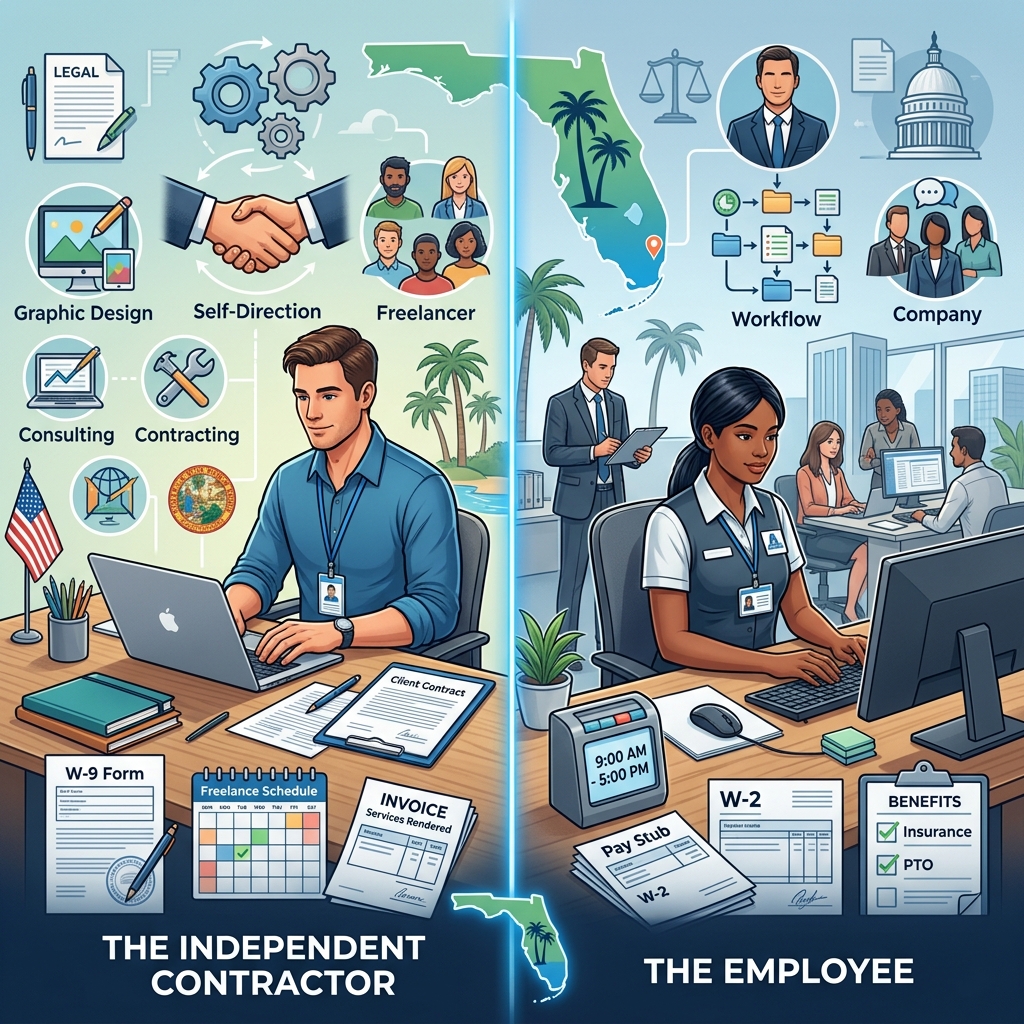
Independent contracting is common in Florida’s economy, especially in construction, professional services, gig work, and small businesses. Understanding how Florida law distinguishes independent contractors from employees is critical: misclassification can trigger tax assessments, benefit claims, and penalties. This guide explains the legal framework, practical tests, rights and obligations, and compliance strategies for both businesses and contractors, based on authoritative Florida and federal sources.
Florida’s Legal Framework for Independent Contractors
Florida does not have a single, universal statute that covers every aspect of independent contracting. Instead, several laws and regulations work together to determine whether a worker is treated as an employee or an independent contractor for different purposes, including workers’ compensation, reemployment tax (unemployment), and retirement programs.
- Workers’ Compensation: Florida’s workers’ compensation statute defines when a worker is an employee and when they qualify as an independent contractor for coverage and benefits.
- Reemployment Tax (Unemployment): Chapter 443, Florida Statutes, governs whether services constitute covered employment for the state’s reemployment assistance program.
- Common-law rules: For many programs, including certain retirement arrangements, Florida applies general common-law tests to decide if a worker is truly independent.
- Federal law overlay: Federal tax and labor rules (such as IRS common-law factors and Fair Labor Standards Act concepts) also influence classification, although state law ultimately governs Florida-specific benefits and taxes.
Because each system (tax, workers’ compensation, retirement) may apply slightly different criteria, a worker’s status can vary between contexts. However, the central question is almost always the same: how much control does the hiring entity exert over how the work is performed.
Core Definition: What Makes Someone an Independent Contractor in Florida?
Florida’s workers’ compensation statute provides a detailed definition for independent contractors, including a list of criteria that, when met, establish that a worker is not an employee. Under this framework, a worker is generally treated as an independent contractor if they operate a separate business and control the manner and means of their services.
Florida law typically looks for multiple indicators of independence. For example, a worker may be an independent contractor if they:
- Maintain their own business premises or equipment, such as an office, truck, or tools.
- Use a business identity (including a federal employer identification number) rather than working solely under their individual name.
- Receive payment to a business account and manage their own business expenses.
- Offer services to multiple clients and are free to accept other work without going through an employer’s hiring process.
- Provide services under a contract that is based on completing tasks or projects, often for a set price.
Even if not all criteria are met, Florida may still presume a worker to be an independent contractor when the overall arrangement shows genuine business independence, such as the worker controlling how the work is done, bearing the main expenses, and being responsible for delivering the final result.
Independent Contractor vs Employee: Key Differences
The distinction between an employee and an independent contractor matters because different rights, protections, and tax obligations apply. Florida’s Department of Revenue focuses on how the hiring entity exercises control and how the worker is treated in practice.
| Factor | Employee | Independent Contractor |
|---|---|---|
| Control over work | Employer decides what work is done and how it is done, including methods, schedule, and procedures. | Worker controls the means and methods of doing the job; client specifies results but not the detailed process. |
| Tools and equipment | Employer typically provides tools, supplies, and workspace. | Worker usually provides their own tools, equipment, and workspace at their expense. |
| Payment structure | Paid by hour, week, or salary; employer withholds taxes. | Paid by project, task, or contract; no tax withholding, and worker handles own tax obligations. |
| Duration of relationship | Often indefinite or ongoing, integrated into operations. | Typically limited to specific contracts or projects, may be intermittent. |
| Benefits and protections | May receive benefits and be covered by reemployment assistance and workers’ compensation. | Generally not covered as employees under these programs; protections are more limited. |
Importantly, Florida emphasizes that labels do not control. Calling someone a “contractor” in a written agreement, or issuing a Form 1099, does not automatically make them an independent contractor if the day-to-day relationship functions like employment.
Florida Reemployment Tax and Classification
Florida reemployment tax (unemployment tax) is owed when workers are classified as employees under Chapter 443, Florida Statutes. To decide whether a worker’s services are covered employment, the Department of Revenue applies a common-law control test and examines the overall relationship.
Key points for employers:
- Control test: If a business retains the right to direct how work is done—not just the outcome—the worker is more likely to be an employee.
- Agreement vs reality: Written contracts describing a worker as an independent contractor matter, but they can be overridden if the actual practice shows an employment relationship.
- Business nature: When the hiring party is a business organization, Florida presumes more likelihood of an employment arrangement than when an individual hires another individual.
- Department review: Florida may ask both parties to complete an Independent Contractor Analysis form and issue a formal determination on worker status.
Misclassification—treating employees as independent contractors—can result in retroactive tax assessments and possibly penalties. Florida encourages businesses to classify workers correctly and report concerns about intentional misclassification to the Department of Revenue.
Workers’ Compensation and Statutory Criteria
Florida’s workers’ compensation statute sets out a structured series of criteria for treating someone as an independent contractor. The goal is to distinguish workers who operate businesses of their own from workers who are integrated into another entity’s operations.
Examples of statutory indicators of independent contractor status include:
- Maintaining a separate business facility or equipment, such as an office, truck, or similar accommodations.
- Holding or applying for a federal employer identification number (unless a sole proprietor is not required to have one).
- Receiving compensation to a business entity, rather than direct payment solely to an individual.
- Having at least one business bank account used to pay business expenses.
- Having the ability to perform work for additional entities at the worker’s election.
- Being compensated on a competitive bid or per-task basis under a contract that does not expressly create an employment relationship.
If fewer than four of these criteria are met, Florida can still find independent contractor status by looking at other conditions, such as who controls the means of performance, who incurs principal expenses, and whether the worker has ongoing business obligations.
Rights and Limitations of Independent Contractors in Florida
Independent contractors in Florida enjoy business flexibility but give up many protections that employees receive under state law. Understanding these trade-offs is crucial for both sides of the relationship.
Common Rights of Independent Contractors
- The right to enter into contracts that define the scope of work, price, and terms.
- The right to market services to other clients and work with multiple customers simultaneously.
- The right to negotiate payment structures, including fixed fees, milestone payments, or project-based compensation.
- The ability to control work methods and use professional judgment to complete tasks, within the bounds of the contract.
Limitations Compared to Employees
- No automatic minimum wage or overtime: Independent contractors are generally not entitled to minimum wage or overtime protections that apply to employees under state and federal law.
- No workers’ compensation as employees: Contractors are usually outside employee-based workers’ compensation systems and may need their own insurance.
- No reemployment assistance: Contractors do not qualify for unemployment benefits through Florida’s reemployment assistance program as employees do.
- Limited anti-discrimination protections: Many workplace discrimination statutes focus on employees; independent contractors often have narrower recourse.
- At-will termination: Unless the contract provides constraints, independent contractors can typically be released from projects for almost any lawful reason, so long as contract obligations are honored.
In short, independent contractors trade statutory employment protections for autonomy and business flexibility. They must rely heavily on contract terms and their own insurance and compliance practices.
Contracts and Documentation: Best Practices in Florida
While the law focuses on how workers are treated in practice, clear documentation is still essential. Well-drafted agreements and records support correct classification and help avoid disputes.
Essential Elements of Independent Contractor Agreements
Florida law does not mandate a specific contract format, but effective agreements generally include:
- Identification of parties: Names of the business and contractor, addresses, and any business identifiers (such as EINs).
- Description of services: A clear outline of tasks, deliverables, or projects to be completed.
- Payment terms: How and when the contractor will be paid—commonly a fixed fee or project-based structure rather than hourly wages.
- Timeline and milestones: Expected start and completion dates, or milestones linked to payment.
- Responsibility for expenses: Allocation of costs such as tools, travel, and materials.
- Confidentiality and intellectual property: Protection of business information and rules for use or ownership of work product.
- Termination provisions: The circumstances under which either party can end the contract and any notice requirements.
- Insurance obligations: Whether the contractor must maintain liability or other coverage.
In addition to contracts, businesses should maintain invoices, proof of multiple clients, and evidence of the contractor’s separate business operations to support independent status.
Practical Compliance Tips for Businesses
- Use written agreements that describe the relationship accurately and stress the contractor’s control over work methods.
- Apply classification rules consistently across departments and locations, avoiding ad hoc treatment.
- Review roles regularly: A contractor role can evolve into one that looks more like employment; re-evaluate classifications when scopes or durations change.
- Seek determinations when uncertain: In gray areas, businesses may consult the Florida Department of Revenue or legal counsel.
Common-Law and Administrative Tests Used in Florida
Beyond statutory criteria, Florida often applies common-law rules focusing on control, integration, and economic realities. These tests are similar to those used by federal agencies and courts.
Typical factors considered include:
- Behavioral control: Who directs how and when the work is done?
- Financial control: Who bears risk, controls expenses, and determines the opportunity for profit or loss?
- Relationship of the parties: Are benefits provided? Is the relationship expected to be permanent? Is the work integral to the business?
No single factor is decisive. Instead, Florida authorities consider all available information about the actual working relationship, not just formal labels.
FAQs: Florida Independent Contractor Laws
1. Does a contract calling someone an independent contractor automatically settle their status?
No. Florida regulators will honor a contract’s description only if it accurately reflects the real working relationship. If the day-to-day arrangement functions like employment—especially if the business controls how the work is done—the contract label can be disregarded.
2. Can a worker receive a Form 1099 and still be classified as an employee under Florida law?
Yes. Tax documentation is one piece of evidence but does not control classification. Florida looks at how the worker is treated in practice, including control, integration, and duration of the relationship.
3. Are independent contractors in Florida entitled to unemployment benefits?
Generally no. Only workers classified as employees are covered under the Florida Reemployment Assistance Program Law and may qualify for benefits under Chapter 443.
4. Do independent contractors receive minimum wage and overtime protections?
Independent contractors are typically not covered by employee-oriented wage and hour protections, including minimum wage and overtime requirements. These protections apply to employees under state and federal law, not to genuinely independent businesses.
5. What should a contractor do if they believe they are misclassified?
If a worker believes they are treated like an employee but labeled as a contractor, they may contact the Florida Department of Revenue or seek legal advice. The Department can review the relationship using its analysis forms and issue a determination on status.
References
- 2025 Florida Statutes, Chapter 440.02 (Definitions) — Florida Legislature / Online Sunshine. 2025-01-01. https://www.leg.state.fl.us/Statutes/index.cfm?App_mode=Display_Statute&URL=0400-0499/0440/Sections/0440.02.html
- Reemployment Tax: Employees vs. Independent Contractors — Florida Department of Revenue. 2023-06-01. https://floridarevenue.com/taxes/taxesfees/Pages/rt_employee.aspx
- Independent Contractor Determinations / Section 218 Agreements — Florida Department of Management Services. 2022-05-10. https://www.dms.myflorida.com/workforce_operations/retirement/section_218_agreements/independent_contractor_determinations
- What Are My Rights As An Independent Contractor In Florida? — RAF Lawyers. 2021-08-01. https://raflorida.org/what-are-my-rights-as-an-independent-contractor-in-florida/
- Everything You Need to Know About Independent Contractor Agreements in Florida — Law Office of Paul J. Burkhart, PL. 2020-03-15. https://paulburkhart.net/blog/everything_you_need_to_know_about_independent_contractor_agreements/
- Independent Contractor or Employee? A Florida Tax Guide — Thomas Howell Ferguson P.A. CPAs. 2025-06-13. https://www.thf.cpa/2025/06/13/independent-contractor-or-employee-a-florida-tax-guide/
- Independent Contractors: Florida (Practice Note) — Thomson Reuters Practical Law. 2023-09-01. https://anzlaw.thomsonreuters.com/1-506-2780
Similar Articles








Read full bio of medha deb




