
When Can Police Search Your Car Without a Warrant?
Understand when officers may search your vehicle without a warrant, your rights during traffic stops, and how key Fourth Amendment rules apply.
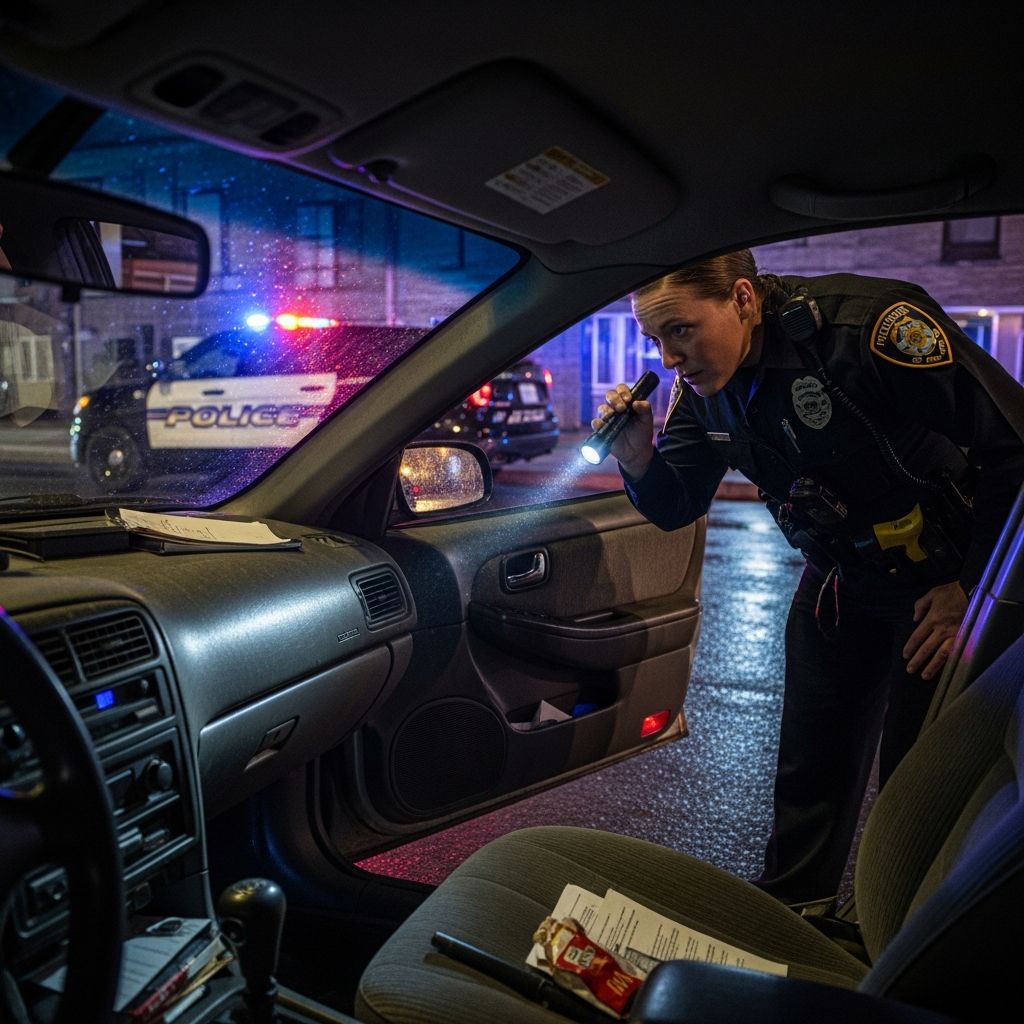
Traffic stops are stressful, especially when an officer starts looking into your vehicle. The U.S. Constitution protects you from unreasonable searches, but that does not mean police can never search your car without a warrant. In fact, courts have carved out several important exceptions to the warrant requirement specifically for motor vehicles.
This guide explains the main situations in which officers may search a vehicle without first obtaining a warrant, what rights you still have during these encounters, and when it is wise to speak with a criminal defense lawyer.
Core Constitutional Principle: The Fourth Amendment
The starting point is the Fourth Amendment to the U.S. Constitution, which protects people against unreasonable searches and seizures by the government. In general:
- A warrant signed by a judge is usually required for a full search.
- Warrants must be based on probable cause that evidence of a crime will be found in the place to be searched.
- All warrantless searches are presumed unreasonable unless they fit into a recognized exception.
Automobiles are treated differently from homes because of their mobility and because drivers have a reduced expectation of privacy in vehicles on public roads. This has led to a specific doctrine often called the “motor vehicle” or “automobile” exception.
The Automobile Exception: Probable Cause and Mobility
The key rule for vehicle searches is that police may search a car without a warrant if they have probable cause to believe it contains contraband or evidence of a crime.
Probable cause exists when known facts would lead a reasonable person to believe that a crime has been, is being, or will be committed, and that evidence is likely inside the vehicle. Courts allow a warrantless search in this context because:
- Vehicles can be quickly moved, driven away, or have their contents removed.
- Drivers already have reduced privacy expectations on public roads.
The U.S. Supreme Court has held that once probable cause to search a vehicle is established, officers may search it at the scene or later at a station house, without needing to get a warrant in between.
Scope of a Search Under the Automobile Exception
If the automobile exception applies, officers may usually search:
- The passenger compartment
- The trunk
- Closed containers such as bags, boxes, or luggage, if the object they are looking for could reasonably be inside them
However, they are limited by the nature of the probable cause. For example, probable cause to look for a large stolen object does not justify opening tiny containers that obviously could not hold it.
Consent: When You Say “Yes” to a Search
One of the most common ways police legally search a car is by consent. If you voluntarily agree to a search, no warrant or probable cause is required.
Key points about consent-based searches:
- You generally have the right to refuse consent to search your vehicle.
- Consent must be voluntary, not the result of threats or coercion.
- Officers do not have to tell you that you can say no.
- You may limit the scope of the consent (for example, allowing a search of the passenger compartment but not the trunk).
- You may attempt to withdraw consent, though evidence already found before withdrawal can still be used.
If you refuse consent, officers may still search if another exception applies, such as probable cause under the automobile exception or a search incident to arrest.
Searches Incident to Arrest: After a Lawful Arrest
When officers lawfully arrest a driver or recent occupant, they may search parts of the vehicle in limited circumstances. The U.S. Supreme Court significantly restricted these searches in Arizona v. Gant.
Under current law, a search of a vehicle incident to arrest is permitted only if one of the following is true:
- The arrestee is within reaching distance of the passenger compartment during the search, creating officer-safety or evidence-preservation concerns; or
- It is reasonable to believe the vehicle contains evidence of the offense for which the person was arrested.
For example, if a driver is arrested for a drug offense and officers reasonably believe more drugs might be in the car, a limited search incident to arrest may be allowed. If the driver is arrested for a minor traffic offense, such as driving with an expired license, there may be no basis to search for additional evidence, and a full search would likely be unlawful.
Inventory Searches: When the Vehicle Is Impounded
Police may sometimes conduct a so-called inventory search of a vehicle that has been lawfully impounded, even without a warrant or probable cause. The U.S. Supreme Court has approved this practice when two main conditions are met:
- The vehicle is lawfully impounded (for example, following an arrest where no licensed driver is available, or when the car is blocking traffic and must be towed).
- The inventory is conducted pursuant to standardized procedures designed to catalog property and protect the owner’s belongings, not to search for evidence.
Legitimate purposes of an inventory search include:
- Protecting the owner’s property while the vehicle is in police custody.
- Shielding the police from claims that property was stolen or damaged.
- Checking for hazardous items such as weapons.
Evidence of crime accidentally discovered during a good-faith inventory search is typically admissible, but officers may not use an “inventory” label as a pretext to evade the warrant requirement.
Reasonable Suspicion and Limited Protective Searches
Not every encounter involving a vehicle leads to a full search. In many cases, officers have only reasonable suspicion, a lower standard than probable cause, that some criminal activity may be occurring.
With reasonable suspicion, officers may:
- Conduct a brief investigative stop of the vehicle (often called a Terry stop).
- Order occupants to step out of the car.
- Perform a limited protective “frisk” of the person or accessible areas of the vehicle if they reasonably believe someone is armed and dangerous.
This kind of search is narrowly focused on locating weapons for officer safety, not on searching for general evidence of crime.
Other Common Exceptions That May Affect Motorists
Several other recognized exceptions to the warrant requirement can arise in the vehicle context:
- Plain view: If officers lawfully stop a vehicle and can see contraband or evidence of a crime in plain view inside the car, they may seize it and may gain probable cause to search further.
- Exigent circumstances: In an emergency involving immediate danger to life, serious property damage, or pursuit of a fleeing suspect, officers may conduct a warrantless search to address the emergency.
- Border and checkpoint searches: Vehicles entering the United States at an international border or authorized checkpoint may be subject to more intrusive searches under separate legal doctrines.
Comparing Major Vehicle Search Doctrines
| Legal Basis | What Justifies the Search? | Is a Warrant Required? | Typical Scope |
|---|---|---|---|
| Automobile exception | Probable cause vehicle contains evidence or contraband | No | Entire vehicle and containers where evidence might be found |
| Consent | Voluntary permission from driver or another person with authority | No | Limited by scope of the consent given |
| Incident to arrest | Lawful arrest of driver/recent occupant plus access or evidence of offense | No | Passenger compartment and containers, within limits set by Gant |
| Inventory search | Lawful impoundment and standardized inventory policy | No | Areas covered by the agency’s written inventory procedures |
Your Rights and Practical Steps During a Vehicle Stop
Knowing the law is one thing; exercising your rights respectfully in the moment is another. During a traffic stop or roadside encounter, consider the following practical steps:
- Stay calm, keep your hands visible, and follow basic safety instructions.
- You may politely ask if you are free to leave. If the officer says yes, you can end the encounter.
- If the officer asks to search your car and you do not wish to allow it, you may clearly say:
“I do not consent to a search of my vehicle.” - Do not physically resist or interfere with officers, even if you believe they are acting unlawfully. Instead, calmly state your objection and consult an attorney later.
- If you are arrested or questioned about potential criminal activity, you may invoke your right to remain silent and request an attorney.
If evidence is found during a search that violated the Fourth Amendment, your lawyer may be able to file a motion to suppress that evidence, which can profoundly affect the outcome of the case.
When to Speak With a Criminal Defense Lawyer
Vehicle search law is complex and fact-specific. Small details about where the car was located, what the officer saw or smelled, when the arrest happened, and whether the car was impounded can determine whether a search was lawful.
You should strongly consider consulting a criminal defense attorney if:
- You were arrested after a traffic stop or roadside encounter.
- Police searched your car and found drugs, weapons, or other contraband.
- You believe you were pressured into consenting to a search.
- Your car was towed or impounded and later searched.
An attorney can evaluate whether the officers had probable cause, whether an exception to the warrant requirement truly applied, and whether any evidence might be excluded because of constitutional violations.
Frequently Asked Questions
Can police search my car after a simple traffic ticket?
Generally, issuing a routine traffic citation by itself does not justify a full search of your vehicle. Officers may ask for consent or perform limited safety checks, but without consent, probable cause, or another recognized exception, a comprehensive search is usually not permitted.
Do officers need a warrant to look in my trunk?
A warrant is not required if an exception applies. Under the automobile exception, for example, probable cause that evidence is in the vehicle can justify searching the trunk and any containers where the evidence could reasonably be found. Without probable cause, consent, or another exception, officers typically may not access the trunk.
What if I consent after the officer suggests I have no choice?
Consent must be voluntary to be valid. Courts look at the total circumstances to decide whether a reasonable person would have felt free to refuse. If your consent was obtained through threats or clear coercion, a court may find the search unconstitutional, though this analysis is very fact-dependent.
Can my passenger give valid consent to search the car?
Sometimes. A passenger may have authority to consent to a search of areas they reasonably control or use, such as a bag at their feet. However, a passenger’s consent may not extend to the entire vehicle or to clearly personal property of the driver, depending on the circumstances.
Is everything found in an inventory search automatically admissible?
Not necessarily. The inventory must be conducted according to standardized, good-faith procedures related to safekeeping property, not as a pretext to hunt for evidence. If officers deviate from policy or use the inventory primarily as an investigative tool, a court may suppress some or all of the evidence found.
References
- Vehicular Searches — Fourth Amendment — Justia. 2023-01-01. https://law.justia.com/constitution/us/amendment-04/16-vehicular-searches.html
- Requirement—Search of Vehicle Incident to Arrest of a Recent Occupant — United States Court of Appeals for the Ninth Circuit. 2022-01-01. https://www.ce9.uscourts.gov/jury-instructions/node/152
- How Search Warrants Work in Colorado — Bruno Lilly LeClere, PLLC. 2022-06-01. https://www.bll.legal/how-search-warrants-work-colorado
- Search & Seizure Laws in Colorado – How It Works — Shouse Law Group. 2023-05-01. https://www.shouselaw.com/co/defense/search-and-seizure/
- FAQ: Colorado Law Automobile “Inventory” Searches — Colorado Criminal Lawyer. 2021-09-01. https://www.criminal-lawyer-colorado.com/your-legal-rights/search-warrants/faq-colorado-law-automobile-searches.html
- Motor Vehicle Exception to the Search Warrant Requirement — FBI Law Enforcement Bulletin via National Criminal Justice Reference Service. 1981-12-01. https://www.ojp.gov/ncjrs/virtual-library/abstracts/motor-vehicle-exception-search-warrant-requirement-conclusion
Similar Articles








Read full bio of medha deb




