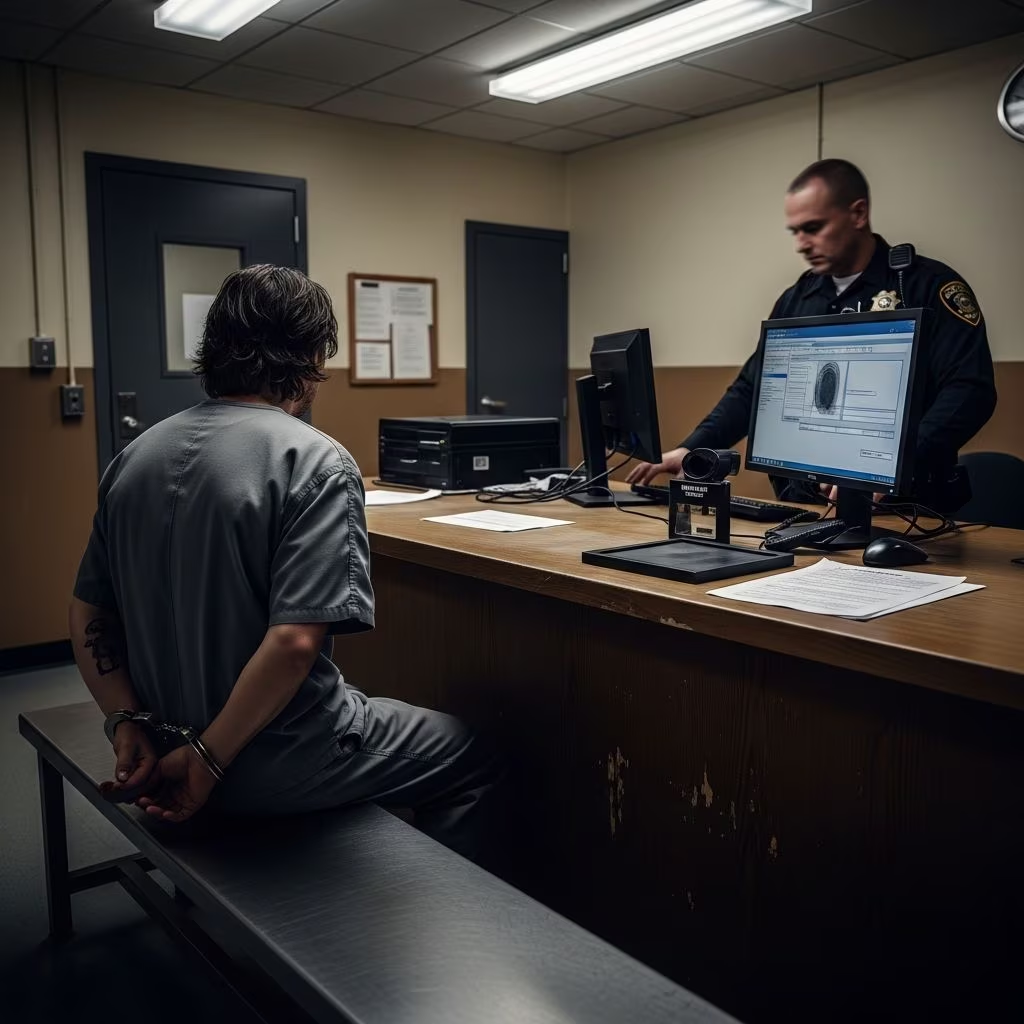
Being arrested and taken to jail is stressful, confusing, and often frightening. Understanding what happens during the booking process can help you protect your rights and prepare for what comes next in your criminal case.
This guide walks through each typical step after you arrive at a jail or detention facility, from the moment officers bring you in until you are either released or held for court.
1. From Arrest to Arrival at the Jail
Once officers decide to take you into custody, you will usually be transported to a local jail or detention facility. Booking generally happens:
- At a city or municipal jail (often for lower-level offenses or short-term holding)
- At a county jail (where more serious or longer-term pretrial detention usually occurs)
- Occasionally at a regional or state facility for specific types of cases or warrants
According to criminal justice guidance, booking is a formal process in which the jail accepts custody of the arrested person and creates an official record of the arrest. During this time, you are not yet convicted; you are considered a pretrial detainee.
2. Initial Security and Intake Procedures
Safety and security are the jail’s immediate priorities when a new person arrives. You can typically expect:
- Pat-down search: Officers usually perform an outer clothing search to look for weapons, drugs, or dangerous items.
- Removal of personal items: Belts, shoelaces, jewelry, and other items that could be used for self-harm or concealment are commonly taken.
- Property inventory: Your cash, phone, keys, and other possessions are documented and stored until release, unless they are seized as evidence.
- Short-term holding: You may be placed in a holding cell or open seating area until staff can complete the booking steps.
Some facilities also use metal detectors or body scanners to detect contraband that a pat-down might miss.
3. Identity Checks and Creation of the Jail Record
The core of booking is creating an official record that ties your identity to the arrest. Typical steps include:
- Personal information: You will be asked for your name, address, date of birth, and other basic details.
- Physical description: Height, weight, eye color, scars, tattoos, and other identifying features may be recorded.
- Offense details: The alleged offense, date and time of arrest, and the arresting agency are logged.
- Government database checks: Staff typically run your information through local, state, and federal systems to look for outstanding warrants or detainers.
- Assignment of an inmate number: You usually receive a unique booking or inmate ID that tracks you in the jail’s system.
These records form part of your permanent arrest history and may be accessible to other agencies, prosecutors, and courts.
4. Fingerprints, Photographs, and Biometrics
Most jails take multiple forms of identifying information:
- Fingerprinting: Your fingerprints are collected, often electronically, and sent to state and federal databases such as those used by the FBI.
- Mugshots: Front and side photos document your appearance at the time of arrest, including visible tattoos or injuries.
- Biometrics (where used): Some facilities may also record palm prints, iris scans, or other biometric identifiers depending on local policy.
This information can be used to confirm your identity, check criminal history, and connect you to other pending or past cases.
5. Health and Medical Screening
Medical screening protects both you and others in custody. Standard jail practice, often guided by medical and correctional standards, includes:
- Basic health questions: Prior medical conditions, current medications, allergies, and recent injuries or surgeries.
- Mental health assessment: Screening for suicide risk, self-harm history, or serious psychiatric conditions.
- Visual check: Staff or medical personnel look for signs of intoxication, withdrawal, illness, or trauma.
- Decision to admit or send for treatment: Policies often require that seriously ill or injured individuals receive medical treatment before being accepted into jail custody.
Once the jail formally admits you, it generally assumes responsibility for your necessary medical care while you are detained.
6. Questions About Background, Safety, and Classification
Beyond basic identity details, staff typically ask further questions to decide where and how you will be housed. These may cover:
- Current or recent drug or alcohol use
- History of violence or institutional discipline
- Known gang affiliations or enemies in custody
- Any known disabilities or special needs
Facilities use this information to:
- Separate vulnerable individuals from likely predators
- Keep rival groups or known enemies apart
- Place you in an appropriate housing unit (general population, protective custody, medical, or mental health)
In many states, answers about gang affiliations or other matters can sometimes be used in later criminal proceedings, even if you have not received full Miranda warnings, depending on the nature of the questions. It is important to know that you generally have the right to remain silent about potentially incriminating information and to ask for a lawyer.
7. Searches, Clothing, and Property Handling
After initial intake, staff usually conduct more thorough searches and changeover steps:
- Detailed search: Facilities may perform more extensive pat searches, and in some cases strip searches, subject to constitutional limits and local policy.
- Issuance of jail clothing: If you will be held beyond initial booking, you are often given jail uniforms and footwear.
- Storage of property: Non-evidence items are inventoried and stored under your name; you typically sign a property form.
Your personal property is normally returned upon release, unless it is contraband or being used as evidence in a criminal case.
8. How Long Does the Booking Process Take?
The amount of time booking takes can vary widely based on:
- The size and type of facility (city vs. county jail)
- How busy the jail is at that moment
- The number of staff available to process new arrestees
- Whether additional checks, medical clearances, or holds are required
Legal guides report that booking can range from less than an hour to several hours, with one to two hours being common in many jurisdictions. In some busy county jails, however, the total intake and clearance process may take much longer.
| Type of Facility | Common Time Range | Key Influencing Factors |
|---|---|---|
| Small city jail | Under 1–2 hours | Lower volume, simpler procedures |
| Busy county jail | 1–4+ hours | High intake volume, limited staff, extra checks |
| Regional / specialized facility | Several hours or more | Additional security or medical requirements |
9. Access to Phone Calls and Legal Help
During or shortly after booking, many jails allow limited access to telephones. Practices vary by jurisdiction, but you may be allowed to:
- Call a family member or friend to inform them of your arrest
- Contact a criminal defense attorney
- Reach out to a bail bond company, if that is permitted locally
Some jurisdictions have statutes or regulations guaranteeing a reasonable opportunity to use a phone for legal purposes after booking, although specific rules differ by state. Speaking with a lawyer as early as possible can help you understand your options for release and protect your rights during questioning.
10. Bail, Release Options, and Holding
Once the jail finishes the initial intake steps, attention usually turns to whether you can be released before your first court appearance. Common outcomes include:
- Release on your own recognizance (ROR): You are released without paying money, based on your promise to appear in court.
- Release with bail: A set bail amount must be paid in cash, property, or via a bail bond to secure your release.
- Hold without bail: In serious cases or when the law allows, a judge may order you held without bail.
- Continued detention until arraignment: If bail is not immediately set or you cannot pay, you will stay in a holding cell or housing unit until you see a judge.
In many jurisdictions, prosecutors must decide whether to file charges within a relatively short time after booking (for example, 48–72 hours, depending on state law). If charges are not filed by that deadline, you may be entitled to release, though rules vary.
11. After Booking: Arraignment and the Early Court Process
Once booking is complete and charges are filed, your case generally moves to the first court stage, often called arraignment.
- The judge reads or confirms the charges against you.
- You enter an initial plea (commonly not guilty at this early stage).
- The court reviews or sets bail and release conditions.
- You may be assigned a public defender if you cannot afford an attorney and you qualify financially.
From there, the case proceeds through pretrial conferences, plea negotiations, motions, and possibly trial. The booking record created at the jail becomes part of the broader file that prosecutors, defense lawyers, and courts may use.
12. Key Rights to Remember During Booking
While procedures vary, certain core rights generally apply during booking and early detention, subject to your jurisdiction’s law and the specific circumstances:
- Right to remain silent: You usually do not have to answer questions about the alleged crime itself. Basic identity questions may still be required.
- Right to an attorney: You can ask to speak to a lawyer before answering questions that may incriminate you.
- Protection against unreasonable searches: Strip searches and invasive procedures are limited by constitutional standards, though security needs can justify some intrusions.
- Right to necessary medical care: Once formally admitted, jails generally must provide access to essential medical treatment.
- Right to a prompt court appearance: Criminal procedure rules typically require that you be brought before a judge within a specified time frame.
Because state and local laws differ, speaking with a licensed criminal defense attorney where the arrest occurred is the best way to get advice about your specific situation.
Frequently Asked Questions About Jail Booking
Q1: Can I refuse to be fingerprinted or photographed?
Generally, you cannot refuse routine identification steps such as fingerprinting and photographs. Courts have long upheld fingerprinting and similar non-invasive identification procedures as standard parts of arrest processing. Refusal may lead to additional charges or force being used to obtain the records, depending on local law.
Q2: Will everyone know I have been booked into jail?
Many jurisdictions treat booking information as public record, and some jails publish online rosters or mugshots. However, the level of public access varies widely by state and county. Victim privacy laws, juvenile protections, and sealing or expungement procedures may limit how long records remain easily accessible in some cases.
Q3: Do I get my belongings back when I am released?
Normally, personal items that were inventoried as property are returned when you are released. Items that are illegal to possess (contraband) or that are held as evidence in a criminal case will not be returned. You may need to sign a property form acknowledging receipt of your belongings.
Q4: How soon can I talk to a lawyer after I am booked?
In practice, you may be able to contact a lawyer by phone shortly after you arrive at the jail, once staff allow phone access. Law and ethical rules in many jurisdictions recognize the importance of early access to counsel, particularly before police questioning. If you clearly state that you want an attorney, officers typically must stop interrogating you about the alleged crime until you have a chance to consult with one.
Q5: What if the jail refuses to release me even after the legal deadline?
If you believe you are being held illegally or for longer than the law allows, your attorney can ask the court to review your detention. One common tool is a petition for a writ of habeas corpus, which challenges unlawful custody and asks a judge to order your release or correct the conditions of confinement.
References
- Booking and Admitting Inmates — U.S. Office of Justice Programs / National Criminal Justice Reference Service. 1981-01-01. https://www.ojp.gov/ncjrs/virtual-library/abstracts/booking-and-admitting-inmates
- Arrest and Booking — Spolin Law (Criminal Appeals Advocates, P.C.). 2023-05-01 (last updated, approximate). https://spolinlaw.com/criminal-defense/arrest-and-booking/
- How Long Does Booking Take? — Nolo (Legal Encyclopedia). 2022-09-15 (approximate). https://www.nolo.com/legal-encyclopedia/what-happens-during-booking.html
- How long is the booking process after an arrest? — Shouse Law Group. 2023-08-10 (approximate). https://www.shouselaw.com/ca/blog/how-long-does-booking-take-in-jail/
- Jail Booking Process — King Triton Bail Bonds. 2021-06-01 (approximate). https://www.kingtritonbail.com/blog/jail-booking-process/