
Weaponized Police Drones and Civil Liberties
Legal and ethical implications of armed police drones in American skies.
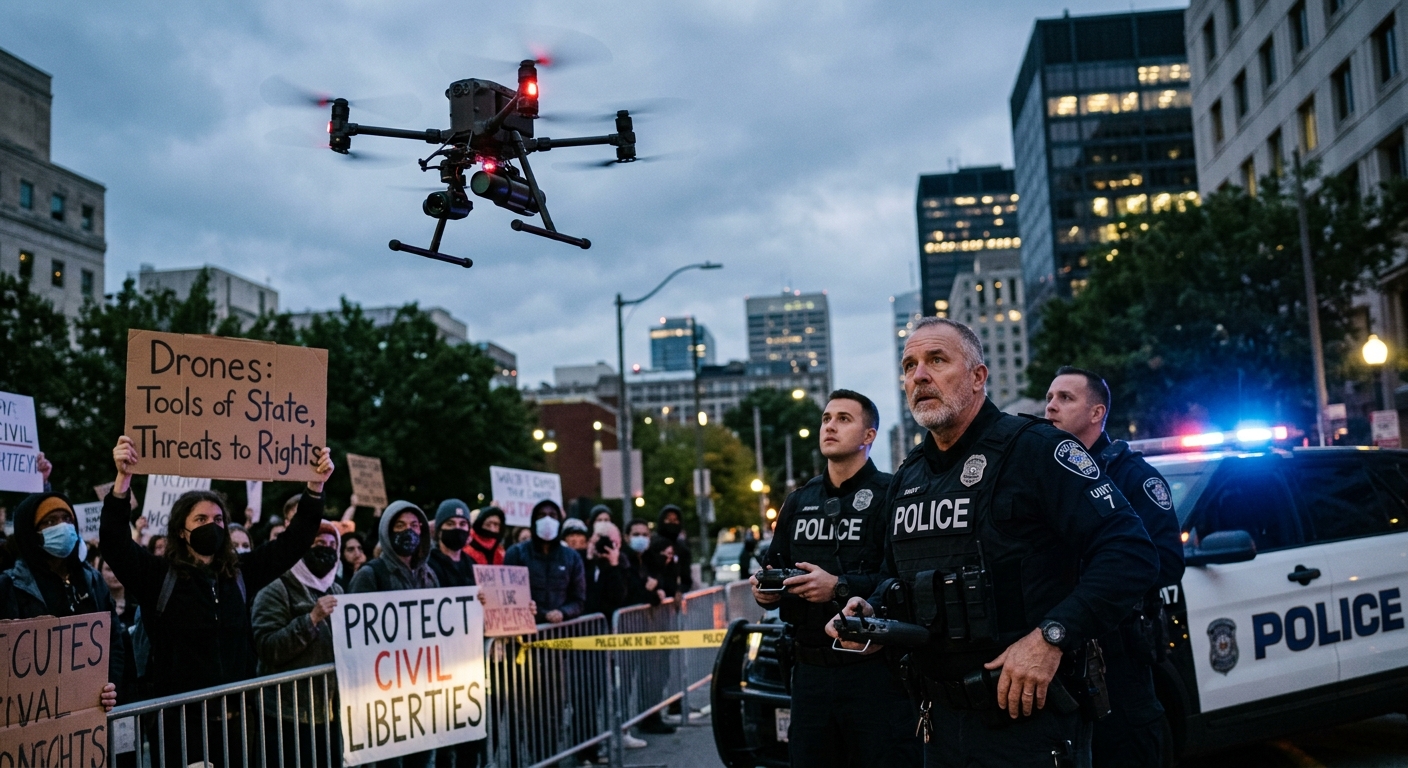
The rapid integration of Unmanned Aerial Systems (UAS)—commonly referred to as drones—into domestic law enforcement operations represents one of the most significant technological shifts in modern policing. Over the past decade, drones have transitioned from novelties to standard equipment in thousands of police departments across the United States. Initially praised for their utility in benign operations such as search and rescue or traffic accident reconstruction, the conversation surrounding police drones has grown increasingly complex and contentious. As technology advances, the potential for these devices to carry active payloads—ranging from advanced surveillance sensors to less-lethal and potentially lethal weapons—has sparked intense national debate. The prospect of weaponized domestic drones sits squarely at the intersection of public safety, federal aviation regulations, and constitutional civil liberties. This article explores the evolution of this technology, the legal barriers currently in place, and the profound implications for civil rights in an era of aerial policing.
From Observation to Intervention: The Evolution of Police Drones
To understand the current debate over weaponized drones, one must examine the trajectory of their adoption by domestic security forces. In the early 2010s, local and state agencies began acquiring small, commercially available quadcopters. These initial deployments were strictly observational. High-definition cameras provided a bird’s-eye view that proved invaluable during natural disasters, large-scale public events, and complex search-and-rescue operations where human helicopters were either too expensive or too risky to deploy.
However, as the commercial drone industry expanded, so did the payload capabilities of the hardware. Modern law enforcement drones are no longer mere flying cameras; they are sophisticated, adaptable platforms. Today’s high-end UAS models boast thermal imaging, facial recognition integration, and the mechanical capacity to carry varied attachments. The leap from passive observation to active intervention occurs when agencies explore equipping these platforms with mechanisms to drop tear gas, emit deafening acoustic waves, or deploy kinetic impact projectiles. While the deployment of heavily armed drones is traditionally associated with overseas military operations, the continued militarization of domestic police equipment has naturally led to questions about whether unmanned aerial force could be utilized within city limits to end standoffs or control volatile crowds.
Navigating the Federal Regulatory Framework
The airspace above the United States is strictly governed by the Federal Aviation Administration (FAA), an agency tasked with ensuring the safety and efficiency of national skies. When the discussion of weaponizing civilian or local government drones first gained public attention, federal lawmakers intervened to draw a hard regulatory line .
Under the FAA Reauthorization Act of 2018, Congress enacted explicit prohibitions regarding the arming of civilian unmanned aircraft. Codified in 49 U.S.C. 44802, the federal law clearly states that no person may operate an unmanned aircraft equipped with a “dangerous weapon” without express authorization from the FAA Administrator. To define a “dangerous weapon,” the statute relies on the federal criminal code (18 U.S.C. 930), which describes it as any device, instrument, or substance capable of causing death or serious bodily injury. Violating this prohibition carries steep civil penalties, often amounting to up to $25,000 per violation .
Despite this federal baseline, the definition of a “dangerous weapon” creates complex gray areas for domestic policing . While firearms and explosive devices are unquestionably prohibited, law enforcement agencies frequently utilize tools categorized as “less-lethal,” such as tear gas canisters, pepper ball launchers, or taser-like attachments. The legal ambiguity surrounding whether these less-lethal payloads cross the threshold of a dangerous weapon under federal aviation law remains a subject of ongoing legal interpretation and policy debate.
| Federal Classification | Examples of Payloads / Attachments | General Legality for Law Enforcement |
|---|---|---|
| Observation & Sensors | High-definition cameras, FLIR (Thermal), LiDAR, Spotlights | Generally Permitted (Subject to state warrant requirements) |
| Communication Devices | Loudspeakers, Acoustic Hailing Devices | Generally Permitted |
| Less-Lethal Deployments | Tear gas canisters, Pepperball launchers | Legally Ambiguous / Restricted by Specific State Laws |
| Dangerous Weapons | Firearms, Explosives, Incendiary Devices | Federally Prohibited (49 U.S.C. 44802) |
State Legislative Responses: A Patchwork of Regulations
Because the FAA primarily concerns itself with navigable airspace and aviation safety, the broader regulation of police conduct, citizen privacy, and use-of-force policies falls largely to individual states and municipalities . This division of constitutional authority has resulted in a chaotic patchwork of legislation across the country, with some states adopting strict preventative measures and others expanding law enforcement capabilities.
In recent years, several state legislatures have proactively addressed the potential for weaponized policing from the sky. For example, Illinois implemented the Drones as First Responders Act, which significantly amended the state’s Freedom from Drone Surveillance Act. The updated Illinois guidance strictly prohibits law enforcement agencies from outfitting drones with either lethal or non-lethal weapons under any circumstances, drawing a definitive line against aerial force .
Conversely, states like Florida and Virginia have focused more heavily on the surveillance aspect, requiring police to obtain a search warrant before using a drone to gather evidence, except in emergencies like active terrorist threats or missing persons cases . Yet, even in states with strict warrant requirements, the specific prohibition of less-lethal weapon attachments is not always explicitly codified, leaving room for future technological escalation. Furthermore, recent federal and state discussions have centered around giving local police the authority to actively disable or take down civilian drones during major public events, effectively introducing “counter-drone” technologies that further complicate the bounds of aerial police power.
Balancing Public Safety with Constitutional Liberties
The potential introduction of armed or use-of-force-capable drones into domestic policing raises severe constitutional concerns, particularly regarding the First and Fourth Amendments. Civil rights advocates argue that the remote nature of drone operations psychologically distances the operator from the target. When an officer is removed from the immediate physical danger and human reality of a situation, there is a heightened psychological risk that force might be deployed more readily or disproportionately.
From a Fourth Amendment perspective, the primary concern revolves around unreasonable searches and seizures. A drone hovering hundreds of feet in the air, equipped with high-powered magnification and thermal sensors, can bypass physical fences and peer into areas where individuals possess a reasonable expectation of privacy . If such a device is also capable of deploying physical force, the threat of an unconstitutional “seizure” is magnified dramatically.
Additionally, the deployment of prominent, potentially armed drones at protests or public gatherings introduces a distinct chilling effect on First Amendment rights. The mere presence of a low-flying, militarized unmanned aircraft can intimidate citizens, discouraging them from exercising their fundamental rights to free speech and peaceful assembly. Critics argue that allowing drones to carry crowd-control payloads, such as chemical irritants, transforms a tool of observation into an unregulated weapon of mass suppression.
The Law Enforcement Perspective: Mitigating Human Risk
While civil liberties organizations raise critical alarms, proponents of advanced police drone technology argue that the primary directive of adopting unmanned aerial systems is the preservation of human life. In active shooter scenarios, barricaded suspect situations, or high-risk hostage negotiations, sending human officers into the line of fire often results in casualties. A highly maneuverable drone could theoretically be sent into a dangerous environment to scout the area, communicate with a suspect, or, in extreme cases, deploy a less-lethal incapacitant to resolve the standoff without lethal crossfire.
Proponents argue that a machine can absorb a bullet, ensuring officers return home safely. Furthermore, specialized operations units assert that limiting drone capabilities strictly to observation deprives first responders of tools that could swiftly neutralize immediate public threats, emphasizing that stringent use-of-force protocols and departmental accountability measures would still stringently govern any aerial deployment, just as they do with physical firearms.
Crafting Ethical Frameworks and Future Policies
As unmanned technology continues to outpace the law, communities and lawmakers must collaborate to establish robust, ethical frameworks governing the acquisition and deployment of advanced drone systems. The most effective approach involves implementing rigorous oversight protocols:
- Community Oversight (CCOPS): Enacting Community Control Over Police Surveillance ordinances requires agencies to publicly disclose their intent to acquire new drone technologies, opening the floor for city council approval and public debate.
- Transparent Policies: Agencies must publish clear, accessible guidelines detailing exactly how drones will be used, the specific payloads permitted, and the strict circumstances required for their deployment.
- Data Retention Limits: Implementing strict schedules for the destruction of aerial surveillance footage to prevent drones from becoming tools for warrantless mass data collection .
- Independent Audits: Creating independent review boards to meticulously monitor, audit, and publicly report on every instance a drone is deployed in the field.
Without these necessary safeguards, the unchecked proliferation of unmanned aerial systems risks transforming domestic airspace into an unregulated frontier of law enforcement overreach.
Frequently Asked Questions (FAQs)
Can police legally attach firearms or explosives to drones in the United States?
No. Under 49 U.S.C. 44802, the Federal Aviation Administration strictly prohibits any person, including local law enforcement, from operating an unmanned aircraft equipped with a dangerous weapon capable of causing death or serious bodily injury, unless explicitly authorized by the FAA Administrator.
What are “less-lethal” drones, and are they legal?
Less-lethal drones are equipped with tools designed to incapacitate rather than kill, such as tear gas canisters, acoustic hailing devices, or pepper spray. Their legality is currently a gray area; while they may not strictly violate the federal aviation definition of a “dangerous weapon,” several states (such as Illinois) have explicitly banned police from using drones equipped with any kind of weapon, lethal or non-lethal.
Do police need a warrant to use a drone for surveillance?
It depends entirely on the state jurisdiction and the specific situation. While the U.S. Supreme Court has ruled that observing property from navigable airspace does not always require a warrant, many individual states (such as Florida and Virginia) have passed specific legislative acts requiring police to obtain a search warrant before using drones to gather evidence, with narrow exceptions for emergencies like search and rescue or active terrorist threats.
Conclusion
The integration of unmanned aerial systems into domestic policing is an undeniable reality, offering profound operational benefits for search and rescue, disaster response, and scene reconstruction. However, as these platforms inevitably evolve to support payloads capable of delivering physical force, the stakes for civil liberties and constitutional rights have never been higher. The dividing line between protecting the public and creating an omnipresent, militarized aerial panopticon is incredibly thin. Moving forward, it is imperative that federal regulators, state lawmakers, and local communities engage in transparent, rigorous debate to ensure that the deployment of police drones is strictly governed by the principles of justice, legal accountability, and the unwavering protection of civil rights.
References
- 49 U.S.C. 44802 – Prohibits Weapons on Drones — United States Code / Congress. 2018-10-05. https://uscode.house.gov/
- Non-Regulatory Guidance to Law Enforcement Agencies: Drone Usage — Illinois Attorney General. 2023-07-01. https://ag.state.il.us/
- Public Safety – Federal Aviation Administration — Federal Aviation Administration (FAA). 2026-03-26. https://www.faa.gov/uas/public_safety_gov
- Drones and aerial surveillance: Considerations for legislatures — Brookings Institution. 2022-01-01. https://www.brookings.edu/articles/drones-and-aerial-surveillance-considerations-for-legislatures/
Similar Articles








Read full bio of medha deb




