
W-2 vs. 1099-NEC: Business Classification Guide
Navigate the key differences between W-2 employees and 1099-NEC contractors to ensure compliance and optimize your workforce strategy.
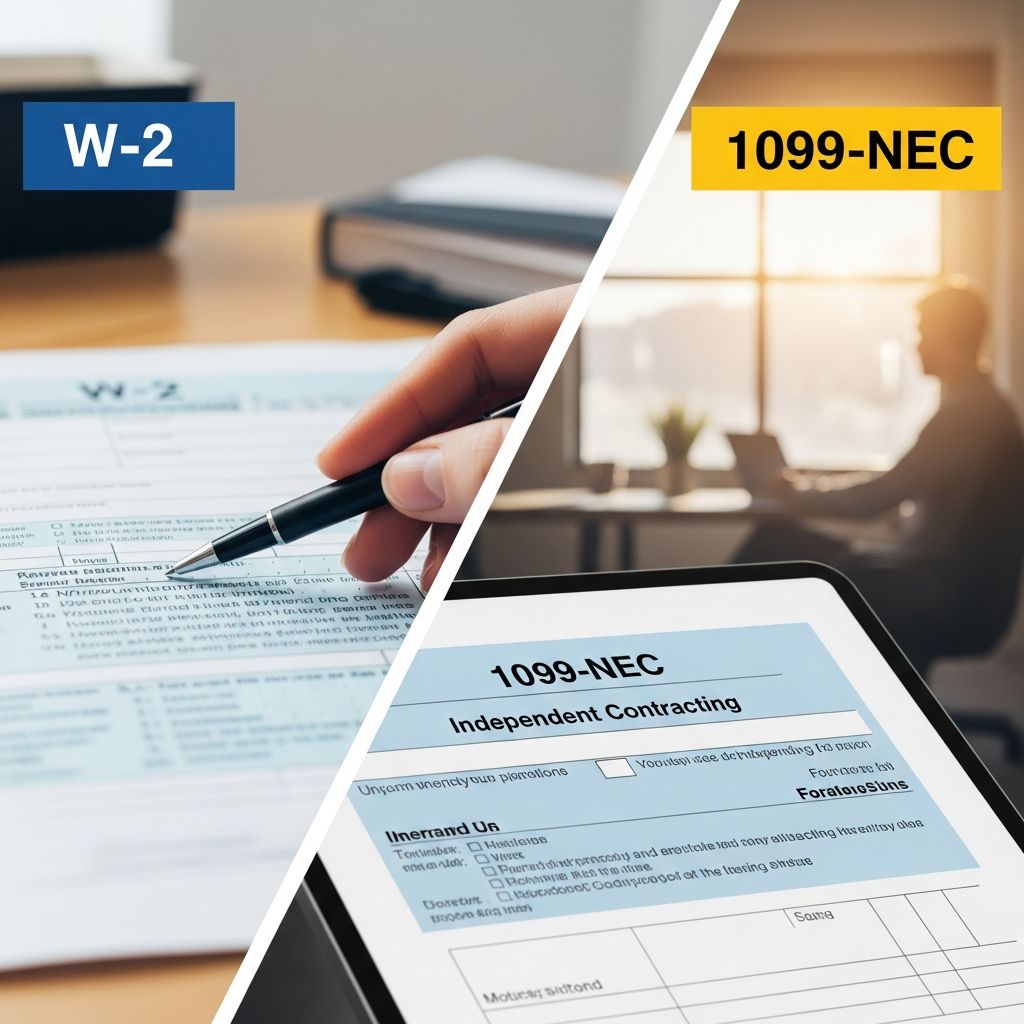
Businesses must correctly classify workers as either employees receiving W-2 forms or independent contractors issued 1099-NEC forms to comply with IRS regulations and manage tax responsibilities effectively. Misclassification can lead to significant penalties, audits, and back taxes.
Understanding Worker Forms: W-2 and 1099-NEC Basics
The W-2, or Wage and Tax Statement, is issued by employers to employees, detailing wages, tips, benefits, and withheld taxes like income, Social Security, and Medicare. Employers send copies to the IRS and Social Security Administration, while employees use it for their tax returns.
In contrast, Form 1099-NEC reports nonemployee compensation to independent contractors paid $600 or more annually. It only lists gross payments without tax withholdings, leaving contractors to handle their own taxes.
Key distinction: Businesses cannot issue both forms to the same worker for identical duties in one tax year; all employee payments must appear on a W-2.
IRS Criteria for Classifying Employees vs. Contractors
The IRS uses a multi-factor test, primarily behavioral control, financial control, and relationship type, to determine classification. No single factor decides; it’s the overall relationship.
- Behavioral Control: Employees receive detailed instructions on when, where, and how to work, including training provided by the employer. Contractors maintain autonomy over methods and processes.
- Financial Control: Employees get reimbursements for expenses, tools from the employer, and no investment risk. Contractors supply their own equipment, bear unreimbursed costs, and can profit from efficiency or seek other clients.
- Type of Relationship: Employees enjoy benefits like health insurance, paid leave, and indefinite employment. Contractors have project-based, finite engagements without perks.
For uncertain cases, businesses can file Form SS-8 with the IRS for a determination.
Tax Responsibilities: Employers and Workers Compared
Employers withhold federal income tax, Social Security (6.2%), Medicare (1.45%), and often state taxes from W-2 employees’ paychecks, matching Social Security and Medicare contributions. They also pay federal unemployment (FUTA) and state unemployment (SUTA) taxes.
1099-NEC recipients receive full payment without withholdings. Contractors pay self-employment tax (15.3%, covering both employee and employer portions) quarterly via estimated taxes and report all income. They deduct business expenses like home office costs, which W-2 workers cannot.
| Aspect | W-2 Employee | 1099-NEC Contractor |
|---|---|---|
| Tax Withholding | Employer withholds and remits | None; self-managed |
| Payroll Taxes | Employer pays half (7.65%) | Full 15.3% self-paid |
| Deductions | Limited (pre-tax benefits) | Business expenses deductible |
| Filing Threshold | All wages reported | $600+ nonemployee comp |
Example: Two workers earning $50,000 yearly. The W-2 employee sees taxes withheld per paycheck; the contractor pays estimated taxes quarterly and an additional self-employment portion.
Workplace Control and Autonomy Differences
W-2 employees operate under employer oversight: fixed schedules, assigned multifaceted tasks, and company policies dictate procedures. Employers provide tools and direct outcomes.
Contractors enjoy flexibility, setting their hours, using personal methods, and focusing on specific deliverables. This suits specialized projects but limits task reassignment without contract changes.
Benefits and Protections: What Each Classification Offers
W-2 status grants legal protections: minimum wage, overtime (FLSA), family leave (FMLA), and workers’ compensation. Benefits often include health insurance, 401(k) matching, paid vacation, and performance-based raises. In 2022, benefits comprised 31% of private industry compensation costs per Bureau of Labor Statistics data.
1099-NEC workers lack these, funding their own insurance and retirement. Advantages include schedule freedom, remote options, multi-client work, and specialization, with potential for higher net earnings after deductions.
Risks of Misclassification for Businesses
Improperly classifying employees as contractors triggers IRS penalties: back employment taxes, fines up to 20% of unpaid amounts, and interest. States may impose additional unemployment and workers’ comp liabilities. Audits can arise from worker complaints or IRS reviews.
Avoidance strategies:
- Review contracts for control language.
- Use IRS checklists or SS-8.
- Consult payroll experts or attorneys.
Pros and Cons from Business and Worker Perspectives
For Businesses
- W-2 Pros: Full control, loyalty, scalability for core roles.
- W-2 Cons: Higher costs (payroll taxes ~7.65%, benefits).
- 1099-NEC Pros: Lower overhead, flexibility for short-term needs.
- 1099-NEC Cons: Less reliability, no task versatility.
For Workers
- W-2 Pros: Steady pay, benefits, protections.
- W-2 Cons: Less autonomy, fixed hours.
- 1099-NEC Pros: Flexibility, deductions, higher potential pay.
- 1099-NEC Cons: Tax burden, no benefits, income variability.
Practical Tips for Hiring and Compliance
Assess needs: Use contractors for niche, temporary projects; employees for ongoing operations. Negotiate rates considering total costs. Require W-9 from contractors upfront and issue 1099-NEC by January 31.
Track payments meticulously. For growth, hybrid models balance costs and control.
Frequently Asked Questions
When must a business issue a 1099-NEC?
Issue Form 1099-NEC if paying a non-employee $600 or more in a year for services.
Can a worker be both W-2 and 1099-NEC?
No, not for the same duties in one tax year; all employee services go on W-2.
What if classification is unclear?
File IRS Form SS-8 for an official determination.
Do contractors get overtime pay?
No, independent contractors are exempt from FLSA overtime and minimum wage rules.
How do self-employment taxes work?
Contractors pay 15.3% on net earnings, deductible half on income taxes.
Strategic Workforce Planning
Modern businesses blend classifications: core W-2 teams for stability, 1099-NEC for agility. Regularly audit relationships amid evolving IRS scrutiny, like the 2023-2024 focus on gig economy misclassification. Invest in compliance tools or services to mitigate risks and leverage each model’s strengths.
For expanding firms, calculate total worker costs: W-2 averages 1.25-1.4x base salary including taxes/benefits; contractors near 1.1x but without loyalty. Scale thoughtfully to foster growth without legal pitfalls.
References
- 1099-NEC vs. W-2: What They Are, Differences and Tips — Indeed. 2023. https://www.indeed.com/career-advice/career-development/1099-vs-w2
- W-2 Vs 1099 Workers: Understand the Difference Before you Hire — Complete Payroll Solutions. 2023. https://www.completepayrollsolutions.com/blog/w2-vs-1099
- The Difference Between 1099 and W-2 Forms — H&R Block. 2023. https://www.hrblock.com/tax-center/irs/forms/the-difference-between-1099-and-w-2-forms/
- 1099 vs. W-2: Breaking Down the Differences — NerdWallet. 2023. https://www.nerdwallet.com/taxes/learn/1099-vs-w2-difference
- Forms W-2 and 1099-NEC – Part 1: Understanding the Critical Differences — G&A Partners. 2023. https://www.gnapartners.com/resources/articles/forms-w-2-vs-1099-nec
- 1099 vs. W-2 Tax Form Guide: What Employers Need To Know — Paychex. 2023. https://www.paychex.com/articles/payroll-taxes/1099-vs-w2-when-should-employers-use-these-tax-forms
- Form 1099-NEC & Independent Contractors — IRS.gov. 2024-02-09. https://www.irs.gov/faqs/small-business-self-employed-other-business/form-1099-nec-independent-contractors/form-1099-nec-independent-contractors
Similar Articles








Read full bio of Sneha Tete


