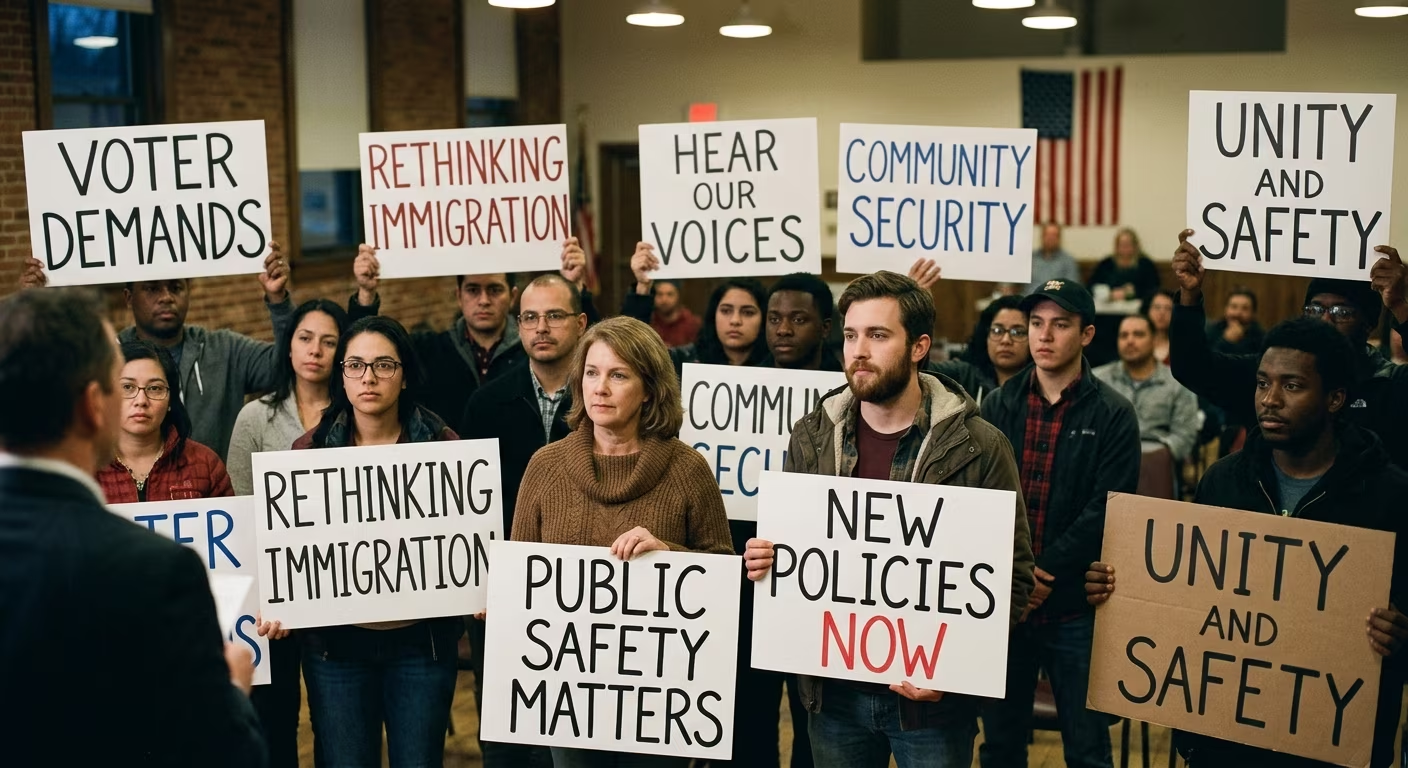
The Disconnect Between Political Rhetoric and Electorate Reality
During highly contested election cycles, the American public is frequently subjected to a barrage of political messaging that relies heavily on fear-based narratives. Politicians and partisan commentators often frame national issues—most notably immigration and public safety—as existential crises requiring draconian, punitive responses. The prevailing rhetorical playbook suggests that the electorate demands militarized borders, mass deportations, and an unflinching “tough on crime” approach to domestic security. However, when we move beyond the polarized soundbites and examine empirical data, a strikingly different picture of the American voter emerges. The reality is that the electorate is far more pragmatic, compassionate, and economically minded than the political theater suggests. Voters overwhelmingly favor balanced, humane policies that integrate undocumented populations and redefine public safety through community investment rather than sheer incarceration.
This deep-seated disconnect between what political campaigns sell and what the general public actually desires is a profound feature of modern democratic dysfunction. While extreme positions may mobilize fringe primary voters, the broader electorate consistently signals a desire for functional, solutions-oriented governance. By analyzing comprehensive public opinion polling and sociological research, we can decode the true demands of voters regarding immigration reform and criminal justice, revealing a mandate for empathy, systemic overhaul, and sustainable policy rather than perpetual partisan warfare.
Decoding the Data: The Modern Voter’s Stance on Immigration
For decades, immigration has been wielded as a potent wedge issue. Pundits often claim that economic anxieties drive native-born citizens to demand highly restrictive immigration policies. Yet, recent extensive surveys consistently dismantle this assumption, showcasing a public that recognizes the indispensable value of immigrants to the nation’s cultural fabric and economic engine.
Embracing Economic and Social Contributions
Contrary to the narrative of a nation pulling up the drawbridge, polling indicates a remarkable softening of anti-immigrant sentiment. For instance, mid-2025 data from Gallup reveals that a record-high 79% of U.S. adults believe that immigration is a “good thing” for the country. Even more telling is the sharp decline in public demand for restrictionist policies; the share of Americans wanting immigration levels reduced plummeted from 55% in 2024 to just 30% a year later. This shift transcends partisan lines and reflects a growing recognition of demographic and economic realities. With an aging native-born population and persistent labor shortages in critical sectors such as agriculture, healthcare, and technology, voters intuitively understand that a robust, regulated influx of foreign-born talent is vital for the nation’s competitive future.
This positive disposition toward immigration is not merely a fleeting sentiment; it is rooted in the everyday experiences of Americans who interact with immigrant business owners, colleagues, and neighbors. As inflation stabilizes and the acute panic of border surges subsides, the electorate has returned to a historically grounded appreciation for the American tradition of welcoming those seeking opportunity.
Pathways to Citizenship Over Punitive Mass Deportation
When polled on specific policy mechanisms, the electorate’s preference for restorative rather than punitive measures becomes undeniable. While political hardliners frequently propose mass deportation as a viable solution to unauthorized immigration, the public overwhelmingly rejects the logistical nightmare and moral cruelty of such an approach. Polling from Quinnipiac University has demonstrated surging support for providing undocumented immigrants with a pathway to legal status or citizenship, provided they meet certain requirements.
Voters generally prioritize the following immigration policy frameworks:
- Earned Legalization: Creating structured, rigorous pathways for undocumented individuals who have established deep roots in the U.S., paid taxes, and maintained clean records to achieve permanent residency or citizenship.
- Family Reunification: Protecting the integrity of mixed-status families by avoiding deportations that separate parents from their American-born children.
- Efficient Asylum Processing: Modernizing the immigration court system to adjudicate asylum claims swiftly and fairly, rather than detaining vulnerable populations indefinitely or turning them away without due process.
- Targeted Enforcement: Focusing border security resources on intercepting illicit drug trafficking, such as fentanyl, and human smuggling rings, rather than prosecuting ordinary families seeking economic survival.
This nuanced view highlights that Americans do not advocate for “open borders”—a common political strawman—but rather for an orderly, humane, and functional system that honors the rule of law alongside human dignity. Pew Research Center surveys underscore this balanced approach, noting that while voters care about border security, they equally emphasize the humane treatment of migrants and the protection of long-term residents.
Beyond Incarceration: A New Era of Public Safety
Much like immigration, public safety is frequently weaponized in political discourse. The “tough on crime” era of the 1980s and 1990s established a bipartisan consensus around mandatory minimum sentences, three-strikes laws, and the aggressive expansion of the prison-industrial complex. Today, the United States houses a disproportionate percentage of the global prison population. However, the American voter has witnessed the devastating social and financial fallout of mass incarceration and is actively demanding a paradigm shift.
The Waning Appeal of Mass Incarceration
The Brennan Center for Justice has long documented the public’s growing exhaustion with the carceral state. Voters across the political spectrum—from progressive urbanites to conservative rural residents—have come to view the current justice system as financially bloated and fundamentally ineffective at preventing recidivism. The staggering costs of housing millions of inmates, many of whom are incarcerated for non-violent drug offenses or technical probation violations, have alienated fiscal conservatives. Concurrently, the evident racial and socioeconomic disparities embedded within the justice system have mobilized civil rights advocates.
This bipartisan disillusionment has translated into tangible electoral support for reform. Initiatives aimed at rolling back mandatory minimums, restoring voting rights to formerly incarcerated individuals, and ending the cash bail system—which penalizes poverty rather than addressing public risk—have enjoyed widespread public backing when placed directly on state ballots.
Investing in Root Causes and Community Resilience
If voters are moving away from incarceration, what do they want instead? Modern polling indicates a strong preference for addressing the root causes of crime through proactive community investment. The electorate recognizes that law enforcement is currently forced to act as the primary responder for issues they are not equipped to handle, such as severe mental illness, substance abuse disorders, and chronic homelessness.
A redefined vision of public safety favored by voters includes:
- Specialized Crisis Response: Deploying trained mental health professionals and social workers, rather than armed police officers, to manage non-violent behavioral health crises.
- Rehabilitation and Reentry: Diverting funds toward educational programs, job training, and addiction treatment within correctional facilities to ensure individuals can successfully reintegrate into society.
- Community Violence Intervention: Supporting local, grassroots organizations that utilize credible messengers to mediate conflicts and prevent gang violence before it escalates.
- Economic Uplift: Recognizing that the most effective crime prevention tool is a thriving local economy, leading voters to support investments in affordable housing, youth employment programs, and neighborhood infrastructure.
The Intersection of Immigration and Community Trust
The realms of immigration reform and public safety are not isolated policy spheres; they are deeply interconnected, particularly at the municipal level. Aggressive federal immigration enforcement often relies on the cooperation of local law enforcement agencies through programs like 287(g) agreements. However, compelling local police to act as de facto immigration agents actively undermines public safety.
When immigrant communities fear that interacting with local police could lead to their deportation or the deportation of a family member, they retreat into the shadows. Victims of domestic violence, witnesses to violent crimes, and individuals subjected to labor exploitation become terrified to dial 911 or cooperate with investigations. This chilling effect creates a vacuum of trust, emboldening criminals who know they can target vulnerable immigrant populations with impunity.
Voters implicitly understand this dynamic. Support for “sanctuary” policies—which simply limit the extent to which local resources are used to enforce federal immigration law—is often robust in diverse metropolitan areas because residents prioritize safe neighborhoods over rigid federal enforcement. By keeping local policing distinct from immigration enforcement, municipalities foster the community trust required to investigate and resolve actual threats to public safety.
Comparing Narratives: Rhetoric vs. Reality
To fully grasp the magnitude of the disconnect between what is broadcasted during campaign seasons and what the electorate actually supports, it is helpful to juxtapose political narratives against verified voter preferences.
| Policy Area | Prevailing Political Rhetoric | Actual Voter Preference |
|---|---|---|
| Undocumented Immigrants | Widespread support for militarized roundups and mass deportation operations to remove all undocumented residents. | Strong majorities favor providing earned pathways to citizenship for those deeply integrated into U.S. communities. |
| Economic Impact of Immigration | Immigrants are draining public resources and taking jobs from native-born citizens. | 79% of adults view immigration as a “good thing,” recognizing their necessity in addressing critical labor shortages. |
| Crime Prevention | Safety requires expanding police budgets, lengthening prison sentences, and maintaining strict cash bail systems. | Voters prefer investing in mental health services, substance abuse treatment, and economic opportunities to prevent crime. |
| Drug Offenses | Strict criminalization and harsh mandatory minimums are the only way to combat the drug epidemic. | Widespread bipartisan support for treating drug addiction as a public health crisis rather than a criminal justice issue. |
Why the Narrative Gap Persists
If the data so clearly demonstrates that voters want humane immigration pathways and reformative justice, why do extreme, punitive narratives continue to dominate the political landscape? The answer lies in the structural mechanics of modern American politics and the media ecosystem.
First, the primary election system disproportionately rewards ideological purity and hyper-partisanship. Because voter turnout in primaries is typically low and heavily skewed toward the most zealous political bases, candidates are incentivized to adopt extreme positions to secure their party’s nomination. Once in the general election, they are often locked into these hardline stances, leaving the pragmatic majority of voters feeling unrepresented.
Second, gerrymandering has created numerous uncompetitive legislative districts. When a politician is virtually guaranteed to win the general election due to district drawing, their only real threat is a primary challenge from their political flank. This structural flaw essentially silences the moderate, reform-minded consensus.
Finally, the modern media landscape thrives on conflict, crisis, and outrage. Nuanced policy discussions about the economic benefits of immigration or the long-term efficacy of violence intervention programs do not generate the same viewership metrics as footage of chaos at the border or localized spikes in property crime. Consequently, the electorate’s balanced views are frequently overshadowed by sensationalized reporting that amplifies the loudest, most extreme voices.
Conclusion: A Mandate for Pragmatic Policymaking
The empirical evidence is irrefutable: the American electorate is vastly more nuanced, compassionate, and forward-thinking than the political establishment gives it credit for. Voters do not want a nation defined by endless incarceration, nor do they desire a closed-off society that treats vulnerable migrants with cruelty. They are demanding a recalibration of national priorities. They want an immigration system that honors human dignity while satisfying economic needs, and a public safety apparatus that builds resilient communities rather than merely filling prison cells.
Policymakers who have the courage to look past the manufactured outrage of the 24-hour news cycle will find a broad, eager coalition waiting to support genuine reform. The path forward requires abandoning the outdated, punitive playbooks of the past and embracing data-driven, community-centered solutions. The voters have already signaled their readiness for change; it is now up to their elected representatives to execute it.
Frequently Asked Questions (FAQs)
Do a majority of voters really support open borders?
No. Polling consistently shows that voters want a secure and orderly border. However, they strongly differentiate between effective border management and punitive policies against peaceful migrants. They prefer efficient processing, targeting of actual criminal enterprises, and robust legal pathways over chaotic enforcement or blanket bans.
How does public opinion on criminal justice reform cross party lines?
Criminal justice reform is one of the rare areas of modern bipartisan agreement. Conservative voters often support reform from a perspective of fiscal responsibility, religious redemption, and governmental overreach, while liberal voters approach it from the angles of racial equity and social justice. Both sides agree that mass incarceration is an expensive failure.
What role does the economy play in voter attitudes toward immigration?
A significant one. In periods of acute labor shortages, such as those experienced in the post-pandemic recovery, public appreciation for immigrant labor surges. Voters recognize that foundational industries—from agriculture to construction and hospitality—rely heavily on foreign-born workers to keep prices stable and supply chains functional.
Is “defunding the police” a popular concept among general voters?
The specific slogan “defund the police” is highly unpopular with the general electorate. However, the underlying policy goals—such as reallocating municipal funds to social workers, mental health crisis teams, and community violence intervention programs—enjoy substantial majority support when explained without politically charged rhetoric.
References
- Surge in U.S. Concern About Immigration Has Abated — Gallup News. 2025-07-11. https://news.gallup.com/poll/744004/surge-concern-immigration-abated.aspx
- Support Rises For Giving Most Undocumented Immigrants A Pathway To Legal Status — Quinnipiac University National Poll. 2025-06-26. https://poll.qu.edu/poll-release?releaseid=3912
- A Federal Agenda for Criminal Justice Reform — Brennan Center for Justice. 2020-12-09. https://www.brennancenter.org/our-work/policy-solutions/federal-agenda-criminal-justice-reform
- Immigration attitudes and the 2024 election — Pew Research Center. 2024-06-06. https://www.pewresearch.org/politics/2024/06/06/immigration-attitudes-and-the-2024-election/