
Verified Statements In Legal Filings: Rules And Best Practices
Navigate the rules for oaths and affirmations in court documents to ensure compliance and strengthen your case.
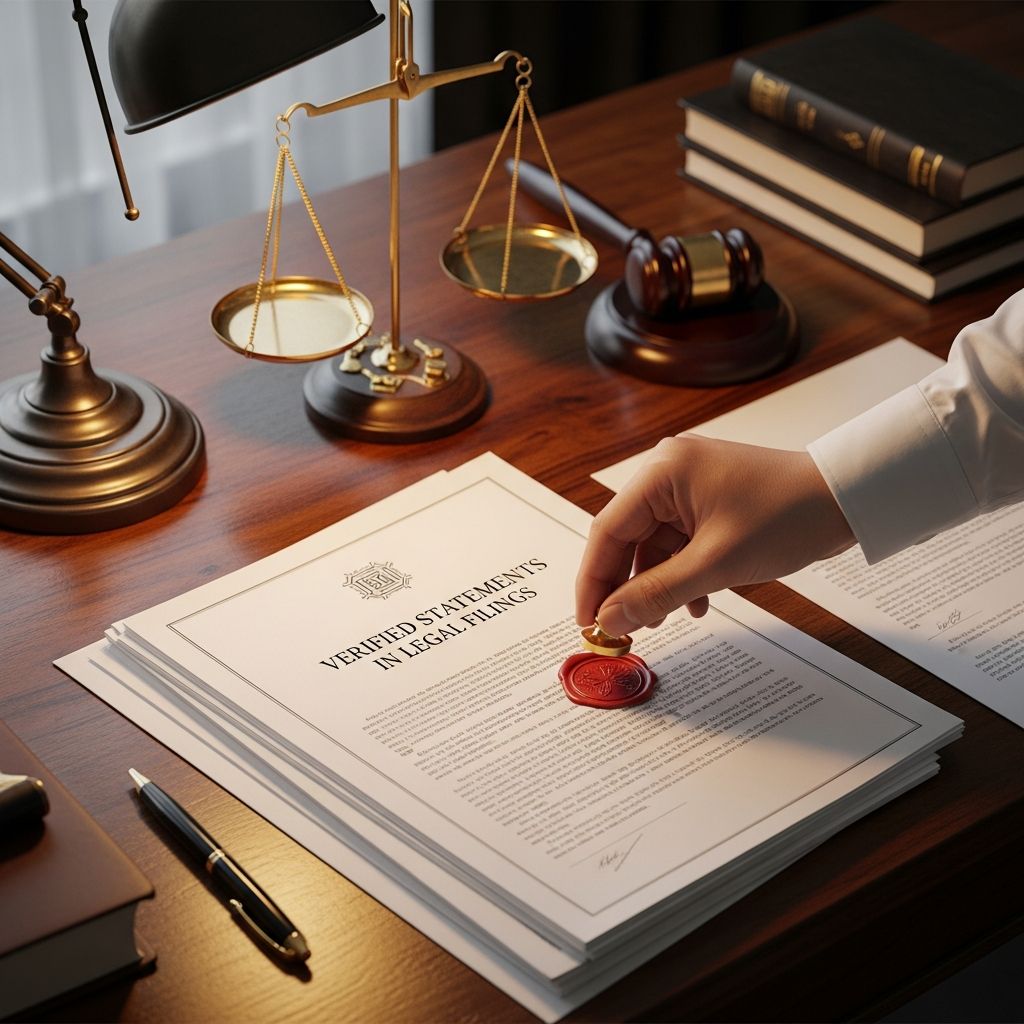
Legal professionals often face decisions about incorporating sworn affirmations into their court submissions. These verified elements lend credibility to claims but come with strict procedural demands. Understanding when verification is mandatory, optional, or inadvisable prevents procedural missteps and bolsters case strength.
Understanding Verification in Court Documents
Verification refers to a formal declaration under penalty of perjury that the contents of a filing are true to the best knowledge of the signatory. This process transforms an ordinary document into a sworn statement, subjecting the verifier to potential perjury charges if falsehoods are proven. Courts rely on these to filter meritless claims early.
In civil litigation, verification typically appears in complaints, answers, or motions where factual assertions need evidentiary weight. Federal Rule of Civil Procedure 11 requires attorneys to certify filings are not for improper purposes, grounded in fact and law, but full verification under 28 U.S.C. § 1746 elevates this to oath level.
When Verification Becomes Mandatory
Certain filings demand verification by statute or rule. For instance, in federal diversity cases involving amounts over $75,000, complaints may require it if state law mandates. Administrative charges, like those to the Equal Employment Opportunity Commission (EEOC), historically allowed post-filing oaths, as affirmed by the Supreme Court.
The Court in Edelman v. Lynchburg College (1999) ruled that unverified EEOC charges could be cured by later verification, prioritizing access to justice for lay filers over rigid timing. This ‘relation-back’ doctrine under 29 CFR § 1601.12(b) ensures technical defects do not bar claims.
- Complaints in specific jurisdictions: California Code of Civil Procedure § 446 requires verification for certain actions.
- Motions for summary judgment: Affidavits must be notarized or declared under penalty of perjury.
- Petitions for injunctions: Often need sworn support to demonstrate irreparable harm.
Strategic Advantages of Swearing to Pleadings
Voluntary verification signals confidence in facts, pressuring opponents to respond substantively rather than motion to dismiss. It can expedite discovery by establishing prima facie cases. In contentious disputes, sworn pleadings deter frivolous counterattacks.
| Aspect | Verified Pleading | Unverified Pleading |
|---|---|---|
| Credibility | High; subjects to perjury risk | Lower; easier to challenge |
| Court Response | Less likely for dismissal | Vulnerable to 12(b)(6) motions |
| Discovery Impact | Accelerates process | May delay proceedings |
| Risk Level | Higher for filer if facts weak | Lower initial exposure |
Judges view verified submissions favorably when supported by evidence, as they align with oaths used in testimony.
Risks and Pitfalls of Over-Verification
Swearing to unsubstantiated allegations invites sanctions under Rule 11 or state equivalents. Perjury convictions carry imprisonment, fines, and bar complaints. Inaccurate details, even if unintentional, erode attorney credibility.
Courts scrutinize verified facts during motions practice. Opposing counsel can demand proof, turning pleadings into mini-trials. Avoid verification for speculative claims better suited for later affidavits.
- Perjury exposure under 18 U.S.C. § 1621.
- Sanctions including fees and costs.
- Potential for amended pleadings if facts evolve.
Differences Across Jurisdictions
Federal courts standardize via FRCP, but states vary. New York CPLR § 3020 mandates verification for most pleadings, executed by plaintiffs or agents. Texas rules allow unsworn declarations per Texas Civil Practice & Remedies Code § 132.001.
In administrative forums like EEOC or NLRB, flexibility prevails. Supreme Court precedent supports curative oaths post-deadline, balancing procedural rigor with substantive rights.
Practical Steps for Proper Verification
- Draft meticulously: Ensure every sworn fact is investigable.
- Select verifier: Plaintiff, attorney, or agent with knowledge.
- Use correct language: ‘I declare under penalty of perjury that the foregoing is true and correct.’
- Notarize if required: Some courts demand it; others accept declarations.
- File timely: Relation-back may apply, but promptness avoids disputes.
For electronic filings, platforms like PACER accept scanned notarizations or e-signatures compliant with 28 U.S.C. § 1746.
Verification in Specialized Proceedings
In family law, verified petitions detail custody facts. Bankruptcy schedules under 11 U.S.C. § 521 require debtor oaths. Probate filings often swear to asset inventories.
Class actions demand plaintiff verification to confirm standing. Securities litigation under PSLRA mandates safe harbor for forward-looking statements but verifies historical facts.
Alternatives to Full Verification
Not every assertion needs swearing. Attach affidavits for key facts, preserving pleading flexibility. Rule 56 affidavits suffice for summary judgment without amending complaints.
Unsworn declarations work in permissive jurisdictions, carrying similar weight without notary fees.
Ethical Considerations for Attorneys
ABA Model Rule 3.3 prohibits false statements to tribunals. Advising clients on verification implicates competence (Rule 1.1). Over-reliance risks malpractice if claims falter.
Counsel must confer pre-filing per Rule 11, certifying reasonable inquiry.
Case Studies: Successes and Failures
In employment discrimination suits, timely verified EEOC charges preserved claims despite initial omissions, per Supreme Court guidance. Conversely, unverified complaints in fraud cases faced dismissal for lacking particularity under Rule 9(b).
A notable federal case dismissed a verified motion where facts contradicted deposition testimony, imposing sanctions.
Frequently Asked Questions
What forms of oath are acceptable in federal court?
Notarization, unsworn declaration under 28 U.S.C. § 1746, or affirmation. Courts accept ‘so help me God’ variants or secular pledges.
Can I verify on behalf of a corporate client?
Yes, an officer or authorized agent with personal knowledge may sign.
Does verification extend statutes of limitations?
In EEOC contexts, yes via relation-back; check jurisdiction-specific rules elsewhere.
What if facts change post-verification?
Amend promptly under Rule 15 to avoid waiver or sanctions.
Is profanity allowed in verified statements?
Accurate quotation of profane speech is permitted when documenting events; avoid gratuitous use.
Modern Trends and Technology
E-filing has streamlined verification with digital signatures. Blockchain-based oaths emerge for tamper-proof declarations. AI tools draft compliant language, but human review remains essential.
COVID-19 accelerated remote notarizations under federal law, persisting for efficiency.
Mastering verification enhances advocacy while mitigating risks. Tailor to case needs, jurisdiction, and strategy for optimal results.
References
- Common Courtroom Phrases — Administrative Office of the Courts, Nevada. Accessed 2026. https://nvcourts.gov/aoc/programs_and_services/court_interpreter/interpreter_resources/common_courtroom_phrases
- Swearing Is No Big Deal At Least When Filing An EEOC Complaint — Gordon Feinblatt LLC. 1999-05-24. https://www.gfrlaw.com/what-we-do/insights/swearing-no-big-deal-least-when-filing-eeoc-complaint
- Is It Legal to Use Profanity In Court? — YouTube (Video). Accessed 2026. https://www.youtube.com/watch?v=Cx7UexzqcEU
- To Swear or Not to Swear: Using Foul Language During a Supreme Court Oral Argument — Washington University Law Review Commentaries. 2012-01-01. https://openscholarship.wustl.edu/law_lawreview_commentaries/20/
- How do I document profanity? — Avvo Legal Answers. Accessed 2026. https://www.avvo.com/legal-answers/how-do-i-document-profanity–2255546.html
Similar Articles








Read full bio of Sneha Tete


