
Understanding U.S. Vaping and E-Cigarette Laws by State
A practical, state-focused overview of how U.S. laws regulate vaping devices, e-liquids, and e-cigarette use in public and private spaces.
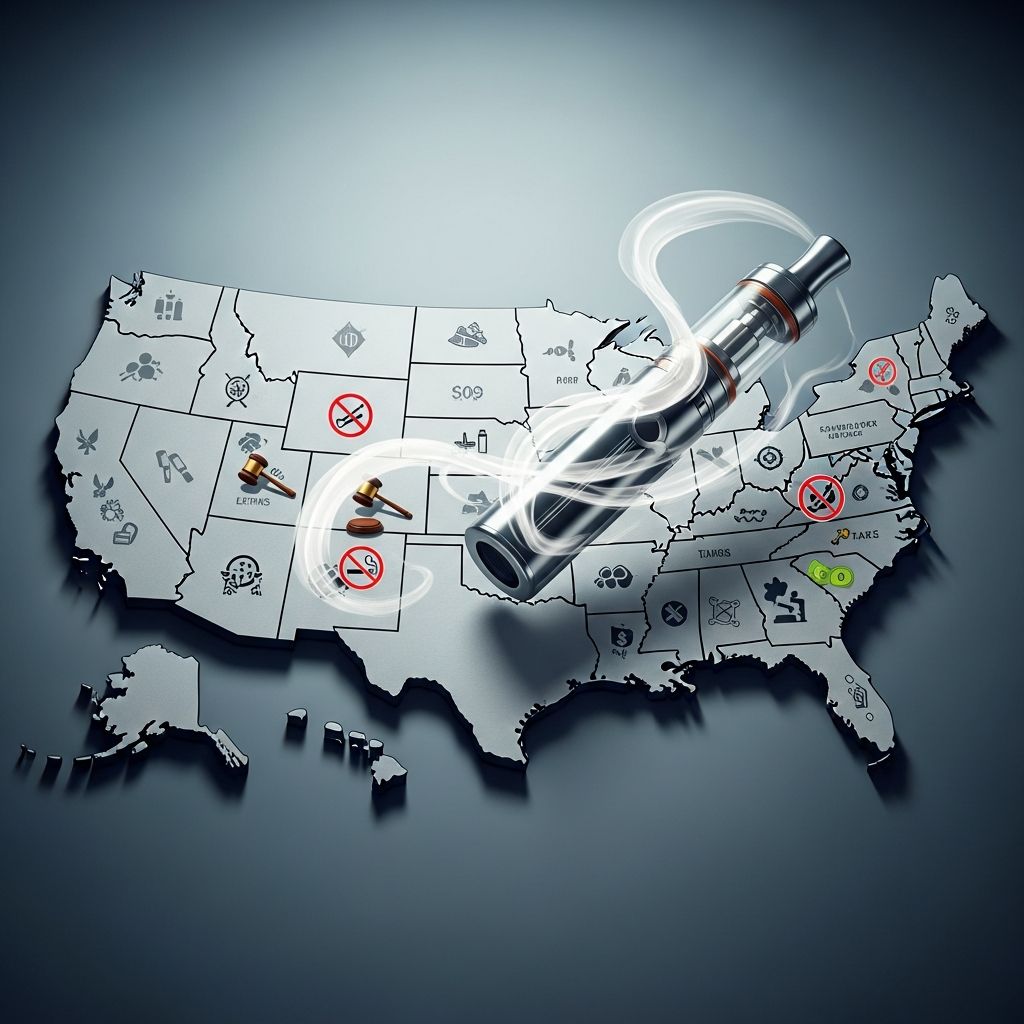
Vaping and e-cigarettes are regulated in the United States primarily at the state and local level, layered on top of federal rules that govern how these products are made, marketed, and sold. While many states treat e-cigarettes similarly to traditional tobacco products, the details differ significantly from one jurisdiction to another.
This guide offers a practical, plain-language overview of the key ways states regulate vaping and e-cigarettes, highlighting major trends, common rules, and examples of how laws vary around the country. It is intended for general information only and is not a substitute for legal advice about any specific state or situation.
1. The Legal Framework: Who Regulates What?
Vaping rules arise from a combination of federal, state, and local authority. Understanding this framework helps explain why the law can look very different from one city or state to the next.
1.1 Federal Role in E-Cigarette Regulation
At the federal level, the U.S. Food and Drug Administration (FDA) regulates e-cigarettes as tobacco products, because the nicotine used in most e-liquids is derived from tobacco. Federal rules focus on:
- Product standards – approving or denying marketing of specific vaping products.
- Manufacturing and labeling – ingredient disclosure, warning labels, and quality controls.
- National minimum purchase age – federal law prohibits sale of any tobacco product, including e-cigarettes, to people under 21.
Federal law does not fully standardize public-use rules, taxes, or retail licensing, leaving those choices to states and local governments.
1.2 State and Local Authority
States use their traditional police powers to regulate vaping for public health and safety. They commonly address:
- Where vaping is allowed (indoor workplaces, restaurants, bars, schools, parks).
- Who may buy or possess e-cigarettes (age limits and youth-specific rules).
- How products are sold (licensing, online sales, flavor bans, delivery rules).
- Taxation of vaping devices and e-liquid.
Local governments often go further than their state, for example by adding stricter smoke-free laws or local flavor restrictions in cities or counties.
2. Common Types of State Vaping Laws
Although each state takes its own approach, most vaping laws fall into several broad categories. The table below summarizes the main regulatory levers and what they typically cover.
| Regulatory Category | Typical Legal Questions | What States Commonly Do |
|---|---|---|
| Public-use restrictions | Where can people legally vape? | Ban vaping anywhere smoking is prohibited (e.g., workplaces, restaurants, bars). |
| Age and youth access | Who may buy or possess e-cigarettes? | Set 21 as minimum age, restrict sales near schools, and prohibit sales to minors. |
| Retail licensing | Who may sell vaping products? | Require tobacco or vape retailer licenses and impose compliance checks. |
| Flavor and product rules | What kinds of products are allowed? | Some states or cities restrict flavored e-liquids or certain devices. |
| Taxation | How are e-cigarettes taxed? | Tax per milliliter of liquid, as a percentage of wholesale/retail price, or both. |
| Advertising & marketing | How may products be promoted? | Limit youth-oriented advertising and require health warnings. |
3. State Approaches to Public Vaping: From Strict Bans to Minimal Rules
The most visible vaping laws concern whether e-cigarettes may be used in indoor public places, such as restaurants, bars, offices, and public buildings.
3.1 States that Include Vaping in Comprehensive Smoke-Free Laws
Many states have amended their smoke-free air laws so that “smoking” covers both combustible tobacco and e-cigarettes, effectively banning vaping wherever smoking is banned. As of late 2024, the Centers for Disease Control and Prevention (CDC) reports that:
- 20 states, the District of Columbia, and Puerto Rico have comprehensive indoor air laws that explicitly include e-cigarettes.
- These laws typically cover private worksites, restaurants, and bars, and sometimes extend to other locations such as public transit and common areas of multi-unit housing.
Including vaping in smoke-free laws allows for consistent signage and enforcement, since existing “No Smoking” rules usually apply to e-cigarettes as well.
3.2 States with Partial Indoor Vaping Restrictions
Some states regulate vaping only in certain locations. Common examples include:
- Government buildings and courthouses.
- Public schools and college campuses.
- Healthcare facilities and daycare centers.
- Correctional institutions or specific state properties.
In these states, bars, restaurants, and many private workplaces may or may not prohibit vaping depending on local ordinances or company policies.
3.3 States with No Broad Statewide Indoor Vaping Ban
A smaller number of states have chosen not to adopt a comprehensive statewide indoor vaping ban. Instead, they allow:
- Individual employers and business owners to set their own policies.
- City or county governments to pass stricter local ordinances.
In these jurisdictions, the legal status of vaping in a particular bar, restaurant, or workplace may vary dramatically even within the same state, depending on local law and property-owner rules.
4. Age Limits, Youth Protections, and School Policies
Preventing youth access to e-cigarettes is a central focus of state vaping laws, driven by public health concerns over nicotine addiction in adolescents.
4.1 Minimum Age to Buy and Possess
Following changes in federal law, all states now align with a minimum sales age of 21 for tobacco products, including e-cigarettes. States typically:
- Prohibit retailers from selling or providing e-cigarettes to anyone under 21.
- Require age verification for in-person and online sales.
- Impose civil or criminal penalties on retailers for unlawful sales to underage buyers.
Some states also regulate youth possession of vaping products specifically on school grounds or in public places, sometimes pairing enforcement with education or diversion programs rather than heavy fines for minors.
4.2 School and Campus Rules
State statutes and school policies commonly treat vaping as a form of tobacco use and ban it:
- On K-12 school property, including buildings, athletic fields, and school vehicles.
- At school-sponsored events, even when held off-campus.
- On many college and university campuses, particularly state institutions.
Violations can result in school discipline, confiscation of devices, and sometimes referral to cessation or counseling programs.
5. How States Tax Vaping Products
Taxation is another major area of variation in state vaping laws. States use taxes both to generate revenue and to discourage youth use by raising prices.
5.1 States that Tax E-Cigarettes
According to CDC’s STATE System, as of September 30, 2024:
- 33 states, the District of Columbia, Puerto Rico, and the U.S. Virgin Islands impose some form of tax on e-cigarettes.
- Tax structures vary widely by state, product type, and sometimes device design.
5.2 Major Types of Vaping Taxes
States typically use one or more of the following models:
- Specific tax per volume – A fixed amount per milliliter of e-liquid (often used for closed systems or cartridges).
- Ad valorem tax – A percentage of a defined price (wholesale, manufacturer’s price, or retail price), commonly applied to open systems or devices.
- Hybrid models – Some states tax closed systems per milliliter but tax open systems or other components as a percentage of cost.
These differences mean that the same product can be significantly more expensive in some states than others, even before regular sales tax is applied.
6. Retail Sales, Licensing, and Online Purchases
Most states regulate the business side of vaping through licensing and sales restrictions aimed at limiting youth access and improving oversight of the marketplace.
6.1 Licensing Vape and Tobacco Retailers
Common licensing-related rules include:
- Requiring retailers that sell e-cigarettes to obtain a tobacco or vape license.
- Allowing license suspension or revocation for repeated violations (such as selling to minors).
- Requiring retailers to display their license and comply with inspections.
States may also license wholesalers or distributors separately, particularly where special vaping taxes are collected at the wholesale level.
6.2 Restrictions on Online and Delivery Sales
Some states have enacted rules that address modern purchasing methods:
- Mandating age verification for online sales, including third-party databases or ID checks at delivery.
- Requiring signature upon delivery for shipments containing vaping products.
- Limiting or prohibiting shipment of vaping products directly to consumers in the state.
These state rules interact with federal restrictions on mailing and shipping certain tobacco products, creating a complex regulatory environment for online vape retailers.
7. Flavor Bans and Product-Specific Restrictions
To address youth appeal of sweet or fruity e-liquids, some states and localities have moved beyond general vaping restrictions to target specific products.
7.1 State and Local Flavor Policies
Approaches include:
- Statewide flavor bans for all non-tobacco flavors in e-cigarettes.
- Partial bans that focus on flavored cartridges but allow certain open-system liquids.
- Local ordinances in cities or counties that prohibit the sale of flavored vaping products within local borders.
These rules exist alongside federal policy and court decisions, leading to a patchwork in which a product may be legal in one state but unavailable in a neighboring city or county.
7.2 Device and Packaging Requirements
States may also regulate:
- Child-resistant packaging for nicotine liquids.
- Container size limits for e-liquids.
- Warning labels on packaging in addition to federal requirements.
Violations in this area usually lead to administrative or civil penalties for manufacturers and retailers rather than criminal charges for consumers.
8. State-by-State Variation: Patterns and Practical Tips
Because no two states regulate vaping in exactly the same way, a person who vapes legally in one state can unknowingly break the law in another. Below are common patterns and practical guidance for navigating this variation.
8.1 Typical State Patterns
- More restrictive states often combine comprehensive indoor vaping bans, flavor restrictions, special taxes, and robust enforcement against youth access.
- Moderate states may ban vaping in certain sensitive locations (schools, healthcare facilities) and tax products but leave many indoor spaces and product types less regulated.
- Less restrictive states may rely heavily on local governments and private policies, with fewer statewide vaping-specific rules, though they still must comply with federal minimum age laws.
8.2 Practical Tips for Consumers
- Check state law before traveling if you plan to vape in public or carry e-cigarettes across state lines.
- Observe posted signage: in many places, “No Smoking” signs apply to vaping by law or policy.
- When in doubt, ask the property owner (such as a restaurant or landlord) about their rules.
- Avoid vaping in obviously sensitive areas, such as schools, healthcare settings, and government buildings, unless signage clearly permits it.
8.3 Practical Tips for Retailers and Landlords
- Obtain all required licenses and renew them on time.
- Train staff on age-verification procedures and applicable state sales rules.
- Clarify your policies in writing for employees, tenants, or customers, particularly when state law does not address vaping explicitly.
9. Criminal, Civil, and Administrative Consequences
Vaping laws can carry different types of consequences depending on the specific rule and state.
9.1 Penalties for Individuals
For individual users, consequences are often civil or administrative rather than strictly criminal, especially for first-time violations. Examples may include:
- Fines for vaping in prohibited public spaces.
- Civil citations for underage possession or use on school grounds.
- Disciplinary actions in employment or housing settings, including termination or lease enforcement.
In some states, repeated or willful violations, or providing vaping products to minors, can rise to the level of misdemeanor offences.
9.2 Penalties for Retailers and Businesses
Retailers, distributors, and sometimes landlords face a wider range of potential sanctions, such as:
- Civil fines for improper sales or failure to verify age.
- License suspension or revocation for repeated violations.
- Tax assessments, interest, and penalties for improper reporting of vaping taxes.
。
10. Staying Current with Changing State Laws
Vaping legislation is one of the fastest-moving areas of tobacco control law in the United States. Public health agencies and legal research centers regularly track updates.
10.1 Reliable Resources for State Law Updates
- Centers for Disease Control and Prevention (CDC) – Tracks state e-cigarette taxes and smoke-free laws nationwide.
- Public Health Law Center – Maintains a 50-state review of e-cigarette laws, updated periodically and focused on statutory and regulatory developments.
- State health departments and attorneys general – Often publish guidance documents or summaries for residents and businesses.
Because laws change frequently, any summary can become outdated quickly. Always review the latest authoritative information or consult a qualified attorney when making decisions that depend on current state vaping law.
Frequently Asked Questions (FAQs)
Q1: Is vaping allowed anywhere smoking is allowed?
Not always. Many states and cities treat vaping like smoking and prohibit it in the same places, but some jurisdictions have separate rules. In a few states, there is no broad statewide ban, and individual property owners or local ordinances decide whether vaping is permitted.
Q2: Do all states tax e-cigarettes?
No. As of late 2024, 33 states, the District of Columbia, Puerto Rico, and the U.S. Virgin Islands tax e-cigarettes, using per-milliliter, percentage-of-price, or hybrid tax models. Other states either do not tax vaping products specifically or treat them only under general sales tax.
Q3: What is the legal age to buy vaping products?
Federal law sets 21 as the nationwide minimum age for purchasing any tobacco product, including e-cigarettes, and states have incorporated this standard into their own laws. Retailers who sell to underage buyers can face fines, license sanctions, or other penalties.
Q4: Can local governments be stricter than state vaping laws?
Often yes. In many states, cities and counties are allowed to adopt stronger vaping regulations than state law, such as banning flavors or extending smoke-free protections to more places. However, some states limit or preempt local control, so the answer depends on the state.
Q5: How can I find the exact vaping rules in my state?
Start with official state resources such as the health department or attorney general’s website, and consult national summaries from organizations like the CDC and the Public Health Law Center. For business decisions or legal questions, it is wise to seek advice from an attorney familiar with your state’s tobacco control laws.
References
- STATE System E-Cigarette Fact Sheet — Centers for Disease Control and Prevention (CDC). 2024-09-30. https://www.cdc.gov/statesystem/factsheets/ecigarette/ECigarette.html
- List of vaping bans in the United States — Wikipedia (summarizing state and local laws; used only for general pattern recognition, not citation of specific statutes). Accessed 2025-12. https://en.wikipedia.org/wiki/List_of_vaping_bans_in_the_United_States
- Vaping Laws for All 50 States — Signs.com. 2019-08-23. https://www.signs.com/blog/vaping-laws-for-all-50-states/
- States and Municipalities with Laws Regulating Use of Electronic Cigarettes — Americans for Nonsmokers’ Rights Foundation. 2023-04-01. https://no-smoke.org/pdf/ecigslaws.pdf
- U.S. E-Cigarette Regulations – 50 State Review — Public Health Law Center at Mitchell Hamline School of Law. Updated 2024. https://www.publichealthlawcenter.org/resources/us-e-cigarette-regulations-50-state-review
Similar Articles








Read full bio of medha deb


