
When Your License Is Valid at Home but Revoked Elsewhere
Understand how state license rules, interstate compacts, and reciprocity affect you when one state suspends or revokes your driving privilege.
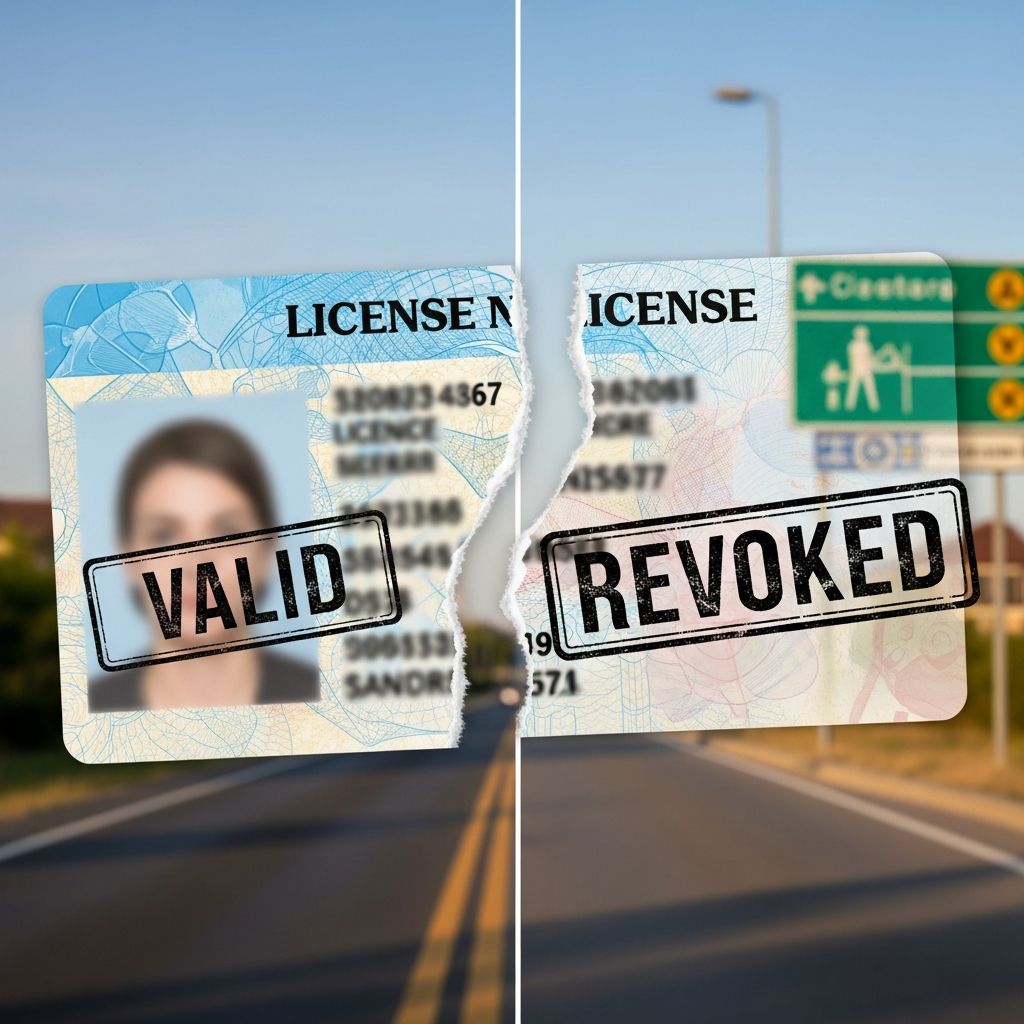
Many drivers are surprised to learn that a license can appear valid in their home state even though another state has suspended or revoked their driving privilege. Understanding how states share information and honor each other’s decisions is essential if you drive or move across state lines.
This guide explains how interstate data sharing works, why one state can revoke your right to drive even if your original license remains technically “valid,” and what practical steps you can take if you are caught in the middle of conflicting state actions.
Driving Privilege vs. Physical License Card
A key distinction in U.S. traffic law is the difference between the physical license issued by your home state and your legal privilege to drive in a particular jurisdiction.
- License card: The plastic or digital card your home state issues that shows you passed the required tests and met eligibility requirements.
- Driving privilege: The legal authorization to operate a motor vehicle on public roads within a state’s boundaries.
Each state controls who may drive within its borders. A state can suspend or revoke your privilege to drive there even if it does not have the power to physically take away another state’s card. When that happens, you may still hold a seemingly valid license, but driving in the state that imposed the revocation is illegal.
How States Share Driver Information
Most U.S. states participate in formal agreements designed to prevent drivers from escaping penalties simply by crossing a border. Two major tools are used to share driver information:
- Driver License Compact (DLC): An interstate compact that allows states to exchange information on license suspensions and traffic violations for nonresidents, with a goal of “one driver, one license, one record.”
- National data systems and DMV exchanges: State motor vehicle agencies routinely transmit conviction and suspension information to the driver’s home state under laws and policies coordinated by national organizations such as the American Association of Motor Vehicle Administrators (AAMVA).
Under these systems, the state where the violation occurred sends a report back to the driver’s home state. The home state may then impose its own penalties as if the offense had happened locally.
Why a Suspension in One State Matters Everywhere
When you are convicted of a serious traffic offense or fail to comply with a court requirement in another state, that state can suspend or revoke your privilege to drive there. If the states are part of the DLC or similar arrangements, your home state will usually receive the information and may take action against your license as well.
Common triggers for out-of-state suspensions and revocations include:
- Driving under the influence (DUI / DWI)
- Reckless or dangerous driving
- Leaving the scene of an accident involving injury or significant damage
- Driving on an already suspended or revoked license
- Failing to appear in court or to pay required fines
Many states treat these serious offenses similarly regardless of where they occur. For example, if your home state would suspend a license for DUI, it will generally impose a similar suspension when it receives a DUI conviction from a DLC member state.
Compact vs. Non-Compact States
Not all states participate in the same way. The DLC historically included most states, but a few did not join or adopted different rules. Some important points:
- Compact members: These states transmit most serious traffic convictions to the driver’s home state and are expected to honor each other’s suspensions and revocations.
- Non-compact or partial participants: A handful of states either do not belong or handle out-of-state violations more selectively. Even there, basic recognition of another state’s suspension is common, especially for serious offenses.
Over time, older compacts have been supplemented or replaced by newer agreements and data-sharing initiatives, but the practical effect for drivers has stayed consistent: states seldom ignore major violations from other states.
Practical Scenarios: Valid in One State, Revoked in Another
To see how this plays out, consider several realistic situations:
- Scenario 1: Local suspension only
You receive a serious speeding conviction while visiting another state. That state suspends your privilege to drive there for six months but does not send the conviction to your home state (for example, due to local policy or a technical error). Your home license remains active, but the other state can arrest or cite you if you drive there during the suspension period. - Scenario 2: Interstate reporting and home-state action
In a similar case, the state where you were ticketed reports your conviction under the Driver License Compact. Your home state processes the report and imposes its own suspension. Your card may be physically confiscated, and you are prohibited from driving anywhere until the suspension ends. - Scenario 3: Conflicting rules
One state treats an offense as license-revocation-worthy; another does not. After receiving the conviction report, your home state may apply a different penalty than the original state did, because the home state uses its own laws to decide what action to take.
How a Revocation Affects New Licenses in Other States
Many drivers assume they can move to a new state and “start fresh” by applying for a new license, but state DMVs typically check national databases and prior records.
- National record checks: When you apply for a new license, the new state usually searches for prior suspensions and revocations, then requires clearance of outstanding actions before issuing a license.
- One license rule: Compact principles aim to prevent a person from holding multiple active licenses in different states at once.
- Mandatory clearances: Many states refuse to issue or renew a license until you resolve an outstanding suspension or revocation from another state (such as paying fines or completing required programs).
The goal is to keep serious violations from being erased simply by moving. This is particularly strict for commercial drivers, where federal rules and reciprocity with Canada further reinforce mutual recognition of disqualifications.
Special Considerations for Commercial Drivers
Commercial drivers are subject to stricter oversight and enhanced reciprocity rules. U.S. and Canadian commercial driver’s licenses are mutually recognized for cross-border operations, which means a serious violation in either country can affect a driver’s ability to work on both sides of the border.
| Type of Driver | Cross-Border Effect of Revocation |
|---|---|
| Non-commercial U.S. driver | Out-of-state suspensions often lead to home-state action through compacts and data-sharing, but rules vary by state. |
| U.S. commercial driver | Disqualifications can be recognized across the U.S. and by Canadian authorities, limiting operation in both countries. |
| Canadian commercial driver in U.S. | U.S. authorities recognize valid Canadian commercial licenses; serious violations can affect status in Canada as well. |
International Reciprocity and Foreign Licenses
Similar issues arise when foreign drivers use their home-country licenses in U.S. states. Some states recognize foreign licenses for a limited period, often under treaties or reciprocity agreements.
- Short-term recognition: A valid foreign license may allow temporary driving by visitors for up to a year, depending on the state and relevant international conventions.
- New residents: Once a foreign driver becomes a resident, they are usually required to obtain a local license within a set time frame (for example, 90 days in Texas).
- Reciprocal exchanges: Some U.S. and Canadian jurisdictions negotiate agreements to swap licenses without full testing, often using shared best-practices guidance.
However, even when foreign licenses are recognized, states can still suspend or revoke a visitor’s privilege to drive locally for serious violations. That action may be shared back to the foreign authority if a reciprocity agreement exists.
What To Do If Your License Is Revoked in Another State
If you learn that a different state has suspended or revoked your driving privilege, treating the matter promptly is critical. Ignoring the issue can lead to criminal charges for driving while suspended and can complicate future license renewals.
Immediate Steps
- Confirm the status: Contact the DMV or licensing authority in the state that imposed the action to verify whether the suspension or revocation is active and why it was imposed.
- Request documentation: Ask for written notice, dates, and conditions for reinstatement, including any required classes, treatment programs, or fees.
- Check your home-state record: Contact your home DMV to see whether it has also imposed a suspension based on the out-of-state action.
Clearing the Revocation
- Resolve court obligations: If the action stems from nonpayment of fines or failure to appear, satisfying the court obligations may allow the state to lift the suspension.
- Complete mandated programs: For DUI or similar offenses, you may need to attend an education program, treatment, or traffic school before reinstatement is considered.
- Pay reinstatement fees: Most states charge administrative fees to restore driving privileges after a suspension or revocation.
- Obtain proof of clearance: Once the other state lifts the action, ask for written confirmation. Your home state may require this documentation before removing any corresponding hold on your license.
Because each state’s laws are different and the consequences can be severe, consulting a lawyer experienced in traffic or DUI law may be essential, particularly where a criminal conviction is involved.
Tips to Protect Your Multistate Driving Privileges
Although every case is unique, several general strategies can reduce the risk of ending up with conflicting license statuses:
- Take all out-of-state tickets seriously. Treat a citation in another state as seriously as one at home. Missing a court date or failing to pay can lead to license actions that follow you.
- Keep your mailing address updated. Many drivers first learn of suspensions through mailed notices. If the DMV or court cannot reach you, you may not realize you have lost your driving privilege.
- Verify your record regularly. Especially if you travel or move frequently, check your license status with your home DMV and, if needed, with states where you have had recent violations.
- Be cautious when moving between states. When transferring a license, expect the new state to check for outstanding suspensions and to require that they be cleared first.
- Understand special rules for young or provisional drivers. Some states impose age-based or provisional restrictions; your license may not be honored elsewhere if you do not meet that state’s minimum driving age.
Frequently Asked Questions (FAQs)
Q: Can I legally drive in my home state if another state has revoked my privilege there?
In some cases, yes. If your home state has not taken any action against your license, it may still appear valid for driving at home. However, you remain prohibited from driving in the state that imposed the revocation, and your home state may later suspend your license after receiving updated information.
Q: Will my home state automatically suspend my license if I am suspended elsewhere?
Not always automatically, but many states are required or strongly inclined to impose a similar suspension when they receive notice of an out-of-state conviction under the Driver License Compact or related laws. How and when they respond depends on their own statutes and administrative rules.
Q: If I move, can the new state issue a license while I’m still revoked somewhere else?
Usually no. When you apply for a license, the new state typically checks your national driver record and will refuse to issue a license until all outstanding suspensions or revocations are cleared. The goal is to prevent drivers from bypassing penalties by relocating.
Q: Does a foreign license protect me from U.S. suspensions?
No. A state can revoke or suspend your privilege to drive locally even if you hold a foreign license. Some states recognize foreign licenses for a limited time under international agreements, but serious violations can still result in loss of driving privileges in that state, which may be reported back to your home country if a reciprocity agreement exists.
Q: How do I find out whether my state belongs to an interstate compact?
You can usually check through your state’s motor vehicle department or through official compact resources and government or quasi-governmental organizations that track state membership in the Driver License Compact and related agreements.
References
- Driver License Compact — The Council of State Governments. 2024-01-01. https://compacts.csg.org/compact/driver-license-compact/
- Driver License Compact — Wikipedia (referencing AAMVA and state statutes). 2023-12-15. https://en.wikipedia.org/wiki/Driver_License_Compact
- Driving Privilege Reciprocity — Texas Department of Public Safety. 2023-05-10. https://www.dps.texas.gov/section/driver-license/driving-privilege-reciprocity
- Driver License Foreign Reciprocity — American Association of Motor Vehicle Administrators (AAMVA). 2022-09-01. https://www.aamva.org/topics/driver-license-foreign-reciprocity
- Reciprocity and Recognition of United States and Canadian Commercial Drivers — Federal Motor Carrier Safety Administration. 2017-01-06. https://www.fmcsa.dot.gov/international-programs/reciprocity-and-recognition-united-states-and-canadian-commercial-drivers
- How to Transfer Your Driver’s License to Another State — FirstTimeDriver.com. 2021-08-01. https://www.firsttimedriver.com/blog/how-to-transfer-drivers-license-to-another-state/
- Valid Driver’s License: Is My Driver’s License Valid in Every State? — DriveSafe Online. 2022-11-01. https://www.drivesafeonline.org/traffic-school/is-drivers-license-valid-everywhere/
Similar Articles








Read full bio of medha deb


