
The American Paradox: Global Human Rights vs. Domestic Reality
Examining the stark divide between the United States' international human rights advocacy and its domestic policy failures.
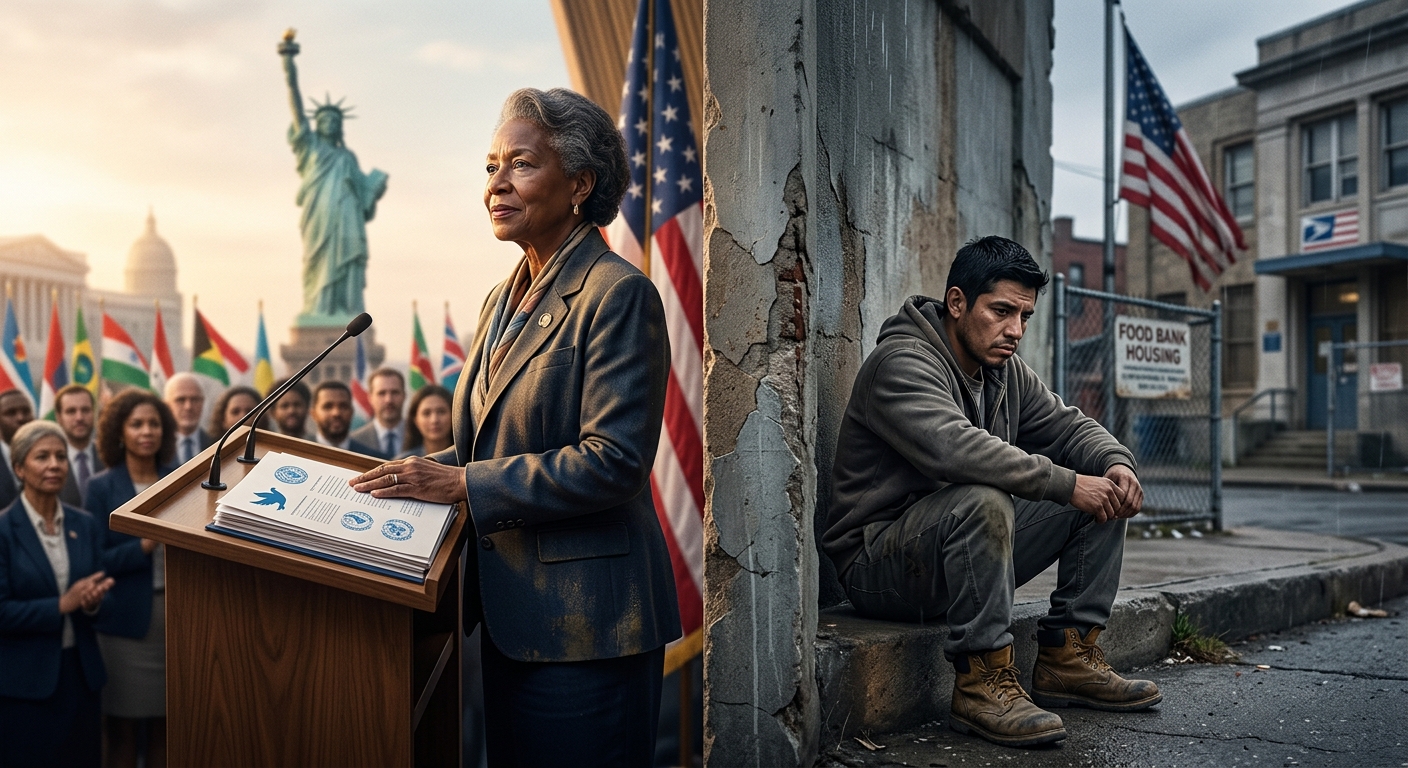
The United States has long positioned itself as the preeminent global defender of human rights. Since the aftermath of the Second World War, American diplomats have been instrumental in drafting the foundational documents of international human rights law, and the nation frequently utilizes its geopolitical leverage to call out abuses abroad. However, this outward-facing leadership often masks a deeply complex and contradictory domestic landscape. When the lens of international human rights standards is turned inward, the image of American exceptionalism begins to fracture, revealing systemic inequities that draw sharp criticism from the global community.
The tension between the United States’ international advocacy and its domestic policy implementation creates a profound paradox. While the nation champions freedom and equality in global forums, its internal mechanisms grapple with persistent crises in criminal justice, racial equality, and economic rights. Understanding this divide requires examining how international monitoring bodies view the United States, analyzing the specific policies that draw global condemnation, and exploring the geopolitical implications of an incomplete commitment to international human rights frameworks.
The Mechanisms of Accountability: Understanding the Universal Periodic Review
In the realm of international human rights, no nation is entirely immune to scrutiny. The primary mechanism for this global accountability is the Universal Periodic Review (UPR), a unique process administered by the United Nations Human Rights Council (UNHRC). Established to ensure equal treatment of all member states, the UPR involves a peer review of the human rights records of all 193 UN nations every four and a half years.
During its UPR cycles, the United States faces an intense, comprehensive examination of its domestic policies. Unlike diplomatic summits where power dynamics heavily favor the U.S., the UPR provides a platform for nations large and small, allied and adversarial, to voice their concerns. Furthermore, civil society organizations and human rights defenders are permitted to submit “shadow reports” that provide ground-level realities, often directly contradicting official state narratives. The recommendations delivered to the U.S. delegation are vast and revealing, covering everything from the abolition of the death penalty to the protection of indigenous lands. The sheer volume and consistency of these recommendations—often numbering in the hundreds—demonstrate that the international community does not view the United States as an unimpeachable authority, but rather as a nation with significant, unresolved structural human rights challenges.
Core Areas of International Scrutiny and Domestic Concern
The Crisis of Mass Incarceration and the Criminal Justice System
One of the most heavily criticized aspects of the American domestic policy landscape is its criminal justice system. The United States incarcerates a larger percentage of its population than any other developed democracy, a reality that deeply alarms international human rights observers. According to preliminary data released by the Bureau of Justice Statistics, the U.S. state and federal prison population stood at approximately 1,254,200 individuals at the end of 2023. When local jails and juvenile facilities are factored in, the total number of individuals deprived of their liberty climbs even higher. The reliance on cash bail systems further exacerbates this issue by criminalizing poverty, leaving legally innocent people behind bars simply because they cannot afford their freedom.
International bodies frequently cite the American reliance on punitive justice over rehabilitative measures as a fundamental human rights failure. Specific practices within the system draw severe condemnation. The widespread use of prolonged solitary confinement, for instance, has been repeatedly categorized by UN experts as a practice that can amount to torture or cruel, inhuman, and degrading treatment. Furthermore, the persistent application of the death penalty in numerous states places the U.S. at odds with the global consensus moving toward abolition. The systemic racial disparities embedded within arrest rates, sentencing lengths, and incarceration demographics further compound these violations, highlighting a justice system that fails to apply the law equitably across all populations.
Systemic Racism and Economic Marginalization
Structural racism within the United States is not merely a domestic political issue; it is a recognized violation of international anti-discrimination conventions. Global watchdogs, including the UN Committee on the Elimination of Racial Discrimination (CERD), continually point to the deep-seated economic and social marginalization of Black, Indigenous, and other communities of color in America.
These disparities manifest in stark wealth gaps, unequal access to quality healthcare and education, and disproportionate exposure to environmental hazards. However, the most visible and internationally criticized symptom of this systemic failure is law enforcement violence. The lack of robust, federal accountability frameworks to prevent excessive use of force by police is frequently highlighted in international reviews. For a nation that advocates for the rule of law globally, the failure to protect its own marginalized citizens from state-sanctioned violence remains a glaring inconsistency that undermines its international credibility.
Reproductive Autonomy and Maternal Healthcare Inequities
The right to health, which inherently includes reproductive autonomy and maternal care, is a cornerstone of international human rights law. In recent years, the United States has faced mounting international scrutiny over its retrograde trajectory regarding women’s healthcare. The dismantling of federal protections for reproductive rights has resulted in a fragmented legal landscape where access to essential medical care is determined by geographic location, disproportionately affecting low-income women, women of color, and those living in rural areas where “maternal care deserts” are expanding rapidly.
Beyond legal access to care, the United States suffers from a maternal mortality crisis that is entirely anomalous among high-income nations. International health and human rights organizations have expressed profound alarm at the rates at which American women, particularly Black and Indigenous women, die from pregnancy-related complications. This crisis is viewed internationally not just as a failure of healthcare infrastructure, but as a systemic violation of the fundamental right to life and health.
Border Governance and the Treatment of Migrants
The treatment of migrants, asylum seekers, and refugees is a critical metric by which a nation’s human rights commitments are measured. The United States’ approach to border governance has frequently triggered international condemnation. Under international law, seeking asylum from persecution is a protected human right, yet U.S. border policies have increasingly relied on deterrence, punitive detention, and expedited deportations.
The reliance on large-scale immigration detention centers, often managed by private, for-profit corporations, raises serious concerns regarding the deprivation of liberty without due process. Policies that treat migration primarily as a criminal offense rather than a humanitarian reality inevitably lead to widespread abuses. Furthermore, historical and ongoing practices that result in the separation of migrant families or the denial of access to essential services for undocumented individuals stand in stark contrast to the humanitarian principles enshrined in international refugee conventions.
The Outlier Status: America’s Reluctance on International Treaties
A true champion of human rights is expected to participate fully in the global legal frameworks designed to protect those rights. However, the United States remains an extreme outlier when it comes to the ratification of core international human rights treaties. While American diplomats often play crucial roles in drafting these instruments, domestic political hurdles—primarily rooted in concerns over national sovereignty, federalism, and the stringent supermajority required in the U.S. Senate for treaty ratification—prevent their formal adoption.
This reluctance creates a significant geopolitical vulnerability. When the U.S. demands that other nations adhere to international standards, those nations often deflect the criticism by pointing to America’s own unsigned treaties. This dynamic weakens the global human rights apparatus and allows authoritarian regimes to dismiss human rights as Western hypocrisy rather than universal standards.
| Treaty Name | U.S. Status | Global Context |
|---|---|---|
| Convention on the Rights of the Child (CRC) | Signed, Not Ratified | The U.S. is the only UN member state that has not ratified this treaty. |
| Convention on the Elimination of All Forms of Discrimination Against Women (CEDAW) | Signed, Not Ratified | One of only a handful of nations globally not to ratify, alongside countries like Iran and Somalia. |
| International Covenant on Economic, Social and Cultural Rights (ICESCR) | Signed, Not Ratified | Ratified by over 170 nations, it protects the rights to health, education, and labor. |
| Convention on the Rights of Persons with Disabilities (CRPD) | Signed, Not Ratified | Despite the U.S. Americans with Disabilities Act inspiring it, the treaty failed to pass the U.S. Senate. |
Charting a Course Toward Authentic Human Rights Leadership
To bridge the vast divide between its global rhetoric and domestic reality, the United States must commit to a profound structural realignment. Authentic leadership cannot be sustained through diplomatic posturing alone; it requires leading by example. This begins with acknowledging that human rights are not merely foreign policy tools, but essential frameworks for domestic governance and civil rights protections.
A crucial first step would be the establishment of a National Human Rights Institution (NHRI). Unlike many of its democratic peers, the U.S. lacks a centralized, independent federal body tasked with monitoring domestic compliance with international human rights standards. Furthermore, the U.S. must prioritize the ratification of outstanding core treaties, integrating international standards into federal and state law. Addressing the structural crises of mass incarceration, systemic racism, and healthcare inequity requires more than piecemeal legislative reform; it demands a comprehensive, rights-based approach to policymaking. Only by holding itself to the exact standards it demands of the rest of the world can the United States reclaim legitimate authority as a global human rights champion.
Frequently Asked Questions (FAQs)
- What is the Universal Periodic Review (UPR)?
The UPR is a process established by the United Nations Human Rights Council where the human rights record of every UN member state is peer-reviewed by other nations. It occurs every four and a half years and results in a series of recommendations aimed at improving domestic human rights conditions.
- Why hasn’t the United States ratified the Convention on the Rights of the Child?
The U.S. is the sole UN member state that has not ratified the CRC. The delay is largely due to domestic political opposition concerning national sovereignty, states’ rights, and unfounded fears that the treaty might interfere with parental authority, despite the treaty’s universal global acceptance.
- How does the U.S. prison system violate international human rights?
International observers criticize the U.S. prison system for its immense scale, with over 1.25 million people incarcerated in state and federal prisons. Specifically, practices like prolonged solitary confinement, systemic racial disparities in sentencing, poor facility conditions, the criminalization of poverty through cash bail, and the continued use of the death penalty are frequently cited as violations of international norms regarding cruel and inhumane treatment.
- What does it mean for a country to sign but not ratify a treaty?
Signing a treaty indicates a country’s preliminary endorsement and intent to examine the document domestically. However, the treaty is not legally binding upon that country until it is formally ratified. In the United States, ratification requires a two-thirds supermajority vote in the Senate, a high hurdle that has historically blocked many international human rights agreements.
References
- Prisons Report Series: Preliminary Data Release, 2023 — Bureau of Justice Statistics. 2024-12-31. https://bjs.ojp.gov/library/publications/prisons-report-series-preliminary-data-release-2023
- United States of America: Universal Periodic Review — Office of the High Commissioner for Human Rights (OHCHR). https://www.ohchr.org/en/hr-bodies/upr/us-index
- Ratification status by country — UN Treaty Body Database (OHCHR). https://tbinternet.ohchr.org/_layouts/15/TreatyBodyExternal/Treaty.aspx?CountryID=187&Lang=EN
Similar Articles








Read full bio of medha deb


