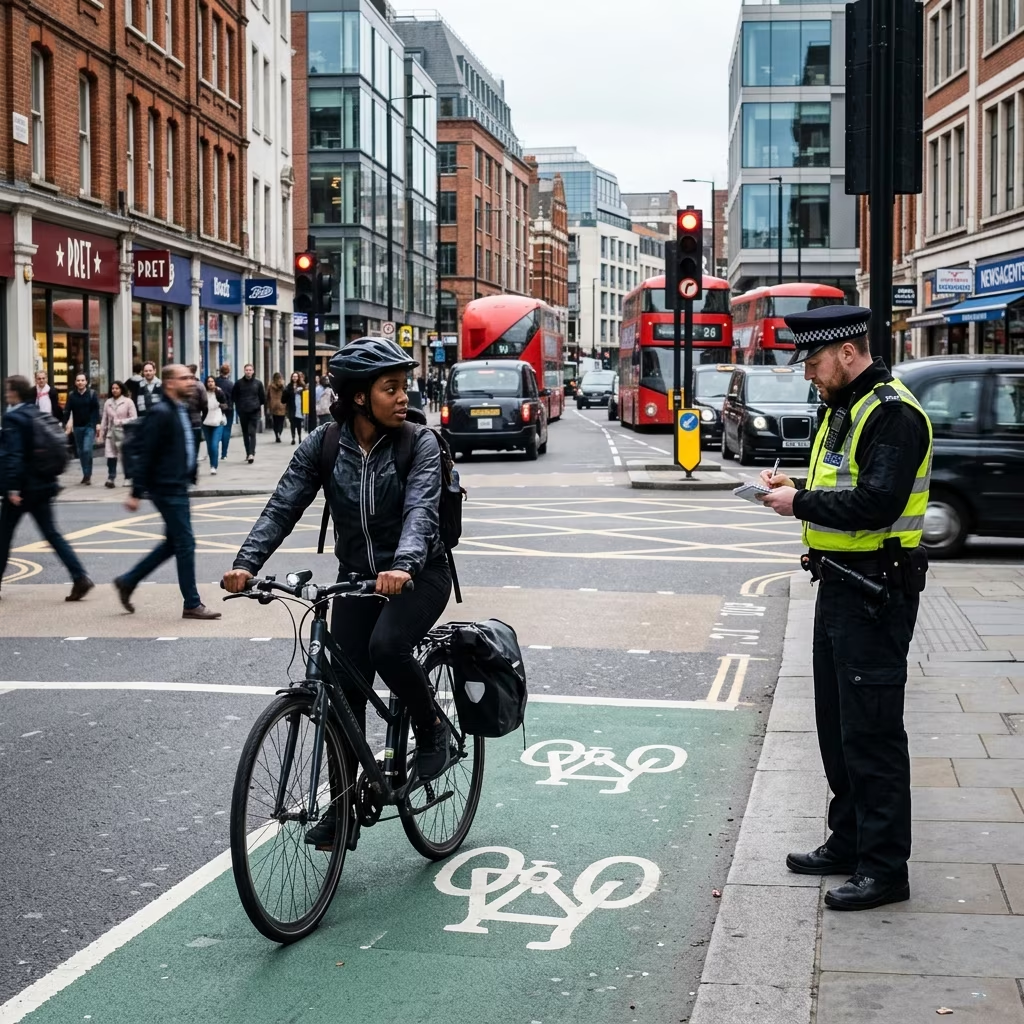
The Hidden Inequality of Urban Mobility
Bicycles have long been championed as symbols of freedom, sustainability, and accessible transportation. In an era increasingly defined by the urgent need for eco-friendly commuting options and urban congestion relief, cycling presents a universally appealing solution. However, beneath the surface of this seemingly innocuous activity lies a highly complex web of systemic inequality, urban policing strategies, and profound racial disparities. The simple act of riding a bicycle in the United States can carry vastly different risks and consequences depending on the neighborhood you navigate and the color of your skin. This phenomenon, which exposes a critical intersection between criminal justice, transportation equity, and civil rights, demonstrates how mundane activities can become heavily scrutinized under the lens of modern law enforcement.
Investigations across various municipalities have brought to light alarming patterns of disproportionate traffic enforcement targeted at minority populations. When communities of color rely on bicycles for daily commuting, they frequently encounter aggressive policing tactics that transform their journey into a gauntlet of potential legal entanglements. By examining the underlying data, the historical context of urban planning, and the psychological toll of these enforcement strategies, we can begin to understand the broad societal implications of unevenly applied traffic laws.
Unpacking the Data: The Reality of Bicycle Citations
To truly grasp the magnitude of the issue, one must delve into the empirical evidence surrounding bicycle citations in metropolitan areas. Over the past decade, civil rights organizations and federal agencies have scrutinized the ticketing practices of various municipal police departments. The findings repeatedly illustrate a stark reality: Black and Brown cyclists are stopped, questioned, and ticketed at rates that far exceed their representation in the general population.
A notable investigation into the Tampa Police Department by the U.S. Department of Justice’s Office of Community Oriented Policing Services (COPS) provided a comprehensive look at this disparity . The data revealed that an overwhelming majority of bicycle citations were issued to Black residents, despite them constituting a much smaller percentage of the city’s overall population. This disproportionality could not be adequately explained by differences in ridership levels, commuting habits, or varying propensities to commit minor traffic infractions. Instead, the statistics pointed to targeted enforcement practices concentrated in specific, lower-income neighborhoods.
The Justification vs. The Outcome
Law enforcement agencies have historically justified high-volume, low-level stops as a necessary component of proactive policing. The rationale is often rooted in the belief that strictly enforcing minor infractions—such as riding without a proper headlight, cycling on a sidewalk, or failing to keep both hands on the handlebars—will deter more serious criminal activity and aid in the recovery of stolen property. Proponents argue that a visible police presence and strict adherence to municipal codes keep neighborhoods safer.
However, when these strategies are subjected to rigorous analysis, the outcomes rarely justify the societal costs. Federal reviews, such as the COPS office report , often conclude that these aggressive enforcement tactics fail to significantly impact broader crime rates or meaningfully improve bicycle safety. Instead, they place an undue and heavy burden on minority populations, funnelling individuals into the criminal justice system for trivial administrative violations that pose little to no threat to public safety.
The Intersection of Urban Infrastructure and Enforcement
The conversation surrounding disparate bicycle policing cannot be decoupled from the realities of urban planning and infrastructure design. Historically redlined and economically disadvantaged neighborhoods suffer from chronic underinvestment, resulting in built environments that are inherently hostile to safe cycling. In these communities, residents often navigate roads lacking dedicated bike lanes, contend with inadequate street lighting, and face poorly maintained or non-existent sidewalks.
When urban infrastructure fails to provide safe, designated pathways for cyclists, riders naturally adopt survival tactics. A cyclist commuting home from a late-night shift may choose to ride on a well-lit sidewalk rather than risk being struck by a vehicle on a dark, high-speed arterial road. Unfortunately, these necessary adaptations frequently violate local municipal codes. Consequently, residents of underfunded neighborhoods are structurally forced into non-compliance. Academic research underscores this dynamic, demonstrating that racial disparities in bicycle stops are heavily intertwined with deficient transportation infrastructure in minority neighborhoods . The lack of safe cycling spaces essentially weaponizes traffic laws against those who are merely trying to commute safely.
“Broken Windows” Policing on Two Wheels
The enforcement of these minor infractions is heavily influenced by the “broken windows” theory of policing, which posits that cracking down on minor offenses prevents major crimes. In the context of cycling, this manifests as pretextual stops. A police officer may use a minor bicycle equipment violation as a legal pretext to stop an individual, request identification, run background checks, and conduct searches. While the U.S. Supreme Court has upheld the legality of pretextual stops, their application is notoriously subjective and prone to implicit bias.
When officers are encouraged to use traffic codes as investigative tools, the discretion afforded to them often results in racial profiling. A white cyclist in an affluent neighborhood riding without a bell may be ignored, while a Black cyclist in a historically marginalized neighborhood committing the exact same infraction is stopped, questioned, and ticketed. This double standard transforms community policing into an adversarial relationship, eroding the fundamental principles of equal protection under the law.
The Far-Reaching Consequences for Minority Communities
The impact of disproportionate bicycle ticketing extends far beyond a simple reprimand; it triggers a cascade of severe socioeconomic and psychological consequences for the individuals and communities targeted.
Economic Hardships and Legal Entanglements
For individuals who rely on bicycles because they cannot afford an automobile or public transit fares, a traffic citation carries a devastating financial burden. A ticket for a minor infraction can range from tens to hundreds of dollars. If a low-income wage earner cannot pay the fine, the penalties compound. Late fees accrue, and unpaid citations can lead to suspended driver’s licenses or even arrest warrants. Furthermore, some police departments have engaged in the practice of confiscating bicycles if the rider cannot immediately produce a receipt or proof of ownership, stripping the individual of their sole means of transportation to work, school, or essential services.
Erosion of Community Trust
Beyond the financial toll, the psychological impact of constant surveillance and harassment is profound. When community members—including teenagers and children—are routinely stopped and searched for riding a bike, it fosters deep-seated resentment and alienation. Trust in law enforcement is entirely compromised. Instead of viewing police as protectors and partners in community safety, residents come to view them as an occupying force intent on punitive enforcement. This erosion of trust makes it significantly more difficult for police to investigate actual crimes, as community members become understandably reluctant to cooperate with agencies that routinely subject them to unwarranted scrutiny.
The National Landscape: Is It Just a Local Problem?
While specific cities like Tampa have served as high-profile case studies, the criminalization of minority mobility is a pervasive national issue. Data from major metropolitan centers across the United States, including Chicago, New York City, and Los Angeles, reveal mirroring patterns of racial disparity in pedestrian and bicycle stops. Civil rights organizations have repeatedly highlighted these trends, emphasizing that the misuse of traffic enforcement is a systemic feature of modern American policing rather than an isolated anomaly . As urban centers push to become greener and encourage active transportation, the failure to address these policing disparities ensures that the benefits of “bike-friendly” cities remain exclusive to affluent, predominantly white neighborhoods.
Key Factors Contributing to Bicycle Citation Disparities
Understanding the root causes of these disparities requires analyzing the intersection of multiple systemic issues. The table below outlines the primary drivers contributing to the disproportionate policing of minority cyclists.
| Factor | Description | Impact on Cyclists |
|---|---|---|
| Infrastructure Deficits | Lack of bike lanes, poor lighting, and unsafe road designs in minority neighborhoods. | Forces cyclists to break minor traffic laws (e.g., riding on sidewalks) for their own physical safety. |
| Pretextual Policing | Using minor traffic infractions as an excuse to stop and search individuals for suspected criminal activity. | Leads to subjective, bias-driven enforcement where minority riders are targeted at wildly disproportionate rates. |
| Economic Vulnerability | Lower-income individuals relying on bikes may not afford proper equipment (lights, bells, reflectors). | Increases the likelihood of being ticketed for equipment violations, leading to a cycle of debt and court appearances. |
| Policy Directives | Departmental mandates pushing for high volumes of stops in “high crime” areas. | Saturates minority neighborhoods with police presence, guaranteeing higher citation rates regardless of actual danger. |
A Roadmap for Equitable Transportation and Policing
Addressing the inequities inherent in bicycle policing requires a multifaceted approach that bridges the gap between transportation policy, urban design, and criminal justice reform. Cities must move away from punitive enforcement and embrace comprehensive strategies that prioritize safety, equity, and community well-being.
- Decriminalizing Mobility: Municipalities should reevaluate their traffic codes to ensure that minor equipment violations or safety adaptations (like riding on an empty sidewalk) do not serve as grounds for police stops. Fines should be replaced with educational programs or equipment voucher systems that provide lights and helmets to those in need.
- Investing in Equitable Infrastructure: Transportation budgets must prioritize historically underinvested neighborhoods. Building continuous, protected bike networks, improving street lighting, and ensuring safe pedestrian pathways eliminate the environmental conditions that force cyclists into non-compliance.
- Data Transparency and Accountability: Law enforcement agencies must be mandated to collect and publicly report demographic data for all traffic and bicycle stops. Independent oversight boards should review this data to identify patterns of racial bias and hold departments accountable for discriminatory practices.
- Ending Pretextual Stops: Policies must be enacted at the state or local level to ban the use of minor traffic infractions as legal justifications for investigative stops and searches. Police resources should be redirected toward addressing genuine public safety threats rather than harassing daily commuters.
Frequently Asked Questions (FAQs)
What is pretextual policing?
Pretextual policing occurs when a law enforcement officer uses a minor, easily observable violation—such as a broken taillight or riding a bicycle without a bell—as a legal excuse to stop an individual. The true intent of the stop is often to investigate the person for unrelated, more serious crimes, typically involving a search for drugs or weapons. This practice heavily relies on officer discretion and frequently results in racial profiling.
Why are bicycle laws strictly enforced in some neighborhoods and not others?
Enforcement disparities often stem from departmental directives that concentrate police patrols in specific “high-crime” or lower-income neighborhoods. Additionally, implicit biases can influence an officer’s decision to issue a citation rather than a warning. In more affluent areas, minor bicycle infractions are frequently ignored, whereas in marginalized communities, they are used as tools for aggressive, proactive policing.
How does poor infrastructure contribute to bike citations?
When a neighborhood lacks dedicated bike lanes and safe road designs, cyclists must prioritize their physical safety over strict adherence to municipal codes. For instance, avoiding a dangerous, high-speed roadway by riding on the sidewalk is a common survival tactic. Because marginalized neighborhoods often suffer from poor infrastructure, their residents are structurally forced into committing ticketable offenses just to commute safely.
What reforms are recommended to prevent racial profiling of cyclists?
Key reforms include banning pretextual stops for minor infractions, mandating the collection and public release of demographic data for all police stops, and shifting the focus from punitive ticketing to educational safety initiatives. Furthermore, investing in equitable urban infrastructure—such as protected bike lanes in minority neighborhoods—removes the built-environment hazards that lead to minor infractions.
Conclusion
The disproportionate policing of Black and Brown cyclists is a profound failure of both urban planning and criminal justice. When the simple act of riding a bicycle becomes fraught with the risk of police harassment, financial penalty, and legal jeopardy, it is clear that systemic reforms are desperately needed. By prioritizing equitable infrastructure investments and dismantling discriminatory policing practices, municipalities can ensure that cycling remains a safe, accessible, and liberating mode of transportation for all residents, regardless of their zip code or the color of their skin.
References
- An Examination of Racial Disparities in Bicycle Stops and Citations Made by the Tampa Police Department — U.S. Department of Justice: Office of Community Oriented Policing Services. 2016-04-26. https://portal.cops.usdoj.gov/resourcecenter?item=cops-w0801
- Biking where Black: Connecting transportation planning and infrastructure to disproportionate policing — Transportation Research Part D: Transport and Environment / Jesus M. Barajas. 2021-09-03. https://doi.org/10.1016/j.trd.2021.102961
- Racial Disparities in Florida Safety Belt Law Enforcement — American Civil Liberties Union. 2016-01-16. https://www.aclu.org/publications/racial-disparities-florida-safety-belt-law-enforcement