
Unveiling the Legacy of Brehon Law: Ireland’s Ancient Legal Heritage
Explore the distinctive Brehon Law system that shaped Ireland’s culture, justice, and society long before English common law prevailed.
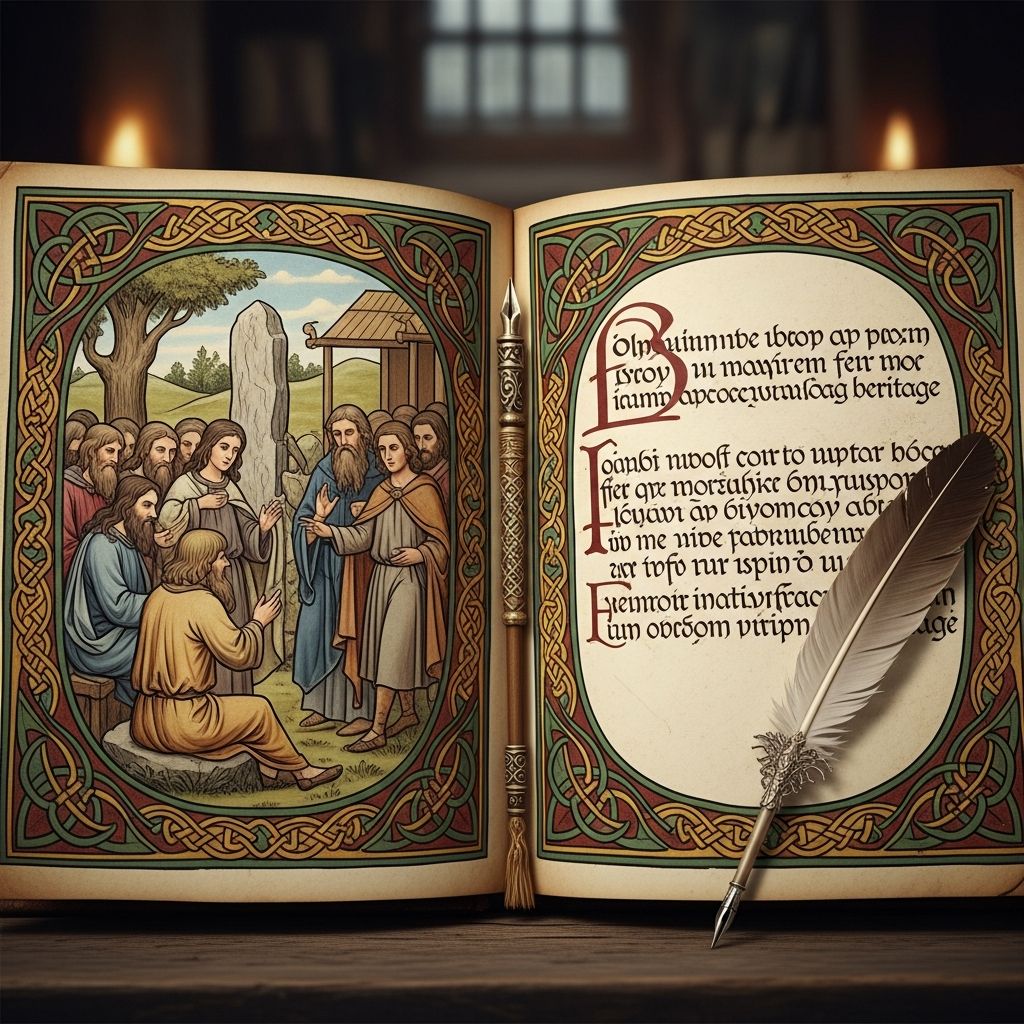
Origins of Brehon Law: Ireland’s Indigenous Legal Tradition
Brehon Law represents a sophisticated indigenous legal framework that governed ancient Gaelic Ireland long before the imposition of English common law. Its roots reach back to pre-Christian times, emerging from oral traditions passed down several generations before being inscribed in manuscripts during the 7th century CE. The term “Brehon” itself derives from the Irish word breitheamh, meaning judge, highlighting the system’s focus on legal arbitration by specialized jurists known as Brehons.
This early legal code was not crafted by a central legislative body but organically evolved through accumulated judgments rendered by Brehons, blending customary practices with evolving societal norms. Christian monastic scribes later transcribed these laws, merging native traditions with Christian ethical influences, thereby formalizing the legal corpus known as the Senchus Már.
The Structure and Philosophy Underpinning Brehon Law
Unlike feudal systems centered on hierarchical ownership and punitive enforcement, Brehon Law functioned as a civil and restorative framework focused on mediation, compensation, and social harmony. It rejected the notion of the state as enforcer, instead relying on community responsibility and negotiated settlements adjudicated by respected Brehons.
- Restorative Justice: Compensation (known as éraic) was the primary method for resolving offenses, emphasizing restitution over retribution.
- Tribal and Familial Rights: Law emphasized kinship groups, pledging social accountability within clans and ensuring protection of family rights.
- Natural Law Principles: Rooted deeply in what might be called natural law, the system applied practical, “common sense” rules suited to the Irish social context.
Distinctive Rights and Roles of Women and Children
Remarkably for its era, Brehon Law provided women with significant protections and rights, offering them economic independence and property ownership privileges uncommon in medieval Europe. Women’s rights were structurally embedded in laws governing marriage, inheritance, and contracts:
- Women retained separate ownership of their property and could enter into legally binding contracts independent of their husbands.
- The matrimonial laws allowed for various household arrangements, reflecting flexible family structures and inheritance divisions.
- Children’s rights were guarded through clearly stipulatied guardianships and property interests.
This elevated legal status contributed to an intricate societal balance where gender roles were both distinct and respectful of women’s agency.
Land Tenure and Ownership Under Brehon Law
One of the unique features of Brehon Law was its communal approach to land. Unlike the feudal English system, which emphasized outright ownership by nobles, Brehon Law recognized territory as held collectively by clans with chiefs as custodians rather than absolute owners. Key points include:
- The clan chief held land in trust for the entire clan rather than personal possession.
- Inheritance often followed a system of primogeniture, but also incorporated clan consensus.
- Women and lower clan members had indirect rights relating to land usage and tenancy.
This framework fostered social cohesion centered on shared responsibility and kin-based resource management rather than individual property rights.
Brehon Judges: Role, Selection, and Legal Authority
Brehons were the learned legal authorities, often hereditary or trained through extensive apprenticeship. They fulfilled multiple roles:
- Interpreting laws and hearing disputes with impartiality.
- Providing legal education and preserving the oral and written law traditions.
- Advising chiefs and communities on legal matters and social contracts.
Despite their respected status, Brehons possessed no power to enforce rulings through coercion; enforcement depended on the consent of parties and public opinion. This voluntary compliance highlights the strong cultural value placed on legal order and communal consensus.
Transition and Decline: The Impact of English Conquest and Common Law
The arrival of the Anglo-Normans in the late 12th century and subsequent English conquest gradually displaced Brehon Law. The introduction of feudal concepts, centralized authority, and English common law began encroaching on Irish legal customs. Major turning points:
| Period | Change | Effect on Brehon Law |
|---|---|---|
| 12th Century | Norman invasion and imposition of feudal land ownership | Brehon Law maintained sway outside the Pale, coexisting with English law in certain areas |
| 16th Century | Plantations and Tudor conquest | English law expanded, Brehons lost patrons, weakening enforcement of native law |
| 17th Century | Flight of the Earls and full English control | Formal suppression of Brehon Law; replaced by English common law nationwide |
Though official authority faded, the resilience of Brehon law culture ensured elements persisted in rural Ireland, influencing local dispute resolution well beyond the formal abolition.
Enduring Legacy and Modern Perspectives
Today, Brehon Law is recognized as an early model of a legal system that embraced fairness, restitution, and community values over hierarchy and punishment. Irish legal historians and scholars celebrate it for several reasons:
- It presents one of Europe’s oldest known recorded legal systems, exemplifying indigenous jurisprudence.
- Its principles of mediation and compensation foreshadow modern restorative justice practices.
- The nuanced treatment of gender and property rights challenges common perceptions of medieval societies as uniformly patriarchal.
- It provides a cultural touchstone for Irish identity and legal history intertwined with Gaelic traditions.
Efforts to study and translate surviving manuscripts began earnestly in the 19th century, and modern legal theory continues to draw inspiration from Brehon Law’s holistic and human-centered approach to justice.
Frequently Asked Questions About Brehon Law
What was the main purpose of Brehon Law?
Brehon Law primarily aimed to maintain social order and harmony by resolving disputes through compensation and restorative methods rather than punishment.
How did Brehon Law treat women compared to other medieval European laws?
Brehon Law granted women considerable rights including property ownership, legal contracts, and protections within marriage, which were progressive relative to contemporary European standards.
Why did Brehon Law eventually disappear?
The expansion of English control, imposition of common law, loss of native patrons, and political changes during the 16th and 17th centuries led to its formal suppression and replacement by English law.
Are any aspects of Brehon Law still relevant today?
Yes, Brehon Law’s principles of restorative justice and community mediation resonate in modern legal reforms emphasizing fairness and reconciliation instead of punitive measures.
Where can one find surviving texts of Brehon Law?
Ancient manuscripts of Brehon Law have been preserved and translated in academic collections and libraries, with key texts like the Senchus Már studied by legal historians and scholars of Irish history.
References
- History of the Law in Ireland — Courts of Ireland. 2023. https://www.courts.ie/visit-and-learn/history-of-the-law-in-ireland
- Ireland’s Brehon Laws: A Progressive Ancient Legal System — Irish Central. 2022. https://www.irishcentral.com/roots/ireland-brehon-laws
- The Brehon Laws: Ancient Irish Legal System — Britannica. 2022. https://www.britannica.com/topic/Brehon-laws
- The Ancient Brehon Laws of Ireland — Pennsylvania Law Review. 1936. https://scholarship.law.upenn.edu/cgi/viewcontent.cgi?article=7288&context=penn_law_review
- The Brehon Laws — Catholic Encyclopedia. 1913. https://www.newadvent.org/cathen/02753a.htm
Similar Articles








Read full bio of Sneha Tete


