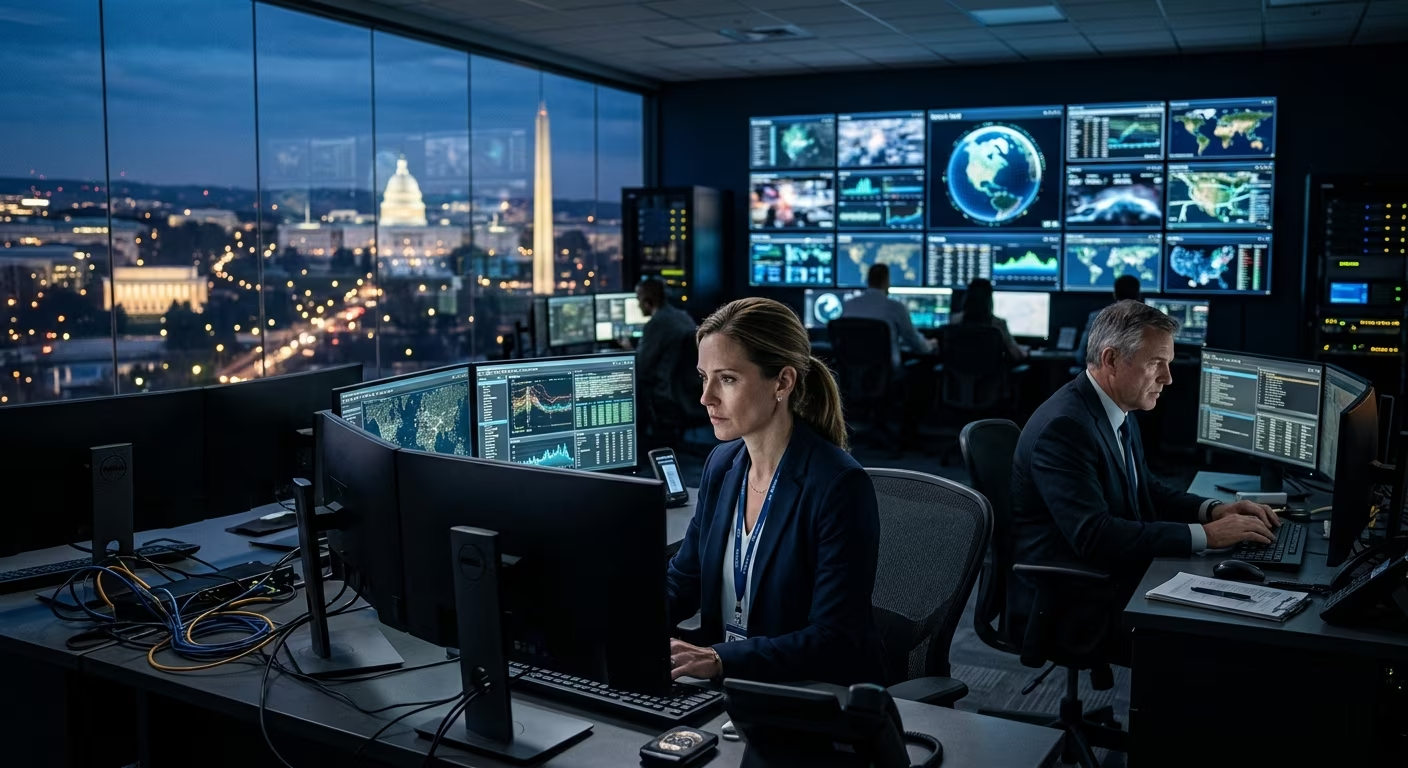
The Genesis of Domestic Intelligence Coordination
Following the tragic events of September 11, 2001, the United States fundamentally reorganized its domestic security apparatus. The primary critique emerging from the 9/11 Commission was the concept of siloed intelligence—the failure of disparate federal, state, and local agencies to share critical information that could have prevented the attacks. In response to this systemic failure, the federal government catalyzed the creation of state and regional intelligence nodes known as fusion centers.
These entities were originally conceptualized as vital clearinghouses where the Department of Homeland Security, the Federal Bureau of Investigation, and local law enforcement could seamlessly exchange counterterrorism intelligence. However, over the past two decades, the scope, capabilities, and technological reach of these centers have expanded dramatically. Today, what began as a targeted counterterrorism initiative has evolved into a sprawling domestic surveillance network. This evolution has sparked intense debate among legal scholars, privacy advocates, and lawmakers regarding the delicate balance between national security and the preservation of fundamental constitutional rights. The mystery surrounding their daily operations, coupled with documented instances of overreach, demands a rigorous examination of their current role in American policing.
Shifting Mandates: From Counterterrorism to All-Hazards
When initially established, the mandate of fusion centers was strictly confined to counterterrorism. They were designed to connect the dots between international terror threats and local vulnerabilities. Yet, as the immediate threat of foreign terrorism shifted and funding requirements evolved, these centers underwent a significant bureaucratic phenomenon known as mission creep. To justify their continued existence and secure ongoing funding streams, many of the approximately eighty recognized fusion centers operating across the United States transitioned to an all-crimes and all-hazards approach.
This paradigm shift meant that the sophisticated surveillance and data-aggregation tools originally reserved for tracking high-level terror suspects were now routinely deployed against local criminal enterprises, drug trafficking networks, and even public health crises. While proponents argue that an all-hazards approach maximizes the utility of these multi-million dollar facilities, critics warn that using counterterrorism tools for ordinary policing fundamentally alters the relationship between the state and its citizens. The threshold for monitoring individuals has been drastically lowered, bringing ordinary Americans into the crosshairs of a formidable intelligence apparatus. The consequence is a profound expansion of domestic surveillance capabilities that far exceeds the original legislative intent, raising critical questions about the proportionality of the response to everyday domestic issues.
| Era / Phase | Primary Mandate | Target Focus | Civil Liberty Risk Level |
|---|---|---|---|
| Post-9/11 (2001-2005) | Strict Counterterrorism | International & Domestic Terrorist Networks | Moderate to High (Targeted) |
| Expansion Era (2006-2015) | All-Crimes / All-Hazards | Drug Cartels, Organized Crime, Natural Disasters | High (Broadened Scope) |
| Modern Era (2016-Present) | Predictive Policing & Mass Data Aggregation | Everyday Criminality, Protest Movements, Cyber Threats | Severe (Automated & Bulk Surveillance) |
The Architecture of Data Aggregation
To understand the privacy risks inherent in fusion centers, one must examine the mechanisms through which they collect and process information. The lifeblood of these intelligence hubs is data, sourced from a vast array of streams including license plate readers, facial recognition databases, social media monitoring software, and public records.
Suspicious Activity Reports and Their Pitfalls
At the core of this data collection ecosystem is the Nationwide Suspicious Activity Reporting Initiative. This program encourages local law enforcement officers, private sector security personnel, and even ordinary citizens to report behaviors they deem suspicious. While the stated goal is to identify precursor activities to terrorism, the criteria for what constitutes a suspicious act are notoriously vague. Activities such as taking photographs of infrastructure, taking notes in public places, or simply appearing nervous have frequently been flagged and logged into centralized databases.
The fundamental flaw in the Suspicious Activity Reporting system is its reliance on subjective human interpretation, which is inevitably colored by implicit biases. Reports have repeatedly shown that individuals from marginalized communities, particularly people of color and members of specific religious groups, are disproportionately targeted. Once an individual’s innocuous behavior is documented and entered into a fusion center database, it can remain there for years, accessible to thousands of law enforcement agencies nationwide, without the individual ever knowing they are being monitored.
Algorithmic Amplification and Bias
The modern fusion center is not merely a repository of files; it is a highly automated data processing engine. Advanced algorithms and predictive analytics are increasingly deployed to sift through the mountains of data collected daily. While proponents hail these technologies as a force multiplier for law enforcement, privacy scholars issue stark warnings about the inherent risks of algorithmic bias.
When historical crime data, which is often skewed by decades of disproportionate policing in minority neighborhoods, is fed into predictive models, the software invariably targets those same communities for intensified surveillance. This creates a destructive feedback loop: over-policed neighborhoods generate more data, which in turn directs the fusion center algorithms to focus even more resources on those areas. Furthermore, the integration of nascent technologies such as facial recognition software introduces high error rates, particularly for people of color. The automation of intelligence gathering effectively launders human bias through a veneer of objective mathematics, making the resulting discrimination harder to identify and challenge.
Constitutional Friction: Privacy and Civil Liberties at Risk
The expansion of fusion centers presents profound challenges to the constitutional safeguards designed to protect citizens from unwarranted government intrusion. The intersection of mass data aggregation and policing inevitably creates friction with both the First and Fourth Amendments.
- The First Amendment Under the Microscope: The First Amendment guarantees the right to free speech, peaceful assembly, and the petitioning of the government. However, when intelligence agencies utilize fusion centers to monitor political protests, environmental activism, and civil rights demonstrations under the guise of threat assessment, a chilling effect occurs. Law-abiding citizens may hesitate to participate in constitutionally protected activities if they fear their presence will be cataloged in a criminal intelligence database. History provides numerous examples of fusion centers inappropriately disseminating bulletins regarding peaceful activist groups, conflating legitimate dissent with potential extremism.
- The Fourth Amendment in the Digital Age: The Fourth Amendment protects against unreasonable searches and seizures, generally requiring law enforcement to establish probable cause and obtain a warrant before conducting surveillance. Fusion centers often operate in a legal gray area that circumvents these traditional protections. By aggregating vast amounts of commercially available data, social media posts, and unverified tips, these centers can construct comprehensive profiles of individuals without ever needing to demonstrate probable cause to a judge. This model of predictive or pre-emptive policing flips the presumption of innocence, treating entire populations as potential suspects whose digital footprints must be constantly analyzed for anomalies.
The Accountability Vacuum
One of the most perplexing aspects of fusion centers is the structural ambiguity that insulates them from meaningful oversight. These centers are a unique hybrid: they are typically owned and operated by state or local governments, yet they are heavily subsidized by federal grants and staffed, in part, by federal intelligence analysts from the Department of Homeland Security and the Federal Bureau of Investigation.
This complex intergovernmental structure creates a jurisdictional labyrinth. When abuses occur, federal agencies often deflect responsibility by claiming the centers are state-run entities. Conversely, state authorities frequently point to federal guidelines and funding mandates when questioned about controversial practices. This dynamic effectively creates an accountability vacuum where definitive oversight is elusive.
Furthermore, the intelligence products generated by these centers are often shielded from public records requests under the pretext of national security and classified information exemptions. The lack of transparency prevents journalists, civil rights organizations, and even local lawmakers from independently auditing the centers activities to ensure compliance with civil liberties guidelines.
Congressional Scrutiny and the Efficacy Debate
The lack of transparency has not gone entirely unnoticed by the legislative branch. Over the years, numerous governmental audits and congressional investigations have cast serious doubt on the efficacy and fiscal responsibility of fusion centers.
A landmark bipartisan investigation conducted by the United States Senate Permanent Subcommittee on Investigations concluded that the Department of Homeland Security’s involvement with these state and local hubs has not yielded significant useful information to support federal counterterrorism intelligence efforts. The comprehensive report bluntly stated that the centers often wasted taxpayer money, produced deeply flawed or useless intelligence, and overstepped civil liberty boundaries.
More recently, ongoing scrutiny from bodies like the Government Accountability Office and the House Homeland Security Committee has continued to highlight systemic failures. Legislative pushes emphasize the need for urgent reforms, specifically pointing to politicization risks and persistent civil liberty concerns regarding how intelligence is shared with state and local partners. Despite these damning assessments and repeated calls for reform, the fundamental structure and funding of the national fusion center network have remained largely intact.
Reimagining the Framework for Domestic Security
The current trajectory of domestic intelligence gathering necessitates a critical re-evaluation of the fusion center model. A democratic society requires security measures that are both effective and unequivocally bound by the rule of law. Achieving this balance requires comprehensive and immediate reform.
First and foremost, robust, independent oversight mechanisms must be established. This includes granting independent auditors the necessary security clearances to thoroughly review the data collection practices and intelligence products of these centers. Secondly, strict, legally binding data retention limits must be implemented for the Suspicious Activity Reporting system to ensure that innocent individuals do not have their names permanently etched into terror watchlists based on unfounded suspicions. Finally, there must be a clear legislative demarcation returning these centers to their original counterterrorism mandate, or alternately, requiring them to operate under the strict evidentiary standards of traditional criminal law if they pursue an all-crimes approach.
Frequently Asked Questions (FAQs)
What exactly is a fusion center?
A fusion center is an information-sharing hub established primarily after the 9/11 attacks. They serve as focal points for the receipt, analysis, gathering, and sharing of threat-related information between federal, state, local, tribal, territorial, and private sector partners.
How many fusion centers currently operate in the United States?
There are approximately eighty recognized fusion centers operating across the United States. Every state has at least one, and many major urban areas operate their own localized intelligence centers.
What is a Suspicious Activity Report?
A Suspicious Activity Report is an official documentation of observed behavior that is deemed indicative of intelligence gathering or pre-operational planning related to terrorism or other criminal activity. The standard for what constitutes suspicious is notoriously broad and often highly subjective.
Why are privacy and civil liberties advocates concerned about these facilities?
Advocates argue that fusion centers collect and store massive amounts of personal data without probable cause, disproportionately target minority communities through biased reporting, and chill First Amendment rights by monitoring peaceful protests and political activities without adequate oversight.
Are fusion centers federally or state controlled?
They are primarily state and locally owned and operated. However, they receive substantial federal funding and operational support, including deployed personnel and access to classified networks from the Department of Homeland Security and the FBI, creating a complex overlap of jurisdictions and an oversight vacuum.
Have these centers been effective in stopping terrorism?
Their effectiveness is a subject of significant debate. Major congressional reports, including a comprehensive Senate Subcommittee investigation, have found that they often provide little to no value to federal counterterrorism efforts, while simultaneously raising major civil liberties issues.
References
- Fusion Centers — U.S. Department of Homeland Security. 2022-10-17. https://www.dhs.gov/fusion-centers
- Investigative Report Criticizes Counterterrorism Reporting, Waste at State & Local Intelligence Fusion Centers — U.S. Senate Permanent Subcommittee on Investigations. 2012-10-02. https://www.hsgac.senate.gov/subcommittees/investigations/media/investigative-report-criticizes-counterterrorism-reporting-waste-at-state-and-local-intelligence-fusion-centers/
- Privacy and Civil Liberties Guides and Templates — Bureau of Justice Assistance, U.S. Department of Justice. https://bja.ojp.gov/program/it/privacy-civil-liberties/guides-templates
- Counterterrorism Subcommittee Advances Bipartisan Legislation Refocusing DHS’s Office of Intelligence & Analysis — House Committee on Homeland Security. 2026-05-14. https://homeland.house.gov/2026/05/14/counterterrorism-subcommittee-advances-bipartisan-legislation/