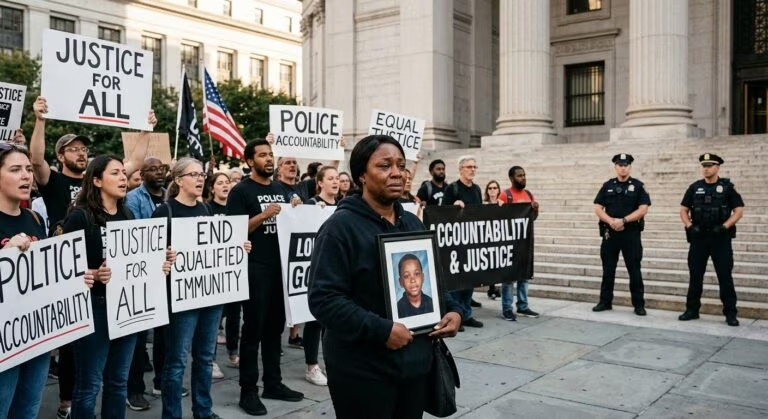
The bedrock of the American legal system rests on a simple, yet profound principle: an individual is presumed innocent until proven guilty. However, the reality of the nation’s contemporary justice system often contradicts this foundational ideal. On any given day, hundreds of thousands of people sit locked inside county jails across the United States without a conviction. They have not been found guilty by a jury of their peers, nor have they admitted fault before a judge. Instead, they are held in pretrial detention. While originally intended as a rare, precautionary measure reserved for individuals who pose a severe flight risk or an imminent danger to the community, pretrial incarceration has metastasized into a default procedure.
This widespread practice generates an invisible carceral state that punishes legally innocent individuals. The ramifications of this system extend far beyond the confines of a jail cell, unleashing a cascade of devastating consequences that destabilize lives, fracture families, and impose exorbitant financial burdens on local municipalities. Understanding the profound and tragic costs of holding the unconvicted is paramount for charting a path toward genuine, equitable legal reform.
The Mechanics of the Cash Bail System
Underpinning the massive scale of pretrial incarceration is the commercial cash bail system. When an individual is arrested, a magistrate or judge typically sets conditions for their release pending trial. In many jurisdictions, this condition is a financial one: the accused must pay a specified amount of money—bail—to secure their freedom. The theoretical premise is that a financial stake will guarantee the defendant’s appearance at future court dates. However, in practice, this mechanism effectively criminalizes poverty.
For individuals with financial means, bail is a temporary inconvenience. They pay the court, return to their homes, and prepare their legal defense from a position of stability. For individuals living paycheck to paycheck, however, even a modest bail amount of a few hundred dollars can represent an insurmountable obstacle. Unable to purchase their liberty, these legally innocent individuals are remanded to jail. Research from the Vera Institute of Justice notes that the U.S. pretrial population surged by over 400 percent between 1970 and 2015, driven largely by an increased reliance on financial conditions for release rather than any massive spike in crime rates . Consequently, local jails have transformed from short-term holding facilities into sprawling warehouses for the poor, dictating justice not by culpability, but by wealth.
Cascading Economic Fallout
The economic destruction wrought by pretrial detention is both immediate and enduring, severely impacting both the detained individual and society at large. For a person living on the financial margins, being locked up for even a few days can trigger a catastrophic chain reaction. The immediate casualty is often employment. Most low-wage or hourly jobs do not offer the flexibility to accommodate sudden, unexplained absences. A worker who misses three days of shifts because they are trapped in a jail cell is highly likely to be terminated.
Without income, housing instability quickly follows. Missed rent payments precipitate eviction notices, and vehicles essential for transportation may be repossessed. A groundbreaking study published by researchers at Stanford University and the National Bureau of Economic Research demonstrated that pretrial detention significantly decreases a defendant’s likelihood of participating in the formal labor market for years after their case is resolved .
Beyond the individual, the macroeconomic cost is staggering. Local county governments shoulder the massive financial burden of housing, feeding, and guarding hundreds of thousands of unconvicted individuals. Maintaining this vast infrastructure of county jails costs American taxpayers billions of dollars annually. Every dollar spent on unnecessary incarceration is a dollar siphoned away from community investments, public education, infrastructure, and violence prevention programs that actually foster long-term public safety .
A Public Health Crisis Behind Bars
Incarcerating individuals before trial also precipitates a severe public health crisis. Local jails are notoriously chaotic environments, frequently operating over capacity and lacking the necessary resources to provide adequate medical or psychiatric care. When legally innocent people are suddenly separated from their support networks, stripped of their autonomy, and thrust into an inherently volatile environment, their mental and physical well-being rapidly deteriorates.
The initial days of confinement are uniquely traumatic. Individuals experiencing mental health crises or substance use disorders are particularly vulnerable; instead of receiving clinical intervention or therapeutic support, they are placed in cells that exacerbate their conditions. The risk of self-harm and suicide spikes dramatically during the first week of pretrial detention. Furthermore, the physical environment of overcrowded county jails facilitates the rapid spread of infectious diseases. Poor ventilation, unsanitary conditions, and the close proximity of inmates create a breeding ground for illness. Detainees frequently face life-threatening delays in receiving basic medical attention or access to their prescribed daily medications. This systemic neglect transforms a presumed-innocent holding period into an environment that actively threatens the health and survival of the accused.
The Psychological Pressure of Coerced Pleas
Perhaps the most insidious structural consequence of pretrial detention is the profound psychological pressure it exerts on defendants to abandon their constitutional rights. The criminal justice system is notoriously sluggish, and an individual who cannot afford bail may languish in a cell for weeks, months, or even over a year awaiting their day in court. Facing the prospect of indefinite incarceration, losing their livelihood, and being separated from their children, many detainees reach a breaking point.
Prosecutors frequently leverage this desperation by offering a plea deal: admit guilt, accept a conviction, and go home today. The aforementioned Stanford study found that pretrial detention significantly increases the probability of a conviction, primarily through a dramatic increase in guilty pleas . Legally innocent individuals routinely plead guilty to crimes they did not commit simply because it is the fastest mechanism to escape the trauma of a jail cell. This creates a permanent criminal record, which subsequently becomes an insurmountable barrier to future employment, securing housing, and accessing social safety nets. By leveraging the agony of pretrial confinement, the system undermines the integrity of the judicial process, prioritizing swift administrative resolution over the actual pursuit of truth and justice.
The Ripple Effects on Families and Communities
The collateral damage of pretrial incarceration radiates outward, inflicting deep wounds on the families and communities of the detained. When a parent is unexpectedly jailed, the entire family unit is thrown into chaos. Children may be temporarily displaced or funneled into the foster care system if no other guardian is available to assume custody. The sudden loss of a primary breadwinner plunges the household into immediate financial distress, exacerbating cyclical poverty.
Partners and relatives often drain their own meager savings or take on predatory, high-interest loans to pay non-refundable fees to commercial bail bondsmen. This extracts vital wealth from already marginalized communities, transferring it directly to a private, for-profit bail industry. The cumulative effect of removing working-age adults from a community weakens neighborhood cohesion and social stability. Over time, the aggressive use of pretrial detention in heavily policed neighborhoods fosters a deep-seated distrust of law enforcement and the judicial system. When communities witness their neighbors being punished without trial solely due to a lack of financial resources, the perceived legitimacy of the legal institution crumbles.
Reimagining Justice: Viable Alternatives
Confronting the tragic realities of pretrial detention requires a fundamental paradigm shift away from wealth-based jailing and toward evidence-based alternatives that uphold the presumption of innocence. Numerous jurisdictions across the United States have already begun proving that mass pretrial incarceration is an unnecessary evil. The core of these reforms involves implementing robust, non-financial conditions of release.
- Unsecured Bonds: Rather than demanding cash upfront, courts can utilize unsecured bonds where a defendant only pays a financial penalty if they actively fail to appear for their scheduled hearings.
- Technological Reminders: Simple, cost-effective interventions like automated text message or phone call reminders for upcoming court dates have proven incredibly successful at mitigating “failure to appear” rates, which are often the result of genuine confusion or scheduling errors rather than intentional flight.
- Community-Based Supervision: Implementing individualized, community-based supervision allows individuals to maintain their employment, seek necessary medical care, and preserve family ties while awaiting trial.
Data from the Prison Policy Initiative emphasizes that releasing people pretrial does not inherently threaten public safety; in fact, several states that have drastically curtailed their use of cash bail have seen their pretrial populations drop significantly without experiencing surges in local crime . True justice reform demands that municipalities divest from expanding jail infrastructure and instead invest those resources into community health, stable housing, and supportive services that address the root causes of systemic instability.
Frequently Asked Questions (FAQs)
What exactly is pretrial detention?
Pretrial detention occurs when a person is kept in custody, typically in a local county jail, after they have been arrested but before their criminal case has been resolved by a trial or plea agreement. Legally, these individuals are still presumed innocent.
Why do so many people end up in pretrial detention?
The primary driver of modern pretrial detention is the commercial cash bail system. If a judge sets a financial condition for release and the defendant cannot afford to pay that amount, they must remain in jail until their trial concludes. This results in the widespread incarceration of individuals simply because they lack liquid financial resources.
Does releasing individuals pretrial lead to higher crime rates?
No. Extensive research and data from jurisdictions that have reformed their bail systems indicate that releasing people pretrial does not compromise public safety. The vast majority of individuals released without financial conditions attend their required court dates and do not commit new offenses while awaiting trial.
How does being detained affect a person’s legal case?
Being detained severely hinders a person’s ability to assist in their own defense. They cannot easily meet with attorneys, gather outside evidence, or locate vital witnesses. Furthermore, the desperation to leave jail frequently coerces legally innocent people into pleading guilty to secure their immediate release, leading to higher conviction rates for those detained compared to those who fight their cases from home.
References
- Bail Reform — Vera Institute of Justice. 2024-05-29. https://www.vera.org/initiatives/bail-reform
- The Effects of Pretrial Detention on Conviction, Future Crime, and Employment — Stanford Law School. 2018-02-15. https://law.stanford.edu/publications/the-effects-of-pretrial-detention-on-conviction-future-crime-and-employment-evidence-from-randomly-assigned-judges/
- The Scale of Jail Construction Across the United States, 2002–2022 — Vera Institute of Justice. 2026-05-29. https://www.vera.org/publications/the-scale-of-jail-construction-across-the-united-states-2002-2022
- Releasing people pretrial doesn’t harm public safety — Prison Policy Initiative. 2023-07-06. https://www.prisonpolicy.org/blog/2023/07/06/bail-reform/