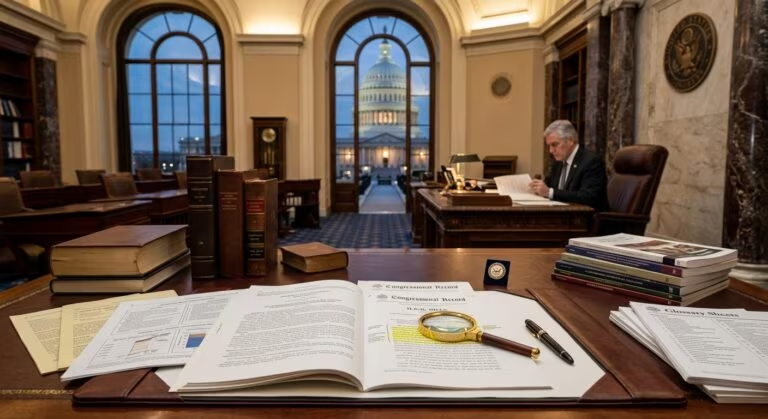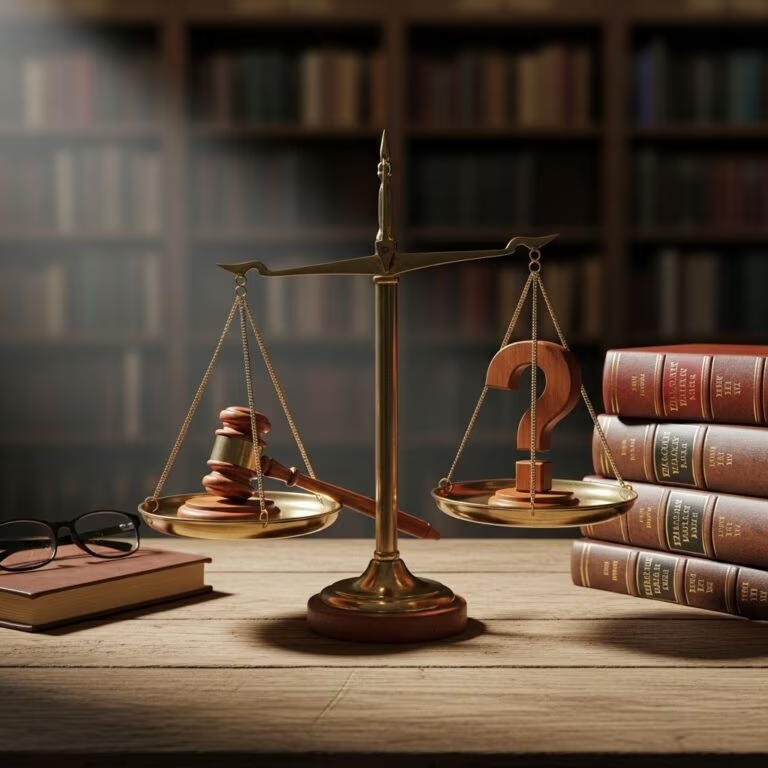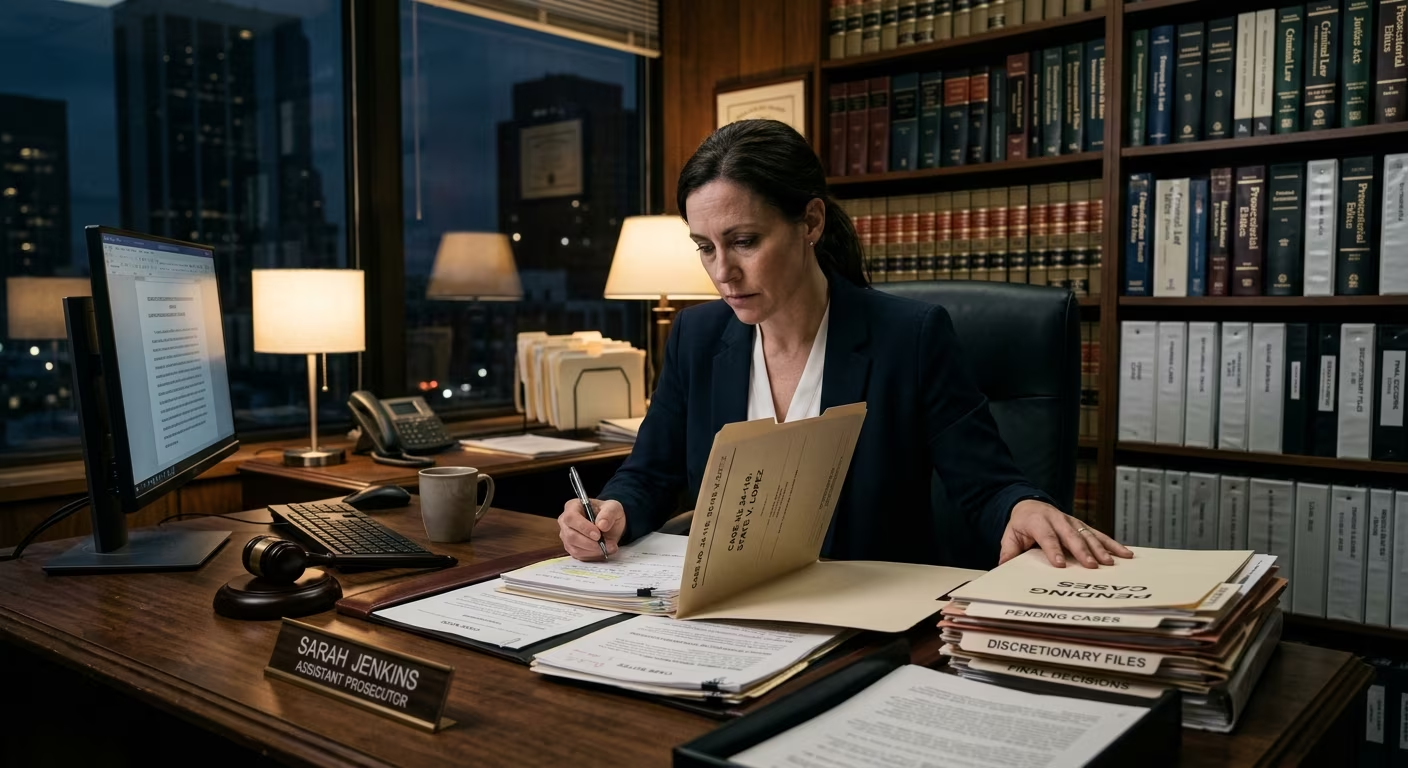
When the average citizen envisions the American criminal justice system, they often conjure images popularized by television dramas and cinematic thrillers. In these cultural representations, the judge sits elevated at the center of the courtroom, wielding a wooden gavel as the ultimate authority. The defense attorney delivers impassioned speeches to a captivated jury, while the outcome hangs delicately in the balance of a dramatic trial. However, this theatrical depiction fundamentally misrepresents the true power dynamics of the modern legal framework. The most powerful actor in the criminal justice system does not wear a black robe, nor do they sit in the jury box. Instead, the true architect of criminal outcomes is the prosecutor.
From the moment an individual is investigated for a crime to the final sentencing, the prosecuting attorney possesses a level of authority that is largely unchecked by judicial review or public oversight. This concept, known as prosecutorial discretion, allows these legal officials to determine who gets charged, what specific crimes are alleged, and what penalties are pursued. By pulling the levers of this vast bureaucratic machinery, prosecutors serve as the gatekeepers of the penal system. Understanding the sheer magnitude of prosecutorial power is essential for anyone seeking to comprehend the complexities of the legal system, the realities of plea bargaining, and the ongoing debate surrounding mass incarceration and criminal justice reform.
The Unrivaled Scope of Prosecutorial Discretion
At the very heart of a prosecutor’s power is the doctrine of prosecutorial discretion. This legal principle grants law enforcement agencies, and specifically prosecuting attorneys, the authority to decide whether to enforce the law against a specific individual. According to the United States Department of Justice’s Principles of Federal Prosecution, a determination to prosecute represents a profound policy judgment. Prosecutors must weigh whether the fundamental interests of society require the application of criminal law to a particular set of circumstances .
This discretion operates across several critical junctures in the criminal process. First, when police make an arrest, the prosecutor alone decides whether to formally file charges. They can choose to dismiss a case entirely—even if there is sufficient evidence to secure a conviction—if they believe pursuing the case does not serve the public interest. Conversely, they can decide to bring the most severe charges possible based on the facts presented.
Furthermore, prosecutors possess the authority to shape the narrative of the alleged crime. An incident involving a physical altercation could be charged as a low-level misdemeanor assault or elevated to a felony aggravated assault, depending entirely on the prosecutor’s interpretation and strategic goals. This extraordinary flexibility means that two individuals who commit the exact same act in different jurisdictions—or even within the same jurisdiction under different prosecutors—can face vastly different legal consequences.
- Screening and Charging: The unilateral decision to initiate formal criminal proceedings or dismiss the case entirely.
- Charge Selection: The ability to choose the severity and quantity of charges, directly dictating the potential maximum sentence.
- Bail Recommendations: The power to recommend pre-trial detention or exorbitant cash bail, heavily influencing whether a defendant remains incarcerated while awaiting trial.
- Diversion Programs: The authority to offer alternatives to incarceration, such as drug treatment or restorative justice programs, to eligible defendants.
The Myth of the Trial and the Reality of the Plea Bargain
The constitutional right to a trial by a jury of one’s peers is a cornerstone of American jurisprudence. Yet, in practice, the jury trial has become an exceptionally rare phenomenon. The overwhelming majority of criminal convictions are not the result of a grueling, evidence-based courtroom battle; they are the product of negotiated settlements known as plea bargains. In this realm, the prosecutor’s power is absolute.
According to data from the Bureau of Justice Statistics, the United States relies heavily on a vast network of state prosecutors. In 2020, there were 2,347 state prosecutor offices employing over 35,000 attorneys. These offices handled an immense volume of felony cases, and notably, 67% of all felony matters concluded by state prosecutor offices were adjudicated following a plea bargain . In the federal system, the rate of cases resolved through guilty pleas is often even higher.
The mechanics of plea bargaining heavily favor the prosecution. Because prosecutors control the initial charges, they can engage in what legal scholars refer to as “charge stacking.” By charging a defendant with multiple severe offenses, the prosecutor artificially inflates the potential prison sentence the defendant would face if they lost at trial. Faced with the terrifying prospect of decades in prison, even innocent defendants may feel intensely pressured to accept a plea deal for a lesser charge and a guaranteed, manageable sentence. This dynamic effectively strips the judge and the jury of their traditional roles, transferring the power of adjudication and sentencing directly to the prosecutor’s desk behind closed doors.
Mandatory Minimums: A Transfer of Judicial Power
To fully grasp how prosecutors acquired such dominant control over sentencing, one must look at the legislative shifts of the late 20th century. During the “tough on crime” era of the 1980s and 1990s, state and federal lawmakers passed sweeping legislation designed to ensure strict, uniform punishments for offenders. The most notable of these mechanisms were mandatory minimum sentencing laws.
The explicit goal of mandatory minimums was to restrict judicial discretion. Legislators believed that judges were being too lenient, so they enacted laws requiring that anyone convicted of a specific crime—often related to drug distribution or firearms—receive a baseline sentence, regardless of mitigating circumstances. However, taking discretion away from judges did not eliminate discretion from the system; it merely transferred it to prosecutors.
Because mandatory minimums are triggered by specific charges, the person who selects the charge ultimately dictates the sentence. A prosecutor can choose to charge an offense that carries a mandatory ten-year minimum, or they can choose to charge a slightly different offense that carries no mandatory minimum at all. Consequently, the prosecutor uses the threat of the mandatory minimum to leverage a plea deal, dictating the terms of the defendant’s punishment before the judge ever has a chance to weigh in.
The Engine Behind Mass Incarceration
The United States incarcerates a higher percentage of its population than almost any other developed nation in the world. For years, policy analysts and sociologists attributed the explosion of the prison population solely to rising crime rates, aggressive policing, or the War on Drugs. However, contemporary empirical research points to a different primary driver: the localized decisions of prosecuting attorneys.
According to researchers like Professor John Pfaff of Fordham University, who has extensively studied the empirical data behind mass incarceration, the surge in prison populations beginning in the mid-1990s correlates strongly with changes in prosecutorial behavior . Even as crime rates began to decline nationwide, prosecutors were filing felony charges against arrestees at significantly higher rates than in previous decades. By turning more arrests into felony prosecutions, and subsequently utilizing plea bargaining to secure convictions, prosecutors quietly fueled the massive expansion of the American penal system.
This reality highlights a structural anomaly in criminal justice design. Prosecutors are often evaluated and politically rewarded based on their conviction rates and their perceived toughness on crime. There is historically little to no professional or political reward for declining to prosecute, prioritizing rehabilitation, or reducing incarceration rates. Therefore, the internal incentive structures of district attorney offices have traditionally pushed toward maximum enforcement and punitive outcomes.
Electoral Accountability and the Push for Reform
Given the staggering authority wielded by these officials, one might assume they are subject to intense scrutiny and rigorous oversight. The reality is quite the opposite. In the vast majority of jurisdictions in the United States, local chief prosecutors—commonly known as District Attorneys, State’s Attorneys, or County Attorneys—are elected officials. They are chosen by the voters of their county or district.
However, historically, prosecutorial elections have been low-visibility affairs. Most voters are unaware of who their local district attorney is, let alone the specific charging policies that office employs. As a result, incumbent prosecutors frequently run unopposed and remain in office for decades, operating with a mandate of institutional inertia rather than active public consent.
In recent years, this dynamic has begun to shift. A growing movement centered around “reform prosecutors” or “progressive prosecutors” has emerged across the nation. Recognizing that the power to incarcerate also inherently includes the power to decarcerate, newly elected reform-minded prosecutors are utilizing their absolute discretion to fundamentally alter the justice system from the inside out. By implementing policies such as declining to prosecute low-level nonviolent offenses, refusing to request cash bail for indigent defendants, and establishing robust conviction integrity units to review past injustices, these legal officials are attempting to reverse the trends of the past four decades.
This movement has not been without controversy. Critics argue that declining to enforce certain laws undermines public safety and oversteps the bounds of the executive branch by effectively rewriting legislation. Proponents, however, counter that prosecutors have always exercised this level of discretion; they are simply choosing to utilize it in a manner that prioritizes community stability and equity over punitive incarceration.
Key Stages of Prosecutorial Influence
To summarize the lifecycle of a criminal case and the prosecutor’s role within it, the following table outlines the distinct phases where discretion fundamentally alters the trajectory of a defendant’s life.
| Phase of Justice System | Prosecutorial Action | Impact on Defendant and System |
|---|---|---|
| Investigation & Arrest | Reviewing police reports and deciding whether to initiate a formal case. | Determines if an individual will face the stress, financial burden, and stigma of the legal process. |
| Pre-Trial Custody | Making recommendations to the judge regarding bail amounts or detention. | Dictates whether a defendant remains in jail or goes home to their job and family pending trial. |
| Discovery & Plea Negotiation | Controlling the flow of evidence and offering reduced sentences in exchange for guilty pleas. | Bypasses the trial process entirely; accounts for the vast majority of all criminal convictions. |
| Sentencing Phase | Recommending a specific prison term or probation conditions to the judge. | Heavily influences the final punishment, especially in cases involving mandatory minimums. |
Frequently Asked Questions
What exactly does a District Attorney do?
A District Attorney (DA) is the chief law enforcement official for a specific local jurisdiction, usually a county. They manage an office of assistant prosecutors who represent the state or the government in criminal proceedings. The DA sets the office’s policies regarding what types of crimes to prioritize, how to handle plea bargains, and what sentencing recommendations to make.
Can a judge override a prosecutor’s decision to drop charges?
Generally, no. Under the doctrine of separation of powers, the prosecutor represents the executive branch, which is tasked with enforcing the law. The decision to bring or dismiss charges is almost exclusively an executive function. While a judge can dismiss a case if there is insufficient evidence, they rarely have the authority to force a prosecutor to pursue charges they wish to drop.
Why do so many cases end in plea bargains instead of trials?
The criminal justice system is massively overburdened. If every defendant invoked their right to a jury trial, the courts would instantly collapse under the backlog. To maintain efficiency, the system relies on plea bargains. Prosecutors incentivize defendants to plead guilty by offering lighter sentences or reduced charges, while threatening exponentially harsher penalties if the defendant insists on a trial and loses.
How can the public hold prosecutors accountable?
Because most local chief prosecutors are elected at the county level, the primary mechanism for accountability is the ballot box. Citizens can hold prosecutors accountable by paying attention to local DA elections, questioning candidates on their specific charging policies, and voting for individuals whose vision of justice aligns with the community’s values.
Conclusion
The architecture of the American legal system places extraordinary trust and power in the hands of its prosecutors. Operating largely outside the public eye and shielded from judicial interference, these attorneys make daily calculations that ripple outward, affecting individual lives, families, and entire communities. From the quiet dismissal of a minor infraction to the aggressive pursuit of a decades-long mandatory minimum sentence, prosecutorial discretion is the hidden engine driving criminal justice outcomes. As public awareness of this reality grows, the conversation surrounding legal reform must continue to focus not just on the laws written in the books, but on the individuals empowered to enforce them. Only through active civic engagement and informed electoral participation can communities ensure that the unparalleled power of the prosecutor is wielded in the genuine pursuit of justice.
References
- 9-27.000 – Principles of Federal Prosecution — United States Department of Justice. 2026-05-08. https://www.justice.gov/jm/jm-9-27000-principles-federal-prosecution
- Prosecutors in State Courts, 2020 — Bureau of Justice Statistics. 2024-11-14. https://bjs.ojp.gov/library/publications/prosecutors-state-courts-2020
- The Big Idea: Local Politics, Reform Prosecutors, and Reshaping Mass Incarceration — Fordham Law News (Professor John Pfaff). 2025-03-31. https://news.law.fordham.edu/blog/2021/03/31/the-big-idea-local-politics-reform-prosecutors-and-reshaping-mass-incarceration/