
Unsecured Promissory Notes: Benefits and Drawbacks
Discover the advantages and risks of unsecured promissory notes for quick loans without collateral in personal and business lending.
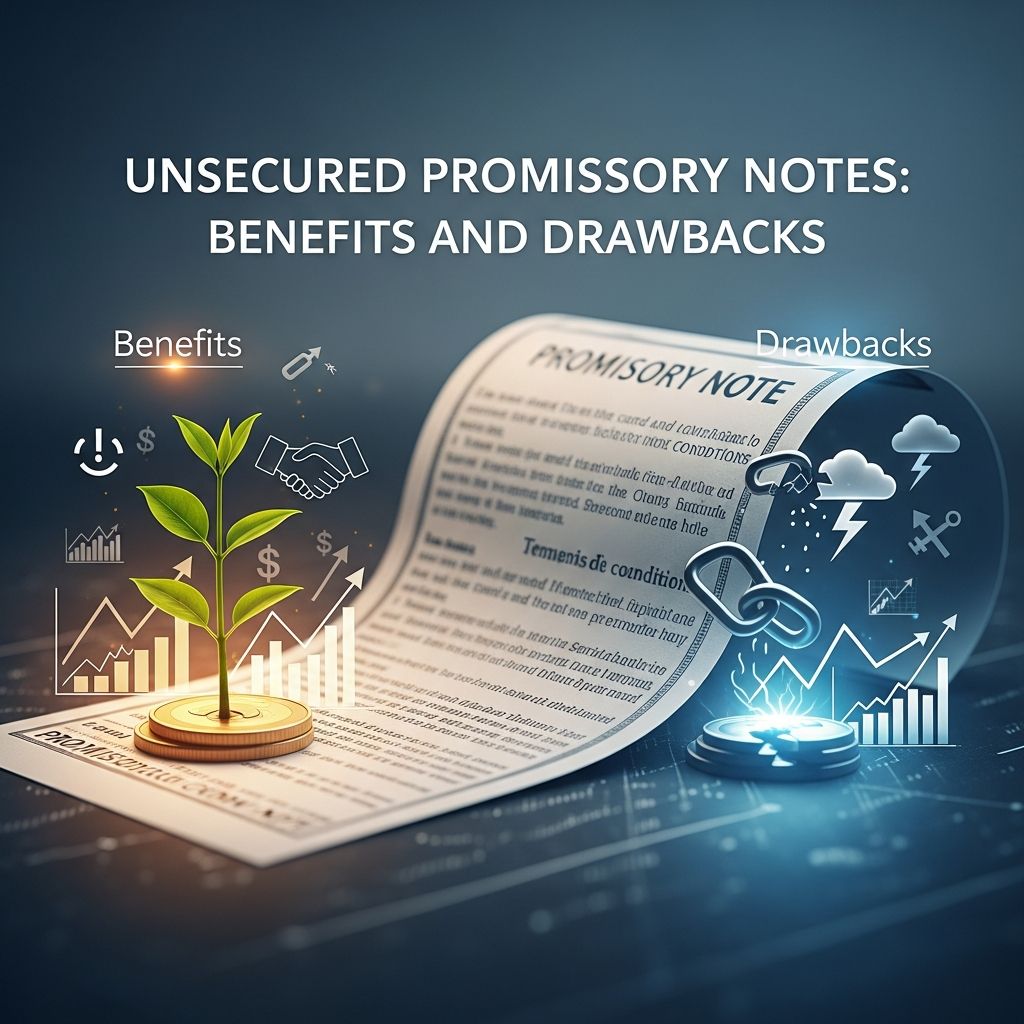
Unsecured promissory notes serve as straightforward legal agreements where a borrower commits to repaying a loan without pledging any assets as security. These documents rely entirely on the borrower’s word and credit reliability, making them popular for informal or urgent transactions.
Understanding the Fundamentals of Unsecured Promissory Notes
At its core, an unsecured promissory note functions as a binding promise to repay a specified sum, including any agreed interest, by defined terms. Unlike secured versions, it lacks collateral such as property or vehicles, shifting all protection to the contract’s enforceability. Key elements typically include the loan principal, interest rate, repayment schedule, maturity date, and consequences of default. This simplicity allows for rapid creation and signing, often without extensive paperwork.
These notes are prevalent in scenarios like family loans, short-term business advances, or peer-to-peer funding where trust underpins the deal. Lenders assess the borrower’s financial stability and reputation rather than asset values, which can expedite funding but demands careful evaluation.
Key Advantages for Borrowers and Lenders
Unsecured notes provide notable upsides, particularly in speed and accessibility.
- Rapid Execution: Absent collateral verification or appraisals, these agreements can be drafted and executed in hours, ideal for emergencies like medical bills or cash flow gaps.
- No Asset Risk: Borrowers retain full control over their property, avoiding foreclosure or repossession threats.
- Flexibility in Terms: Parties can customize repayment schedules, interest (or none), and conditions to suit unique needs, fostering trust in personal relationships.
- Lower Barriers: Suitable for those without substantial assets, enabling access to funds based on income or character.
For lenders comfortable with moderate risk, the ease outweighs potential downsides in low-stakes loans.
Significant Disadvantages and Risk Factors
Despite conveniences, unsecured notes expose parties to vulnerabilities.
- Elevated Lender Risk: Without collateral, default leaves lenders pursuing court judgments, a time-consuming process with no repayment guarantee.
- Higher Costs: To offset risks, interest rates often exceed those of secured loans, increasing borrower expenses.
- Enforcement Hurdles: Recovery demands lawsuits, potentially costing thousands in legal fees with uncertain outcomes.
- Trust Dependency: Success hinges on borrower’s honesty; strained relations can complicate collections.
| Aspect | Unsecured Notes | Secured Notes |
|---|---|---|
| Risk Level | High for lender | Low due to collateral |
| Setup Time | Fast (hours) | Slow (days/weeks) |
| Interest Rates | Higher | Lower |
| Asset Impact | None | Risk of loss |
This comparison highlights trade-offs, with unsecured options prioritizing speed over security.
Ideal Scenarios for Deployment
Select unsecured notes when speed trumps security.
- Family or friend loans under $10,000 for brief needs.
- Business partners bridging temporary shortfalls.
- Startups securing seed money from known investors.
- Urgent personal expenses without time for asset pledges.
Always pair with credit checks or co-signers for added protection.
Essential Components of a Robust Agreement
A well-crafted note minimizes disputes.
- Party Details: Full names, addresses, and contacts for borrower, lender, and guarantors.
- Financial Terms: Exact principal, interest calculation method, and payment timeline.
- Default Clauses: Define late fees, acceleration of full balance, and remedies.
- Governing Law: Specify jurisdiction for disputes.
- Signatures: Notarize for stronger enforceability.
Consult legal templates or attorneys to ensure completeness.
Legal Recourse in Case of Default
Upon non-payment, lenders file suits to obtain judgments, then use wage garnishment or liens. Success rates vary by borrower’s solvency; proactive communication often resolves issues amicably.
Comparing with Secured Alternatives
Secured notes link repayment to assets, offering lenders repossession rights and lower rates but burdening borrowers with property risks. Choose based on relationship strength and loan size.
Frequently Asked Questions
Are unsecured promissory notes legally binding?
Yes, they create enforceable obligations if properly documented, allowing court action for breaches.
Can I add interest to an unsecured note?
Absolutely; state usury laws cap rates, but flexibility exists for private deals.
What if the borrower declares bankruptcy?
Unsecured debts rank low in priority, complicating recovery.
Do I need a lawyer to create one?
Not always, but professional review prevents errors, especially for larger sums.
How do they differ from standard IOUs?
Notes include detailed terms and legal structure, unlike informal IOUs.
Best Practices for Safe Usage
To optimize outcomes:
- Vet borrower’s finances thoroughly.
- Include personal guarantees.
- Monitor payments closely.
- Use e-signatures for efficiency.
- Keep records meticulously.
These steps balance convenience with caution.
References
- Exploring the Differences: Secured vs. Unsecured Promissory Notes — Seascape Capital. 2023. https://seascapecapital.com/blog/promissory-note-secured-vs-unsecured/
- Unsecured Promissory Note: A Risk-Tolerant Tool for Fast Lending — Certinal. 2024. https://www.certinal.com/blog/unsecured-promissory-note
- What is a Promissory Note? — OneMain Financial. 2025-01-15. https://www.onemainfinancial.com/resources/loan-basics/what-is-a-promissory-note
- Unsecured Promissory Note Template — PromissoryNotes.org. 2024. https://promissorynotes.org/unsecured/
- The Promissory Note – Chapter 5 — University of Vermont (PDF). 2022. https://www.uvm.edu/newfarmer/business/finance-guide/Chapter5.pdf
Similar Articles








Read full bio of medha deb




