
The Enduring Power of Collective Action and Labor Rights
Despite political attempts to undermine the NLRB, the American labor movement continues to drive economic and racial equity.
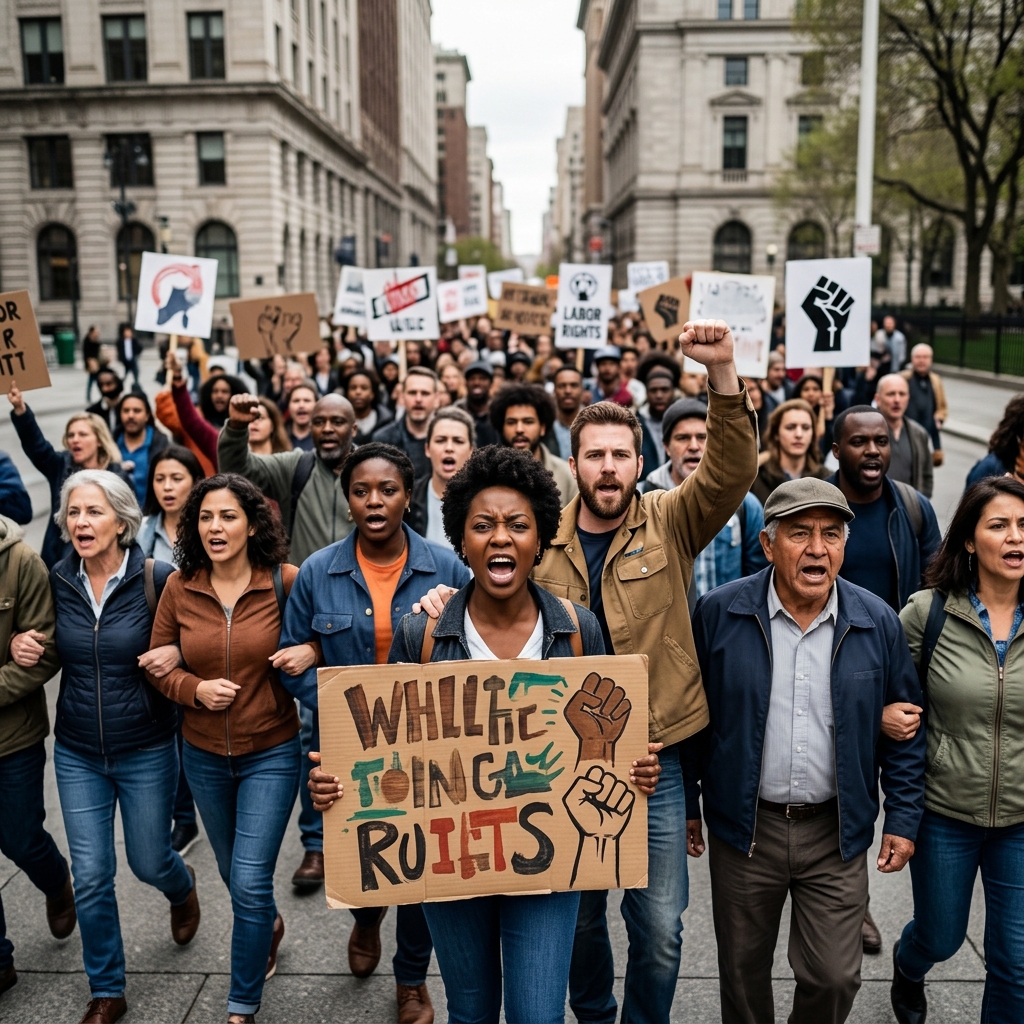
The Unbreakable Spirit of the American Worker
The discourse surrounding labor rights in the United States has long been punctuated by intense friction between the working class and those who hold outsized economic and political power. In recent times, the public sphere has witnessed a resurgence of anti-worker rhetoric, with high-profile political figures and corporate executives publicly disparaging collective bargaining efforts and the regulatory bodies designed to protect them. Attempts to deride striking workers or mock labor protections are not merely off-the-cuff remarks; they represent a calculated strategy to chill labor organizing. Yet, history and modern economic data reveal a profound truth: the power of collective action remains fundamentally unbreakable. Regardless of how loudly union-busting sentiments are broadcast, the systemic demand for equitable treatment, fair wages, and workplace democracy continues to fuel one of the most resilient social movements in modern history.
To understand why labor organizing withstands political disparagement, one must look beyond the rhetoric and examine the material realities of the modern workforce. Stagnant wages, skyrocketing executive compensation, and the erosion of traditional workplace benefits have created a perfect storm of worker dissatisfaction. When political actors attempt to laugh off the threat of strikes or boast about mass terminations, they inadvertently highlight the very asymmetry of power that makes unions an absolute necessity. Workers are increasingly realizing that their true leverage lies in their numbers and their ability to withhold their labor. This realization transcends political affiliation, drawing workers from diverse backgrounds into a shared, unified struggle for dignity.
The National Labor Relations Act: A Primer on Workplace Democracy
The legal framework that underpins this struggle is the National Labor Relations Act (NLRA). Enacted in 1935 during the Great Depression, the NLRA was explicitly designed to encourage collective bargaining and protect workers’ full freedom of association. It established the United States’ policy that industrial peace is best achieved not through the unilateral dictates of management, but through the balanced negotiation of equals. The law fundamentally recognizes that a solitary employee possesses little to no bargaining power against a massive corporate entity. Therefore, it federally protects the right of workers to band together to improve their terms and conditions of employment.
At the heart of the NLRA is Section 7, which explicitly guarantees employees the right to self-organization, to form, join, or assist labor organizations, and to engage in other concerted activities for the purpose of collective bargaining or other mutual aid or protection. Crucially, these legal protections extend far beyond formalized unions. The National Labor Relations Board (NLRB) vigorously protects “concerted activity,” which occurs when two or more employees take action for their mutual aid or protection regarding the terms and conditions of their employment. This means that even if a workplace does not have a recognized union, workers discussing their wages, circulating a petition for better safety protocols, or jointly addressing management are legally protected from retaliation. Furthermore, Section 8(a)(1) of the Act makes it an unfair labor practice for an employer to interfere with, restrain, or coerce employees in the exercise of these fundamental rights.
When public figures joke about illegally firing striking workers, they are not just expressing an anti-labor sentiment; they are promoting blatant violations of federal law. The NLRB, an independent federal agency, is tasked with enforcing the NLRA and remedying unfair labor practices. While political administrations may attempt to defund or understaff the NLRB to weaken its enforcement capabilities, the statutory rights of the workers remain legally intact. The Board holds the authority to order the reinstatement of unlawfully terminated employees, mandate back pay, and force employers to the bargaining table. The sheer existence of this regulatory apparatus acts as a vital bulwark against the unbridled exploitation of the labor force.
Bridging the Divide: How Labor Rights Fuel Racial Justice
Beyond basic workplace protections, the labor movement serves as one of the most effective engines for racial and economic justice in the United States. Systemic discrimination has long permeated the American labor market, manifesting in persistent wage gaps, occupational segregation, and deeply unequal access to wealth accumulation. Political attempts to weaken labor rights disproportionately harm Black, Hispanic, and other minority workers who have historically relied on collective bargaining to secure a stable foothold in the middle class.
The statistical evidence demonstrating the equalizing power of unions is incredibly compelling. Research from the Economic Policy Institute highlights that the “union advantage” is particularly robust for Black and Hispanic households, significantly narrowing the racial wealth gap. In the broader economy among nonunion families, the median white family possesses more than $7 in wealth for every $1 held by the median Black family. However, within unionized families, this staggering disparity is roughly cut in half, with the median white family holding $3.70 in wealth for every $1 held by the median Black family.
This dramatic reduction in inequality is not an accidental byproduct; it is the direct result of the structural mechanisms inherent in collective bargaining agreements. Union contracts prioritize pay transparency, establish standardized wage progressions based on seniority or objective skill metrics, and enforce strictly defined “just cause” provisions for discipline and termination. These contractual guarantees drastically reduce the discretionary power of management, thereby limiting the avenues through which conscious or unconscious racial bias can negatively impact an employee’s career trajectory and earning potential. By standardizing pay and benefits, unions ensure that workers performing the same job receive the exact same compensation, irrespective of their racial or ethnic background.
Furthermore, labor unions have historically been at the forefront of broader social justice movements. From the civil rights era, where organized labor supported marches and strikes for racial equality, to contemporary fights for equity, unions have provided crucial financial, logistical, and political support to marginalized communities. When political leaders attempt to deride the NLRB or dismantle labor rights, they are actively attacking one of the few proven institutional vehicles for racial economic advancement. Protecting the right to strike and organize is, therefore, inextricably linked to the broader fight for civil rights and societal equity.
The Empirical Evidence: A Resurgence in Work Stoppages
Despite the hostile rhetoric from certain political echelons and the highly sophisticated union-busting campaigns employed by massive corporations, the American workforce is currently experiencing a profound revitalization of collective action. Workers are not being intimidated into submission; instead, they are taking to the picket lines in numbers not seen in decades. This resurgence of strike activity underscores the reality that when workplace conditions become untenable, the power of collective refusal is absolute and transformative.
Data compiled by the U.S. Bureau of Labor Statistics (BLS) paints a clear, undeniable picture of this escalating worker mobilization. In 2023, the nation witnessed 33 major work stoppages (defined as involving 1,000 or more workers), which idled a staggering 458,900 workers. This represented a massive surge in labor militancy, driven by high-profile strikes in the automotive, entertainment, and healthcare sectors. The momentum has proven to be highly sustainable. In 2025, the BLS reported 30 major work stoppages beginning in the year, involving 306,800 workers.
Recent Major Work Stoppages (By Year)
| Year | Number of Major Work Stoppages | Number of Workers Idled (in thousands) |
|---|---|---|
| 2022 | 23 | 120.6 |
| 2023 | 33 | 458.9 |
| 2024 | 31 | 271.5 |
| 2025 | 30 | 306.8 |
Source: U.S. Bureau of Labor Statistics,
These statistics highlight a critical failure in the strategy of labor disparagement. Threatening workers with replacement or mocking their demands does not extinguish their grievances; it often serves as a massive accelerant for mobilization. In industries ranging from education and health services—which accounted for 196,500 idled workers in 2025 alone—to manufacturing and retail, employees are recognizing that their collective power can bring billion-dollar enterprises to a complete halt. The sheer economic impact of these strikes forces corporations to the negotiating table, proving that the structural power of labor cannot be canceled by a dismissive political soundbite.
Beyond traditional sectors like manufacturing and healthcare, the modern labor movement is rapidly expanding into completely new frontiers. Workers in the technology sector, the gig economy, and green energy initiatives are increasingly recognizing the necessity of collective bargaining. These emerging industries, often characterized by precarious independent contractor classifications and a lack of traditional benefits, are becoming fierce new battlegrounds for workplace democracy. The expansion of organizing efforts into these modern fields proves that the desire for fair representation is not an artifact of the industrial past, but a continuously evolving necessity for the modern economy.
Rhetoric Versus Reality: The Futility of Disparagement
Why, then, do political and corporate leaders continue to engage in anti-labor rhetoric if the statistics prove it is ineffective? The answer lies in psychological warfare. Because the legal framework of the NLRA strictly prohibits direct retaliation, opponents of labor often resort to creating an atmosphere of futility and fear. By publicly belittling the NLRB or suggesting that striking workers are easily expendable, they aim to convince employees that organizing is a hopeless, ultimately damaging endeavor. This is a desperate attempt to win the battle of perception before the legal battle even begins.
However, this tactic is increasingly falling flat on the modern workforce. The contemporary labor movement is highly networked, technologically savvy, and supported by a general public that views unions more favorably today than at any point in the last fifty years. When a prominent political or corporate figure mocks the concept of collective bargaining, it almost instantly results in a surge of grassroots donations to strike funds, increased public solidarity on social media, and a deeply renewed determination among the workers themselves. The public fundamentally recognizes that a healthy democracy requires a healthy middle class, and a healthy middle class requires robust, legally protected labor rights.
Conclusion: The Enduring Power of Solidarity
The ongoing attempts to deride the National Labor Relations Board and undermine the power of collective action are destined to encounter fierce, organized resistance. The legal foundation laid by the NLRA in 1935 remains a vital cornerstone of American economic life, offering concrete, enforceable protections against corporate overreach. Furthermore, the empirical evidence overwhelmingly demonstrates that unions are indispensable in the fight against racial economic inequality, providing a mathematically proven mechanism to close the wealth gap and ensure equitable treatment for marginalized communities.
As the recent surge in major work stoppages clearly indicates, American workers are no longer willing to accept stagnant wages and deteriorating working conditions in silence. The power of the picket line, the solidarity of the strike fund, and the legal shield of the NLRB form a formidable triad that cannot be dismantled by mere political posturing. The true power of collective action lies not in the benevolence of the employer or the rhetoric of the politician, but in the unbreakable resolve of the workers who keep the world running.
Frequently Asked Questions (FAQs)
What exactly is the National Labor Relations Board (NLRB)?
The NLRB is an independent federal agency established in 1935 to enforce the National Labor Relations Act (NLRA). It protects the rights of private-sector employees to join together, with or without a union, to improve their wages and working conditions. The agency actively investigates unfair labor practices and conducts democratic elections for labor union representation.
Can I be fired for discussing my wages with coworkers?
No. Under Section 7 of the NLRA, employees have the federally protected right to engage in “protected concerted activity,” which explicitly includes discussing wages, benefits, and working conditions with colleagues. It is a direct violation of federal law for an employer to retaliate against, discipline, or fire an employee for these essential discussions.
How do labor unions help close the racial wealth gap?
Labor unions establish standardized pay scales, enforce total pay transparency, and require “just cause” for discipline or termination. These measures remove the subjective, discretionary power of management that often leads to implicit or explicit racial bias. Data conclusively shows that the wealth gap between white and Black families is cut in half among unionized households compared to non-union households.
Do I need to be in a union to be protected by the NLRA?
No. The NLRA protects the rights of both union and non-union private-sector employees to engage in concerted activities for mutual aid or protection. For example, if you and a coworker collectively approach your manager to ask for safer working conditions or better pay, that is protected activity regardless of your formal union status.
What constitutes a “major work stoppage”?
The U.S. Bureau of Labor Statistics defines a “major work stoppage” as a strike or lockout involving 1,000 or more workers that lasts at least one full shift during the standard work week (Monday through Friday, excluding federal holidays).
References
- National Labor Relations Act — National Labor Relations Board. https://www.nlrb.gov/guidance/key-reference-materials/national-labor-relations-act
- Interfering with employee rights (Section 7 & 8(a)(1)) — National Labor Relations Board. https://www.nlrb.gov/about-nlrb/rights-we-protect/the-law/interfering-with-employee-rights-section-7-8a1
- Employee Rights — National Labor Relations Board. https://www.nlrb.gov/about-nlrb/rights-we-protect/the-law/employee-rights
- Major Work Stoppages: Annual summary data — U.S. Bureau of Labor Statistics. 2026-02-20. https://www.bls.gov/web/wkstp/annual-listing.htm
- Work Stoppages Summary – 2025 A01 Results — U.S. Bureau of Labor Statistics. 2026-02-20. https://www.bls.gov/news.release/wkstp.nr0.htm
- Unions promote racial equity — Economic Policy Institute. 2023-07-31. https://www.epi.org/publication/unions-promote-racial-equity/
Similar Articles








Read full bio of Sneha Tete




