
Undefined Immigrant Worker Exploitation: 4 Policy Reforms Now
Exploring the intersection of immigrant labor exploitation and detention centers.
The pursuit of a fair and equitable society fundamentally depends on how it treats its most vulnerable populations. Within the United States, the intersection of immigrant labor rights and the conditions within immigration detention centers presents a profound human rights challenge. For decades, the global economy has relied heavily on the physical labor of immigrants, yet the frameworks designed to protect these essential workers consistently fall short. When these same individuals cross the threshold from the civilian workforce into the sprawling network of federal immigration detention centers, their vulnerability to exploitation deepens dramatically. Understanding this crisis requires an unvarnished look at systemic exploitation, the privatization of civil confinement, and the legal battlegrounds where advocates are fighting to uphold basic human dignity.
Advocates, legal scholars, and civil rights organizations have increasingly focused their efforts on exposing the dual hardships faced by noncitizens: severe workplace abuses in the free market and forced, undercompensated labor within detention walls. By examining the mechanisms of this exploitation, we can begin to chart a course toward meaningful policy reform and institutional accountability.
The Double Bind: Systemic Vulnerability of Immigrant Workers
Immigrant workers, particularly those who are undocumented or hold temporary, employer-tied visas, navigate a precarious reality in the American labor market. Their economic contributions are vast, spanning agriculture, construction, meatpacking, and hospitality. Yet, the foundational threat of deportation is routinely weaponized by unscrupulous employers to maintain a compliant and easily exploitable workforce. This dynamic creates a “double bind” where workers are forced to endure illegal conditions or risk being separated from their families and removed from the country.
Wage theft is one of the most pervasive forms of abuse targeting this demographic. Employers may refuse to pay overtime, illegally deduct expenses from paychecks, or simply withhold wages entirely, banking on the assumption that an undocumented worker will not dare contact the authorities. Furthermore, dangerous working conditions are disproportionately thrust upon immigrants. When safety equipment is lacking or machinery is unsafe, voicing a complaint can result in immediate termination or a retaliatory call to immigration enforcement authorities.
Despite these harsh on-the-ground realities, federal protections technically extend to all workers. The Occupational Safety and Health Administration (OSHA) and the Department of Labor (DOL) have explicitly stated that workplace safety standards and wage laws apply to individuals regardless of their immigration status. Recent memorandums from OSHA have reinforced that all workers have the right to a workplace free of known hazards without the fear of retaliation. However, the chilling effect of interior immigration enforcement often renders these theoretical protections ineffective in practice, demanding stronger structural safeguards to ensure workers can actually report abuses.
Inside the Walls: The Profiteering of Immigration Detention
The vulnerabilities that immigrants face in the traditional labor market are significantly amplified when they are placed into civil immigration detention. The U.S. immigration detention system is the largest in the world, and a defining characteristic of this network is its deep reliance on privatization. Rather than being housed in government-run facilities, the vast majority of detained noncitizens are held in facilities owned and operated by massive, for-profit private prison corporations.
According to the U.S. Government Accountability Office (GAO), the reliance on private operators has become the cornerstone of immigration enforcement logistics. In fiscal year 2019, data revealed that U.S. Immigration and Customs Enforcement (ICE) held detainees in 79 percent of its contracted facilities, with private operators commanding the lion’s share of the average daily population. This profit-driven model inherently incentivizes cost-cutting measures at every operational level, often at the direct expense of the health, safety, and basic dignity of the detained individuals.
Reports from independent watchdogs and civil rights advocates consistently highlight alarming conditions inside these private centers. Detainees frequently report inadequate access to medical care, substandard food, overcrowding, and arbitrary use of solitary confinement. Because the primary fiduciary duty of these private corporations is to their shareholders rather than the public good, the humanitarian purpose of civil detention is routinely compromised. Detainees are treated not as individuals awaiting administrative hearings, but as commodified units generating daily revenue for corporate entities.
The $1-a-Day Illusion: Exploitative Labor Inside Detention Centers
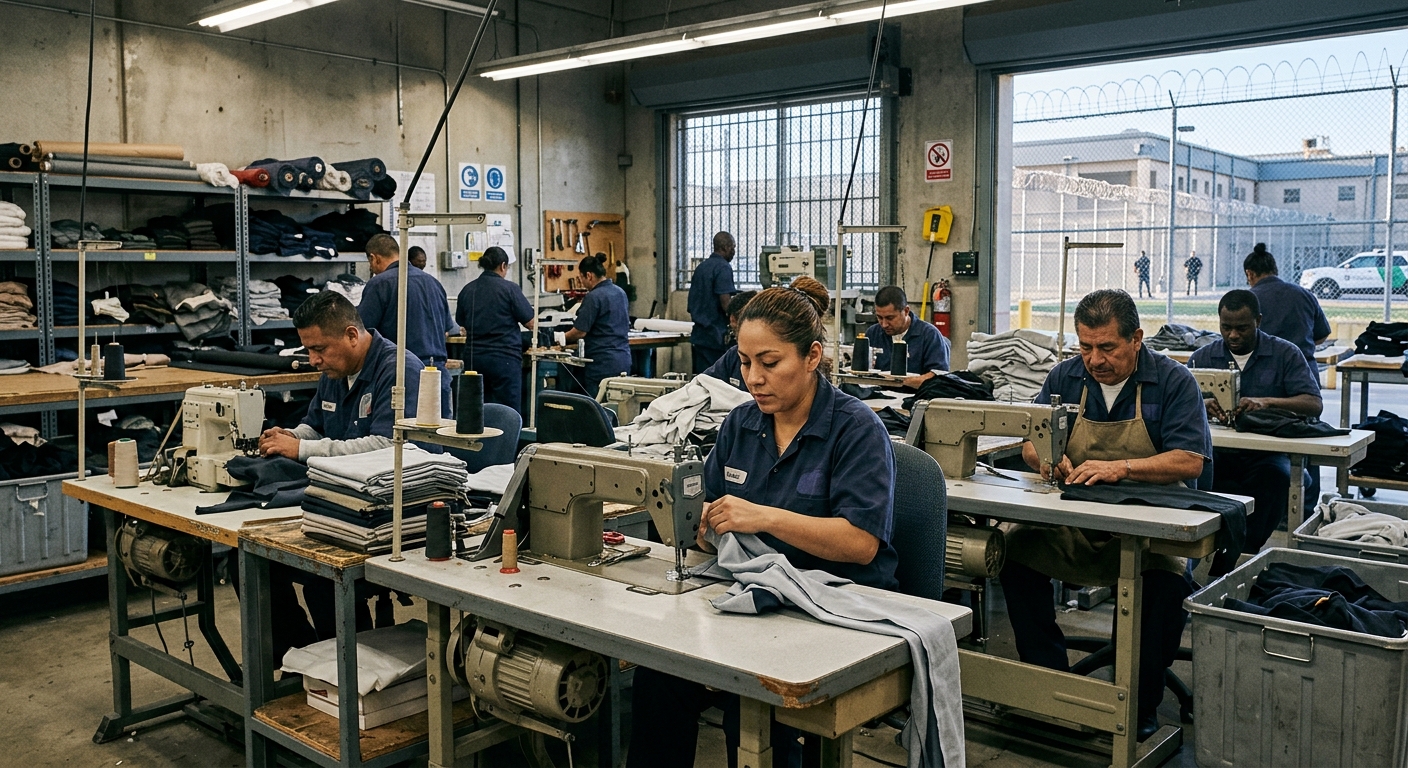
Perhaps the most egregious intersection of detention and labor exploitation occurs through the “Voluntary Work Program” implemented in ICE facilities. Under this program, detained immigrants are enlisted to perform the essential daily labor required to keep the detention centers operational. This includes cooking meals, cleaning bathrooms, doing laundry, buffing floors, and performing general facility maintenance.
The compensation for this labor is notoriously set at just $1 per day. Private prison corporations argue that the program is entirely voluntary and designed to prevent “idleness” among the detained population, pointing to a 1950 federal statute as the basis for the compensation rate. However, advocates and detainees paint a vastly different picture. Because the basic necessities provided by the private operators—such as adequate food, warm clothing, and personal hygiene products like toothpaste—are often insufficient, detainees are effectively forced to work to afford these items at inflated prices from the facility commissary.
This practice has drawn intense legal and ethical scrutiny. The U.S. Commission on Civil Rights has openly raised alarms regarding alleged abusive labor practices, urging federal investigations into a system that allows private corporations to drastically reduce their overhead costs by utilizing a captive, sub-minimum-wage workforce. If the private companies were required to hire local civilian staff to perform these core operational duties, their profit margins would shrink considerably. Instead, they rely on the desperation of detainees, creating a system that critics argue closely mirrors indentured servitude.
Major legal battles are currently being waged over this practice. In high-profile cases like Nwauzor v. The GEO Group, Inc., plaintiffs have argued that private operators should be subject to state minimum wage laws because the facilities are functioning as private economic enterprises, not merely federal extensions. While corporations argue that federal policy preempts state wage laws, courts are increasingly grappling with the sheer scale of the unjust enrichment these companies gain off the backs of civilly detained noncitizens.
Legal Frameworks vs. On-the-Ground Realities
The gap between the rights written into American law and the realities experienced by immigrant workers and detainees is a chasm that legal advocates fight daily to close. The Fair Labor Standards Act (FLSA) of 1938 is the bedrock of American labor rights, establishing minimum wage, overtime pay, and youth employment standards. Crucially, federal courts and the DOL have long maintained that the FLSA covers undocumented immigrants. The rationale is clear: if employers could legally underpay undocumented workers, it would create a perverse incentive to hire them exclusively, driving down wages and safety standards for all American workers.
Despite this, the enforcement mechanism is heavily reliant on worker complaints. When the threat of deportation looms over a worker’s head, the statutory right to file a complaint is effectively neutralized. To combat this, advocates have heavily pushed for the expanded use of U and T nonimmigrant visas. These visas are designed to offer legal status and protection to victims of specific crimes, including human trafficking and severe labor exploitation, allowing them to assist law enforcement without fear of removal. Recently, OSHA gained the authority to issue these visa certifications during workplace safety investigations, a monumental step toward empowering vulnerable workers to blow the whistle on dangerous conditions.
Yet, within detention centers, the legal framework is even more restrictive. Because detainees are held in civil, not criminal, custody, they are theoretically not being punished. However, the conditions of their confinement and the forced nature of their $1-a-day labor blur the line between civil administration and punitive incarceration. The struggle for detainees’ rights involves complex litigation challenging the constitutionality of these labor programs and the lack of oversight by ICE over its private contractors.
Advocacy in Action: Pathways to Meaningful Reform
Dismantling the structures of exploitation requires comprehensive, multi-faceted reform. Advocacy groups are not merely pointing out the flaws in the system; they are proposing concrete legislative and administrative actions to protect immigrant workers and detainees alike.
- Ending For-Profit Detention: The most pressing demand from civil rights advocates is the termination of ICE contracts with private prison corporations. Removing the profit motive from civil detention is viewed as the necessary first step toward improving facility conditions and eliminating captive labor exploitation.
- Strengthening Agency Firewalls: To protect workers in the free market, there must be an impenetrable firewall between federal labor enforcement agencies (like OSHA and the DOL) and immigration enforcement (ICE). Workers must trust that reporting wage theft or safety hazards will not result in their deportation.
- Abolishing the $1-a-Day Wage: Legislative action is required to update the 1950 statute that allows for the $1-a-day Voluntary Work Program. Detainees performing essential facility operations should be compensated fairly, or the private operators should be mandated to hire outside staff for core functions.
- Expanding Whistleblower Protections: Streamlining the approval process for U and T visas and ensuring that workers who report abuses receive immediate, deferred action on deportations will empower more immigrants to stand up against exploitative employers.
The table below summarizes the key differences between the theoretical rights and the practical experiences of these vulnerable populations:
| Domain | Theoretical Legal Right | Practical Reality / On-the-Ground Experience |
|---|---|---|
| Civilian Labor Market | Covered by the Fair Labor Standards Act and OSHA safety regulations. | Severe underreporting of abuses due to fear of retaliation and deportation. |
| Detention Center Labor | Voluntary participation to prevent idleness; compensated per federal guidelines. | Coerced labor to afford basic necessities, saving private corporations millions in payroll. |
| Whistleblower Protections | Eligible for U and T visas for assisting law enforcement. | Massive backlogs and bureaucratic delays leave whistleblowers exposed to immediate removal. |
Conclusion: Upholding Basic Human Dignity
The systemic exploitation of immigrant workers in the fields and factories of America, mirrored by the commodified labor of detainees inside private immigration jails, represents a critical failure of human rights enforcement. The resilience of the advocates, lawyers, and the affected individuals themselves shines a light into these dark corners of the economy and the justice system. By reforming labor laws to protect all workers unreservedly and by stripping the profit motive away from human confinement, society can begin to align its practices with its stated values of liberty and justice for all.
Frequently Asked Questions (FAQs)
Do undocumented immigrants have labor rights in the United States?
Yes. Federal laws such as the Fair Labor Standards Act (FLSA), which mandates minimum wage and overtime pay, and the Occupational Safety and Health Act, apply to all workers in the United States regardless of their immigration status. However, enforcement remains challenging because many undocumented workers fear retaliation, such as being reported to immigration authorities by their employers.
What is the “Voluntary Work Program” in immigration detention?
The Voluntary Work Program is an initiative within ICE detention centers that allows detained noncitizens to work inside the facility doing tasks like cooking, cleaning, and maintenance. While labeled “voluntary,” participants are paid only $1 per day. Critics argue the program is coercive, as detainees often need the meager earnings to purchase essential hygiene items and supplemental food from the facility’s commissary.
Why are immigration detention centers run by private companies?
The federal government increasingly outsourced immigration detention to private, for-profit corporations over the last few decades to manage surges in detained populations and ostensibly lower operational costs. Today, the vast majority of ICE detainees are held in private facilities, a practice heavily criticized by advocates who argue that profit motives lead to substandard living conditions and human rights abuses.
References
- GAO-21-149, IMMIGRATION DETENTION: Actions Needed to Improve Planning, Documentation, and Oversight of Detention Facility Contracts — U.S. Government Accountability Office. 2021-01-13. https://www.gao.gov/products/gao-21-149
- US Commission on Civil Rights Concerned with Alleged Abusive Labor Practices at Immigration Detention Centers — U.S. Commission on Civil Rights. 2017-12-21. https://www.usccr.gov/files/press/2017/12-21-Detention-Centers-Statement.pdf
- Inspection Guidance for Animal Slaughtering and Processing Establishments — Occupational Safety and Health Administration (OSHA), U.S. Department of Labor. 2024-10-15. https://www.osha.gov/laws-regs/standardinterpretations/2024-10-15
- Nwauzor v. The GEO Group, Inc. Slip Opinion (No. 101786-3) — Supreme Court of the State of Washington / United States Court of Appeals for the Ninth Circuit. 2023-12-21. https://www.courts.wa.gov/opinions/pdf/1017863.pdf
Similar Articles








Read full bio of medha deb




