
The Cornerstone of Liberty: Unpacking Free Speech in America
A comprehensive guide to understanding the First Amendment and its boundaries.
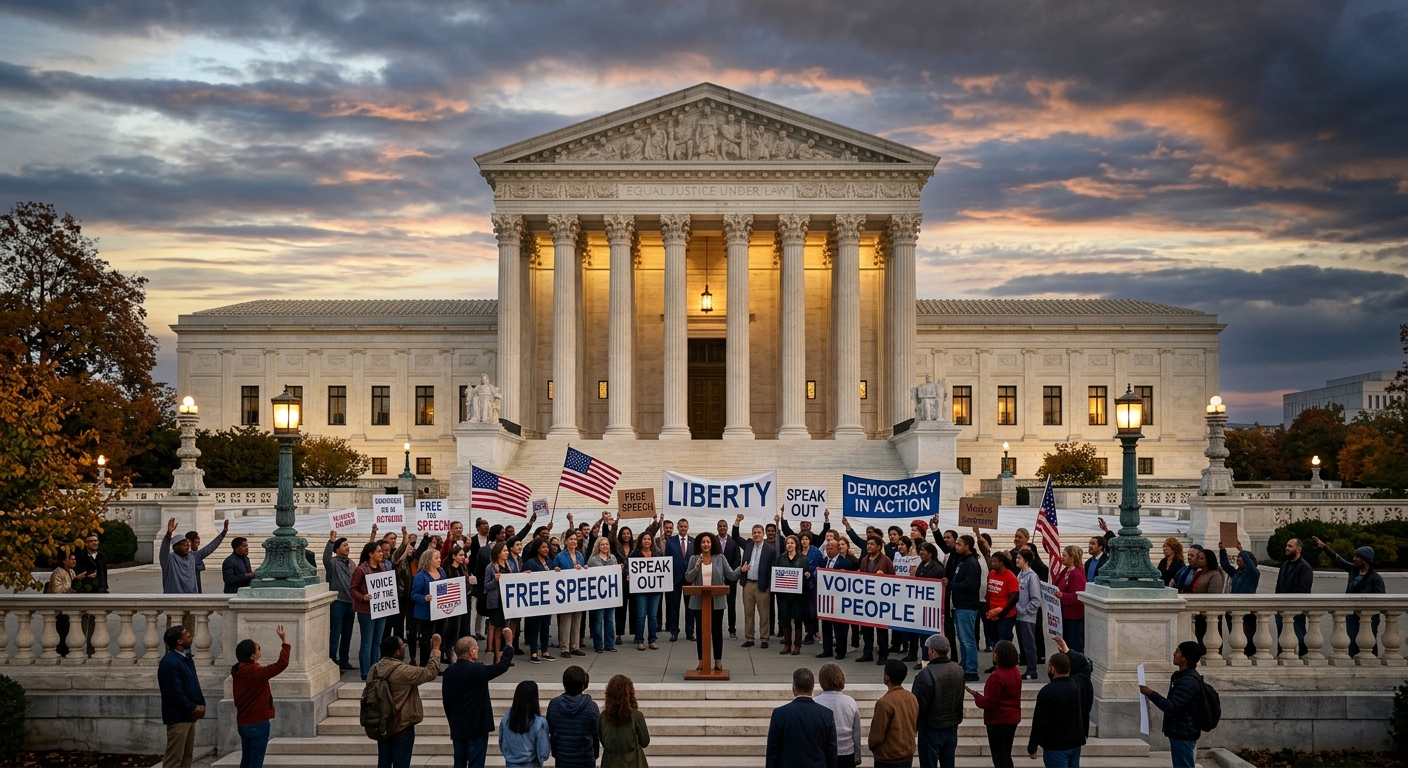
The Bedrock of American Democratic Society
In the grand tapestry of the United States Constitution, few provisions loom as large or are invoked as frequently as the First Amendment. It serves as the primary bulwark defending civil liberties, acting as the bedrock upon which the nation’s democratic processes rely. Yet, despite its cultural prominence and frequent invocation in public discourse, the First Amendment remains one of the most misunderstood legal doctrines in American jurisprudence. From heated debates on college campuses to controversies surrounding content moderation on global social media platforms, ‘free speech’ is often cited as an absolute shield. In reality, the legal landscape governing freedom of expression is highly nuanced, carved by centuries of judicial interpretation and philosophical debate.
Understanding the contours of this fundamental right requires moving beyond mere platitudes. It necessitates a deep dive into the underlying philosophy of the constitutional framework, the specific legal doctrines that define its boundaries, and the critical distinction between government censorship and private regulation. The purpose of this guide is to demystify these legal principles, offering a clear-eyed look at what the First Amendment actually protects, the specific categories of speech that fall outside its safe harbor, and why the overarching philosophy of protecting even the most controversial ideas remains vital to the health of a free society.
The State Action Doctrine: Who Does the First Amendment Constrain?
Perhaps the most pervasive misconception regarding the First Amendment is the belief that it guarantees an absolute right to speak one’s mind anywhere, at any time, without facing any consequences. This misunderstanding stems from a failure to grasp the State Action Doctrine, which is the foundational threshold for any constitutional claim. The First Amendment begins with the words, “Congress shall make no law…” Through the Fourteenth Amendment, this restriction was subsequently extended to state and local governments. Therefore, the First Amendment is a limitation solely on government power.
This means that only entities acting under the color of state law—such as public schools, city councils, police departments, state universities, and federal agencies—are constitutionally prohibited from censoring or retaliating against individuals based on their speech. If a public university expels a student for writing a controversial op-ed in the campus newspaper, that is a clear First Amendment issue. The government is using its authority to punish expression.
Conversely, private individuals and entities are not bound by the First Amendment. A private corporation can fire an employee for making public statements that do not align with the company’s values. A private social media platform can ban users who violate its terms of service. A private theater can refuse to host a controversial speaker. In these scenarios, there is no “state action.” In fact, compelling private entities to host or endorse speech they disagree with would itself be a violation of their First Amendment rights, often referred to as the doctrine of compelled speech. Understanding this demarcation is crucial for navigating modern debates about censorship, particularly in the digital age where private tech companies control the primary town squares.
The Boundaries of Expression: Categories of Unprotected Speech
While the protection of expression in the United States is arguably the most robust in the world, it is not absolute. The Supreme Court has historically identified certain narrow, well-defined categories of speech that do not contribute to the marketplace of ideas and instead cause immediate, tangible harm. Because of their nature, these categories receive no First Amendment protection, and the government may regulate or ban them entirely.
1. Incitement to Imminent Lawless Action
The government cannot punish an individual simply for advocating violence or illegal acts in the abstract. For speech to cross the line into unprotected incitement, it must pass the stringent test established by the Supreme Court. The speech must be specifically directed toward inciting or producing imminent lawless action, and it must be likely to incite or produce such action. A vague statement about revolution at an unspecified future date is protected; a fiery speech urging an angry mob to immediately burn down a specific building across the street is not.
2. True Threats
A “true threat” is not protected by the Constitution. This category encompasses statements where the speaker means to communicate a serious expression of an intent to commit an act of unlawful violence to a particular individual or group of individuals. The law prohibits these types of threats to protect individuals from the fear of violence, from the disruption that fear engenders, and from the possibility that the threatened violence will occur. Political hyperbole, however, remains protected. Stating “I’m going to kill the umpire” after a bad call at a baseball game is clearly hyperbole and not a true threat.
3. Defamation, Fraud, and Perjury
False statements of fact that cause concrete harm do not enjoy constitutional protection. Defamation—which includes both libel (written) and slander (spoken)—involves making a false statement of fact about a person that damages their reputation. For public officials and public figures, the standard is even higher; they must prove “actual malice,” meaning the speaker knew the statement was false or acted with reckless disregard for the truth. Similarly, fraud (using false statements to secure a financial or material gain) and perjury (lying under oath) are criminal acts facilitated by speech, and they are firmly unprotected.
4. Obscenity
Obscenity is a highly specific legal category that is entirely unprotected. To determine whether material is legally obscene, courts apply a three-pronged legal standard: (1) whether the average person, applying contemporary community standards, would find that the work, taken as a whole, appeals to the prurient interest; (2) whether the work depicts or describes, in a patently offensive way, sexual conduct specifically defined by applicable state law; and (3) whether the work, taken as a whole, lacks serious literary, artistic, political, or scientific value. It is important to note that most pornography does not meet this strict legal definition of obscenity and is therefore protected.
5. Child Exploitation Material
There is a categorical and absolute ban on the production, distribution, and possession of child exploitation materials. The government has an overwhelmingly compelling interest in protecting children from the severe psychological and physical abuse inherent in the creation of such materials, rendering this category of expression entirely outside the bounds of constitutional protection.
Viewpoint Neutrality and the Issue of Hateful Speech
One of the most complex and frequently debated aspects of American constitutional law is its approach to deeply offensive or hateful speech. Unlike many democratic nations in Europe and elsewhere that have enacted strict laws criminalizing “hate speech,” the United States legal system does not recognize “hate speech” as a legally distinct, unprotected category. Under the First Amendment, the government cannot ban or punish speech simply because it is bigoted, offensive, racist, or morally repugnant to the majority.
This principle is rooted in the doctrine of viewpoint neutrality. The Constitution demands that the government remain neutral regarding the viewpoints expressed by its citizens. If the government were granted the power to decide which ideas are too offensive to be heard, that power could easily be weaponized against marginalized groups and dissenting voices. Historically, censorship mechanisms designed to protect society have frequently been used to silence civil rights leaders, labor organizers, and anti-war activists. By protecting the worst speech, the legal framework ensures the protection of the most vital, revolutionary, and minority speech.
It is crucial to distinguish, however, between bigoted beliefs expressed as general opinions (which are protected) and bigoted speech that crosses into unprotected conduct. If hateful rhetoric transforms into a “true threat” against a specific person, crosses the line into harassment in an educational or workplace setting, or constitutes intentional incitement to violence, it loses its constitutional shield.
Time, Place, and Manner Restrictions
While the government is heavily restricted from regulating the content of speech, it possesses significantly more leeway to regulate the circumstances under which speech occurs. These are known as time, place, and manner restrictions. The core rationale is that while citizens have a right to express themselves, they do not have a constitutional right to do so in a way that severely disrupts society or creates public safety hazards.
For a time, place, and manner restriction to be constitutionally valid, it must meet specific criteria. First and foremost, it must be completely content-neutral. A city cannot ban protests by political activists while allowing parades for local sports teams. Second, the restriction must be narrowly tailored to serve a significant governmental interest, such as maintaining the smooth flow of traffic or preventing noise pollution in residential areas at three in the morning. Finally, the regulation must leave open ample alternative channels for communication of the information. For example, a city might require a permit to use a loud megaphone in a public park, provided the permit process is applied equally to all applicants regardless of their message.
Summary of Constitutional Protections
To clarify the distinction between protected and unprotected expression, consider the following summary table detailing various categories of speech and their typical constitutional status:
| Category of Speech | First Amendment Status | Example Scenario |
|---|---|---|
| Political Dissent & Criticism | Highly Protected | Publishing an editorial harshly criticizing the President’s foreign policy. |
| Offensive / “Hate” Speech | Protected | Holding signs with deeply offensive slurs at a public street corner. |
| Commercial Speech | Moderately Protected | Advertising a legal product (can be regulated for truthfulness). |
| Defamation (Libel/Slander) | Unprotected | Knowingly printing a false claim that a private citizen committed a crime. |
| Incitement to Violence | Unprotected | Urging a present, armed crowd to immediately attack a specific person. |
The Underlying Philosophy: The Marketplace of Ideas
To fully appreciate the scope of these legal doctrines, one must understand the philosophical foundation of the First Amendment: the “marketplace of ideas.” Formulated by early philosophers like John Stuart Mill and popularized in American jurisprudence by Supreme Court Justice Oliver Wendell Holmes, this theory posits that the best test of truth is the power of a thought to get itself accepted in the competition of the market.
The premise is that human beings are fallible, and governments are especially prone to error and corruption. When a government acts as the ultimate arbiter of truth, suppressing dissenting views, society stagnates, and liberty diminishes. By allowing all ideas—good, bad, brilliant, and absurd—to compete openly, society is better equipped to discover the truth. Bad ideas are best defeated not by government bans and censorship, but by better ideas, robust debate, and public refutation.
Furthermore, the First Amendment serves a vital democratic function. A society that governs itself cannot do so effectively if the citizenry is deprived of information or forbidden from fiercely debating the direction of the country. Freedom of speech is not merely an individual right; it is a structural necessity for the functioning of a democratic republic.
Frequently Asked Questions (FAQs)
Does freedom of speech mean I am free from any consequences for what I say?
No. The First Amendment only protects you from government consequences. If you make highly offensive statements, the government generally cannot throw you in jail or fine you. However, you are not protected from the social or economic consequences of your speech. Friends may choose to stop associating with you, customers may boycott your business, and your private employer has the legal right to terminate your employment if your public statements reflect poorly on the company.
Can the government force a social media company to keep my post up?
No. Social media platforms are private companies, not government entities. They have their own First Amendment rights to dictate what kind of content they wish to host on their servers. Regulating user content, banning accounts, or adding warning labels are exercises of their editorial discretion. Compelling them to host speech against their own policies would violate the Constitution.
Are “fighting words” protected by the First Amendment?
Historically, the Supreme Court has ruled that “fighting words”—words which by their very utterance inflict injury or tend to incite an immediate breach of the peace—are not protected. However, over the past several decades, the Court has interpreted this category so narrowly that it is exceedingly difficult for the government to successfully prosecute someone solely under the fighting words doctrine. The speech must be a direct, face-to-face personal insult likely to immediately provoke a violent reaction from the average person.
Why are students treated differently under the First Amendment?
Public school students do not “shed their constitutional rights to freedom of speech or expression at the schoolhouse gate.” However, the Supreme Court has recognized that the unique environment of a school requires a balance between student rights and the school’s educational mission. Schools can regulate speech that causes a “substantial disruption” to the educational environment or speech that is vulgar, lewd, or promotes illegal drug use.
References
- Constitution of the United States: First Amendment — Constitution Annotated, Congress.gov. 2024-01-01. https://constitution.congress.gov/constitution/amendment-1/
- What Does Free Speech Mean? — United States Courts. 2023-08-15. https://www.uscourts.gov/about-federal-courts/educational-resources/about-educational-outreach/activity-resources/what-does
- Citizen’s Guide To U.S. Federal Law On Obscenity — United States Department of Justice. 2024-02-10. https://www.justice.gov/criminal/criminal-ceos/citizens-guide-us-federal-law-obscenity
- The First Amendment: Categories of Speech — Congressional Research Service (CRS). 2024-01-16. https://crsreports.congress.gov/product/pdf/IF/IF11072
Similar Articles








Read full bio of medha deb


