
Union, Closed, and Open Shops: How U.S. Law Draws the Line
Understand how union, closed, agency, and open shops differ, and how federal and state laws determine what employers and workers can require.
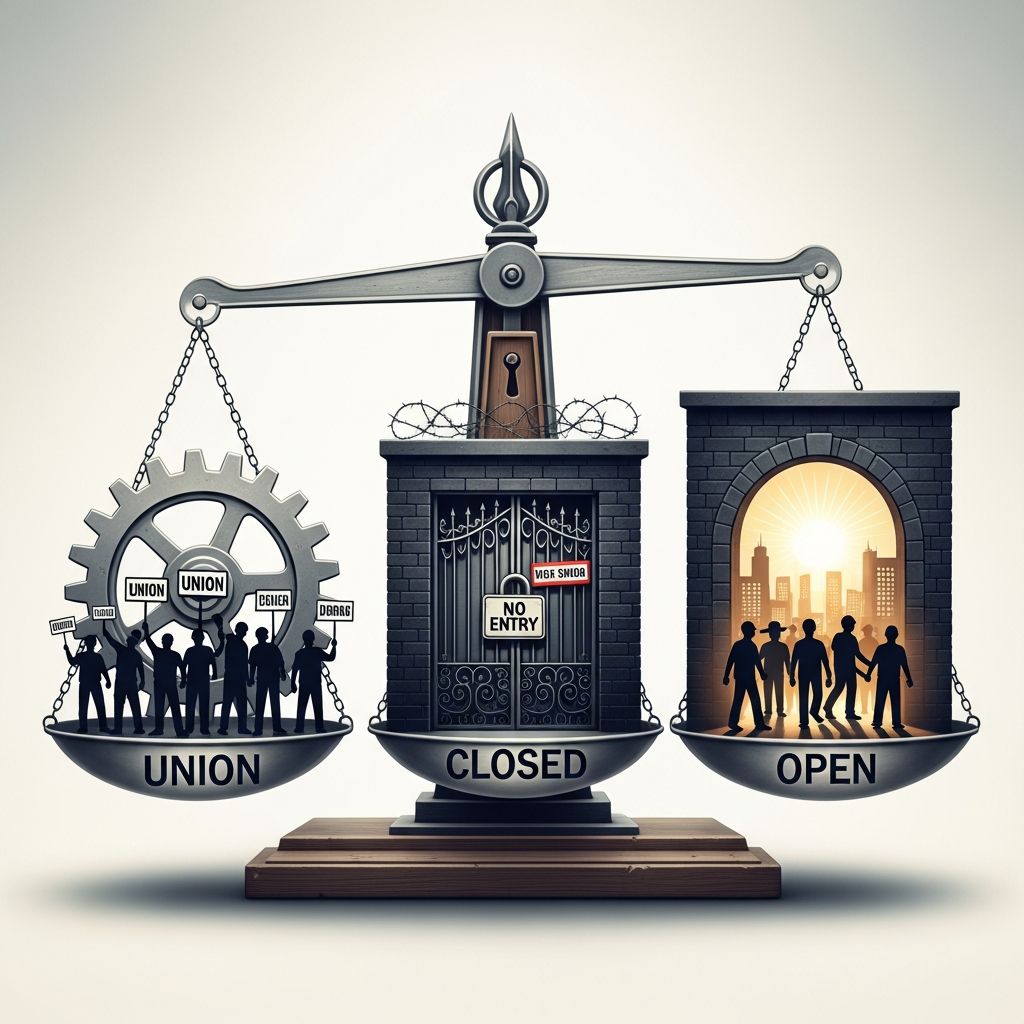
Union representation and mandatory union membership remain some of the most debated issues in U.S. labor law. Employees, employers, and unions all have a stake in how far the law allows a workplace to go in requiring union membership or union-related payments. This article explains the major types of union security arrangements—closed shops, union shops, agency shops, and open shops—and how federal and state law shape what is and is not legal in the United States.
1. What Are Union Security Agreements?
Union security agreements are contract clauses in a collective bargaining agreement that address whether workers must join a union or support it financially as a condition of employment. These clauses sit at the intersection of:
- Freedom of association for workers who prefer not to join a union.
- Collective bargaining strength for workers who want a strong, well-financed union.
- Predictability for employers negotiating with an organized workforce.
U.S. labor law, particularly the National Labor Relations Act (NLRA) and its amendment, the Labor Management Relations Act of 1947 (commonly known as the Taft–Hartley Act), sets the federal baseline on what kinds of union security provisions are allowed in private-sector workplaces.
2. Key Workplace Models: Closed, Union, Agency, and Open Shops
Most disputes about compulsory unionism center on four basic workplace models. The table below summarizes the core differences.
| Shop Type | Union Membership Required? | Union Dues or Fees Required? | General Legal Status in U.S. |
|---|---|---|---|
| Closed shop | Yes, before hiring | Yes, for entire employment | Prohibited under federal law |
| Union shop | Yes, after hiring | Yes, for members | Allowed by federal law but limited by state “right-to-work” laws |
| Agency shop | No | Yes, service/agency fees | Restricted or prohibited in many settings; unconstitutional in public sector after Janus for nonmembers |
| Open shop | No | No | Legal nationwide |
2.1 Closed Shops
A closed shop is an arrangement where an employer agrees to hire only workers who are already members in good standing of a particular union, and to discharge any worker who loses that membership. In effect, the union controls the gate to employment, and continued employment depends on staying in the union.
Under the Taft–Hartley Act, closed shops are specifically defined and made illegal in most private-sector employment. Federal law prohibits employers from promising to hire only union members or from firing employees merely for not being union members.
2.2 Union Shops
A union shop allows employers to hire workers regardless of whether they are union members, but requires those workers to join the union (or begin paying equivalent dues) shortly after being hired. The union must admit all qualified employees; it cannot arbitrarily block membership as a way to control jobs.
At the federal level, the NLRA permits union shop clauses in private-sector collective bargaining agreements where a union has majority support, unless state law says otherwise. Many states have limited or barred these arrangements through so-called right-to-work statutes (discussed below).
2.3 Agency Shops
An agency shop is a compromise model. Workers are not required to formally join the union, but nonmembers can be required to pay a service fee roughly equal to dues, to cover the costs of bargaining and contract administration. The idea is to prevent “free riders” from receiving union-negotiated benefits without contributing to the union’s costs.
Agency fee arrangements have been heavily litigated in the public sector. In 2018, the U.S. Supreme Court held in Janus v. AFSCME that compulsory agency fees for public employees who decline union membership violate the First Amendment, effectively ending mandatory agency fees in state and local government jobs nationwide. Private-sector agency shops are governed primarily by the NLRA and state laws.
2.4 Open Shops
An open shop is a workplace where employees are not required to join a union or pay any union-related fees as a condition of hiring or continued employment. Workers may still choose to join a union if one is present, but union membership is entirely voluntary.
Open shops are legal everywhere in the United States. In states with right-to-work laws, open shop rules are effectively required whenever a union is present, because employers and unions cannot enforce mandatory membership or dues obligations.
3. The Role of Federal Labor Law
Two major federal statutes govern union security agreements in most private workplaces:
- National Labor Relations Act (NLRA) of 1935 – Grants private-sector workers the right to form unions, bargain collectively, and engage in concerted activities, while regulating employer and union practices.
- Taft–Hartley Act (Labor Management Relations Act) of 1947 – Amends the NLRA, adds restrictions on unions, and explicitly outlaws closed shops.
3.1 How Taft–Hartley Changed Closed Shops
Before 1947, closed shop agreements were common in some heavily unionized industries. The Taft–Hartley Act made it an unfair labor practice for employers to agree to hire only union members or to condition employment on pre-existing union membership.
After Taft–Hartley:
- Employers cannot lawfully promise to hire only union members.
- Unions cannot require an employer to fire a worker for any reason other than failing to pay lawfully required dues in a permitted union shop or agency shop arrangement.
- The U.S. Department of Labor formally defines a
closed shop
as the hiring and employment of union members only, and classifies it as illegal.
3.2 Federal Baseline vs. State Choice
The NLRA generally preempts state regulation of private-sector collective bargaining, but it leaves a specific opening for states to decide whether union security clauses will be fully enforceable. Under Section 14(b) of the Taft–Hartley Act, states may enact laws that prohibit requiring union membership or dues as a condition of employment.
As a result, the legality of union and agency shop clauses today depends not just on federal law, but also on whether a state has a right-to-work statute in place.
4. Right-to-Work Laws and Their Impact
Right-to-work laws are state statutes that bar agreements requiring workers to join or pay a union as a condition of employment. The U.S. Supreme Court has recognized that the NLRA allows states to adopt such laws, and the U.S. Department of Labor treats closed shops as unlawful regardless of state law.
4.1 What Right-to-Work Does
In states with right-to-work laws:
- Employers and unions may not agree to require union membership as a condition of hiring or continued employment.
- Employees in a unionized workplace may choose not to join the union and may decline to pay union dues or agency fees.
- Unions still have a legal duty to represent all workers in the bargaining unit, even those who opt out of membership and dues.
Right-to-work laws therefore convert many potential union or agency shop arrangements into open shops by operation of state law.
4.2 Policy Debates
Right-to-work supporters argue that these laws protect individual freedom of choice and encourage a more attractive business environment. Opponents contend that right-to-work leads to weaker unions, lower wages, and fewer benefits for workers.
Empirical research is mixed and often influenced by methodology, but several academic studies have found associations between right-to-work statutes, lower union density, and changes in wage patterns across states. The policy debate continues at both the state and federal levels.
5. Practical Effects on Employers and Employees
Understanding the differences among closed, union, agency, and open shops is essential for evaluating rights and obligations on both sides of the employment relationship.
5.1 For Employers
Employers need to know not only their federal obligations, but also their state’s specific rules on union security arrangements. Key practical points include:
- Employers cannot lawfully agree to a closed shop provision in a private-sector collective bargaining agreement.
- In non–right-to-work states, employers may negotiate union or agency shop provisions, but only within the limits of federal law and court decisions.
- In right-to-work states, employers typically must operate on an open shop basis if their workforce is unionized.
- Employers remain obligated to bargain in good faith with the union that represents their employees, regardless of whether the workplace is open or union shop.
5.2 For Employees
For workers, the shop model determines how much choice they have over union membership and payments:
- In a closed shop (now unlawful in most private contexts), workers would have had to join before being hired and remain members to keep their jobs.
- In a union shop, new hires typically must join the union or begin paying dues after a defined probationary period, unless a state right-to-work law forbids that requirement.
- In an agency shop, workers who decline membership may still be charged a service fee, subject to legal limits, especially in the public sector after Janus.
- In an open shop, workers decide for themselves whether to join or financially support the union.
Regardless of individual membership decisions, if a union has been certified as the bargaining representative, the union’s contract typically covers all workers in the bargaining unit.
6. Advantages and Concerns: Different Perspectives
Debate over union security is not just legal; it reflects competing values about individual rights, collective power, and economic policy.
6.1 Arguments Favoring Stronger Union Security
- Collective bargaining strength: When nearly all workers contribute dues, unions can negotiate more effectively for wages, benefits, and safety protections.
- Reduced free riding: Mandatory dues or fees in union/agency shops are seen as a fair way to share the costs of representation.
- Stability in labor relations: Predictable union financing can reduce disruptive disputes over membership and dues collection.
6.2 Arguments Favoring Open Shop or Right-to-Work
- Individual freedom: No worker should have to join or fund a union to get or keep a job.
- Pluralism of views: Workers may disagree with union political positions and prefer not to support them financially.
- Competition and flexibility: Proponents argue that open shops and right-to-work laws can increase investment and job growth by making labor markets more flexible.
7. Choosing the Right Approach: Compliance and Strategy
For organizations and workers navigating these rules, several practical steps can help ensure both legal compliance and thoughtful policy choices.
7.1 For Employers Considering Union Agreements
- Confirm whether your state has a right-to-work law or other restrictions on compulsory union membership.
- Review the NLRA, NLRB guidance, and U.S. Department of Labor definitions on closed and union shops to avoid prohibited clauses.
- Work with experienced labor counsel when negotiating or revising collective bargaining agreements.
- Train HR and line managers to avoid practices that could be interpreted as unlawful support for, or interference with, a union’s organizing efforts.
7.2 For Employees Evaluating Union Membership
- Ask whether your workplace operates on an open, union, or agency shop basis.
- Review the union’s constitution, dues structure, and the collective bargaining agreement that will apply to you.
- Understand any deadlines for opting into or out of membership under current law and contract language.
- Consider both the benefits (bargained wages, benefits, protections) and the obligations (dues, participation expectations) before deciding.
8. Frequently Asked Questions (FAQs)
Q1: Are closed shops legal anywhere in the United States today?
Closed shops, defined as workplaces that hire and retain only union members, are illegal under federal labor law for most private-sector jobs. Even in states without right-to-work laws, employers cannot lawfully agree to hire only union members as a condition of employment.
Q2: How is a union shop different from a closed shop?
In a closed shop, workers must already be union members to be hired and must remain members to keep their jobs. In a union shop, workers can be hired as nonmembers but may be required to join the union or pay equivalent dues after a set period, unless a state right-to-work law prohibits that requirement.
Q3: Do right-to-work laws eliminate unions?
No. Right-to-work laws do not ban unions; they restrict the enforcement of contract clauses that require union membership or dues as a condition of employment. Unions may still organize workers, bargain collectively, and represent employees, but they must do so without compelling all covered workers to pay dues or fees.
Q4: Can public employees be required to pay agency fees if they are not union members?
In the public sector, the U.S. Supreme Court’s decision in Janus v. AFSCME holds that it violates the First Amendment to require nonmember public employees to pay agency fees. As a result, state and local government workers who decline union membership generally cannot be compelled to pay such fees.
Q5: Where can I find official legal definitions of closed and open shops?
The U.S. Department of Labor’s historical and educational materials define a closed shop as the hiring and employment of union members only and state that this practice is illegal under the Taft–Hartley Act. Additional background is available through reputable legal and reference sources such as Encyclopaedia Britannica and academic labor law texts.
References
- Glossary: Closed Shop — U.S. Department of Labor. 2023-01-10. https://www.dol.gov/general/aboutdol/history/glossary
- Closed Shop — Encyclopaedia Britannica. 2025-09-15. https://www.britannica.com/topic/closed-shop
- Closed Shop — National Labor Relations and U.S. labor practice (summary via high-quality reference). 2024-01-01. https://en.wikipedia.org/wiki/Closed_shop
- What Is a Union Shop? Closed Shop, Open Shop & Agency Shop — Paycor. 2022-06-30. https://www.paycor.com/resource-center/articles/what-is-a-union-shop/
- Closed Shop (Labor): Understanding Union Security Agreements — USLegal / Legal Resources. 2023-05-12. https://legal-resources.uslegalforms.com/c/closed-shop-labor
Similar Articles








Read full bio of medha deb




