
Understanding Virginia Gun Control Rules
A clear, practical overview of how Virginia regulates buying, owning, and carrying firearms and who is allowed to possess them.
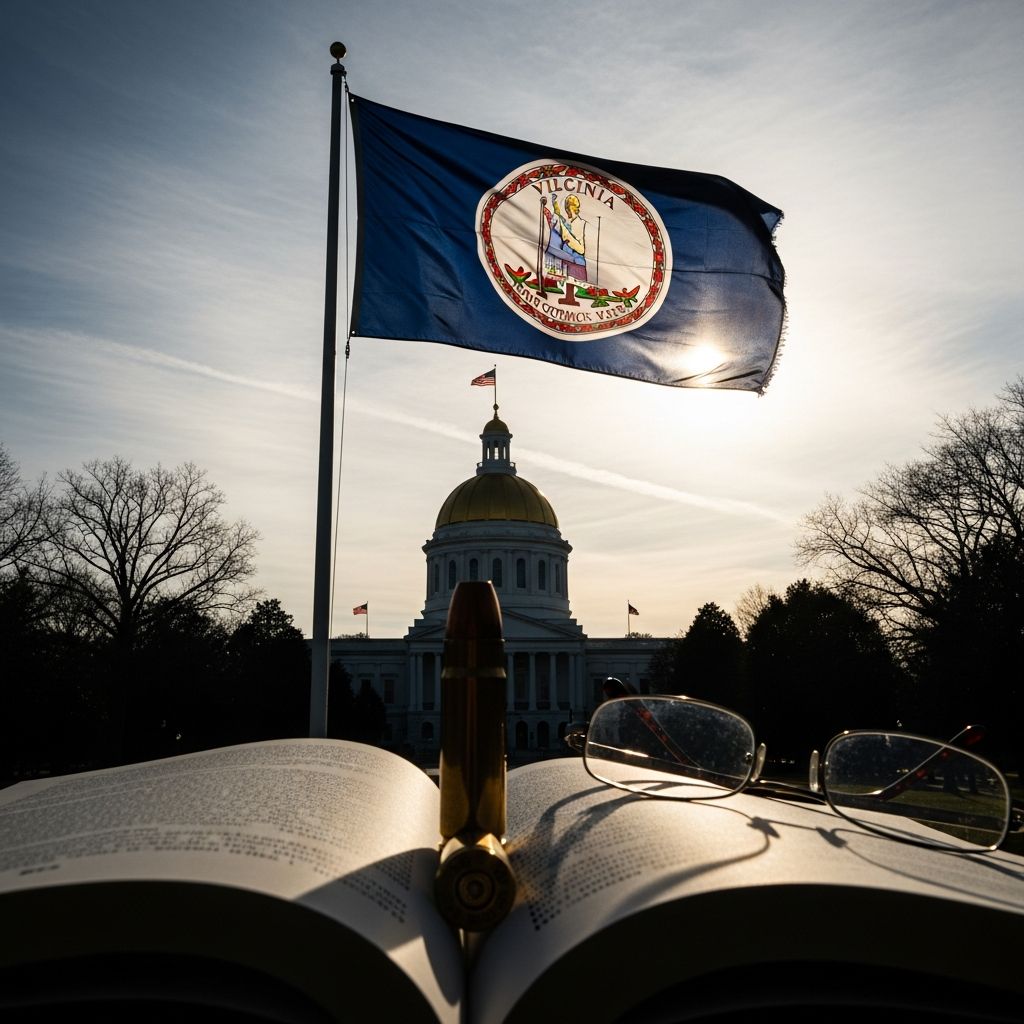
Virginia has a complex mix of firearm regulations that combine long-standing state rules with more recent gun safety reforms. This guide explains the main requirements for buying, owning, and carrying guns in Virginia, and highlights major situations that can affect a person’s right to possess a firearm.
Overview of Virginia Firearm Law
Virginia regulates firearms primarily through state statutes in Title 18.2 (Crimes and Offenses) and Title 18.2 and 18.2.2 for criminal procedure and enforcement, with licensing responsibilities shared by the Virginia State Police and courts for concealed handgun permits. These laws interact with federal rules enforced by the Bureau of Alcohol, Tobacco, Firearms and Explosives (ATF), which set baseline standards for background checks and prohibited persons.
Key themes in Virginia gun regulation include:
- Who may own or possess firearms
- How firearms may be purchased and transferred
- Where and in what manner guns may be carried
- Which types of weapons or accessories face added limits
- What happens when someone becomes prohibited or violates a gun law
Eligibility to Possess Firearms in Virginia
Virginia law and federal law both identify categories of people who may not legally possess firearms. Violations can carry serious criminal penalties.
People Prohibited Under State or Federal Law
Under a mix of state statutes and federal law (18 U.S.C. § 922), the following categories commonly face firearm prohibitions in Virginia:
- Individuals convicted of a felony (state or federal)
- Individuals convicted of certain violent misdemeanors involving assault or domestic violence
- People subject to certain final domestic violence protective orders
- Individuals who have been involuntarily committed or adjudicated mentally incompetent or dangerous
- Unlawful users of or addicts to controlled substances under federal law
- Non-citizens in prohibited immigration categories under federal statutes
Virginia also treats some violent misdemeanor convictions as disqualifiers for concealed carry and, in some cases, future firearm purchases.
Restoring Firearm Rights
Some individuals may petition to have their firearm rights restored after satisfying certain criteria. Typically, a person with a prior felony conviction must first seek restoration of civil rights (such as voting and jury service) through the Governor, and then may apply to a circuit court for a firearms rights restoration order. Courts review factors such as time since conviction, compliance with the law, and evidence of rehabilitation.
Buying a Firearm in Virginia
Virginia residents can buy firearms from licensed dealers and, subject to background check rules, from private sellers. No state-level purchase permit is generally required, but several safeguards now apply.
Minimum Age to Purchase
| Type of Firearm | Minimum Age to Purchase in Virginia |
|---|---|
| Handguns | 21 years old |
| Rifles and shotguns | 18 years old |
These age thresholds align with federal dealer requirements and are reflected in state-level policy summaries.
Background Checks and Waiting Periods
Virginia requires background checks for most firearm sales, including private sales between unlicensed individuals, closing gaps that previously allowed transfers without screening.
- Universal background checks: All commercial and many private transfers must go through a background check conducted by the Virginia State Police or via the federal National Instant Criminal Background Check System (NICS).
- Extended review period: Virginia lengthened the time allowed to complete a background check before a dealer may transfer a gun if NICS has not returned a final answer, addressing the so-called “Charleston loophole.”
Dealers must also keep transaction records as required by federal law, and certain transactions may be delayed or denied if the purchaser’s eligibility cannot be confirmed.
Limits on Multiple Purchases
Virginia has, at various times, limited handgun purchases to reduce trafficking. Recent reforms have again restricted many buyers to purchasing no more than one handgun within a 30-day period, with exceptions for concealed handgun permit holders, law enforcement, and other specified categories.
Possessing and Storing Firearms
Virginia does not require a general license to possess a regular rifle, shotgun, or handgun, but it does regulate some weapon types and expects gun owners to handle firearms responsibly.
General Possession Rules
- No basic registration requirement for most ordinary firearms
- No general state permit required just to own a firearm
- Possession of prohibited weapons such as unregistered “sawed-off” shotguns or rifles is criminal unless falling under narrow exceptions (for example, compliance with the federal National Firearms Act).
Safe Storage and Access by Minors
Virginia law addresses child access to firearms and, more recently, has moved toward stronger safe-storage expectations. Some statutes make it a crime to recklessly leave a loaded firearm in a manner that endangers a child, while new legislation under consideration emphasizes secure storage of firearms and ammunition in locked containers, particularly when minors are present.
Public health research by the Centers for Disease Control and Prevention (CDC) and others has associated safe storage—locked, unloaded, and separated from ammunition—with reduced risks of accidental shootings and youth suicides, providing context for such legislative efforts.[CDC WISQARS, 2023]
Carrying Firearms: Open and Concealed
Virginia historically permits open carry in many places but requires a permit for most concealed handgun carry in public.
Open Carry
According to guidance from the Virginia State Police, open carry of a handgun is generally lawful for those who may legally possess a firearm, except in specified prohibited locations or where local ordinances, school rules, or property rights restrict firearms.
- Open carry is often subject to location-based limits (such as on school property or in certain government buildings).
- Brandishing a firearm in a threatening manner, even when otherwise lawful to carry, can constitute a criminal offense.
Concealed Handgun Permits
To carry a concealed handgun in most public places in Virginia, an individual must obtain a Concealed Handgun Permit (CHP) issued by a circuit court in the applicant’s county or city of residence.
Typical requirements include:
- Being at least 21 years of age
- Lawful presence in the United States and Virginia residency (with limited provisions for non-residents)
- Completion of an approved firearms safety or training course
- No disqualifying criminal or mental health record under Virginia or federal law
The Virginia State Police explain that CHPs are generally valid for several years and must be renewed before expiration, with background checks conducted at issuance or renewal.
Reciprocity and Out-of-State Permits
Virginia recognizes concealed carry permits from many other states when certain conditions are met, subject to change through statutory amendments or administrative agreements. Travelers should verify current reciprocity listings on the Virginia State Police website before relying on an out-of-state permit.
Where Firearms Are Restricted
Even where a person may lawfully own and carry a gun, Virginia limits firearms in certain sensitive locations for safety and security reasons.
Common Prohibited or Restricted Places
- Schools and school property: Firearms are heavily restricted on K-12 school grounds and in school buildings, with limited exceptions such as law enforcement or authorized security personnel.
- Courthouses and some government buildings: Many courts and state facilities prohibit weapons, often enforced by posted notices and security screening.
- State Capitol and political demonstrations: Virginia has adopted measures restricting the public carry of firearms at the Capitol and at certain demonstrations or large political gatherings.
- Private property: Owners of private businesses and residences may bar firearms on their premises, and failure to comply with posted or direct requests can lead to trespass charges.
Special Categories: Assault-Style Weapons and Accessories
Virginia has moved toward stricter oversight of assault-style weapons and certain accessories, particularly those associated with rapid fire or enhanced lethality.
Assault-Style Firearms
While Virginia does not mirror all aspects of the most restrictive state bans, it has adopted or considered measures aimed at regulating semi-automatic centerfire rifles, pistols, and shotguns that share features with military-style weapons.
- Age-based restrictions on the purchase and possession of certain semi-automatic firearms
- Limits or proposed limits on carrying specific semi-automatic rifles and shotguns in public places open to the general public
- Prohibitions on the sale or possession of some newly manufactured magazines above a defined capacity threshold
The details of these provisions can change with each legislative session, so referring to the Virginia Legislative Information System (LIS) for current statutory text is essential.
Conversion Devices and Rapid-Fire Accessories
Policy summaries note that Virginia prohibits various devices that significantly increase the rate of fire or alter the basic operation of a semi-automatic firearm, such as bump stocks and auto sears. These restrictions align with broader federal enforcement trends and safety recommendations by national law enforcement organizations, which highlight the heightened risk posed by such devices.[DOJ, Final Rule on Bump-Stock-Type Devices, 2018]
Domestic Violence, Protective Orders, and Firearms
Firearm access in a domestic violence context is a major focus of recent reforms. Virginia law incorporates both state and federal protections for victims.
Firearms and Protective Orders
Under state law, final protective orders in family abuse or certain stalking and harassment cases typically bar the respondent from purchasing or possessing firearms during the order’s duration. Courts may require the individual to:
- Surrender firearms to law enforcement
- Sell firearms to a licensed dealer
- Transfer firearms to an eligible third party who does not reside with the respondent
Some pending or enacted bills also authorize law enforcement to seek search warrants if there is probable cause that a prohibited individual has not surrendered all firearms as ordered, improving compliance and victim safety.
Domestic Violence Convictions
Convictions for certain domestic violence offenses can trigger both state-level and federal prohibitions under the Lautenberg Amendment, permanently barring firearm possession in many cases. Courts, prosecutors, and defense counsel in Virginia must therefore carefully explain these consequences at the time of plea or sentencing.
Criminal Penalties and Enforcement
Violations of Virginia gun laws can result in misdemeanors or felonies, depending on the conduct involved.
- Felon in possession: A serious felony, often with mandatory minimum prison terms.
- Carrying a concealed handgun without a permit: Typically a misdemeanor for a first offense, escalating with prior convictions.
- Illegal transfer to a prohibited person: May expose the seller to criminal liability, especially if the seller knew or should have known the buyer was barred.
- Possession of certain prohibited weapons or devices: Frequently classified as felonies, including unregistered short-barreled rifles or shotguns and some unserialized “ghost guns.”
Law enforcement agencies rely on state statutes, federal partnerships, and court orders to enforce these provisions. The Virginia State Police maintain public guidance and FAQs explaining how many of these rules operate in practice.
Staying Current with Changes in the Law
Virginia’s gun laws have changed significantly in recent years and continue to evolve as lawmakers introduce new bills and policy packages. Anyone who owns or plans to purchase a firearm should periodically review:
- The Virginia Legislative Information System (LIS) for the current text of firearms statutes and newly enacted bills
- Virginia State Police firearms and concealed weapons FAQs for guidance on implementation and procedures
- Official updates from the Governor’s office or Attorney General on signed or vetoed legislation
Because penalties can be severe, it is wise to consult a qualified Virginia attorney for personalized legal advice, especially when facing criminal charges, protective orders, or questions about rights restoration.
Frequently Asked Questions About Virginia Gun Laws
Q: Do I need a license just to own a gun in Virginia?
No general license is required to own a typical handgun, rifle, or shotgun in Virginia, but separate rules apply if you want to carry a concealed handgun or possess certain restricted weapons.
Q: Is a background check required for a private gun sale?
Virginia law requires most firearm transfers, including many private sales, to go through a background check process, which can be initiated through a licensed dealer or state-approved channel.
Q: Can I openly carry a handgun without a permit?
In many parts of Virginia, adults who may legally possess a firearm can openly carry a handgun without a permit, but they must obey location-based restrictions and avoid threatening or reckless behavior.
Q: How do I get a concealed handgun permit in Virginia?
You generally file an application with your local circuit court, provide proof of firearms training, undergo a background check, and meet all state and federal eligibility requirements.
Q: What happens to my guns if I am subject to a domestic violence protective order?
Final protective orders in Virginia often require you to surrender, sell, or transfer your firearms and prohibit you from buying or possessing guns for the duration of the order, consistent with both state law and federal restrictions.
References
- Firearms/Concealed Weapons Frequently Asked Questions — Virginia State Police. 2024-05-01. https://vsp.virginia.gov/services/firearms/faq/
- Gun Laws in Virginia — Everytown Research & Policy. 2023-11-15. https://everytownresearch.org/rankings/state/virginia/
- VCDL’s 2025 Legislation Tracking Tool — Virginia Citizens Defense League. 2025-02-20. https://vcdl-lis.org
- Virginia State Gun Laws — NRA Institute for Legislative Action. 2024-06-10. https://www.nraila.org/gun-laws/state-gun-laws/virginia/
- SB1181 – 2025 Regular Session, Virginia General Assembly — Virginia Legislative Information System. 2025-02-18. https://lis.virginia.gov/bill-details/20251/SB1181/text/SB1181
- Final Rule – Bump-Stock-Type Devices — U.S. Department of Justice, Bureau of Alcohol, Tobacco, Firearms and Explosives. 2018-12-26. https://www.govinfo.gov/content/pkg/FR-2018-12-26/pdf/2018-27857.pdf
- Web-based Injury Statistics Query and Reporting System (WISQARS) — Centers for Disease Control and Prevention. 2023-10-10. https://www.cdc.gov/injury/wisqars/index.html
Similar Articles








Read full bio of Sneha Tete


