The federal courts of the United States form one of three co-equal branches of the national government, alongside Congress and the President. They interpret and apply federal law, resolve disputes under the U.S. Constitution, and ensure that the powers of government remain within constitutional limits. This guide explains how the federal courts are organized, what kinds of cases they hear, and how a case can move from a trial court all the way to the Supreme Court.
1. Constitutional Foundations of the Federal Judiciary
The structure and authority of the federal courts originate in the U.S. Constitution and are shaped further by federal statutes.
- Article III, Section 1 vests the “judicial Power of the United States” in one Supreme Court and in any lower courts that Congress chooses to create.
- Congress, using this authority, has established a multi-level system that now includes district courts, courts of appeals, and specialized tribunals.
- Federal courts operate within a broader system of constitutional checks and balances: Congress passes laws, the President enforces them, and the judiciary interprets them and can assess their constitutionality.
Because of this design, the federal courts are not simply dispute-resolvers. They also serve as guardians of constitutional rights and limits on governmental power.
2. Federal and State Courts: Parallel Systems
Every U.S. state has its own court system, and those state courts are entirely separate from the federal judiciary. Many legal disputes can be heard in either system, depending on the nature of the claim.
| Feature | Federal Courts | State Courts (general pattern) |
|---|---|---|
| Source of authority | U.S. Constitution and federal statutes | State constitutions and state laws |
| Main levels | District courts, courts of appeals, U.S. Supreme Court | Trial courts, intermediate appellate courts, state supreme court |
| Typical subject matter | Federal laws, U.S. Constitution, disputes between states, cases involving the U.S. government | State laws, family matters, contracts, property, many criminal cases |
| Highest court | U.S. Supreme Court | State supreme court (names vary) |
Although these two systems are separate, they sometimes interact. The U.S. Supreme Court can review certain decisions of state supreme courts when a federal question is involved, such as an alleged violation of the U.S. Constitution.[10]
3. The Three Main Levels of Federal Courts
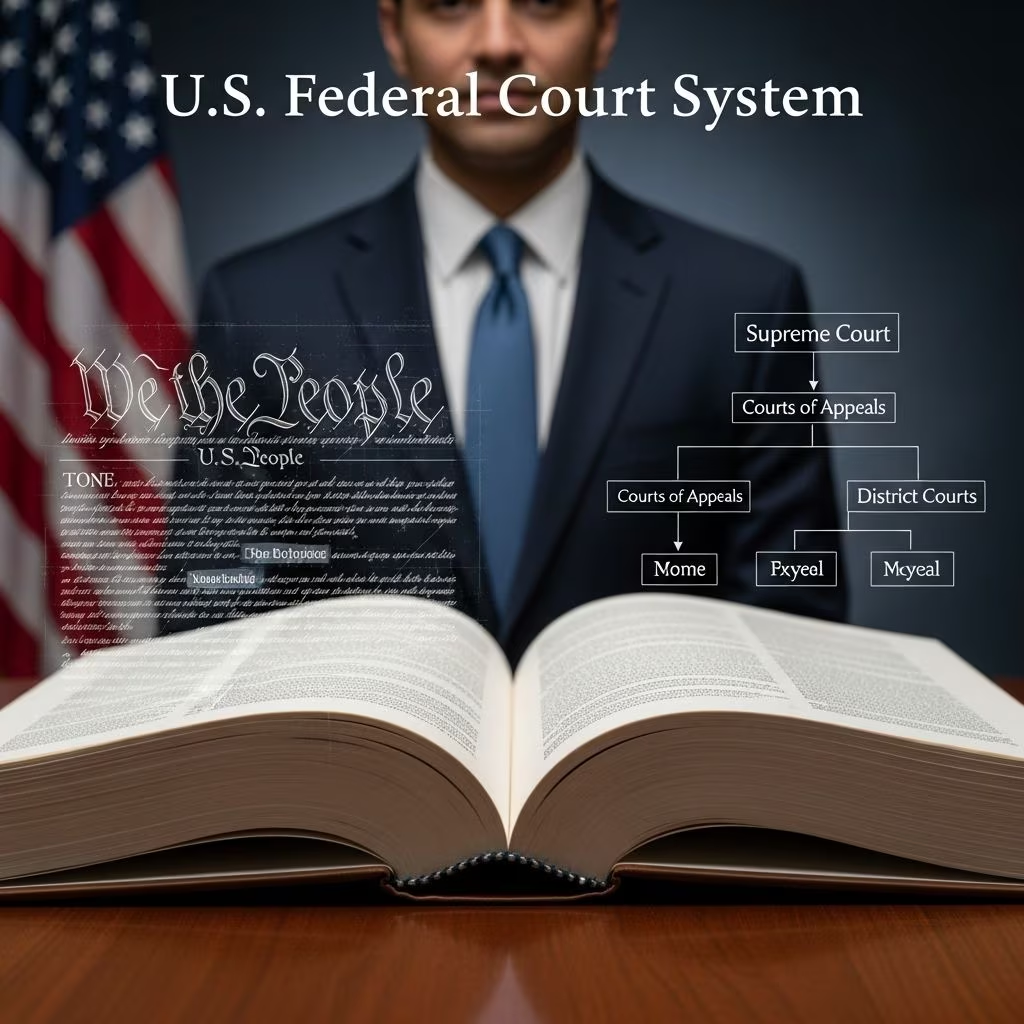
The core of the federal judiciary is often described as a three-tiered pyramid of trial, intermediate appellate, and final appellate courts.
- District courts: federal trial courts where cases begin and evidence is presented.
- Courts of appeals: intermediate appellate courts that review district court decisions.
- U.S. Supreme Court: court of last resort for federal questions.
3.1 U.S. District Courts: The Federal Trial Courts
The U.S. district courts are the workhorses of the federal system. They are the general trial courts for federal civil and criminal cases.
- There are 94 federal district courts located across the states and certain U.S. territories.
- Each district court has at least one federal district judge, along with support from magistrate judges and other judicial personnel.
- District courts conduct jury and bench trials, hear witness testimony, and receive exhibits and other evidence.
Federal district courts also include related judicial officers:
- Magistrate judges, who are appointed to limited terms and handle preliminary criminal proceedings, some civil matters, and assist district judges with pretrial work.
- Bankruptcy courts, which operate as units of the district courts and have exclusive jurisdiction over bankruptcy cases.
3.2 U.S. Courts of Appeals: Intermediate Review
Above the district courts are the U.S. courts of appeals, sometimes called the “circuit courts.” They review final decisions of the district courts and certain decisions of federal agencies.
- The system includes 13 courts of appeals: 12 regional circuits plus the U.S. Court of Appeals for the Federal Circuit.
- Each regional circuit covers a group of states and territories; for example, the Ninth Circuit includes much of the western United States.
- Cases are generally decided by panels of three judges; on rare occasions, a larger group of judges may rehear a case en banc.
Courts of appeals do not conduct new trials or hear new evidence. Instead, they:
- Review the record created in the district court.
- Examine legal briefs and, often, hear oral arguments from the parties.
- Decide whether the district court correctly applied the law to the facts.
Their decisions are binding within their circuits unless overruled by the U.S. Supreme Court or by the circuit sitting en banc.
3.3 The United States Supreme Court
The U.S. Supreme Court is the highest court in the federal system and the final authority on questions of federal law and the U.S. Constitution.
- The Court consists of nine justices: one Chief Justice and eight Associate Justices.
- Justices are nominated by the President, confirmed by the Senate, and hold office during “good Behaviour,” which has been interpreted as life tenure.
- The Court selects most of the cases it hears through a discretionary process (granting or denying certiorari) and accepts only a small fraction of the petitions filed each year.
In addition to hearing appeals, the Supreme Court has limited original jurisdiction—for example, in disputes between states—directly under the Constitution and federal statutes.
4. Types of Federal Courts Beyond Article III
Not all federal tribunals are created under Article III of the Constitution. Congress has also authorized specialized courts and bodies whose judges may serve fixed terms and whose jurisdiction is limited to particular subjects.
- Bankruptcy courts, which hear bankruptcy cases as separate units of the district courts.
- The U.S. Court of Appeals for the Federal Circuit, which has nationwide jurisdiction over specific types of cases, including patent appeals and certain claims against the federal government.
- Other specialized tribunals, such as tax and trade courts, whose powers and structures are defined by statute.
These specialized bodies help concentrate complex or technical disputes in forums with focused expertise.
5. What Kinds of Cases Do Federal Courts Hear?
Federal courts are courts of limited jurisdiction; they can hear only those types of cases that the Constitution and Congress authorize.[10] Broadly, their work falls into several categories:
- Cases involving federal law, such as disputes interpreting federal statutes, regulations, or treaties.
- Cases under the U.S. Constitution, including challenges to the constitutionality of federal or state actions.
- Cases to which the United States is a party, either as plaintiff or defendant.
- Disputes between states or between a state and citizens of another state, in certain circumstances.
- Admiralty and maritime cases, typically involving navigation and shipping.
- Some cases involving citizens of different states (diversity jurisdiction), if legal requirements such as the amount in controversy are satisfied.
By contrast, state courts handle the majority of day-to-day legal matters, including most criminal prosecutions, family law issues, and local business disputes, unless a specific federal question or jurisdictional hook is present.[10]
6. How a Case Moves Through the Federal Courts
Although every lawsuit is unique, many federal cases follow a common path from trial to final appeal.
6.1 Starting in the District Court
Most federal civil and criminal cases begin in a district court.
- A civil case typically starts when a plaintiff files a complaint alleging a violation of federal law or satisfying a jurisdictional ground such as diversity of citizenship.
- In a criminal case, the federal government—acting through a U.S. Attorney—charges a defendant with violating a federal criminal statute.
- The district judge oversees pretrial motions, manages discovery (the exchange of information), and then conducts a bench or jury trial if the case does not settle or resolve earlier.
6.2 Appeal to the Court of Appeals
After the district court enters a final judgment, an aggrieved party may usually appeal to the appropriate court of appeals.
- Appeals are typically limited to alleged errors of law or procedure; the appellate court does not re-try the case or hear new evidence.
- The parties submit written briefs and may participate in oral argument before a panel of judges.
- The court of appeals may affirm (agree with), reverse (overturn), or remand (send back) the case to the district court for further proceedings.
6.3 Possible Review by the Supreme Court
A party dissatisfied with the decision of a court of appeals can ask the Supreme Court to review the case by filing a petition for a writ of certiorari.
- The Supreme Court has broad discretion to decide which cases to hear and grants review in only a small percentage of petitions.
- Cases that are more likely to be accepted often involve conflicts between circuits, significant constitutional questions, or issues of national importance.
- When the Court decides a case, its ruling becomes binding precedent for all federal and state courts on questions of federal law.
7. Federal Judges: Appointment and Independence
The independence of the federal judiciary is closely tied to how federal judges are selected and how long they serve.
- Judges on the Supreme Court and courts of appeals, and district judges, are nominated by the President and confirmed by the Senate.[10]
- These judges hold office during good behavior, which has been interpreted as life tenure, subject to removal only through impeachment.
- Life tenure and protection against salary reduction are designed to insulate judges from political pressure and allow them to decide cases solely on the law and facts.
In contrast, some specialized judges, such as bankruptcy judges and magistrate judges, serve fixed terms and are selected through different processes.
8. Why the Federal Court System Matters
The decisions of federal courts shape the meaning of the Constitution and federal law for generations. Even cases involving only a few parties can establish legal rules that affect millions of people nationwide. Understanding how the system is structured and how cases move through it helps citizens, litigants, and students appreciate the role the courts play in American government.
Frequently Asked Questions (FAQs)
Q1: How many federal district courts are there?
There are 94 U.S. district courts, including districts in the 50 states, the District of Columbia, and several U.S. territories.
Q2: What is the difference between trial and appellate courts in the federal system?
District courts are trial courts that hear evidence, witness testimony, and conduct trials. Courts of appeals and the Supreme Court are appellate courts; they generally review how the law was applied in the trial court without receiving new evidence.
Q3: Can every case be appealed to the U.S. Supreme Court?
No. Most parties may ask the Supreme Court to hear their case, but the Court has discretion over the vast majority of its docket and grants review in only a small portion of petitions each term.
Q4: Are federal judges elected?
Article III federal judges are not elected. They are nominated by the President, confirmed by the Senate, and generally serve for life during good behavior, which promotes judicial independence.[10]
Q5: How do federal and state courts interact?
Federal and state courts are separate systems, but they sometimes hear similar types of disputes. The U.S. Supreme Court can review certain state supreme court decisions that turn on federal law, ensuring that the Constitution and federal statutes are interpreted uniformly across the country.[10]
References
- Court Role and Structure — Administrative Office of the U.S. Courts. 2023-01-01. https://www.uscourts.gov/about-federal-courts/court-role-and-structure
- Comparing Federal & State Courts — Administrative Office of the U.S. Courts. 2022-06-01. https://www.uscourts.gov/about-federal-courts/court-role-and-structure/comparing-federal-state-courts
- Introduction to the Federal Court System — U.S. Department of Justice, U.S. Attorneys. 2020-09-15. https://www.justice.gov/usao/justice-101/federal-courts
- U.S. Federal Courts 101 — The Constitutional Accountability Center. 2018-07-10. https://www.theusconstitution.org/u-s-federal-courts-101/
- What are the Levels of the Federal Courts? — Judicial Learning Center, St. Louis. 2019-05-20. https://judiciallearningcenter.org/student-center/organization-of-the-federal-courts/levels-of-the-federal-courts/
- Understanding the Federal Courts — NAACP. 2021-03-01. https://naacp.org/find-resources/know-your-rights/understanding-federal-courts
- U.S. Court System: Researching Case Law — University of Cincinnati Libraries. 2017-11-01. https://guides.libraries.uc.edu/c.php?g=222559&p=1472872