
Understanding U.S. Drug Schedules Under Federal Law
A clear, practical guide to how U.S. federal law classifies drugs, from Schedule I to Schedule V, and why it matters.
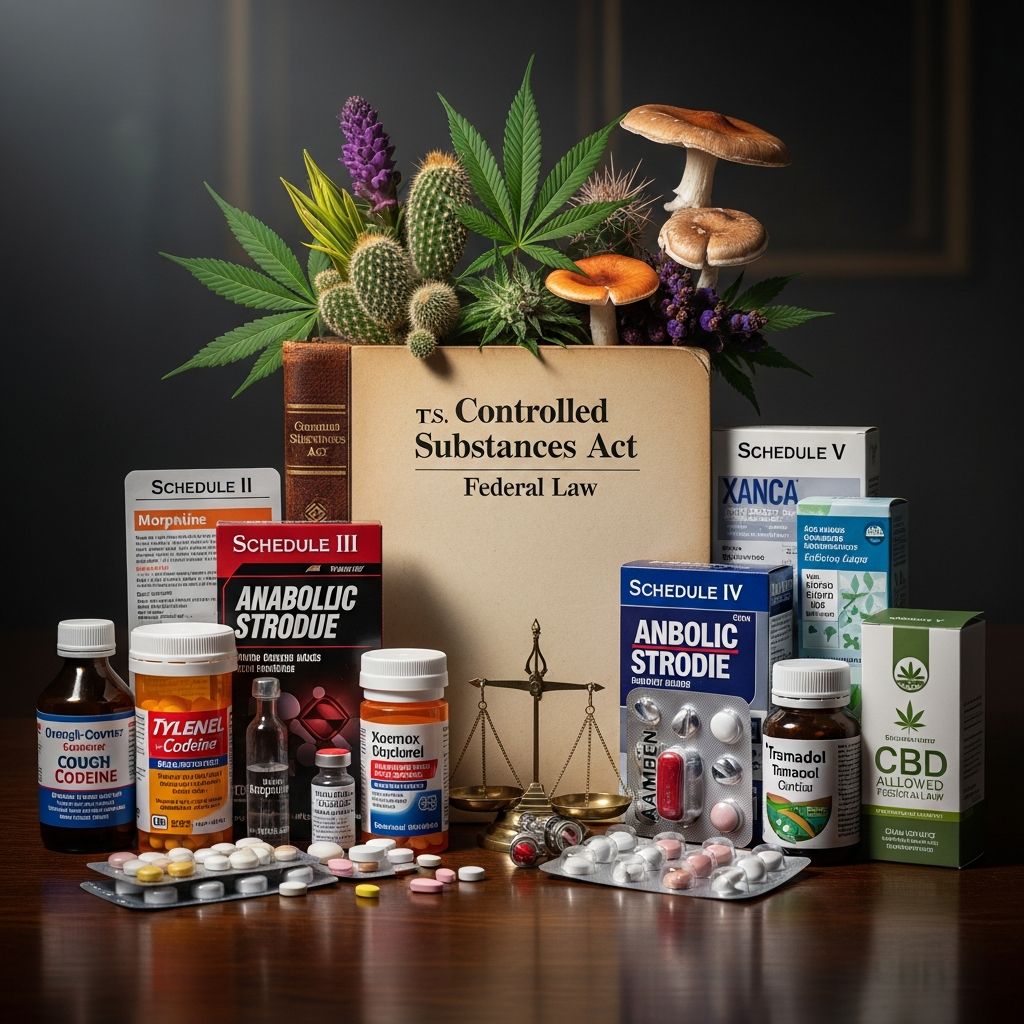
In the United States, many drugs are regulated under a federal law called the Controlled Substances Act (CSA), which places substances into five different schedules. These schedules determine how tightly a drug is controlled, how it may be prescribed, and what criminal penalties can apply for illegal possession or distribution.
This guide explains what drug scheduling is, how substances are placed into Schedules I–V, why these categories exist, and how they affect both everyday medical care and criminal cases.
1. The Legal Framework Behind Drug Scheduling
The modern federal scheduling system was created in 1970 when Congress passed the Controlled Substances Act as part of the Comprehensive Drug Abuse Prevention and Control Act.
- Purpose of the CSA:
- To regulate the manufacture, distribution, and possession of certain drugs and chemicals.
- To balance access to legitimate medical treatments with protection of public health and safety.
- Where the schedules are defined:
- The CSA establishes five federal schedules (I–V).
- An updated list of specific substances appears in Title 21 of the Code of Federal Regulations (CFR) §§ 1308.11–1308.15.
Together, the statute and regulations provide the legal foundation for classifying and controlling drugs throughout the country.
2. Who Decides How Drugs Are Scheduled?
Two main federal agencies share responsibility for which substances appear in each schedule:
- Drug Enforcement Administration (DEA)
- Part of the U.S. Department of Justice.
- Has primary authority to place a substance into a schedule, move it to a different schedule, or remove it from control.
- Enforces criminal laws relating to controlled substances.
- Food and Drug Administration (FDA) and the U.S. Department of Health and Human Services (HHS)
- Provide scientific and medical evaluations of drugs.
- Advise whether a substance has an accepted medical use and how risky it is.
- In some situations, HHS recommendations against control are binding on the DEA.
In practice, the DEA considers scientific data from HHS, public health information, and patterns of abuse before issuing regulations that add, remove, or reschedule a drug.
3. Key Factors Used to Classify a Drug
The CSA sets out core questions that must be considered before a drug is placed into a schedule. Across official sources, three factors consistently stand out:
- Potential for abuse – How likely is the substance to be misused, either medically or recreationally?
- Accepted medical use in the U.S. – Is the drug currently accepted for treatment, and if so, in what circumstances?
- Risk of dependence or addiction – What physical or psychological dependence can occur when the drug is abused?
Statutory and regulatory guidance also directs authorities to consider additional issues, such as:
- Scientific evidence of the drug’s effects.
- History and current patterns of abuse.
- Scope, duration, and significance of abuse for public health.
- Whether the substance is a precursor to another controlled substance.
These criteria help distinguish a high-risk drug with no recognized medical benefit from a lower-risk medicine that can safely be prescribed under appropriate supervision.
4. Comparing Schedules I–V at a Glance
The five federal schedules form a gradient from the most strictly controlled (Schedule I) to the least restricted (Schedule V). The table below summarizes their core legal characteristics.
| Schedule | Potential for Abuse | Accepted Medical Use? | Dependence / Safety Profile |
|---|---|---|---|
| I | High | No accepted medical use in U.S. | Not considered safe even under medical supervision; high risk of dependence. |
| II | High | Yes, but with severe restrictions | Abuse may lead to severe physical or psychological dependence. |
| III | Lower than I or II | Yes | Abuse may lead to moderate or low physical dependence or high psychological dependence. |
| IV | Relatively low | Yes | Abuse may lead to limited physical or psychological dependence compared with III. |
| V | Lower than IV | Yes | Limited risk of dependence; often includes low doses of certain narcotics. |
Although individual states may use their own classifications, federal schedules control how substances are handled nationwide and affect federal criminal charges.
5. Schedule I: Highest Control, No Accepted Medical Use
Schedule I substances are defined by law as having a high potential for abuse, no currently accepted medical use in treatment in the United States, and a lack of accepted safety for use even under medical supervision.
Key legal and practical features include:
- No routine prescribing or dispensing for medical treatment at the federal level.
- Use primarily limited to approved research under tight restrictions and registration requirements.
- Unlawful manufacture, distribution, or possession usually carries the most severe federal penalties.
Public debates frequently focus on whether certain substances should remain in Schedule I, especially when new research suggests potential medical applications.
6. Schedule II: High Risk but Recognized Medical Uses
Schedule II drugs also have a high potential for abuse, but unlike Schedule I substances, they have a currently accepted medical use in the United States, albeit with strict limitations.
Important characteristics:
- They may be prescribed, but under stringent rules regarding how prescriptions are issued, refilled, and documented.
- Abuse can lead to severe physical or psychological dependence, so medical professionals must monitor use carefully.
- Manufacturing, storage, and record-keeping requirements for pharmacies and hospitals are particularly strict.
Because these substances can be both medically valuable and highly addictive, Schedule II is central to discussions about pain management, opioid misuse, and prescription monitoring.
7. Schedule III: Moderate Abuse Risk and Dependence
Schedule III substances have a lower potential for abuse than Schedule I or II drugs and have accepted medical uses.
Key features include:
- Abuse can lead to moderate or low physical dependence or high psychological dependence.
- They may be prescribed and refilled, but with limits on how long prescriptions remain valid and how many refills are allowed without a new prescription.
- Regulations on storage and record-keeping are somewhat less strict than for Schedule II, but still more demanding than for many non-controlled medications.
Many Schedule III drugs are used in routine medical practice but remain controlled due to their potential for misuse.
8. Schedule IV: Lower Abuse Potential
Schedule IV drugs have a relatively low potential for abuse compared with Schedule III substances and are used widely in medical care.
Characteristics generally include:
- Abuse risk exists but is lower; dependence is typically limited compared with Schedule III.
- Prescriptions can usually be refilled several times (subject to statutory time and quantity limits) without a new visit, although details may vary under federal and state rules.
- Pharmacies must still treat them as controlled substances, with specific labeling and record-keeping requirements.
Because many common anxiety and sleep medications fall into this category, Schedule IV rules significantly affect everyday prescribing practices.
9. Schedule V: Lowest Level of Control Under the CSA
Schedule V substances have the lowest potential for abuse among controlled substances and have accepted medical uses.
Common regulatory characteristics:
- Abuse may lead to limited physical or psychological dependence relative to Schedule IV.
- Some Schedule V drugs contain low amounts of certain controlled ingredients, such as small quantities of codeine, often in combination products.
- In some jurisdictions, pharmacists may dispense specific Schedule V medicines under conditions that are less restrictive than for higher schedules, though federal and state rules must both be followed.
Even though Schedule V represents a lower risk level, these drugs remain controlled due to the potential for misuse when taken in large quantities or outside medical guidance.
10. How Re-Scheduling and New Scheduling Happen
Drug schedules are not fixed forever. A substance may be added to the schedules, moved between them, or removed entirely based on new information.
Key points about this process:
- Triggering events
- New scientific or medical evidence, such as studies on effectiveness or addiction risk.
- Changes in abuse patterns, including widespread non-medical use.
- International treaty obligations affecting control of certain substances.
- Evaluation
- HHS and FDA conduct medical and scientific reviews.
- DEA analyzes those findings alongside law enforcement and public health data.
- Rulemaking
- The DEA publishes proposed rules in the Federal Register.
- After receiving public comments, the DEA can finalize a rule that changes a drug’s schedule.
In urgent situations, federal law allows temporary or emergency scheduling to rapidly control a new or emerging substance while a full review is completed.
11. Why Drug Schedules Matter in Everyday Life
The scheduling system affects more than just legal texts. It shapes real-world experiences for patients, healthcare professionals, and anyone facing drug-related criminal allegations.
- For patients and caregivers
- Determines whether a medicine is available by prescription, how often it can be refilled, and what kind of monitoring may be required.
- Influences insurance coverage and pharmacy procedures.
- For healthcare providers
- Dictates registration requirements with the DEA for prescribing or dispensing controlled substances.
- Requires careful record-keeping and compliance with storage and inventory rules.
- For people facing charges
- Penalties for illegal possession, distribution, or manufacture often depend heavily on which schedule applies to the substance involved.
- Higher schedules generally correspond to stricter sentencing ranges under federal law.
Understanding schedules can help individuals recognize the seriousness of certain conduct, communicate effectively with medical providers, and better grasp the legal consequences of drug-related activity.
12. Common Misunderstandings About Drug Schedules
Misinterpretations of the scheduling system can lead to confusion about what the law actually says. Some frequent misconceptions include:
- “If a drug is scheduled, it must be illegal to use it.”
In reality, many scheduled drugs (especially in Schedules II–V) are lawful when prescribed and used as directed. The schedules regulate how they can be manufactured, prescribed, and dispensed, not whether they are always illegal. - “A higher schedule number means more danger.”
The opposite is true. Schedule I is the most restrictive, and Schedule V is the least restrictive. The numbering runs from I (highest control) to V (lowest). - “Scheduling never changes.”
Substances can be added, moved, or removed based on new evidence, public health concerns, and international agreements. Recent drug policy debates show that re-evaluation is ongoing. - “All drugs of abuse are in the schedules.”
Some substances that can be misused, such as alcohol and tobacco, are regulated by other legal frameworks and are not currently scheduled under the CSA.
13. Frequently Asked Questions (FAQs)
Q1: Are federal drug schedules the same as state schedules?
Not always. The CSA establishes federal schedules that apply nationwide, but individual states can create their own controlled substance laws and classifications. State schedules often track federal ones but may differ in how a substance is categorized or penalized. When both apply, prosecutors may choose to bring federal, state, or both types of charges depending on the case.
Q2: Does scheduling determine whether a drug is safe?
Scheduling is a legal classification based on abuse potential, accepted medical use, and dependence risk, not a guarantee of safety. A Schedule II drug may be medically useful but still carry serious risks if misused, while a Schedule V medication can be harmful if taken at high doses or without medical guidance.
Q3: Can a doctor prescribe Schedule I drugs?
Under current federal law, Schedule I substances have no accepted medical use and are not available for routine prescribing. Use is generally limited to approved research with special DEA registration and strict oversight. Some states have separate laws for certain substances, but those do not change the federal prohibition.
Q4: How does a new drug end up in a schedule?
When a new substance appears—either as a pharmaceutical product or an emerging street drug—federal agencies review scientific studies, medical evidence, and abuse data. HHS and FDA evaluate the substance and provide recommendations, while the DEA considers law enforcement and public health factors. After public rulemaking, the DEA assigns the substance to a schedule, if appropriate.
Q5: Where can I find the official list of controlled substances?
The DEA publishes the official list of scheduled substances in Title 21 of the Code of Federal Regulations, sections 1308.11 through 1308.15, and maintains accessible information on its public website. Because rules can change, it is important to consult recent official sources or a qualified attorney for up-to-date information.
References
- Controlled Substance Schedules — U.S. Drug Enforcement Administration (DEA). 2024-01-01. https://www.deadiversion.usdoj.gov/schedules/schedules.html
- Drug Scheduling — U.S. Drug Enforcement Administration (DEA). 2022-09-01. https://www.dea.gov/drug-information/drug-scheduling
- Controlled Substances Act — U.S. Code & related summary (via background description). 2023-01-01. https://en.wikipedia.org/wiki/Controlled_Substances_Act
- Drug Enforcement Administration Drug Scheduling — StatPearls Publishing (NCBI Bookshelf). 2023-07-30. https://www.ncbi.nlm.nih.gov/books/NBK557426/
- Controlled Substances — Rosalind Franklin University of Medicine and Science. 2021-06-01. https://www.rosalindfranklin.edu/research/research-support-offices/environmental-health-and-safety/controlled-substances/
- Controlled Substances Act and Drug Scheduling — Addiction Center. 2023-02-15. https://www.addictioncenter.com/addiction/controlled-substances-act-and-scheduling/
- Drug Scheduling & Classifications (Schedule I–V) — American Addiction Centers. 2023-06-01. https://americanaddictioncenters.org/prescription-drugs/classifications
}
Similar Articles








Read full bio of medha deb




