
Understanding Traffic Ticket Types and Their Legal Consequences
Learn the main categories of traffic tickets, how they differ, and what each one can mean for your license, insurance, and criminal record.
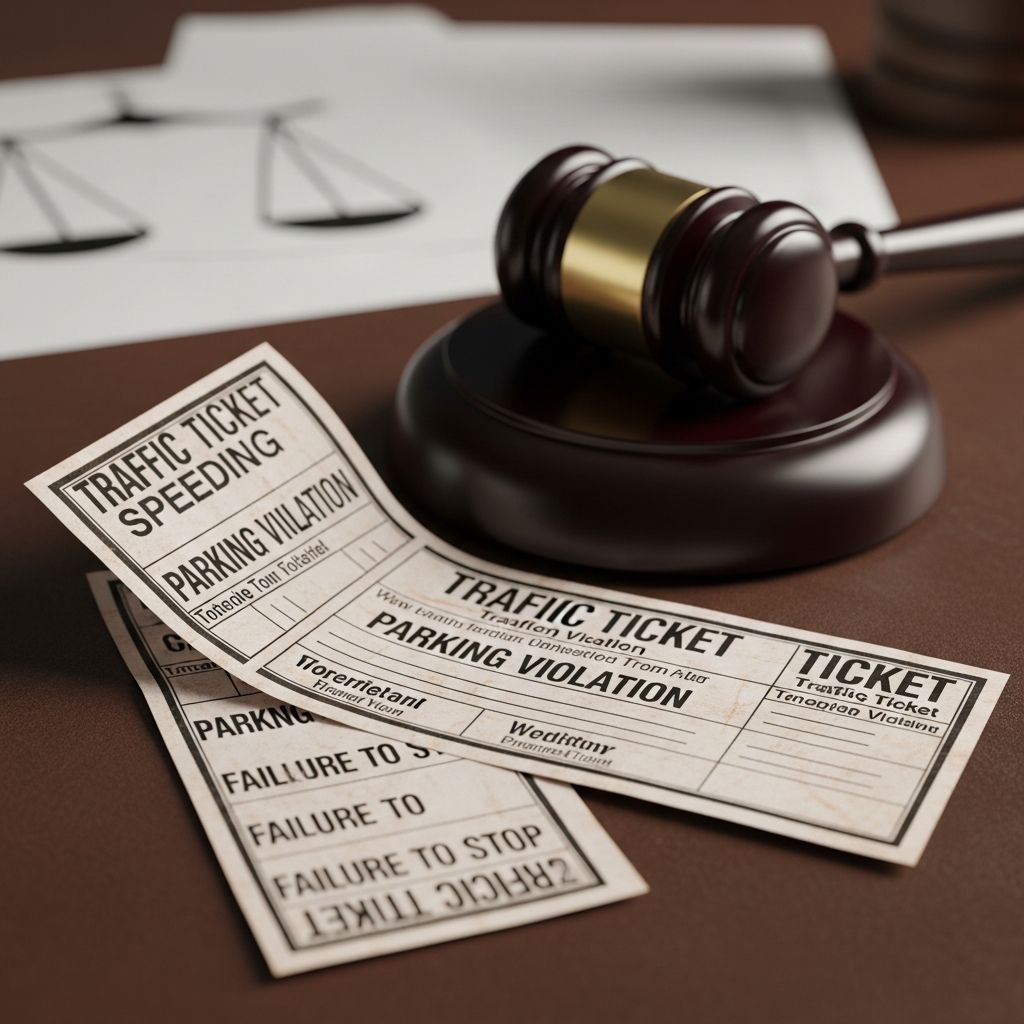
Traffic tickets might look similar on paper, but the law treats different violations in very different ways. A simple parking ticket is not handled the same way as a DUI, and a low-level speeding ticket does not carry the same risks as reckless driving or hit-and-run. Understanding the types of traffic tickets can help you make informed choices about whether to pay, contest, or seek legal help.
1. Core Legal Categories of Traffic Violations
Every state’s traffic code uses its own terminology, but most systems divide traffic violations into a few broad legal categories.
1.1 Infractions, Misdemeanors, and Felonies
From least to most serious, traffic violations usually fall into three levels:
- Civil infractions
- Typically non-criminal.
- Common examples: minor speeding, rolling a stop sign, failure to signal, most parking tickets.
- Normal penalties: fines, court costs, possible points on your license, but no jail time in most jurisdictions.
- Misdemeanor traffic offenses
- Criminal charges that are more serious than infractions but less serious than felonies.
- Typical examples: reckless driving, driving on a suspended license, DUI in many states, leaving the scene of a minor accident.
- Possible penalties: higher fines, probation, license suspension, and potential jail time.
- Felony traffic offenses
- The most serious traffic-related crimes, often involving injury, death, or extreme recklessness.
- Examples: vehicular homicide, felony DUI (often for repeat offenders or where serious injury occurs), hit-and-run involving serious injury or death.
- Possible penalties: substantial fines, long-term license revocation, and imprisonment.
1.2 Moving vs. Nonmoving Violations
In many states, traffic violations are further classified based on whether the vehicle was in motion at the time.
| Type | Definition | Typical Examples | Common Consequences |
|---|---|---|---|
| Moving violations | Violations committed while the vehicle is being driven. | Speeding, running a red light, tailgating, unsafe lane changes, DUI. | Fines, points, insurance increases, possible suspensions for serious or repeated offenses. |
| Nonmoving violations | Violations not directly tied to a vehicle in motion. | Parking tickets, expired registration, equipment violations, plate display issues. | Fines; often no points, but repeated violations or nonpayment can still cause consequences such as registration holds. |
2. Common Moving Traffic Tickets
Most tickets that affect points and insurance are moving violations. Although details vary by state, several types of tickets appear frequently in court records and driver histories.
2.1 Speeding and Speed-Related Offenses
Speeding is one of the most widely issued traffic tickets nationwide, and states regulate speed using different legal approaches.
- Absolute speed limit laws
- Any speed above the posted limit can be a violation, even by 1 mph.
- Proof usually focuses on how the officer measured your speed (radar, lidar, pacing, etc.).
- Basic (or general) speed laws
- Driving is illegal if your speed is unsafe for current conditions, even if you are under the posted limit.
- Conditions considered: traffic, weather, visibility, road design, nearby hazards.
- Presumed (prima facie) speed limits
- Driving somewhat above the posted limit may be lawful if you can prove it was still safe under the circumstances.
- Gives drivers more room to argue that their speed was reasonable.
Some states tie the number of points and fine amounts directly to how far over the limit the driver was going, reflecting the higher crash risk at higher speeds.
2.2 Right-of-Way and Signal Violations
Tickets can also arise from failing to yield the right of way or obey traffic control devices.
- Failure to yield
- Not yielding at uncontrolled intersections, when turning left, or to pedestrians in crosswalks.
- Can be issued even if no collision occurs.
- Stop sign violations
- Rolling through a stop sign instead of coming to a complete stop.
- Often treated as a basic moving violation with fines and points.
- Red light tickets
- Entering an intersection after the light turns red.
- Increasingly enforced by automated cameras that photograph the vehicle and plate.
2.3 Turns, Lane Changes, and Passing
Many dangerous crashes involve improper turns or lane maneuvers, so states closely regulate these behaviors.
- Illegal or unsafe turns
- Improper U-turns (for example, in business districts or where prohibited by signs).
- Failing to stay in the proper lane during a turn or turning from the wrong lane.
- Turning against a sign or signal.
- Unsafe lane changes
- Weaving across lanes without signaling or checking for other vehicles.
- Changing lanes where prohibited by lane markings or signage.
- Improper passing
- Passing on the right when not allowed, or crossing solid lines to pass.
- Passing near curves, hills, or intersections where visibility is limited.
2.4 Following Too Closely (Tailgating)
“Tailgating” is legally known as following too closely and is a frequent contributing factor in rear-end collisions.
- States often use a flexible, conditions-based standard instead of a fixed distance rule, asking whether the following distance was “reasonable and prudent.”
- Teaching guidelines (such as one car length per 10 mph) are common, but they are not always written into law; the actual statute focuses on safety under the conditions.
- Tickets may be issued even if no crash occurs.
2.5 Distracted Driving and Cell Phone Tickets
Many states now issue specific cell phone and texting tickets as part of broader efforts to reduce distracted driving.
- Most states prohibit texting while driving, and many restrict or ban handheld phone use.
- Some laws make texting or handheld use a primary offense, meaning an officer can stop a driver solely for that behavior.
- Penalties may include heavy fines and, in some jurisdictions, points or enhanced penalties for repeat violations.
3. Nonmoving Violations and Equipment Tickets
Nonmoving violations may seem minor, but they can still be costly and can indirectly affect your ability to drive.
3.1 Parking and Stopping Violations
- Expired meters or parking beyond time limits.
- Parking in prohibited zones, such as fire lanes, loading zones, or in front of driveways.
- Unauthorized parking in accessible (disabled) spaces, which often carries significantly higher fines and, in some states, additional penalties.
These tickets usually do not go on your driving record, but unpaid fines can result in registration holds, late fees, or vehicle immobilization (for example, booting or towing).
3.2 Registration, Licensing, and Insurance Issues
Some nonmoving tickets arise from paperwork and status issues rather than driving behavior.
- Expired registration or failure to display current tags.
- Driving without proof of insurance or maintaining required coverage.
- Driving without a valid license or with an improperly classified license (for example, operating a commercial vehicle without a commercial license).
Depending on state law, these can be infractions or misdemeanors, and some can trigger suspensions or higher penalties if not corrected quickly.
3.3 Vehicle Equipment Violations
States require vehicles to meet basic safety and visibility standards. Equipment tickets may involve:
- Broken or nonfunctional lights (headlights, brake lights, turn signals).
- Cracked windshields or obstructed views.
- Excessive window tint beyond legal limits.
- Missing or improperly mounted license plates.
Many jurisdictions allow drivers to correct the defect and show proof (sometimes called a “fix-it” ticket) for reduced fines or dismissal.
4. Serious Traffic Crimes: When Tickets Become Criminal Cases
Certain traffic behaviors go beyond ordinary infractions and may lead to arrest, criminal charges, and court-ordered penalties.
4.1 Reckless and Aggressive Driving
Reckless driving typically involves operating a vehicle with a willful or wanton disregard for the safety of people or property.
- Examples may include extreme speeding, racing, weaving through dense traffic, or driving in a way that obviously endangers others.
- Usually charged as a misdemeanor, but it can be enhanced if injuries or serious damage occur.
- Consequences can include high fines, license suspension, points, and possible jail time, especially for repeat offenders.
4.2 Driving Under the Influence (DUI / DWI)
DUI/DWI laws prohibit driving while impaired by alcohol, drugs, or a combination of both.
- States set per se blood alcohol concentration (BAC) limits (commonly 0.08 for adults) and lower limits for commercial drivers or underage drivers.
- Penalties usually include fines, license suspension, mandatory education or treatment programs, and, in many cases, jail time for first or repeat offenses.
- Aggravating factors (high BAC, minors in the vehicle, accidents causing injury) can increase penalties or lead to felony charges.
4.3 Hit-and-Run and Leaving the Scene
Leaving the scene of an accident without providing required information or assistance is a serious offense in every state.
- Minor property damage incidents might be charged as misdemeanors.
- Crashes involving injury or death are more likely to be felonies, with substantial penalties and long-term license consequences.
5. Points Systems and Long-Term Consequences
Many states use a driver’s license point system to track repeated violations and identify high-risk drivers.
5.1 How Points Work
- Each moving violation is assigned a point value based on severity; more dangerous behaviors carry more points.
- Accumulating too many points within a given time frame can lead to warnings, mandatory driving courses, suspension, or revocation of driving privileges.
- Points may gradually decrease or “age off” after a specified period without new violations.
5.2 Impact on Insurance and Records
- Insurance companies often review traffic records when setting premiums; frequent or serious moving violations typically result in higher rates.
- Some serious offenses, such as DUI or reckless driving, can remain on your driving record for many years and influence both insurance and employment opportunities.
6. Options for Handling a Traffic Ticket
Once you receive a traffic ticket, your options depend on the type and severity of the alleged violation.
6.1 Paying vs. Contesting
- Paying the ticket
- Often treated as an admission of guilt or responsibility.
- May result in points and possible insurance consequences.
- Contesting the ticket
- Involves pleading not guilty and requesting a hearing.
- May lead to dismissal, reduction of charges, or a plea agreement, depending on the evidence and local practice.
- Mitigation or diversion options
- Some jurisdictions allow drivers to attend traffic school or defensive driving courses in exchange for reduced points or dismissal of the ticket.
- Eligibility often depends on prior record and the nature of the current offense.
7. Frequently Asked Questions (FAQs)
Q1: Do all tickets put points on my driver’s license?
No. In many states, only moving violations result in points, while nonmoving violations (such as parking tickets) usually do not. However, unpaid nonmoving tickets can still lead to registration holds or other administrative actions.
Q2: Is a traffic infraction a crime?
Often, traffic infractions are civil, not criminal, and are handled by paying a fine or contesting the ticket in traffic court. In contrast, offenses like reckless driving, DUI, or hit-and-run are typically criminal and may involve jail time, probation, and a permanent record.
Q3: Can a speeding ticket be a misdemeanor or felony?
Ordinary speeding is usually treated as a civil infraction, but extreme speeding or racing can be charged as reckless driving, which is often a misdemeanor. When speeding contributes to serious injury or death, prosecutors may bring felony charges under vehicular assault or homicide statutes, depending on state law.
Q4: How long will a traffic ticket stay on my record?
The retention period varies by state and by offense. Some minor infractions may affect points for only a few years, while serious offenses like DUI or hit-and-run may remain on your driving record much longer and carry additional legal consequences.
Q5: When should I consider talking to a lawyer about a traffic ticket?
You may want legal advice if you are facing a criminal traffic charge (such as DUI, reckless driving, or driving on a suspended license), if your license is at risk of suspension due to accumulated points, or if a commercial or professional driving license is involved.
References
- Types of Traffic Tickets and Penalties — Super Lawyers. 2023-08-01. https://www.superlawyers.com/resources/traffic-violations/types-of-traffic-tickets-and-penalties/
- Types of Traffic Tickets Under the Law — Justia. 2022-06-15. https://www.justia.com/traffic-tickets/types-of-moving-violations/
- Traffic Violations: Are All Traffic Tickets Misdemeanors? — Nolo. 2022-03-10. https://www.nolo.com/legal-encyclopedia/types-of-traffic-violations.html
- Points System — South Carolina Department of Motor Vehicles. 2023-05-01. https://www.scdmvonline.com/Driver-Services/Points-System
- Understanding South Carolina Traffic Tickets and Penalties — MyImprov / South Carolina data. 2023-07-10. https://www.myimprov.com/understanding-south-carolina-traffic-tickets-and-penalties/
- Points System and Fines — Clemson University Municipal Court. 2023-09-01. https://www.clemson.edu/campus-life/municipal-court/court-info/points.html
Similar Articles








Read full bio of medha deb




