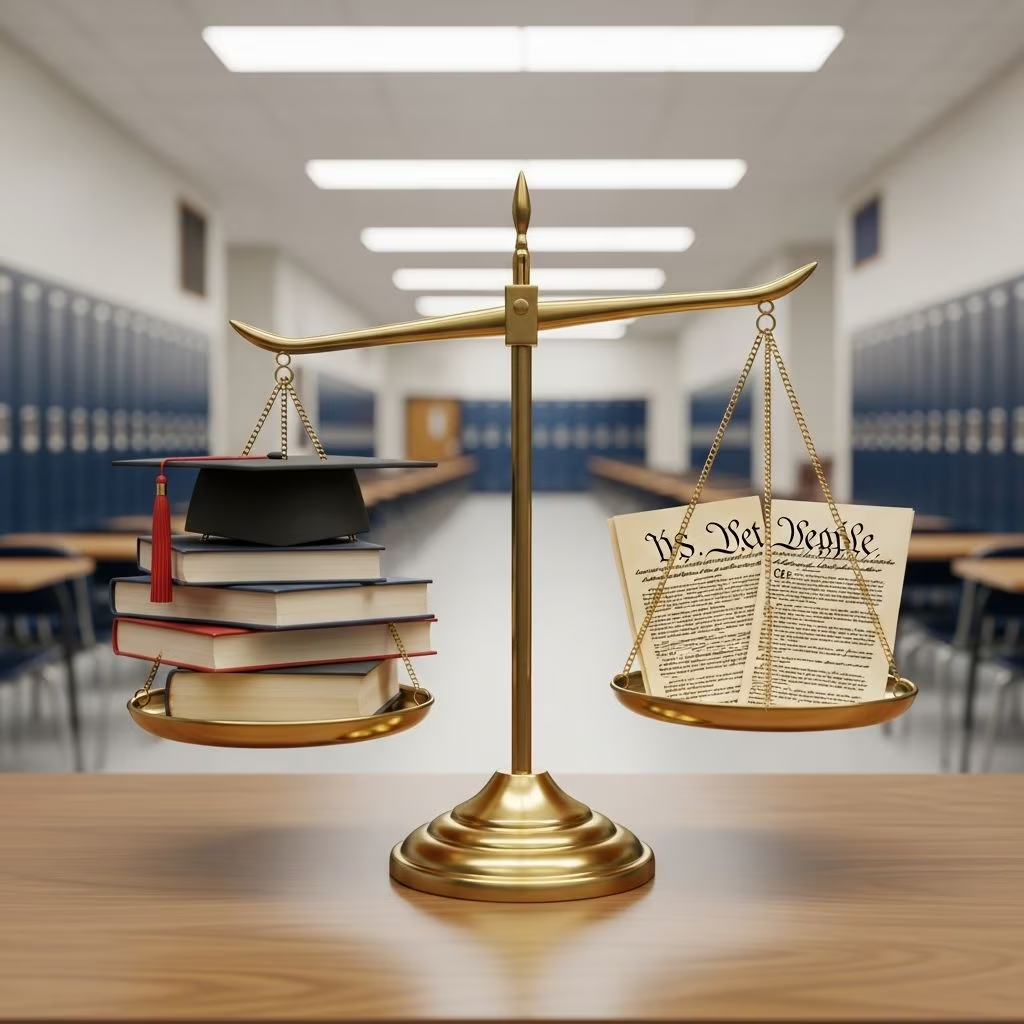
Students in the United States do not leave their legal protections at the school door. Public schools, as government entities, must respect core constitutional and civil rights, and many of these protections also extend to colleges, universities, and career schools that receive federal funds. This guide explains the most important student rights, where they come from, and how they work in everyday school life.
1. Why Student Rights Matter
Education is widely recognized as a fundamental human right and an essential foundation for participation in society. In the U.S., that right is also shaped by the Constitution and a network of federal civil rights laws that govern how schools treat students.
Understanding your rights helps you:
- Recognize when school rules or decisions may be unlawful
- Communicate more effectively with teachers and administrators
- Protect yourself and others from discrimination or unfair discipline
- Know when and how to ask for legal or advocacy help
2. The Legal Foundations of Student Rights
Most student protections in U.S. public schools come from three main sources:
- Constitutional rights – such as freedom of speech, due process, and equal protection, which apply to government actors (including public schools)
- Federal civil rights statutes – laws that prohibit discrimination on the basis of race, color, national origin, sex, disability, and age in programs receiving federal funds
- State constitutions and statutes – which often guarantee access to education and may add extra protections beyond federal law
| Legal Source | What It Protects | Where It Usually Applies |
|---|---|---|
| U.S. Constitution (First & Fourteenth Amendments) | Free speech, religion, due process, equal protection | Public K–12 schools and public colleges |
| Title VI of the Civil Rights Act of 1964 | No discrimination based on race, color, national origin | Any school receiving federal funds |
| Title IX of the Education Amendments of 1972 | No sex-based discrimination (including sexual harassment) | Most K–12 schools, colleges, and universities |
| Section 504 of the Rehabilitation Act & ADA | No disability discrimination; reasonable accommodations | Public schools and private schools receiving federal funds |
| Age Discrimination Act of 1975 | No discrimination based on age | Education programs with federal assistance |
3. The Right to Access Education
While the U.S. Constitution does not label education as a fundamental right, state constitutions and federal civil rights law together ensure that students have meaningful access to schooling.
- Compulsory education laws in every state require most children to attend school up to a certain age and guarantee a publicly funded education.
- Equal access rules bar schools receiving federal funds from excluding students based on race, color, national origin, sex, disability, or age.
- Undocumented and immigrant children have the right to attend public elementary and secondary schools on the same basis as other children; immigration status alone cannot be used to exclude them.
International human rights standards, such as Article 26 of the Universal Declaration of Human Rights, also affirm education as a right for everyone without discrimination, shaping global norms that influence U.S. policy debates.
4. Freedom from Discrimination
Schools that receive federal financial assistance must comply with several major civil rights laws enforced by the U.S. Department of Education’s Office for Civil Rights (OCR).
4.1 Protected characteristics
Schools generally may not discriminate in admissions, academics, discipline, counseling, or extracurricular opportunities on the basis of:
- Race, color, or national origin (Title VI)
- Sex, including pregnancy, sexual harassment, and sexual violence (Title IX)
- Disability (Section 504 of the Rehabilitation Act; Title II of the ADA)
- Age (Age Discrimination Act of 1975)
4.2 Areas where discrimination rules apply
OCR’s enforcement covers a wide range of school functions, including:
- Admissions and recruitment
- Financial aid and scholarships
- Academic programs and grading
- Student services, counseling, and guidance
- Discipline and classroom assignment
- Vocational education and career training
- Athletics, recreation, and physical education
- Housing and employment related to education programs
5. Free Speech, Expression, and Religion
Public school students generally have First Amendment rights, although those rights can be limited when necessary to maintain an orderly learning environment.
5.1 Student speech in school
The Supreme Court has recognized that public school students do not lose all free speech rights “at the schoolhouse gate,” but schools may restrict expression that substantially disrupts school activities or infringes on the rights of others.
Key practical points:
- Students often may express personal opinions in hallways, on clothing, or in student publications, as long as it is not vulgar, threatening, or school-sponsored in a way that suggests official endorsement.
- Schools may place reasonable limits on the time, place, and manner of student expression to maintain safety and order.
- Off-campus and online speech may be regulated in some cases if it creates a serious disruption or targets other students or staff, though this is an evolving area of law.
5.2 Religious expression
- Students may pray individually or in groups and discuss their religious beliefs with peers during non-instructional time, as long as they do not disrupt class or pressure others.
- Public schools must remain neutral; they cannot lead or endorse religious activities but also may not single out religious speech for worse treatment than comparable secular speech.
6. Privacy, Searches, and Student Records
Student privacy in schools involves both physical searches and the confidentiality of academic and disciplinary records.
6.1 School searches
Public school officials are constrained by the Fourth Amendment, but courts generally allow searches based on “reasonable suspicion” rather than the stricter “probable cause” standard that applies to police. The reasonableness of a search often turns on:
- Whether there is a concrete basis to suspect a rule or law violation
- How intrusive the search is compared to the suspected offense
- Whether the search is reasonably related in scope to the goals of the investigation
Random or suspicionless searches (like some drug-testing programs) are judged under different rules and may be allowed in limited situations, especially for voluntary extracurricular activities.
6.2 Educational records
Under federal law, parents (and students over a certain age) typically have the right to access and seek correction of official education records maintained by schools. Schools must also protect the privacy of these records and may only share them in limited circumstances, such as with other school officials who have a legitimate educational interest, or when required by law.
7. Due Process in Discipline and Exclusion
Because public education is treated as an important interest, students are entitled to basic fairness when facing serious discipline, especially suspensions and expulsions.
7.1 Notice and the chance to be heard
Before a student can be removed from school for more than a trivial period, schools generally must:
- Explain what rule or policy the student is accused of breaking
- Describe the evidence or basic facts behind the accusation
- Give the student an opportunity to respond and present their side of the story
For longer suspensions or expulsions, school districts often provide more formal procedures, such as written notices, hearings before a neutral decision-maker, and the right to review evidence.
7.2 Special rules for students with disabilities
When a student with a qualified disability faces discipline that could remove them from their educational placement for an extended period, additional safeguards apply. The school must consider whether the conduct was caused by, or had a direct and substantial relationship to, the student’s disability, and whether the school followed required procedures and accommodations beforehand.
8. Rights of Students with Disabilities
Students with disabilities have specific protections to ensure they can access and benefit from education on an equal basis with others.
- Section 504 of the Rehabilitation Act and Title II of the Americans with Disabilities Act prohibit disability discrimination by public schools and require reasonable modifications and supportive services.
- Schools must provide appropriate academic adjustments, such as extended time on tests, modified assignments, or accessible materials, when needed to give equal opportunity to participate.
- Facilities and programs must be accessible, either structurally or through alternative arrangements.
Disability protections extend to a wide range of physical and mental impairments that substantially limit one or more major life activities, including learning, concentrating, communicating, or moving.
9. Sexual Harassment, Violence, and Title IX
Title IX requires schools receiving federal funds to respond effectively to sex-based harassment and violence that interferes with a student’s ability to participate in education.
9.1 What schools must do
- Designate at least one Title IX coordinator to oversee compliance
- Adopt and publish procedures for handling complaints of sex discrimination and harassment
- Promptly investigate reports of sexual harassment or violence affecting students
- Take steps to stop the misconduct, prevent its recurrence, and remedy its effects
9.2 Who is protected
Title IX protections apply regardless of sex stereotypes or gender identity. They cover students of all genders, including those who experience harassment based on nonconformity with traditional gender roles.
10. Equal Opportunity in Activities and Programs
Student rights extend beyond the classroom to sports, clubs, and other school-sponsored opportunities.
- Athletics: Title IX requires schools to provide equal athletic opportunity, including equitable funding, facilities, and support for girls’ and boys’ teams.
- Clubs and organizations: Schools that allow non-curricular clubs usually must apply their rules consistently and may not favor or disfavor groups based on protected traits or viewpoints.
- Access for outside groups: Federal law, including the Boy Scouts of America Equal Access Act, can require schools to give certain youth organizations equal access to facilities if the school allows comparable groups to meet on campus.
11. How to Raise Concerns or File a Complaint
If you believe your rights, or the rights of another student, have been violated, there are several paths you can take.
11.1 Start locally
- Talk with a trusted teacher, counselor, or administrator.
- Review the school’s student handbook and any district policies related to your concern.
- Submit a written complaint to the school principal or district office, keeping copies for your records.
11.2 Use formal grievance procedures
- Most districts and colleges have written procedures for discrimination and harassment complaints; these should include timelines and appeal options.
- For Title IX, Section 504, or other civil rights issues, you can also contact the school’s designated coordinator.
11.3 Contact external agencies
- You may file a complaint with the U.S. Department of Education’s Office for Civil Rights, which investigates alleged violations of the federal civil rights laws it enforces.
- State education agencies and, in some cases, state civil or human rights commissions may also accept and investigate education-related complaints.
Frequently Asked Questions (FAQs)
Q1: Do private school students have the same constitutional rights as public school students?
A: Not necessarily. Constitutional protections like the First Amendment and due process limits apply to government actors. Public schools are government entities, but most private schools are not, so constitutional rules generally do not apply to them in the same way. However, private schools may still be bound by federal and state civil rights statutes if they receive government funds, and by the terms of their own contracts and policies.
Q2: Can a public school punish me for what I post on social media outside of school?
A: Public schools have greater authority over speech that occurs on campus or during school activities. Off-campus online speech is more protected, but schools may sometimes discipline students if the speech causes a substantial disruption at school or involves serious bullying or threats against students or staff. Courts look closely at the facts of each case, so the boundaries are still developing.
Q3: What should I do if I think I am being discriminated against at school?
A: Document what is happening, including dates, witnesses, and any messages or documents. Then: (1) review your school or district’s discrimination policy; (2) report the issue to a counselor, administrator, or the designated Title IX or civil rights coordinator; and (3) consider filing a written complaint through the school’s grievance process. You may also have the option to submit a complaint directly to the U.S. Department of Education’s Office for Civil Rights.
Q4: Are schools allowed to search my backpack or locker?
A: Public school officials can usually search student belongings when they have reasonable suspicion that a school rule or law has been violated and the search is reasonably related in scope to that suspicion. Searches must not be excessively intrusive given the student’s age and the nature of the suspected infraction. Policies about lockers and personal devices can differ by district, so it is wise to review your student handbook.
Q5: How do disability accommodations work in K–12 schools?
A: If a student has a physical or mental impairment that substantially limits a major life activity such as learning, concentrating, or communicating, they may qualify for protections under federal disability laws. Schools then must evaluate the student, identify their needs, and provide appropriate accommodations or services—such as modified assignments, assistive technology, or behavioral supports—to give the student equal access to education.
References
- Understanding education as a right — Right to Education Initiative. 2022-03-01. https://www.right-to-education.org/page/understanding-education-right
- Protecting Students Overview — U.S. Department of Education, Office for Civil Rights. 2022-11-15. https://www.ed.gov/laws-and-policy/civil-rights-laws/protecting-students/protecting-students-overview
- Protecting Students: Civil Rights Requirements — U.S. Department of Education, Office for Civil Rights. 2022-11-15. https://www.ed.gov/laws-and-policy/civil-rights-laws/protecting-students
- Rights of Students — Free Speech Center at Middle Tennessee State University. 2020-08-01. https://firstamendment.mtsu.edu/article/rights-of-students/
- Students’ Rights — American Civil Liberties Union. 2023-04-10. https://www.aclu.org/know-your-rights/students-rights
- Right to Education: International Legal Framework — UN Human Rights Office / OHCHR. 2019-09-01. https://www.ohchr.org/en/issues/education/training/pages/internationalframework.aspx