
Understanding Straight-Ticket Voting in U.S. Elections
Learn how straight-ticket voting works, why some states allow it, and how it can affect your ballot choices and election outcomes.
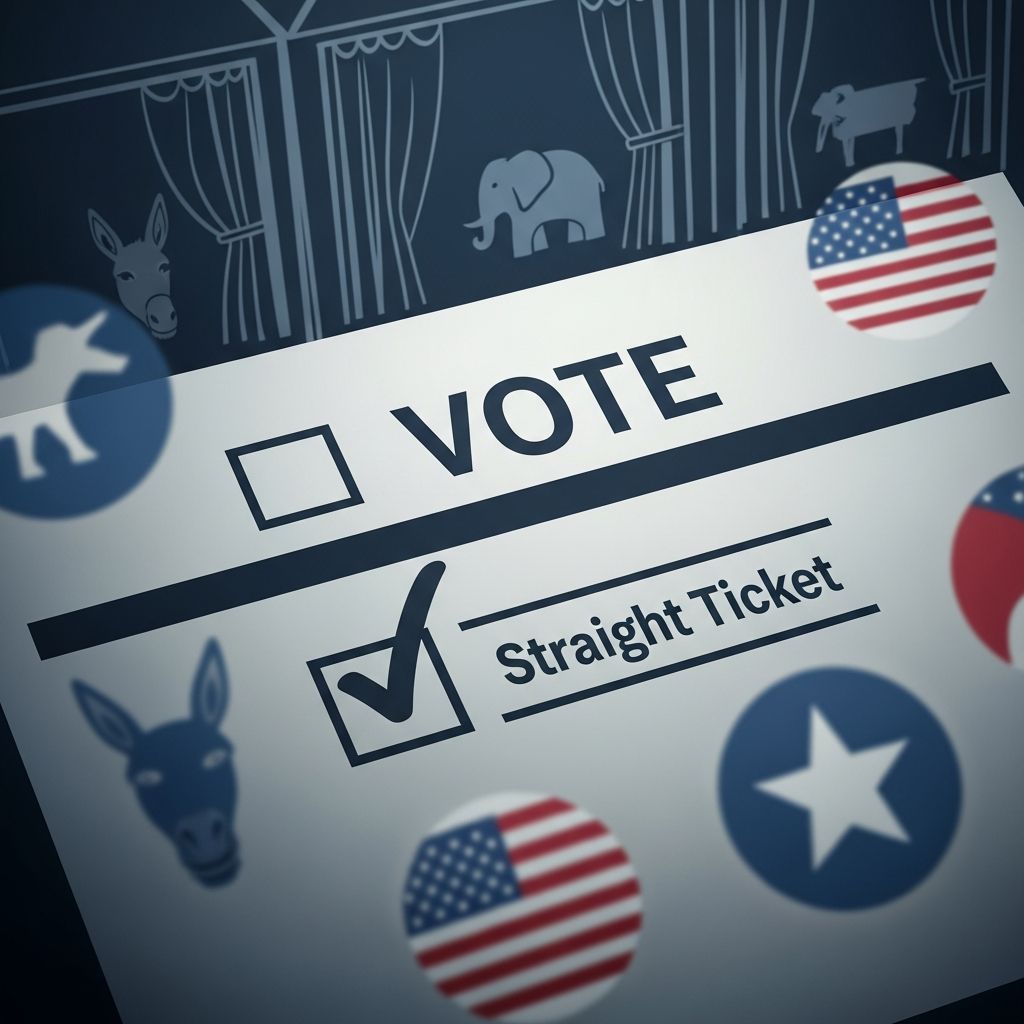
Straight-ticket voting has been one of the most debated ballot features in modern American elections. It is simple in concept, but it touches on complex questions about voter behavior, party power, ballot design, and access to the vote. This guide explains how straight-ticket voting works, where it is used, and what it means for you as a voter.
What Is Straight-Ticket Voting?
Straight-ticket voting (also called straight-party voting) is a method that lets a voter choose all candidates from one political party with a single selection, rather than voting in each race individually. In practice, a voter typically marks one box or presses one button for a party, and that action casts votes for every candidate that party has on the partisan portion of the ballot.
Key elements of the concept include:
- One action, many races: A single party selection applies to all partisan contests on the ballot for which that party has a candidate.
- Partisan contests only: The option does not apply to nonpartisan offices or ballot measures such as referendums and constitutional amendments.
- Party-based choice: Voters who use it are prioritizing party affiliation over individual candidate selection.
How Straight-Ticket Voting Appears on the Ballot
When states allow this practice, the ballot usually includes a clearly labeled area for choosing a party’s entire slate of candidates. The exact placement and wording differ by state, but the basic design ideas are similar.
Typical Layout Features
- Party list near the top: Many ballots place the straight-ticket option prominently near the top of the partisan section, showing each qualifying party with a corresponding marking space.
- Individual races below: Under the straight-ticket area, the ballot still lists each race (governor, legislature, county offices, etc.) with party labels and candidate names.
- Nonpartisan items separated: Judicial races that are officially nonpartisan, school board elections, and local referendums are listed separately and must be voted on individually.
Straight-Ticket vs. Split-Ticket Voting
| Feature | Straight-Ticket Voting | Split-Ticket Voting |
|---|---|---|
| Basic approach | One party choice applies to all partisan races | Voter chooses candidates individually in each race |
| Effort required | Lower; often faster to complete ballot | Higher; requires reviewing each contest |
| Party loyalty signal | Strong indication of party loyalty | Allows support for multiple parties on same ballot |
| Flexibility | Limited, unless the voter overrides specific races | High; voter customizes every choice |
Where Straight-Ticket Voting Is Allowed
Not all states offer a straight-ticket voting option, and the list has changed significantly over time. According to the National Conference of State Legislatures (NCSL), some states have authorized straight-ticket voting in certain periods, while others have explicitly repealed it.
States take different approaches:
- States that allow straight-ticket voting: A limited number of states still permit voters to cast a single straight-party mark that applies to all partisan contests.
- States that have repealed it: Several states, such as Michigan and Texas, have removed the straight-ticket option through legislation in recent years.
- States that never used it: Many states have long required voters to choose in each race individually and have never adopted a straight-party option.
Because election law changes regularly, voters should verify the current rules with their state or local election officials before voting.
How Straight-Ticket Voting Works in Practice
Although the idea is simple, how the option interacts with the rest of your ballot can be more complex. Election officials typically provide detailed instructions in voter guides or sample ballots, because the rules for overrides and special cases are crucial.
Basic Operation
In most systems, choosing a straight-party option has the following effects:
- Your vote is recorded for every candidate nominated by the selected party in partisan races on the ballot.
- Your straight-party selection does not cast votes in nonpartisan contests or for ballot measures, which must be marked individually.
- You still retain the ability to review and mark individual contests, depending on state rules and ballot design.
Overriding a Straight-Party Choice
Many jurisdictions historically allowed voters to select a party’s slate and then customize specific races. When permitted, the typical rule works as follows:
- If you choose a straight-party option and then mark a candidate of a different party in a specific race, the individual mark usually overrides the straight-party vote in that race.
- If your preferred party has no candidate in a race, you can generally vote for a candidate from another party in that contest without affecting the other straight-party selections.
- Marking or skipping nonpartisan races has no impact on your straight-party votes for partisan offices.
States may differ on how overrides are handled, especially with older voting systems, so it is essential to read the instructions on your ballot or voting machine and ask a poll worker if you have questions.
Why Some States Adopted or Repealed Straight-Ticket Voting
Lawmakers and election administrators have long disagreed about whether straight-ticket voting helps or harms the electoral process. Supporters argue that it can make voting easier and reduce lines, while critics claim that it may discourage informed decision-making and distort down-ballot races.
Arguments in Favor
- Faster voting and shorter lines: Allowing a single mark for a party may help voters complete long ballots more quickly, potentially reducing wait times in high-turnout elections.
- Accessibility for some voters: Voters who closely identify with a party or who may have difficulty navigating lengthy ballots can find the option more manageable.
- Clear expression of party preference: Political scientists often interpret straight-ticket votes as a direct measure of strong party identification and loyalty.
Arguments Against
- Reduced candidate evaluation: Critics say straight-ticket voting encourages voters to rely solely on party labels rather than considering each candidate’s qualifications or views.
- Down-ballot distortion: Candidates in lower-profile races may benefit or suffer simply because of their party’s image at the top of the ticket, regardless of local issues.
- Confusion for some voters: Where rules about overrides and mixed-party choices are complicated, voters can misunderstand how their selections interact, especially on older machines.
- Party polarization concerns: Scholars have argued that mechanisms like straight-ticket voting can strengthen party-line behavior and reduce incentives for cross-party appeal.
Legal and Policy Trends
Debates over straight-ticket voting often lead to legislative and court action. Over the past few decades, the general trend has been toward limiting or eliminating straight-party options, though the path has differed by state.
State-Level Reforms
- Legislative repeal: Some state legislatures have passed statutes abolishing straight-ticket voting, citing modernization, uniformity, or concerns about voter confusion.
- Implementation dates: In certain states, repeal bills were adopted years before they took full effect, giving election officials time to adapt voting systems and educate the public.
- Court challenges: In some jurisdictions, efforts to add or remove the option have been challenged in court, often involving claims related to voting rights and equal protection.
Administrative Considerations
Election officials must consider technical and practical implications when straight-ticket voting is added or removed:
- Voting system programming: Electronic machines and scanners must follow precise logic rules to interpret straight-party marks and overrides without errors.
- Ballot design: Removing straight-ticket options may require redesigning ballots so that voters understand they must mark each race individually.
- Voter education: Changes in law must be accompanied by clear voter information campaigns, sample ballots, and poll worker training to avoid confusion on Election Day.
Impact on Voters and Political Parties
Straight-ticket voting affects not only how voters interact with their ballots, but also how parties select candidates and craft campaign strategies. Political scientists have used models to study these effects in detail.
Effect on Voter Behavior
- Time-saving choice: For some voters, especially those with strong party preferences or limited time, the option can lower the cost of participating in lengthy general elections.
- Party-line outcomes: Straight-ticket options tend to increase the share of ballots cast consistently for one party in all partisan contests.
- Turnout interactions: The presence or absence of straight-party options may interact with other factors like ballot length, voter information, and competitiveness, though research findings are mixed.
Effect on Parties and Candidates
- Candidate selection incentives: Theoretical work suggests that when straight-ticket voting is available, parties may emphasize ideological cohesion and party brand more heavily, because voters are deciding at the party level.
- Campaign strategy: Parties might focus resources on building overall party identification, assuming that gains at the top of the ticket will translate into down-ballot support.
- Down-ballot dependency: Local candidates may be more tied to national party fortunes, benefiting in wave elections and struggling when their party’s statewide or national image is weak.
Practical Tips for Voters
Regardless of whether your state offers straight-ticket voting, it is important to understand your options before arriving at the polling place.
Before You Vote
- Check your state’s rules: Visit your state or local election official’s website to see whether a straight-party option will appear on your ballot and how it works in your jurisdiction.
- Review a sample ballot: Many election offices post sample ballots online or mail them to voters so you can see the layout in advance.
- Research candidates and issues: Even if you usually support one party, learning about specific candidates and local measures helps you make more informed choices.
At the Polling Place
- Read instructions carefully: Take a moment to read all instructions on the ballot or voting machine, especially the section describing how straight-ticket marks interact with individual candidate selections.
- Ask for help if needed: Poll workers can explain how the ballot works, though they cannot recommend which candidates to choose.
- Review your ballot: Before casting your ballot, check that your selections (including any overrides, nonpartisan races, and ballot measures) match your intent.
Frequently Asked Questions about Straight-Ticket Voting
Q: Does a straight-ticket vote cover nonpartisan races or ballot measures?
No. Straight-ticket voting, where available, typically applies only to partisan offices. You must mark your choices separately for nonpartisan offices (such as many local judicial or school board races) and for ballot measures, amendments, and referendums.
Q: Can I still vote for candidates from another party if I use the straight-ticket option?
In many systems that have used straight-icket voting, you may choose a party’s slate and then vote for individual candidates from other parties in specific races. In those cases, the individual choice usually overrides the straight-party vote for that contest, but you must follow the instructions provided in your jurisdiction.
Q: Do I have to use straight-ticket voting if it appears on my ballot?
No. It is an optional convenience feature where it exists. You can always choose to vote in each race individually instead of using the straight-party line.
Q: Why have some states eliminated straight-ticket voting?
States that repealed straight-ticket voting often cited goals such as encouraging voters to evaluate each race separately, modernizing election systems, reducing potential confusion, and promoting more informed participation. Legislative debates have also touched on questions of fairness, ballot design, and the impact on lines at polling places.
Q: How can I find out whether my state currently allows straight-ticket voting?
You can check with your state or local election office or consult nonpartisan organizations that track election laws, such as the National Conference of State Legislatures, which maintains summaries of straight-ticket voting policies by state.
References
- Straight Ticket Voting — National Conference of State Legislatures (NCSL). 2021-10-01. https://www.ncsl.org/elections-and-campaigns/straight-ticket-voting
- Straight-ticket voting — Wikipedia (summary of legal history and practice; underlying references include state statutes and news coverage). 2023-06-30. https://en.wikipedia.org/wiki/Straight-ticket_voting
- How does straight ticketing voting work? — City of Ludlow, Kentucky. 2019-08-01. https://www.ludlow.org/Portals/ludlow/Documents/HOW-DOES-STRAIGHT-TICKETING-VOTING-WORK.pdf
- Voting FAQ — Harris County, Texas (HarrisVotes). 2022-10-01. https://www.harrisvotes.com/Voter/Voting-FAQ
- The theory of straight ticket voting — Erin Hengel. 2019-01-01. https://www.erinhengel.com/research/stvo-theory.pdf
- Straight-ticket voting explained — POLYAS Election Glossary. 2020-05-15. https://www.polyas.com/election-glossary/straight-ticket-voting
- Straight-ticket voting definition — Fiveable AP US Government Key Term. 2021-09-01. https://fiveable.me/key-terms/ap-gov/straight-ticket-voting
Similar Articles








Read full bio of medha deb


