
Understanding Speed Traps and Your Legal Rights
Learn how speed traps work, when they are lawful, and how drivers can respond if they believe a speeding ticket was unfairly issued.
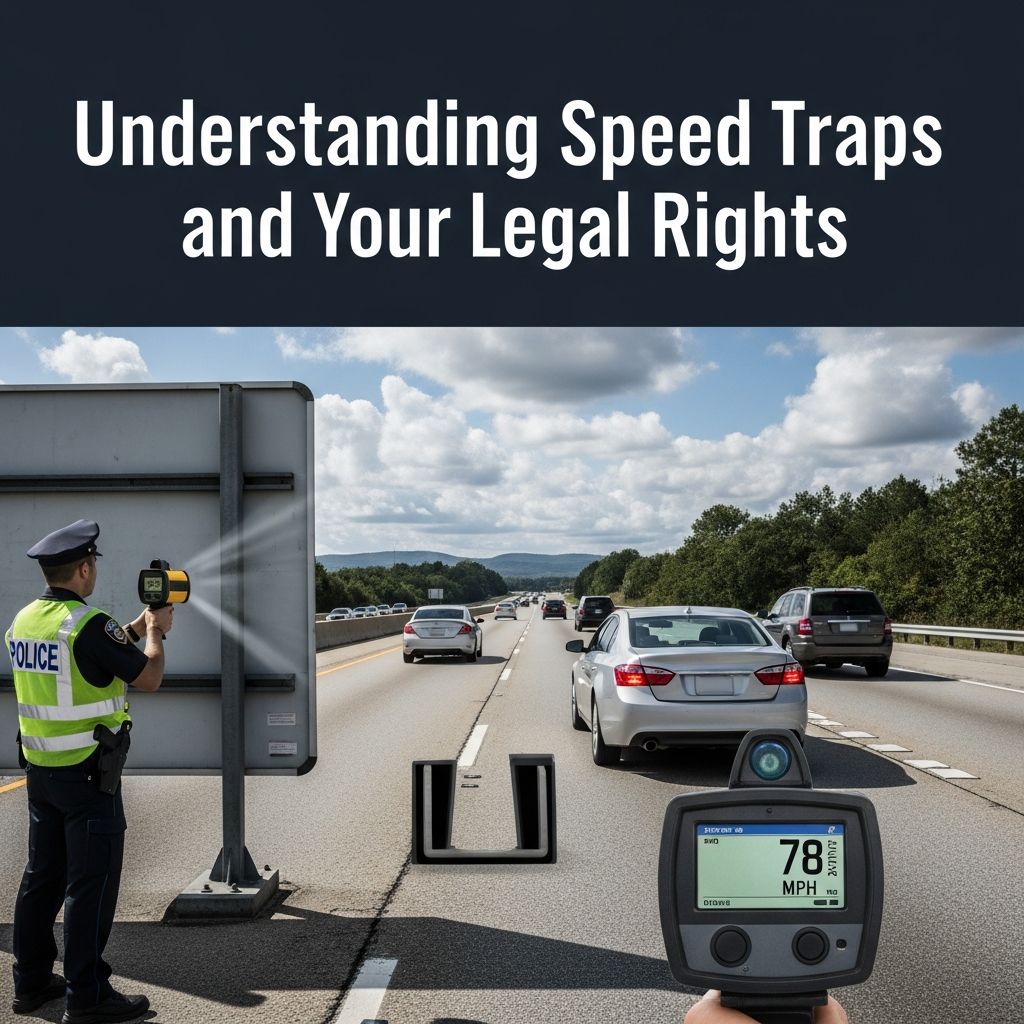
Many drivers have experienced the sinking feeling of suddenly spotting a patrol car just after a sharp drop in the speed limit. That situation is often described as a speed trap. But not every tough speed enforcement zone is unlawful. Depending on the state and the enforcement method, some speed traps are fully legal, while others may violate traffic laws or due process principles.
This article explains what people mean by “speed trap,” how different states treat them, what makes some practices illegal, and what you can realistically do if you believe your speeding ticket came from an unfair setup.
What Is a Speed Trap?
The phrase speed trap is not always used in the same way. In everyday speech, it usually means any location where officers are aggressively enforcing the speed limit, often with tactics that surprise drivers. Legally, however, some states give the term a much narrower and technical definition.
Common Everyday Meanings
Drivers often use “speed trap” to describe:
- An officer parked out of sight, such as behind trees, around a curve, or beyond a bridge, monitoring traffic with radar or lidar.
- A sudden and steep drop in the speed limit for a short stretch of road, especially on highways entering small towns.
- Areas where the posted speed feels much lower than the natural flow of traffic, and tickets seem unusually frequent.
These situations may feel unfair, but they are not automatically illegal. Courts normally allow police to conceal their vehicles and to enforce speed limits as long as the underlying limits and enforcement methods comply with state law.
Legal Definitions in Some States
In several states, including California, statutes define “speed trap” very specifically. For example, California law describes two main types:
- Measured-distance traps: A portion of roadway where an officer or device calculates a vehicle’s speed by timing how long it takes to travel between two marked points.
- Unjustified low limits with electronic enforcement: A non-local road with a posted speed below the general maximum (for example, below 65 mph) that is enforced with radar or similar devices but is not supported by a recent traffic and engineering study.
When those technical conditions are met, California law generally prohibits using evidence from the trap to support a speeding prosecution.
Why Speed Traps Are Controversial
Speed traps sit at the intersection of three competing goals: road safety, revenue generation, and individual rights. Research shows that speed enforcement can reduce crashes, especially in high-risk areas like school zones and work zones. However, when enforcement appears aimed primarily at raising money, public trust erodes.
| Perspective | Concern or Benefit |
|---|---|
| Safety advocates | Consistent enforcement encourages drivers to respect speed limits and can reduce collisions and fatalities. |
| Drivers | Sudden drops in speed limits and hidden patrols can feel like traps designed to catch rather than warn. |
| Local governments | Fines contribute to municipal budgets but can create incentives to over-enforce minor violations. |
| Civil rights groups | Excessive ticketing can disproportionately affect out-of-town drivers and lower-income residents. |
How States Regulate Speed Traps
Whether a speed trap is legal depends heavily on state law. Most states allow proactive speed enforcement but may restrict particular methods or require justification for speed limits.
States That Require Engineering Justification
Several jurisdictions require that non-freeway speed limits be based on an engineering and traffic study, which typically considers factors such as traffic volume, crash history, road design, and pedestrian activity. The goal is to tie speed limits to measurable safety needs, not revenue motives.
For example, in California, a posted limit on many non-local roads cannot be enforced by radar unless it is supported by an engineering survey conducted within a specified time period. If the survey is outdated or missing, the resulting radar-based citation may be excluded in court.
Measured-Distance Timing Bans
Some states prohibit police from enforcing speed laws by timing how long it takes a vehicle to travel between two points on a measured section of road, sometimes known as “timing strips” or “marked road traps.” The law may forbid both the method and the use of that evidence in court.
By contrast, automated average-speed systems used for work zones or toll roads in certain countries (and in a few U.S. pilot programs) are usually authorized by specific statutes and operate under different rules, often with extensive signage and public notice to emphasize safety over surprise.
Hidden Officers and Unmarked Cars
Hiding a patrol vehicle or using an unmarked car is rarely illegal by itself. Courts commonly hold that drivers have no right to advance warning of where officers are stationed, and officers are not required to be visible as long as they obey their own agency policies and state statutes.
In most states:
- Officers may park on side roads, behind buildings, or on overpasses while operating radar or lidar.
- Departments may have internal rules about when unmarked vehicles may initiate traffic stops, often tied to safety considerations.
- Concealment does not usually count as entrapment because it does not induce drivers to speed; it simply allows officers to observe violations that would otherwise go unnoticed.
Are Speed Traps Entrapment?
Many motorists argue that a surprise speed trap feels like entrapment. Legally, however, entrapment is a narrow defense. It requires proof that law enforcement induced a person to commit an offense they were not predisposed to commit.
In most jurisdictions:
- Simply waiting to observe a driver’s speed does not constitute entrapment.
- Reducing a speed limit and enforcing it, even aggressively, does not meet the legal test for entrapment.
- Entrapment would be more likely if an officer encouraged or pressured someone to speed (for example, by challenging them to race) and then issued a ticket.
As a result, claiming “I was caught in a speed trap” rarely succeeds as an entrapment defense on its own.
How Police Measure Speed
Understanding the tools officers use can help you evaluate whether your ticket might be vulnerable to challenge under your state’s laws.
Radar and Lidar
Modern speed enforcement relies heavily on electronic devices:
- Radar uses radio waves to measure a vehicle’s speed based on the Doppler effect.
- Lidar uses laser light pulses to calculate speed and distance with a narrow beam.
Courts generally accept readings from properly calibrated devices operated by trained officers. In states like California, however, special rules apply when radar or lidar is used on roads where the speed limit must be justified by an engineering study.
Aircraft and Aerial Enforcement
In some states, officers in airplanes or helicopters monitor vehicles over marked distances on highways and relay information to ground units. While the basic principle resembles a measured-distance trap, aerial enforcement is often explicitly authorized by statute and supported by visible roadway markings and signs.
VASCAR and Manual Timing
Some agencies use VASCAR or similar devices that combine a timer and distance measurement to calculate average speed between two points. Where state law bans measured-distance traps, the legality of these methods can turn on specific wording in the statute and how the enforcement is carried out.
What Makes a Speed Trap Illegal?
Not all tough enforcement zones are unlawful. A speed trap typically becomes legally problematic when officers or agencies violate specific statutory requirements, such as:
- Using timing over marked distances when that method is expressly prohibited by state law.
- Enforcing a reduced speed limit with radar or lidar on a non-local road without a current traffic and engineering survey where such a survey is required.
- Ignoring procedural safeguards, such as mandated signage or calibration and certification rules for electronic devices.
In states with these rules, the consequence is often that the evidence of speed cannot be introduced at trial, which can force dismissal of the speeding charge.
Practical Steps If You Suspect a Speed Trap
If you receive a ticket and believe a speed trap was involved, there are several information-gathering steps you can take before deciding how to respond.
1. Check the Speed Limit Transition
- Return to the area (safely) and note where the speed limit changes, how many signs are posted, and their visibility.
- Look for obstructions such as foliage or parked trucks that might block signs.
- Photograph or record video of the signs, especially if you believe they were hidden or confusing.
2. Identify the Enforcement Method
- Review your ticket to see whether the officer indicated radar, lidar, pacing, visual estimate, aircraft, or other method.
- If unsure, you may be able to request this information through a discovery request before your hearing, depending on local rules.
3. Research Local Law
- Consult your state’s vehicle code or equivalent statutes for any sections dealing with speed traps, radar use, traffic surveys, or enforcement methods.
- Check whether your state requires an engineering and traffic study to justify certain speed limits.
4. Request Supporting Documents
- In jurisdictions like California, drivers or their attorneys may request copies of the engineering and traffic survey supporting the posted limit.
- Drivers can also seek calibration and maintenance records for the radar or lidar device, where such records are discoverable.
5. Consider Professional Legal Help
- An experienced traffic attorney can evaluate whether your case falls under a technical speed trap statute or another evidentiary rule.
- Lawyers familiar with local courts may know how judges have treated similar speed trap arguments in the past.
Preventive Strategies for Drivers
While you cannot control how and where police enforce speed limits, you can reduce the risk of being caught in a speed trap by adjusting your driving habits and staying informed.
- Watch for transition zones: Slow down proactively when approaching small towns, school zones, or road work areas where speed limits often drop quickly.
- Read all posted signs: Pay attention to advisory signs, school zone hours, and work zone notices, which may temporarily change speed limits.
- Avoid sudden speeding after a limit increase: Even after a sign shows a higher limit, officers may be stationed nearby to catch drivers who accelerate too aggressively.
- Use technology wisely: GPS navigation systems and map apps sometimes indicate changing speed limits, but posted signs always control in court.
Frequently Asked Questions (FAQs)
Q1: Is it always legal for police to hide while monitoring speed?
In most states, yes. Courts typically allow officers to conceal their vehicles or observe traffic from hidden locations. The legality usually depends on the method of speed measurement and whether the posted limits comply with applicable statutes, not on whether the officer was visible.
Q2: If a town suddenly drops the speed limit, is that automatically a speed trap?
No. A sharp drop in speed limits can be legal if it is properly posted and supported by safety considerations, such as intersections, pedestrian traffic, or crash history. Some states require an engineering and traffic study to justify such limits; if that requirement is not met, the limit might be vulnerable to challenge.
Q3: Can I argue that a speed trap was entrapment?
Usually not. Entrapment requires proof that law enforcement induced you to commit a crime you were not predisposed to commit. Simply being monitored or surprised by an officer’s presence does not meet that standard. Courts generally hold that speed traps are not entrapment because officers do not encourage drivers to speed.
Q4: What happens in states that ban certain speed traps?
Where specific speed trap statutes exist, the usual remedy is that evidence obtained through the prohibited method is inadmissible. For example, in California, if officers rely on radar at a location that qualifies as a prohibited speed trap, the reading may be excluded, which can lead to dismissal of the speeding charge.
Q5: Do I need a lawyer to fight a suspected speed trap ticket?
You are not required to have a lawyer, but professional representation can be helpful, especially in states with complex speed trap laws or where you believe technical rules were violated. An attorney can request necessary records, analyze whether statutory conditions for a prohibited speed trap are met, and present arguments effectively in court.
References
- California Vehicle Code §§ 40801–40803 — California Legislature. 2023-01-01. https://leginfo.legislature.ca.gov/faces/codes_displayText.xhtml?lawCode=VEH&division=17.&title=&part=&chapter=3.&article=1.
- Manual on Uniform Traffic Control Devices (MUTCD) — Federal Highway Administration (FHWA), U.S. Department of Transportation. 2009-12-16 (current edition with revisions). https://mutcd.fhwa.dot.gov/htm/2009r1r2/html_toc.htm
- Speed — National Highway Traffic Safety Administration (NHTSA). 2024-01-15. https://www.nhtsa.gov/risky-driving/speeding
- Are Speed Traps Legal? How Do I Fight a Speed Trap Ticket? — Nolo Legal Encyclopedia. 2023-06-01. https://www.nolo.com/legal-encyclopedia/are-speed-traps-legal-how-do-i-fight-a-speed-trap-ticket.html
- Speed Traps and Impound Rackets — Institute for Justice. 2018-05-01. https://ij.org/issues/private-property/fines-and-fees/speed-traps-and-impound-rackets/
- Are Speed Traps Entrapment? — Traffic Ticket Attorney (Blog summarizing entrapment doctrine). 2021-03-10. https://www.trafficticketteam.com/speeding-ticket/are-speed-traps-entrapment/
Similar Articles








Read full bio of medha deb


