
Understanding Rioting and Inciting a Riot
Learn how U.S. law defines riots and incitement, how these charges arise, and what penalties and defenses may apply.
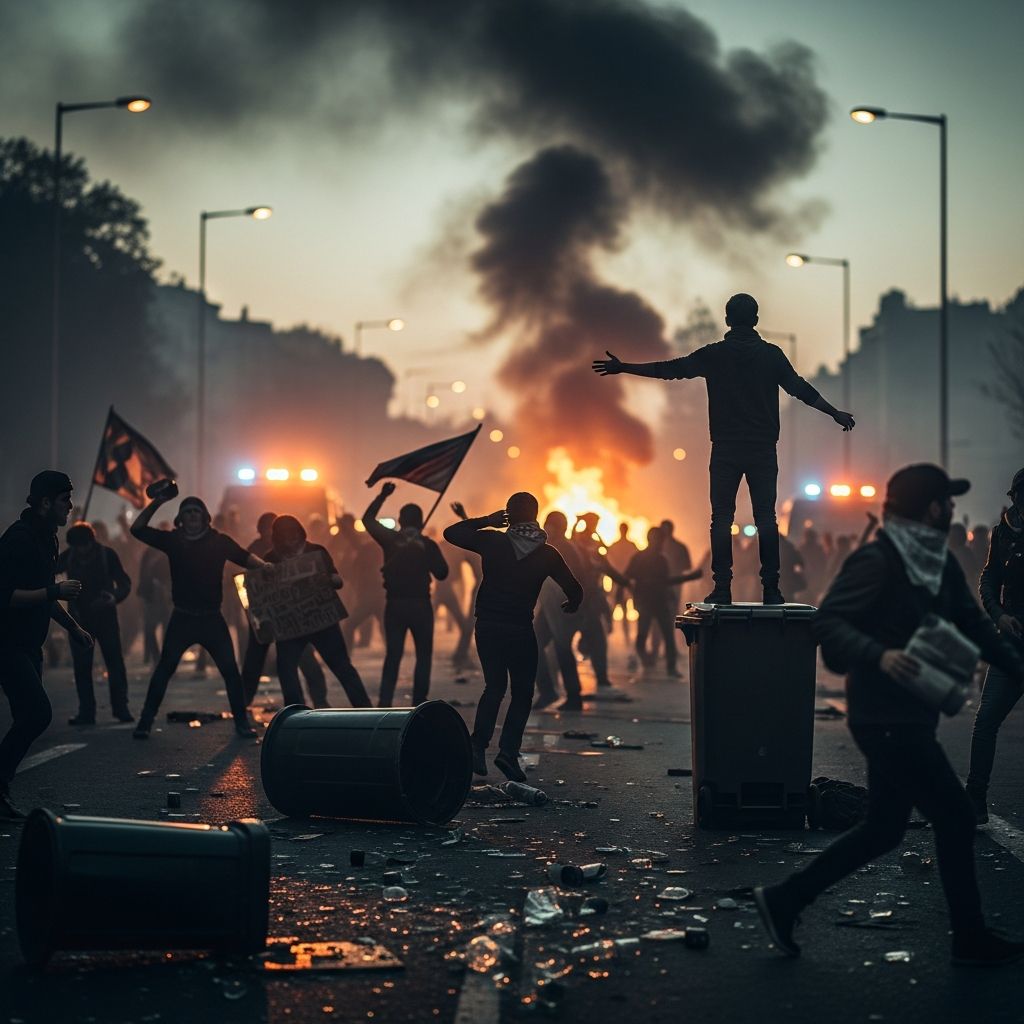
Riots are dramatic events that often receive intense media coverage, but the legal concepts of rioting and inciting a riot are more precise than general public use of the word “riot.” This guide explains how U.S. law treats these offenses, what prosecutors must prove, how penalties can escalate, and how the First Amendment shapes what counts as unlawful incitement.
What Is a Riot in Legal Terms?
Although the exact wording differs from state to state, most U.S. jurisdictions define a riot as a form of public disturbance involving a group that engages in violence, threats of violence, or serious property damage.
For example, federal law describes a riot as a public disturbance involving acts or threats of violence by an assemblage of at least three people, where those acts or threats create a clear and present danger of or actually cause injury or property damage. State laws follow a similar pattern, with some specifying different minimum group sizes or particular types of conduct.
| Key Element | Typical Legal Requirement |
|---|---|
| Number of people | Usually three or more (some jurisdictions require five or more). |
| Location | Public disturbance; can also occur in institutional settings like prisons. |
| Conduct | Violent or tumultuous behavior, or credible threats of such behavior. |
| Harm or risk | Actual injury or property damage, or a clear and present danger of such harm. |
Riots can grow out of otherwise lawful gatherings, such as political demonstrations, labor disputes, celebrations, or protests. The shift from lawful assembly to criminal riot usually occurs when group behavior crosses into violence or serious threats and poses significant risk to people or property.
Rioting vs. Inciting a Riot: Key Differences
Rioting and inciting a riot are related but distinct crimes:
- Rioting: Personally taking part in the violent or threatening conduct of a riot.
- Inciting a riot: Urging, provoking, or encouraging others to participate in a riot, or to commit violent acts that are part of a riot, whether or not the speaker personally engages in the violence.
Many statutes make clear that mere presence at the scene of a disturbance is not enough for a rioting conviction; there must be a willful, active contribution to the unlawful conduct.
Core Elements of a Rioting Charge
Although individual statutes vary, prosecutors generally must prove the following elements to secure a rioting conviction:
- Assemblage: The defendant was part of a qualifying group (often three or more individuals).
- Public disturbance: The incident took place in a context that disturbed public peace or order.
- Violent or tumultuous conduct: The group engaged in actual violence, serious threats of violence, or similarly dangerous conduct.
- Result or risk of harm: There was either actual injury or property damage, or a clear and present danger of such harm.
- Mental state: The defendant acted willfully, meaning intentionally, not by accident.
Some laws increase the severity of the crime when certain aggravating factors are present, such as use of weapons, serious bodily injury, extensive property damage, or death.
What Does It Mean to Incite a Riot?
To incite a riot is to deliberately spur others toward riotous behavior. Legal definitions often focus on urging, instigating, or promoting violent acts or participation in a riot, especially when done under circumstances where disorder is likely or imminent.
Federal law defines inciting a riot broadly as using interstate travel or communications with the intent to incite, organize, promote, encourage, or participate in a riot, and then performing some overt act in line with that intent. Many states, by contrast, do not require an interstate connection but focus on willfully urging others to riot within the state.
Incitement vs. Protected Speech
Not all inflammatory or controversial statements qualify as criminal incitement. U.S. law draws a sharp line between protected advocacy of ideas and unprotected calls for imminent violence. Federal statutes explicitly state that the phrase “to incite a riot” does not include mere oral or written advocacy of ideas or expression of belief that does not involve advocating acts of violence or asserting a right to commit such acts.
This distinction reflects broader First Amendment doctrine: speech is generally protected unless it is directed to inciting or producing imminent lawless action and is likely to produce such action, a standard articulated by the U.S. Supreme Court in Brandenburg v. Ohio (1969). While that case is not itself a riot statute, many riot and incitement laws are interpreted in light of this constitutional test.
Common Elements of Inciting a Riot
Typical incitement statutes share several features, even though their wording differs:
- Willful conduct: The defendant intentionally urged or encouraged others to engage in riotous behavior.
- Direction toward unlawful action: The speech or conduct went beyond expressing opinions and specifically encouraged violent or destructive acts.
- Likelihood or occurrence of a riot: Many laws require that a riot actually occur or that the incitement be directly and imminently likely to produce a riot.
- Contributing cause: Some statutes require proof that the defendant’s incitement was a contributing cause of the resulting riot, especially for enhanced penalties.
Because of constitutional protections, courts often scrutinize incitement charges closely to ensure they do not punish mere advocacy or unpopular opinions.
Typical Penalties for Rioting and Inciting a Riot
Penalties vary widely across jurisdictions but can escalate quickly based on the severity of harm. Many states treat basic rioting and inciting a riot as misdemeanors, while more serious outcomes can lead to felony charges.
Rioting Penalties
- Misdemeanor level: For lower-level conduct, penalties may include fines, probation, and a short term of incarceration in a local jail.
- Felony enhancements: Penalties can increase to multi-year prison sentences if:
- Weapons are used or brandished during the riot.
- Serious bodily injury occurs.
- Property damage surpasses a specified monetary threshold.
- Someone is killed as a result of the riot.
Penalties for Inciting a Riot
- Base offense: Willfully inciting another to engage in a riot is often categorized as a misdemeanor, carrying potential jail time and fines.
- Aggravated incitement: Where the incitement contributes to riots that cause serious injury, substantial property damage, or death, the offense may be charged as a felony with significantly higher penalties.
Some statutes also allow civil remedies. For example, certain state laws authorize victims whose property or person has been injured by a riot to sue violators for triple damages plus costs and attorney’s fees.
How Federal and State Laws Interact
Rioting and inciting a riot are primarily governed by state law, but there is also a distinct federal crime of riot. Federal law generally focuses on riots that cross state lines through interstate travel or the use of interstate communication facilities such as mail, telephone, radio, or other channels of commerce.
Key points about the federal approach include:
- Use of interstate or foreign commerce with intent to incite, organize, promote, or participate in a riot can trigger federal jurisdiction.
- An overt act in furtherance of that intent is required.
- Federal charges can be brought in addition to state charges where both sets of requirements are met.
Because each state crafts its own definitions and penalties, conduct deemed a misdemeanor in one jurisdiction may qualify as a felony in another. Consulting the specific statute for the relevant location is crucial.
Examples of Situations That May Lead to Charges
The same event can generate different types of charges depending on each person’s role and conduct. For instance:
- A person who joins a group that begins smashing windows and setting fires in a downtown area may face rioting charges based on direct participation in violent conduct.
- Another individual who, from a distance, uses electronic communication to urge others to engage in violence or property destruction at the same event might be charged with inciting a riot, particularly if their messages are distributed across state lines.
- Someone who is present at a disturbance but does not act violently, encourage violence, or otherwise participate beyond being there typically cannot be convicted of rioting based on presence alone.
Lawful protest organizers who encourage peaceful assembly and explicitly discourage violence generally fall outside riot and incitement statutes. Problems arise when calls to action become explicit, immediate exhortations to engage in violent or destructive behavior.
Defenses and Legal Issues in Riot and Incitement Cases
Several defenses may be available to someone accused of rioting or inciting a riot, depending on the specific facts and legal framework.
Lack of Intent
Both rioting and incitement typically require a willful mental state. If the defendant did not intentionally participate in or encourage unlawful conduct, but was merely swept up in a crowd or misunderstood, counsel may challenge the intent element.
Mere Presence
Many statutes explicitly state that mere presence at the scene of a riot is insufficient for conviction. Defendants may argue that they did not engage in any overt acts of violence, threats, or encouragement of violence, even if they were physically close to the disturbance.
Protected Speech
Defendants charged with inciting a riot often raise First Amendment defenses, asserting that their statements were political advocacy or general expressions of opinion rather than direct calls for imminent violence. Courts must balance public safety concerns with constitutional protections, trimming statutes that are overly broad or vague.
Mistaken Identity or Insufficient Evidence
Chaotic scenes can lead to errors in identifying who did what. Video evidence, eyewitness accounts, and digital records are often central to proving or disputing a defendant’s role, and any gaps or contradictions in this evidence can form the basis for a defense.
Practical Considerations if You Face These Charges
Being investigated or charged with rioting or inciting a riot can carry serious consequences, including criminal penalties and long-term impact on employment, immigration status, and civil liabilities. Individuals in this situation typically consider the following steps:
- Seek legal counsel promptly to understand the specific statute being applied and potential defenses.
- Preserve evidence, such as messages, videos, or location data that may show non-involvement or peaceful intent.
- Avoid discussing details publicly or online, because statements can be used as evidence.
- Clarify the jurisdiction involved—state, federal, or both—as this affects potential penalties and procedural rules.
Because riot-related laws vary significantly, advice from a lawyer familiar with the relevant local statutes is essential.
Frequently Asked Questions (FAQs)
Q1: Is participating in a protest the same as rioting?
No. Peaceful protesting is generally lawful and protected by the First Amendment. It becomes potential rioting when a group engages in or threatens violent or tumultuous conduct that creates a clear and present danger of injury or property damage.
Q2: Can I be charged with inciting a riot if no riot actually happens?
In some jurisdictions, a riot must occur or be directly and imminently likely to occur as a result of the incitement. Other statutes, including federal law, focus on intent and overt acts, even if the planned riot does not fully materialize, though constitutional limits still apply.
Q3: Does online speech count as inciting a riot?
Potentially yes. Federal law covers the use of any facility of interstate commerce—such as internet communications—with intent to incite or promote a riot, combined with an overt act. However, pure advocacy of ideas without urging violent acts remains protected speech.
Q4: Can I be liable for a riot I did not attend?
Possibly. A person who willfully incites others to engage in a riot, even from a distance, can face incitement charges if their conduct meets statutory requirements and contributes to the disturbance.
Q5: Are labor strikes or picketing considered riots?
Not by default. Strikes, picketing, and demonstrations are often lawful. They may be treated as riots only if they involve group violence, serious threats of violence, or significant property damage or danger to public safety.
References
- 18 U.S. Code Chapter 102 – Riots — Office of the Law Revision Counsel, U.S. House of Representatives. 2022-01-06. https://uscode.house.gov/view.xhtml?path=/prelim@title18/part1/chapter102&edition=prelim
- North Carolina General Statutes § 14-288.2 – Riot; inciting to riot; punishments — North Carolina General Assembly. 2023-01-01. https://www.ncleg.gov/enactedlegislation/statutes/pdf/bysection/chapter_14/gs_14-288.2.pdf
- District of Columbia Code § 22–1322 – Rioting or inciting to riot — Council of the District of Columbia. 2021-03-16. https://code.dccouncil.gov/us/dc/council/code/sections/22-1322
- Riot – Wex Legal Dictionary — Legal Information Institute, Cornell Law School. 2020-06-01. https://www.law.cornell.edu/wex/riot
- Utah Code § 76-9-101 – Riot — Utah State Legislature. 2022-05-04. https://le.utah.gov/xcode/Title76/Chapter9/76-9-S101.html
- Inciting to Riot – Legal Definition — The Law Dictionary (based on Black’s Law Dictionary, 2nd ed.). 2019-01-01. https://thelawdictionary.org/inciting-to-riot/
Similar Articles








Read full bio of medha deb


