
Understanding Reverse Discrimination in Employment
Explore how employment laws address claims of reverse discrimination, legal standards, and practical steps for workers and employers.
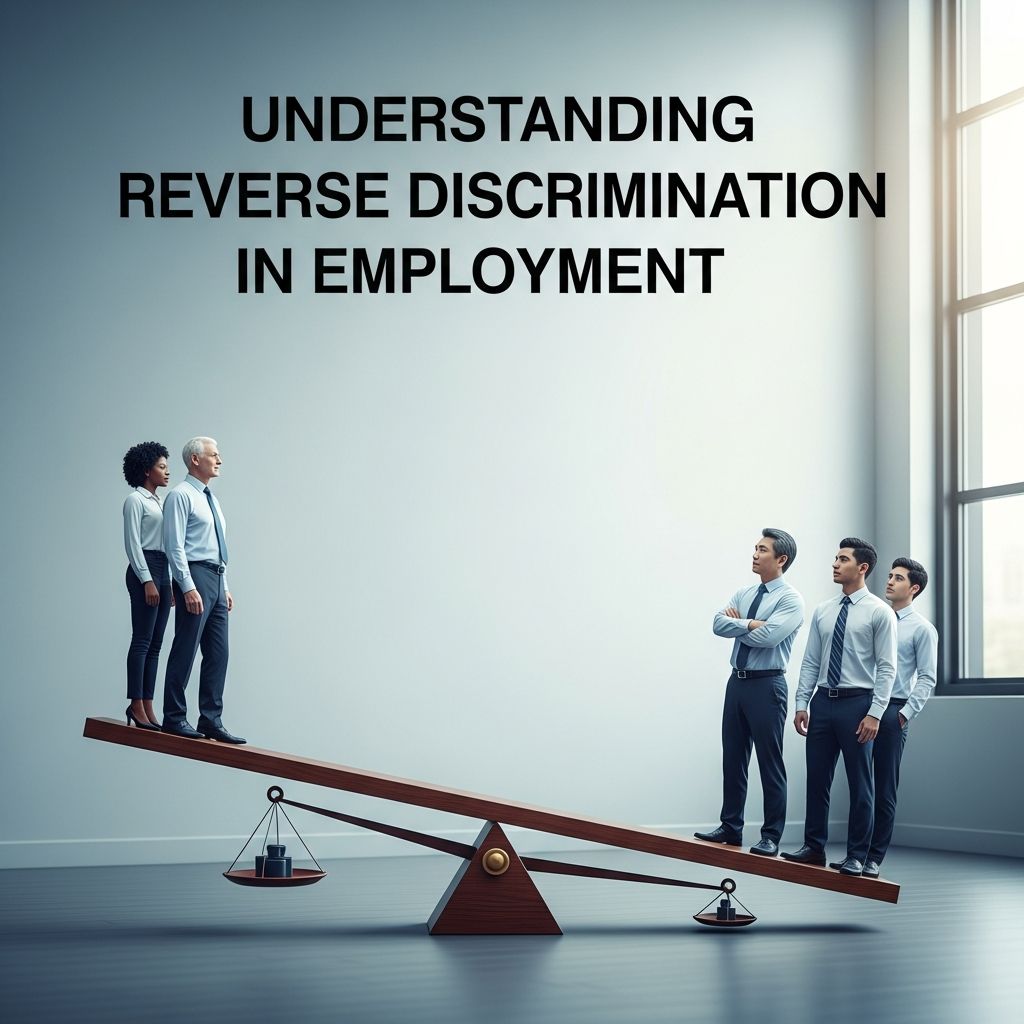
Allegations of reverse discrimination—claims that a member of a majority or historically advantaged group has been treated unfairly because of a protected characteristic—have become more visible as employers expand diversity-focused policies and hiring practices. Despite the label, U.S. anti-discrimination laws do not distinguish between traditional and reverse discrimination: the same statutes and proof standards apply to everyone.
What Is Reverse Discrimination?
In U.S. employment law, reverse discrimination generally refers to claims that an employer has discriminated against a person from a majority or historically dominant group—such as a white employee, a man, or a heterosexual worker—because of a characteristic protected under federal, state, or local law. The claim usually asserts that an employer favored a minority or historically underrepresented applicant or employee instead.
Key points about the concept:
- The term is widely used in litigation and commentary but does not appear in the core federal anti-discrimination statute, Title VII.
- Courts treat reverse discrimination as simply another form of unlawful discrimination: the same legal test applies regardless of whether the plaintiff is in a minority or majority group.
- Disputes often arise in the context of hiring, promotion, layoffs, or diversity, equity, and inclusion (DEI) programs.
Legal Framework: How Federal Law Protects All Groups
The primary federal law governing workplace discrimination in the United States is Title VII of the Civil Rights Act of 1964. Title VII prohibits employers with at least 15 employees from making employment decisions because of:
- Race
- Color
- Religion
- Sex (including pregnancy, sexual orientation, and gender identity)
- National origin
Other federal laws cover additional characteristics—for example, age (for workers 40 and over) and disability—but the logic about equal protection of majority and minority groups is the same: the statutes are written in neutral terms and apply to all individuals.
Important legal principles:
- Symmetric protection: Title VII does not limit protection to historically disadvantaged groups. Any person who can show they experienced an adverse employment action because of a protected trait may bring a claim, regardless of whether they are in a majority or minority group.
- No heightened burden for majority plaintiffs: The U.S. Supreme Court has clarified that plaintiffs alleging reverse discrimination are not required to satisfy a special, more demanding evidentiary standard than other discrimination plaintiffs.
- Intent matters: For intentional discrimination (disparate treatment) claims, a worker typically must show that the employer acted with a discriminatory motive related to a protected characteristic.
How Reverse Discrimination Claims Are Proven
Most employment discrimination cases rely on a structured, burden-shifting framework originally developed by the Supreme Court. Although details can vary by case and jurisdiction, a typical path in a Title VII claim includes the following stages.
1. Establishing a Prima Facie Case
The employee must first present basic facts that, if unexplained, support an inference of discrimination. While the precise formulation differs slightly among federal circuits, a common outline in a hiring or promotion case looks like this:
- The worker belongs to a group protected by Title VII (which includes majority and minority groups).
- The worker was qualified for the position or met the employer’s legitimate expectations.
- The worker suffered an adverse employment action (for example, not being hired, not being promoted, being demoted, or being fired).
- The employer treated someone outside the worker’s protected group more favorably under similar circumstances, or other facts suggest that the adverse action was because of the protected characteristic.
In the past, some federal courts imposed an additional requirement on majority-group plaintiffs to show special “background circumstances” suggesting the employer was unusually inclined to discriminate against the majority. The Supreme Court has now rejected that extra hurdle and held that majority-group plaintiffs must satisfy the same prima facie standard as any other plaintiff.
2. Employer’s Legitimate, Non-Discriminatory Reason
Once the employee makes a prima facie showing, the burden of production shifts to the employer. The employer must articulate a legitimate, non-discriminatory reason for the decision, such as:
- Stronger qualifications of the selected candidate (education, experience, skills).
- Documented performance problems.
- Restructuring, downsizing, or budget cuts.
- Neutral policy applied consistently (for example, seniority systems).
This step does not require the employer to prove the decision was wise or fair, only that it was not based on a prohibited motive. The burden at this stage is one of explanation, not persuasion.
3. Proving Pretext
The final and often most contested step places the ultimate burden of proof on the employee. The worker must show that the employer’s stated reason is not the real reason, but a pretext—a cover for discrimination. This can be shown by evidence that:
- The employer’s explanation is factually inaccurate or has changed over time.
- Lower-performing or less-qualified individuals outside the employee’s protected group were treated more favorably.
- Decision-makers made remarks or engaged in conduct that suggest bias.
- Policies allegedly driving the decision were applied inconsistently.
If the worker proves that discriminatory motive more likely than not drove the decision, they may prevail, regardless of whether the discrimination is labeled “reverse” or otherwise.
Reverse Discrimination and DEI or Affirmative Action Programs
As employers adopt diversity, equity, and inclusion (DEI) initiatives, concerns have grown about when diversity-focused actions might cross the line into unlawful discrimination. Federal agencies and courts have emphasized that DEI itself is not illegal, but how it is implemented matters greatly.
According to the U.S. Equal Employment Opportunity Commission (EEOC), DEI programs may violate Title VII if they involve an employer:
- Making employment decisions because of race, sex, or other protected characteristics, rather than merit-based criteria.
- Imposing quotas or rigid numerical requirements favoring certain groups.
- Penalizing or excluding workers based on their membership in a majority or historically advantaged group.
Lawful DEI efforts generally focus on:
- Expanding outreach and recruitment so that more diverse candidates apply.
- Identifying and correcting biased processes (such as unstructured interviews) that may disadvantage particular groups.
- Training managers on equal employment opportunity and implicit bias, while preserving merit-based decision-making.
Common Contexts for Reverse Discrimination Allegations
Reverse discrimination claims can arise at nearly every stage of the employment relationship. Typical situations include:
- Hiring decisions: A qualified majority-group applicant alleges they were rejected so that the employer could hire an underrepresented candidate because of race, sex, or another protected characteristic.
- Promotions and leadership roles: An employee claims a promotion was denied or a position was restructured to elevate a minority-group employee for diversity reasons rather than performance or qualifications.
- Reductions in force: A worker alleges they were selected for layoff while less senior or less qualified employees outside their group were retained, allegedly to maintain or improve diversity metrics.
- Discipline and workplace climate: An employee argues that similar conduct by coworkers in minority groups was overlooked or punished less severely, or that diversity policies have created a hostile environment toward majority-group workers.
Comparing Traditional and Reverse Discrimination Claims
| Aspect | Traditional Discrimination Claim | Reverse Discrimination Claim |
|---|---|---|
| Typical plaintiff | Member of a minority or historically disadvantaged group | Member of a majority or historically advantaged group |
| Governing statutes | Same federal and state anti-discrimination laws (e.g., Title VII) | Same federal and state anti-discrimination laws |
| Prima facie standard | Show adverse action and circumstances supporting an inference of bias | Identical standard; no extra “background circumstances” requirement after recent Supreme Court clarification |
| Employer defenses | Legitimate, non-discriminatory reason plus lack of pretext | Identical defenses |
| Remedies | Back pay, reinstatement or front pay, compensatory and sometimes punitive damages, attorneys’ fees | Same range of remedies if liability is proven |
Practical Guidance for Employees
Workers who suspect they are experiencing reverse discrimination should proceed carefully and systematically. General steps often recommended by employment law resources and agencies include:
- Document events promptly: Keep notes of dates, participants, comments, and decisions that seem discriminatory, along with copies of relevant emails or performance reviews.
- Compare treatment: Consider whether similarly situated coworkers outside your group were treated more favorably under comparable circumstances.
- Review policies: Examine written policies on promotions, evaluations, layoffs, and DEI initiatives, and note any disparities between policy and practice.
- Use internal processes: Many employers provide equal employment opportunity complaint channels or HR contacts; using these routes can create a record and may resolve issues internally.
- Meet deadlines: Discrimination claims often have strict filing deadlines. For federal Title VII claims, workers usually must file a charge with the EEOC or a state fair employment agency before going to court.
- Seek legal advice: Consulting an employment attorney can help you assess the strength of your evidence, understand applicable law, and plan next steps.
Practical Guidance for Employers
Employers face a dual challenge: complying with equal employment opportunity laws while pursuing business and social benefits associated with a diverse workforce. To reduce the risk of reverse discrimination or other discrimination claims, many legal and compliance advisors recommend the following practices:
- Base decisions on documented criteria: Use clear, job-related standards for hiring, promotion, and discipline, and keep written records showing how those standards were applied.
- Review DEI initiatives through a legal lens: Ensure that diversity programs focus on broadening opportunity and eliminating barriers, not on preferring or disadvantaging any group because of protected traits.
- Train managers consistently: Provide training on equal employment obligations, proper documentation, and how to avoid making decisions—or comments—that could be perceived as based on race, sex, or similar traits.
- Audit outcomes, not just policies: Regularly review hiring, promotion, and discipline data for patterns that might signal bias—against any group—and adjust processes where needed.
- Respond promptly to complaints: Investigate discrimination concerns thoroughly and objectively, and avoid retaliating against employees who raise good-faith complaints.
Frequently Asked Questions About Reverse Discrimination
Does federal law use the term “reverse discrimination”?
No. Federal statutes such as Title VII do not use that phrase. Courts and commentators use it as a descriptive label for discrimination claims brought by members of majority or historically advantaged groups, but the legal tests remain the same as for any other discrimination claim.
Is any preference for underrepresented groups illegal?
Not necessarily. Some outreach and recruitment efforts that aim to increase the diversity of applicant pools can be lawful, especially when they do not involve selecting or rejecting applicants because of protected characteristics. However, decisions that explicitly favor or disfavor candidates based on traits like race or sex can raise serious legal risks under Title VII and related laws.
Can a majority-group employee bring a harassment or hostile environment claim?
Yes. Harassment and hostile work environment protections apply to all employees. If unwelcome conduct based on a protected characteristic is severe or pervasive enough to alter the conditions of employment, the affected worker may have a claim, regardless of group membership.
Are reverse discrimination claims harder to win?
From a legal standard perspective, no. The Supreme Court has clarified that reverse discrimination plaintiffs are not subject to a heightened or different prima facie burden. Practically, however, any discrimination claim—traditional or reverse—turns on the quality of the evidence and the facts of the specific case.
How quickly must I act if I suspect discrimination?
Deadlines are strict. Under federal law, an employee typically must file a charge with the EEOC within 180 or 300 days of the alleged unlawful practice, depending on the state and the involvement of local agencies. State laws may have different timelines. Speaking with a qualified attorney or contacting the EEOC or a state fair employment agency as soon as possible can help protect your rights.
References
- Reverse discrimination — Legal Information Institute, Cornell Law School. 2023-05-01. https://www.law.cornell.edu/wex/reverse_discrimination
- What Employers Need to Know After Supreme Court’s Reverse Discrimination Decision — Tucker Arensberg, P.C. 2025-07-31. https://www.tuckerlaw.com/2025/07/31/what-employers-need-to-know-after-supreme-courts-reverse-discrimination-decision/
- US Supreme Court Clarifies Standard in Reverse-Discrimination Cases — Mayer Brown LLP. 2025-06-11. https://www.mayerbrown.com/en/insights/publications/2025/06/us-supreme-court-clarifies-standard-in-reverse-discrimination-cases
- What You Should Know About DEI-Related Discrimination at Work — U.S. Equal Employment Opportunity Commission. 2024-04-29. https://www.eeoc.gov/wysk/what-you-should-know-about-dei-related-discrimination-work
- Civil Rights Act of 1964, Title VII — U.S. Equal Employment Opportunity Commission. 2020-09-01. https://www.eeoc.gov/statutes/title-vii-civil-rights-act-1964
Similar Articles








Read full bio of medha deb




