
Understanding Property Line Setbacks for Homeowners
Learn how property line setbacks affect what you can build, where you can build it, and how to stay compliant with local land-use rules.
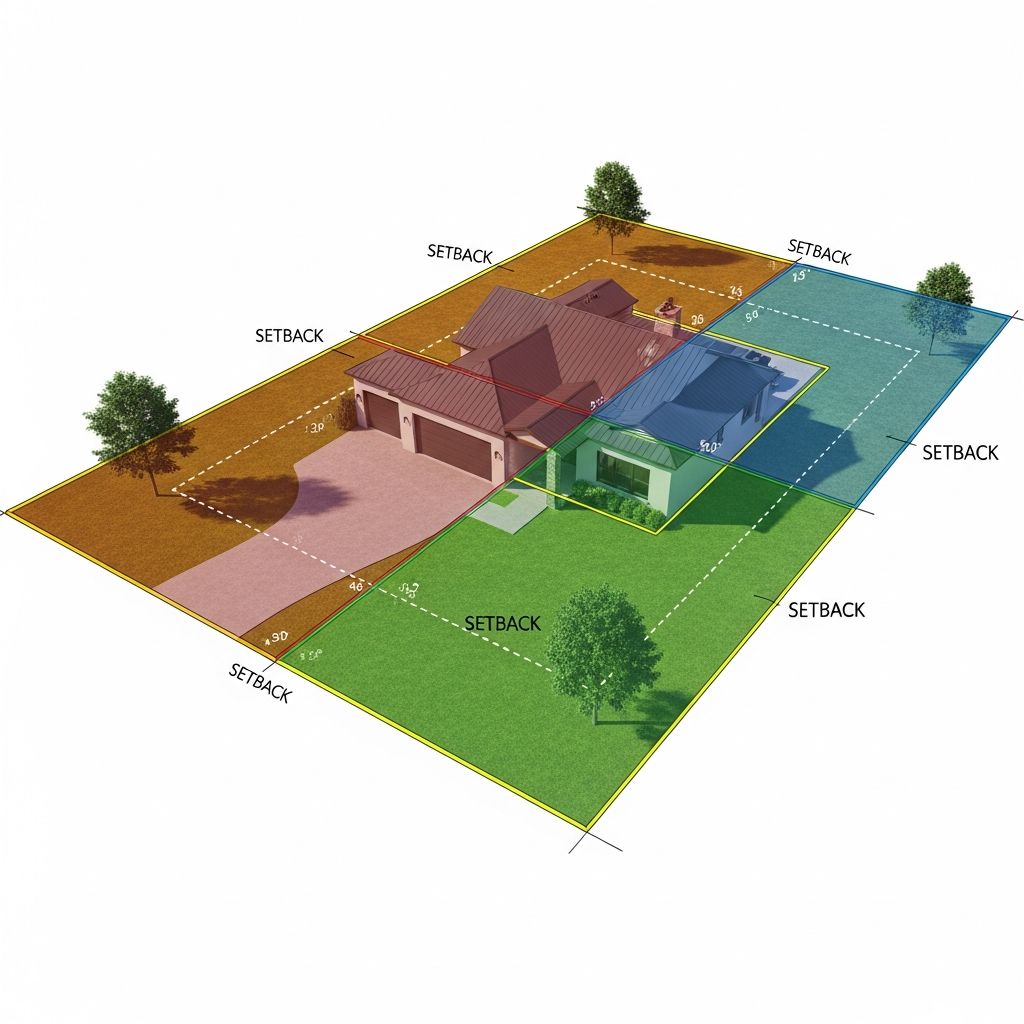
Before adding a new garage, fence, deck, or guesthouse, every property owner needs to understand one critical concept: property line setbacks. These rules control how close you can build to your lot lines, streets, and neighboring structures, and they are enforced through local zoning laws and building codes.
This guide explains in clear language what setbacks are, why they exist, how to find and interpret your local setback requirements, and what options you may have if your project does not meet the rules.
What Is a Property Line Setback?
A property line setback is the legally required minimum distance between a structure and a boundary such as a property line, street, waterway, or another protected feature.
In practice, this means there is a strip of land along the edge of your lot where buildings or certain structures are not allowed.
Key features of setbacks
- Measured from the lot line to the nearest part of a building or structure.
- Defined by local law, typically zoning ordinances and building codes.
- Applies to new construction and many additions, not just brand-new buildings.
- May also restrict other improvements such as fences, retaining walls, septic systems, or accessory buildings depending on local regulations.
Common types of setbacks
| Setback Type | Where It Applies | Typical Purpose |
|---|---|---|
| Front setback | Between the front property line (often along a street) and the primary structure | Creates consistent distance from roadways, room for utilities, and clear sight lines for safety. |
| Side setback | Along the left and right property boundaries | Limits how close neighboring homes can be to each other, promoting fire safety and privacy. |
| Rear setback | At the back lot line | Preserves yard space, access, and separation between lots. |
| Watercourse or environmental setback | Near rivers, streams, floodplains, shorelines, or wetlands | Protects natural resources and reduces flood and erosion risk. |
Why Do Setback Rules Exist?
Setbacks are not arbitrary. Local governments use them to advance several important public policy goals.
1. Health and safety
- Fire protection: By keeping buildings separated, setbacks reduce the risk that fire will quickly spread between structures.
- Emergency access: Clear space around buildings helps firefighters and other first responders reach structures when needed.
- Visibility and traffic safety: Distance from roads improves drivers’ sight lines at driveways and intersections.
2. Access to light, air, and utilities
- Light and ventilation: Space between buildings lets natural light and air reach living spaces, which is a traditional concern of zoning law.
- Utility corridors: Setbacks often provide space for underground water, sewer, and power lines, as well as access to meters.
3. Privacy and neighborhood character
- Privacy: Minimum separation helps ensure that windows, decks, and patios are not uncomfortably close to neighbors.
- Consistent appearance: Developers and local governments use setbacks to keep homes lined up in a relatively uniform way along streets.
4. Environmental protection
- Flood and erosion control: Extra distance from rivers, lakes, or floodplains reduces damage from flooding and bank erosion.
- Protection of sensitive areas: Setback buffers can protect wetlands and riparian habitats from construction impacts.
Where Do Setback Requirements Come From?
Most properties are subject to more than one source of setback rules. Owners must comply with all applicable requirements; the most restrictive rule generally wins.
Primary sources of setback rules
- Local zoning ordinances: City and county zoning codes usually define minimum setbacks by zoning district (for example, single-family residential vs. commercial).
- Building codes: Construction codes sometimes include minimum separation distances for safety and fire resistance, which interact with setbacks.
- Subdivision plats and recorded maps: Official plats may show building lines or no-build zones that function as setbacks.
- Covenants, conditions, and restrictions (CC&Rs): Planned communities and homeowners associations often impose additional or stricter setbacks in recorded covenants.
- State or federal regulations: Along certain highways, shorelines, or protected resources, state or federal setback rules may apply.
How to Find Your Property’s Setbacks
Because every jurisdiction is different, you must look up the specific rules that apply to your parcel. The steps below provide a practical roadmap.
Step 1: Confirm your property boundaries
- Review your deed and any recorded survey or plat map.
- Look for boundary dimensions and references to easements or building lines.
- If boundaries are unclear or disputed, consider hiring a licensed land surveyor.
Step 2: Check local zoning district and code
- Find out your zoning district (e.g., R-1 single-family, R-2 multifamily). This is usually available from the city or county planning department.
- Locate the zoning ordinance section for your district, and note the listed front, side, and rear yard setbacks.
- Pay attention to special rules for corner lots, flag lots, or lots adjacent to alleys or open spaces.
Step 3: Review recorded restrictions
- Search your title documents for any CC&Rs or private restrictions that apply to your subdivision or community.
- Compare these to the zoning rules. If private covenants require greater setbacks, you must follow the larger distance.
Step 4: Identify overlays and special areas
- Ask the planning department whether your property lies in a floodplain, coastal zone, historic district, or environmental overlay.
- These areas may have additional setback buffers from watercourses, wetlands, or historic streetscapes.
What Structures Are Affected by Setbacks?
Setback rules always apply to primary buildings, but they may also apply to many other improvements.
- Primary dwelling units (houses, duplexes, townhomes)
- Accessory buildings such as garages, sheds, workshops, and accessory dwelling units
- Decks, balconies, and porches, especially when elevated or roofed
- Carports and covered parking
- Retaining walls or tall fences, depending on local rules
- Septic systems and wells, which may be subject to health-department setbacks from property lines, buildings, and water sources
Some jurisdictions allow minor encroachments—such as eaves, steps, or bay windows—into setback areas, but only up to specified limits. These allowances are typically spelled out in the zoning ordinance.
Consequences of Ignoring Setback Requirements
Building in violation of a required setback is generally treated as a zoning or building code violation.
Possible outcomes
- Stop-work orders: Inspectors may halt construction until the violation is resolved.
- Fines and penalties: Local governments can impose civil fines for noncompliance.
- Denial of permits or approvals: Final inspections, occupancy permits, or future permits may be withheld until the issue is corrected.
- Required modification or removal: Owners can be ordered to move or demolish the nonconforming structure at their own expense.
- Title and sale complications: Unresolved violations may surface in inspections, appraisals, or due diligence when selling or refinancing the property.
Because remedying a setback violation can be extremely costly—especially for permanent structures—it is essential to verify setback lines before starting any project.
Setback Variances and Other Relief Options
In some situations, property owners can request formal relief from strict setback rules, usually in the form of a variance.
What is a variance?
A variance is an official, case-specific permission granted by a zoning board or similar body that allows a property to deviate from standard setback requirements.
Typical criteria for a variance
- The property has a unique physical condition (such as irregular shape, steep slope, or unusual size).
- Strict application of the code would cause practical difficulty or unnecessary hardship not created by the owner.
- The requested relief is minimal and reasonable and does not harm public health, safety, or welfare.
- The change is consistent with the spirit of the zoning plan and does not substantially impair neighboring properties.
The variance process (typical steps)
- Submit an application with site plans showing the requested setback change.
- Pay applicable fees and provide any supporting documents or studies required.
- Attend a public hearing where neighbors may voice support or opposition.
- Receive a decision granting, modifying, or denying the variance request.
Even when a variance is granted, conditions may be attached (for example, limiting building height or requiring landscaping) to reduce impacts on neighboring properties.
Best Practices Before You Build
To avoid costly mistakes, take the following steps before starting any construction project that might implicate setbacks.
- Contact your local planning or building department early in the planning process to confirm applicable setbacks and permit requirements.
- Obtain a current survey if lot lines are uncertain or if the project is close to a boundary.
- Work with qualified professionals—architects, engineers, and surveyors are accustomed to designing within setback limits.
- Check all layers of regulation, including zoning codes, CC&Rs, plat maps, and any environmental overlays.
- Keep records of approvals, inspections, and surveys in case questions arise in the future.
Frequently Asked Questions (FAQs)
Q1: How do I know whether my shed or deck violates a setback?
A: First, determine your zoning district and look up the required front, side, and rear yard setbacks in your local zoning code. Then, measure from the property lines to the closest point of the shed or deck. If the distance is smaller than the required setback, the structure likely violates the rule.
Q2: Are fences always subject to the same setbacks as buildings?
A: Not necessarily. Many jurisdictions treat fences differently from buildings, allowing them closer to property lines but often limiting their height or design. You must review your specific zoning ordinance and any neighborhood covenants to see whether fences have separate standards.
Q3: Can I rely on my neighbor’s fence as the official property line?
A: No. Fences are frequently built slightly inside or outside the true lot line. To avoid disputes and potential violations, rely on recorded surveys, plats, or a licensed surveyor rather than assuming that existing fences mark the legal boundary.
Q4: What if the house was built in the wrong place before I bought it?
A: Preexisting violations can still create legal and financial risk for current owners, although some jurisdictions recognize nonconforming structures or have limitation periods. Because laws vary widely, you should consult local officials or a qualified real estate attorney to evaluate options such as variances, agreements with neighbors, or corrective construction.
Q5: Do setback rules ever change?
A: Yes. Zoning codes are periodically updated, and new overlays or environmental protections may be added. In some cases, existing structures become “legal nonconforming” if they complied with earlier rules but not with new ones. To confirm your status, check with your planning department when you buy property or plan any major project.
References
- setback | Wex | US Law — Legal Information Institute, Cornell Law School. 2022-06-01. https://www.law.cornell.edu/wex/setback
- Setback (land use) — Various authors, summarized on Wikipedia; primary sources include zoning and planning materials. Accessed 2025. https://en.wikipedia.org/wiki/Setback_(land_use)
- What are building setbacks? — City of Destin, Florida. Accessed 2025. https://www.cityofdestin.com/FAQ.aspx?QID=108
- What Is a Property Setback? — Realtor.com. 2019-05-01. https://www.realtor.com/advice/buy/what-is-a-property-setback/
- What is a Setback Line for Property? — Greenfield Township, Pennsylvania. Accessed 2025. https://www.greenfieldtownshippa.gov/setback-line-property/
- 10-19-7: Setbacks — Pryor Creek, Oklahoma, Municipal Code. Accessed 2025. https://codelibrary.amlegal.com/codes/pryorcreekok/latest/pryorcreek_ok/0-0-0-7630
- Lawyer Explains Property Setbacks — The Real Estate Lawyer (YouTube). 2023-05-25. https://www.youtube.com/watch?v=GPGKShCuC3E
Similar Articles








Read full bio of Sneha Tete


