
Understanding Patent Application Components
Master the essential elements required to file a successful patent application.
Navigating Patent Application Architecture
Filing a patent application represents a critical milestone in protecting intellectual property. The process requires submitting a meticulously organized collection of documents to the United States Patent and Trademark Office (USPTO) that collectively articulate your invention in precise technical and legal language. Understanding the structural framework of a patent application is essential before attempting to navigate the filing process.
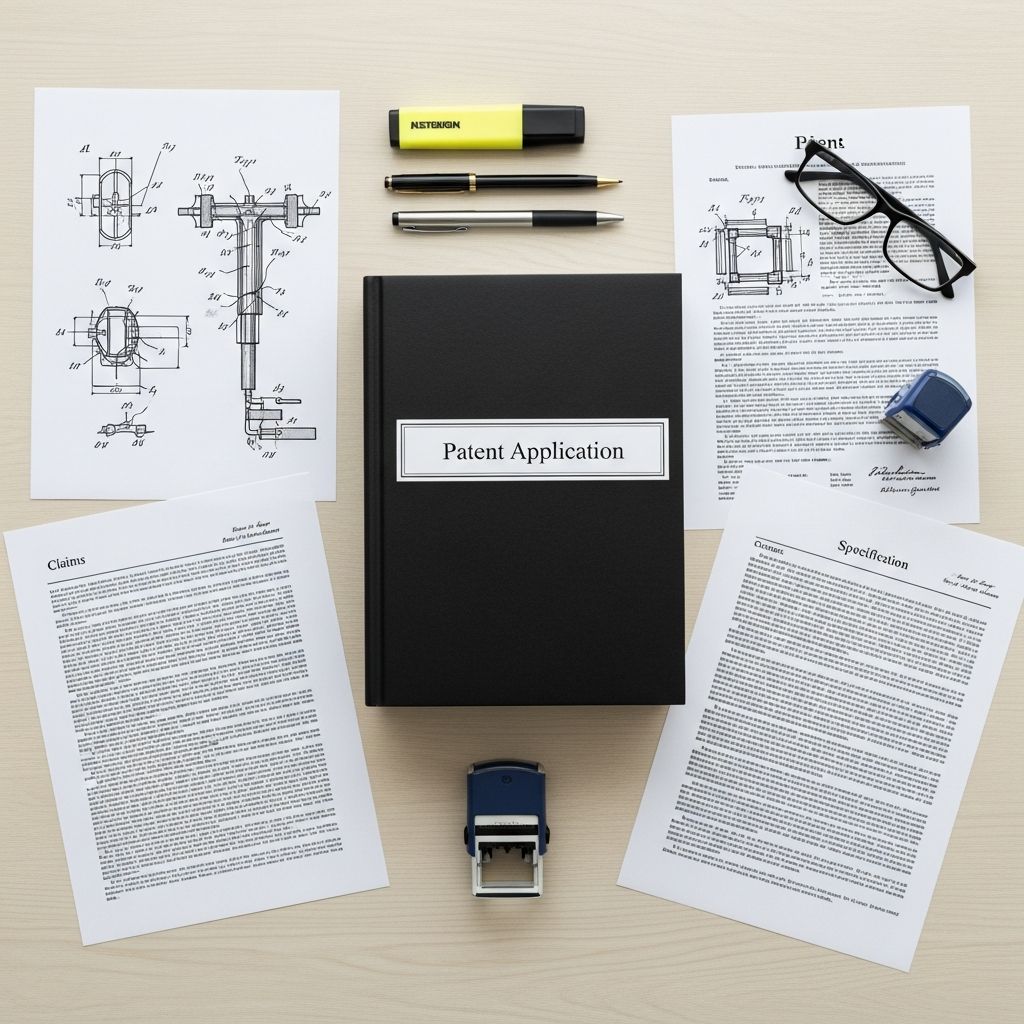
A patent application fundamentally consists of four interconnected sections that work together to present your invention comprehensively. These sections include the front matter and administrative information, technical drawings and visual representations, the specification document containing detailed written descriptions, and the claims that legally define your invention’s scope. Each component serves a distinct purpose and carries specific formatting requirements mandated by USPTO regulations.
The Administrative Foundation: Front Matter and Documentation
Before delving into the technical substance of your invention, the patent application begins with essential administrative elements that establish the foundation for your filing. This section contains critical identifying information that allows the USPTO to process your application efficiently and maintain proper records.
Identifying Your Invention Through the Title
The patent title functions as the official designation for your invention and serves multiple purposes simultaneously. An effective title must be concise yet descriptive, typically ranging from just a few words to a single sentence. The title should clearly indicate the technological field or industry sector your invention addresses without revealing proprietary details or novel aspects that might compromise your competitive advantage after public disclosure.
The title becomes publicly accessible upon patent publication, making it important to balance clarity with discretion. A well-crafted title enables other inventors, researchers, and patent examiners to quickly categorize your invention within the appropriate technological domain, facilitating the prior art search and examination process.
Documenting Applicant Information and Legal Representation
Patent applications require comprehensive identification of all parties involved in the invention and its protection. This includes the names and addresses of all inventors, the applicant (who may differ from the inventor in some cases), and any legal representatives, patent attorneys, or agents managing the filing process on behalf of the applicant.
Additionally, applicants must disclose information regarding related prior filings. If your current patent application builds upon or claims priority from a previously filed provisional application or international filing, these connections must be explicitly documented through serial numbers and filing dates. This disclosure ensures proper examination procedures and may affect the patent’s priority date and effective protection scope.
The Technical Heart: Specifications and Descriptions
The specification represents the most substantive component of any patent application, containing the detailed written explanation of your invention. This document must satisfy rigorous USPTO requirements while clearly communicating how your invention functions, its construction, and its applications. The specification typically comprises several distinct sections that build upon one another logically.
Establishing Context Through Field Classification
Every patent application begins by situating the invention within its appropriate technological landscape. The field section typically opens with a succinct statement categorizing the invention type. For example, an application might state: “This invention relates to advanced materials science, specifically to polymer composites designed for aerospace applications.” This opening statement immediately orients both patent examiners and future researchers within the correct technological domain.
This classification serves practical purposes beyond mere organizational convenience. It guides examiners toward appropriate prior art databases and technical references they should consult during examination, ensuring that the prior art search focuses on genuinely relevant existing technologies rather than tangential fields.
Contextualizing Your Innovation: The Background Section
The background section performs the critical function of establishing why your invention matters and what problems it solves. This section typically divides into two components: first, a description of the current technological landscape and existing solutions; second, an articulation of the limitations, inefficiencies, or problems inherent in those existing approaches.
Patent drafting requires particular care in the background section because characterizations of prior art can create admissions that limit your patent’s eventual scope. Rather than making sweeping dismissals of existing technologies, sophisticated patent applications acknowledge specific limitations while demonstrating how the new invention addresses those particular shortcomings. This nuanced approach prevents examiners from using your own words against you during prosecution or litigation.
Crystallizing Your Innovation: Summary of Inventive Concept
Beyond the abstract (discussed separately below), patent applications include a more substantial summary that explains the problems your invention solves and articulates how it accomplishes this solution. This summary bridges the gap between background discussion and detailed technical explanation, providing readers with a clear understanding of your invention’s purpose and mechanism before encountering exhaustive technical details.
Visual Documentation: Drawings and Their Explanations
Most patent applications require accompanying drawings that illustrate the invention’s structure, operation, or process flow. The specification must include a dedicated section that briefly explains each drawing, identifying what each figure represents. These captions might read: “Figure 1 shows an exploded view of the device assembly” or “Figure 3 depicts the sequence of steps in the manufacturing process.”
While drawings are often optional for certain types of applications, they dramatically enhance clarity and are typically recommended for most inventions. Visual representations help examiners understand three-dimensional structures, spatial relationships, and dynamic processes that would require extensive written description to convey adequately in words alone.
Comprehensive Articulation: Detailed Description Section
The detailed description constitutes the core of the patent specification and typically occupies the majority of the application’s length. This section provides exhaustive explanation of how the invention works, how it is constructed or manufactured, and how it operates under various conditions.
A well-drafted detailed description presents the inventor’s preferred implementation method while also explicitly discussing alternative embodiments and variations that fall within the invention’s broader concept. This approach strengthens the patent by demonstrating that the core inventive concept can be practiced in multiple ways, making the invention harder to circumvent through minor design modifications.
The detailed description must provide sufficient information that someone skilled in the relevant technological field could understand and implement the invention without requiring further experimentation or outside expertise. This requirement, known as enabling disclosure, is fundamental to patent law and ensures that the patent system provides genuine public benefit by making technical information accessible.
The Legal Boundaries: Patent Claims
While the specification describes your invention in narrative form, the claims translate the invention into precise legal language that defines the scope of protection you seek. Claims represent the most critical component of any patent application, as they ultimately determine what your patent covers and protects.
Understanding Claims as Legal Boundaries
Patent claims function analogously to property descriptions in real estate. Just as a property deed specifies exact boundaries through measurements and references to established markers, patent claims delineate the precise boundaries of your intellectual property protection. The scope of protection extends exactly to the boundaries established by claims—no further, no less.
A counterintuitive principle governs claim drafting: fewer elements typically result in broader protection. When a claim specifies fewer components or limitations, it covers a wider range of implementations. Conversely, claims that enumerate numerous specific features provide narrower protection because potential competitors can circumvent the patent through variations that fall outside the claimed elements.
Claim Architecture: Independent and Dependent Claims
Patent applications typically include multiple claims arranged in a hierarchical structure. Independent claims stand alone and define the invention without referring to other claims. These typically appear first and establish the broadest scope of protection sought.
Dependent claims reference earlier claims and add additional limitations or specifications. A dependent claim might read: “The device of claim 1, wherein the component comprises a specific material composition.” This structure allows applicants to seek both broad protection (through independent claims) and narrower, more specifically defined protection (through dependent claims), providing flexibility if examiners reject the broader claims as obvious or anticipated by prior art.
Claim Drafting Principles and Requirements
Each claim must be drafted as a single sentence, despite potentially spanning multiple lines of text. This grammatical requirement, while sometimes awkward, ensures that claims can be evaluated as cohesive logical units. Claims must be written with precision and clarity, avoiding ambiguous language that could generate interpretive disputes during examination or infringement litigation.
Claims must include all elements necessary to distinguish your invention from existing prior art while excluding unnecessary details that would inappropriately narrow the scope. Patent examiners scrutinize claims carefully, and applicants must be prepared to argue for their patentability during the examination process.
Supporting Documentation and Formalities
Beyond the primary application documents, USPTO regulations require several administrative components that formalize your filing and establish its validity.
The Abstract: Concise Searchability
Patent abstracts provide brief, searchable summaries of your invention limited to 150 words maximum in a single paragraph. The abstract should enable readers to quickly grasp your invention’s essence and determine whether reviewing the full application would serve their purposes. Although concise, the abstract must accurately represent the invention without exaggeration or omission of critical features.
Oath or Declaration Requirement
USPTO regulations mandate that all inventors execute an oath or declaration affirming their inventorship and acknowledging their understanding of patent law requirements. This formal declaration establishes the legal chain of inventorship and ensures that only actual inventors are named on the application, preventing ownership disputes and establishing authenticity.
Filing Fees and Application Data Sheets
Patent applications require submission of appropriate filing fees scaled according to the application type and applicant status. Additionally, the Application Data Sheet provides structured information about the applicant, inventors, and application details in a standardized format that facilitates USPTO processing and record management.
Comparative Requirements Across Patent Types
| Component | Utility Patent | Design Patent | Provisional Application |
|---|---|---|---|
| Specification | Required – Comprehensive | Required – Visual focus | Required – May be simplified |
| Drawings | Required for most | Required – Critical | Recommended |
| Claims | Required – Multiple | Single claim | Optional |
| Oath/Declaration | Required | Required | Optional |
| Filing Fee | Required | Required | Lower fee |
Frequently Asked Questions About Patent Applications
Q: What happens if my patent application lacks sufficient detail in the specification?
A: Insufficient specification detail can result in rejection under 35 U.S.C. § 112, which requires that specifications enable a person skilled in the relevant field to understand and implement the invention. The USPTO may issue a rejection requiring you to revise and supplement the specification with additional technical information, which can delay prosecution and potentially require filing an amendment or continuation application.
Q: Can I modify my claims significantly after initial filing?
A: Yes, you can modify claims during prosecution in response to examiner rejections, but modifications are constrained by what is disclosed in your original specification. You cannot broaden the scope beyond what your original filing supports, and substantial modifications may require amendment responses that articulate why the changes remain supported by your original disclosure.
Q: How many claims should I include in my application?
A: The number varies based on your invention’s complexity and protection strategy. Most applications include 15-25 claims combining broad independent claims with multiple dependent claims providing narrower alternatives. More claims increase filing fees but provide flexibility during examination and stronger protection against circumvention.
Q: What is the relationship between the abstract and the summary of the invention?
A: The abstract is a concise, formal summary limited to 150 words for search and retrieval purposes, while the summary of the invention provides a more comprehensive explanation of problems solved and how the invention operates. Both should be consistent with the specification but serve different audiences and purposes.
Q: Why is claim drafting considered the most critical skill in patent prosecution?
A: Claims determine your patent’s actual scope of protection—they define exactly what competitors cannot do without infringing. Even if your specification is comprehensive and your invention is genuinely novel, poorly drafted claims can result in narrow, easily circumvented protection or complete rejection during examination.
Q: Should provisional applications include detailed specifications and claims?
A: While provisional applications technically do not require claims, including a detailed specification and preliminary claims is highly recommended. This approach preserves your filing date while establishing a comprehensive record that supports a stronger utility application filed later within the 12-month window.
References
- What Are the Parts of a Patent Application? — LegalZoom. 2024. https://www.legalzoom.com/articles/what-are-the-parts-of-a-patent-application
- What Are the Different Parts of a Patent Application — Watson IP Group. 2024. https://www.watson-ip.com/blog/what-are-the-parts-of-a-patent-application
- Structure of a Patent: The Complete Guide to Understanding Patent Applications — Arapaks Law. 2024. https://arapackelaw.com/patents/structure-of-a-patent/
- Contents of a Patent Application — IP-Coster Academy. 2024. https://ip-coster.com/academy/details/contents_of_a_patent_application
- Understanding the Parts of a Patent — Henry Patent Law Firm. 2024. https://henry.law/blog/the-anatomy-of-a-patent/
- What Makes Up A U.S. Patent Application? A Breakdown of Key Sections — KPPB Law. 2024. https://www.kppblaw.com/what-makes-up-a-u-s-patent-application-a-breakdown-of-key-sections/
- Lesson 3: Parts of a Patent — University of Wisconsin-Madison Libraries. 2024. https://learn.library.wisc.edu/patents/lesson-3/
Similar Articles








Read full bio of Sneha Tete


