
Understanding Necessity and Permissive Easements
Learn how necessity and permissive easements work, when they arise, and how they affect everyday property ownership and land access.
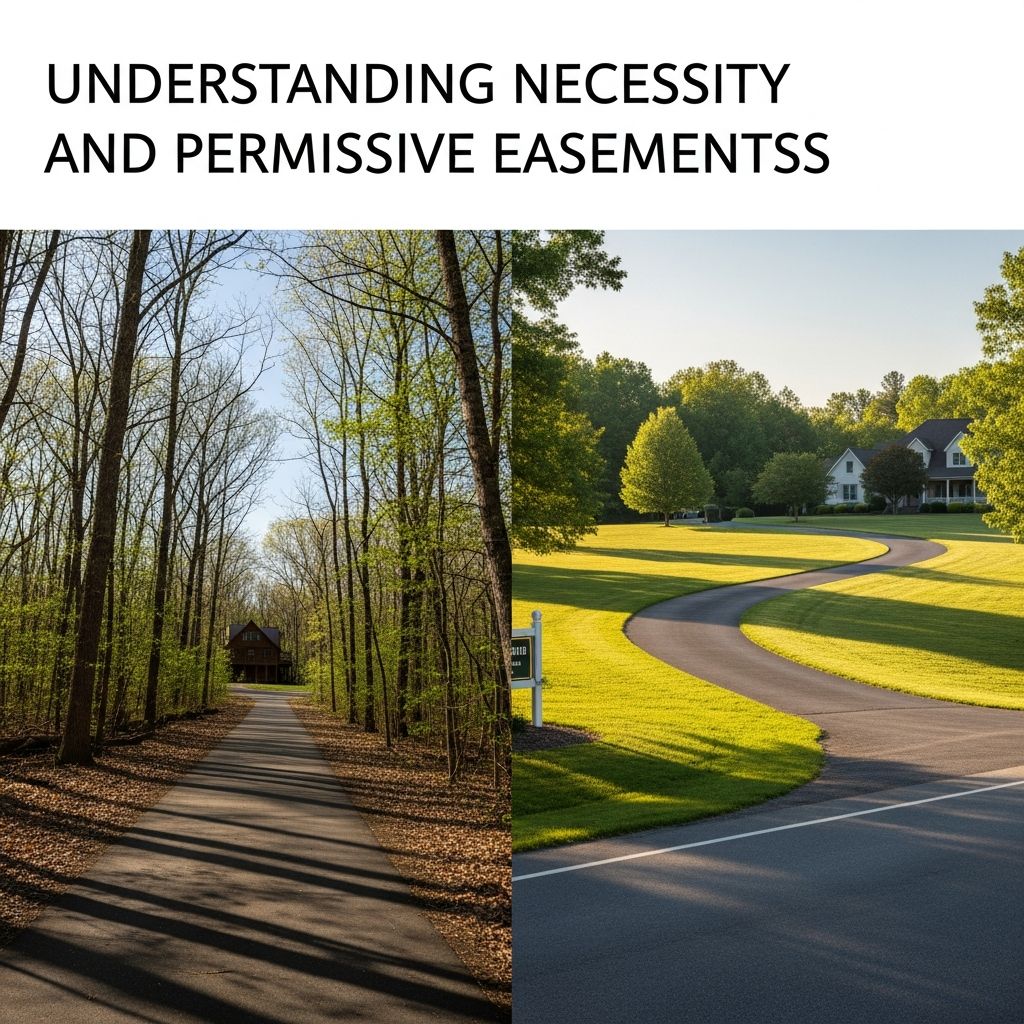
Owning land does not always mean you can use it freely without involving your neighbors. In many situations, you may need a legal right to cross someone else’s property to reach your own, install utilities, or maintain shared features. Two key tools that courts and landowners use to handle these issues are easements by necessity and permissive easements.
This guide explains what these easements are, why they exist, how they are created, and what rights and limits they give to each property owner.
1. Easements in Plain English
An easement is a legal right to use land that belongs to someone else for a specific purpose while they still own it. Easements do not transfer ownership; instead, they create a shared set of rights over the same piece of land.
Common purposes include:
- Driving over a neighbor’s driveway to reach your home
- Running utility lines (water, sewer, electricity, gas) underground or overhead
- Walking along a path to reach a public road, beach, or shared facility
- Accessing farmland or forest that is not directly connected to a public road
Lawyers often describe two key pieces of land when an easement exists:
- Dominant estate – the parcel that benefits from the easement (the user)
- Servient estate – the parcel that is burdened by the easement (the land being used)
2. What Is an Easement by Necessity?
An easement by necessity is a special type of easement that arises when a parcel of land becomes landlocked and has no reasonable way to reach a public road or essential services except by crossing neighboring property. In these cases, courts may create a legal right-of-way even if there is no written agreement.
According to the Cornell Legal Information Institute, an implied easement by necessity requires both prior unity of ownership and necessity at the time the land was split. Many state courts use similar tests.
2.1 Why the Law Allows Easements by Necessity
Courts and legislatures favor easements by necessity for several policy reasons:
- Preventing land from becoming useless – Without access, land may have virtually no utility to its owner.
- Supporting productive land use – Public policy generally discourages wasting land and encourages that property can be reasonably used and developed.
- Presuming reasonable intent – The law often presumes that a seller did not intend to create a parcel that is unfit for use due to lack of access.
2.2 Typical Elements Courts Look For
While details differ by state, courts often require several core elements to establish an easement by necessity:
- Unity of ownership in the past – The dominant and servient parcels were once part of the same tract under a single owner.
- Severance of the property – That common owner split the property into two or more parcels through sale, inheritance, or other transfer.
- Necessity at the time of severance – When the land was divided, one parcel became landlocked or lacked practical access.
- Continuing necessity – The need still exists today; there is no other reasonable legal access.
2.3 Strict Necessity vs. Reasonable Necessity
Courts do not all apply the same level of necessity. Cornell’s Wex legal encyclopedia notes two main approaches:
| Approach | Standard | Practical Effect |
|---|---|---|
| Strict necessity (traditional view) | Requires that the land be fully landlocked with no legal access of any kind. | Easement usually limited to basic access roads; convenience or shorter routes are not enough. |
| Reasonable necessity (minority view) | Requires no other reasonable way to enjoy the property, beyond mere convenience. | May allow easements for utilities or practical access, not just bare roadways. |
Under either approach, a court will not create an easement if the original deed clearly states that the new owner will not have access across the grantor’s land.
3. Creating and Proving an Easement by Necessity
3.1 How These Easements Commonly Arise
Easements by necessity are often created by court order rather than by written contract. Typical situations include:
- A landowner sells the street-front portion of a large tract but keeps the rear portion, accidentally landlocking it.
- A family divides farmland among heirs, and one heir receives an interior parcel with no road frontage.
- A subdivision plat leaves one lot without direct access to a public street, making it dependent on a neighbor’s driveway.
In these scenarios, courts may imply that the parties must have intended some form of access, even if the deed is silent.
3.2 Evidence Often Used in Court
To prove an easement by necessity, property owners may need to present:
- Historical deeds showing that the two parcels were once under common ownership
- Surveys and maps showing the layout of current and former parcels
- Proof that there were no public roads or existing easements providing access when the land was split
- Testimony about how the land was used before and after the division
3.3 Scope and Use of the Easement
Once an easement by necessity is established, its scope should be no broader than reasonably required for the landlocked parcel’s useful enjoyment. Key points include:
- The route and width should be limited to what is reasonably necessary (for example, enough for vehicles or farm equipment).
- Use must be consistent with the purpose of the easement (access, utilities, etc.).
- The servient owner may still use the land, so long as that use does not unreasonably interfere with the easement holder’s rights.
3.4 When an Easement by Necessity Ends
Because necessity is the foundation of this easement, it generally lasts only as long as that necessity continues.
- If the dominant parcel obtains another reasonable access route (for example, a new public road or a purchased right-of-way), the easement by necessity may terminate.
- If the formerly landlocked owner acquires neighboring parcels that provide their own access, courts may find that the easement is no longer needed.
Whether an easement has ended can be a contested question and often requires legal advice.
4. What Is a Permissive Easement?
A permissive easement refers generally to a situation where a landowner consents to another person’s use of their property, but that use is based on permission rather than on a permanent legal right. In many states, this is treated more like a license than an easement unless the parties clearly intend to create a legally enforceable interest.
Key ideas include:
- Permission can be informal – A neighbor may simply say, “You can use my driveway to turn around.”
- Revocability – Because the use is based on consent, the owner can usually withdraw that permission at any time, unless a binding agreement says otherwise.
- Contrast with prescriptive rights – In many jurisdictions, openly using someone’s land without permission for a long, legally specified period can lead to an easement by prescription, but clearly permissive use usually will not.
4.1 Common Examples of Permissive Use
- Parking on a neighbor’s land with their ongoing verbal consent
- Cutting across a vacant lot with the owner’s permission
- Allowing hikers to cross private land under a recreational use policy
If the landowner wants to avoid future disputes over prescriptive claims, they may post signs or send letters making clear that any use is by permission only.
4.2 Turning Permission into a Legal Easement
Property owners who want certainty can convert informal permission into an express easement documented in a written agreement and recorded with the land records. Doing so can:
- Define exact boundaries, width, and location of the easement
- Clarify who maintains the road, driveway, or path and how costs are shared
- Ensure that the rights bind future buyers of both properties
5. Comparing Necessity and Permissive Easements
| Feature | Easement by Necessity | Permissive Easement / License |
|---|---|---|
| How it arises | Created by law or court order when land becomes landlocked and prior unity of ownership exists. | Created by the owner’s consent, often informally; may or may not be documented. |
| Need for written agreement | Not required; can be implied even if deeds are silent. | Often oral or implied; becomes more secure if put in writing. |
| Duration | Lasts only as long as the necessity exists. | Generally lasts only while permission continues; owner may revoke. |
| Revocability | Servient owner cannot unilaterally revoke while necessity continues. | Owner can usually revoke permission at any time, absent a binding contract. |
| Effect on successors | Typically binds future owners of both parcels as a property right. | May not bind future owners unless recorded as an easement. |
6. Practical Issues and Disputes
6.1 Common Conflicts Between Neighbors
Disagreements involving necessity or permissive easements often center on:
- Location of the access route – Each side may prefer a different path across the servient estate.
- Width and intensity of use – Whether the easement supports cars, trucks, farm machinery, or utility equipment.
- Maintenance and repair – Who pays for grading, paving, snow removal, or culvert work.
- Expansion of use – For example, using a path originally meant for a single home to serve a subdivision.
- Alleged trespass – When the easement holder strays outside the defined route.
6.2 Tips for Property Owners
To reduce conflict and protect your rights:
- Obtain and review a current survey and title report when purchasing property.
- Ask directly whether any access to or across the property depends on an easement.
- Document any agreements in writing, with diagrams if possible, and consider recording them.
- Be clear when use is “by permission only” if you are trying to prevent future prescriptive claims.
- Consult a real estate attorney before blocking an existing route that neighbors rely on.
7. Frequently Asked Questions (FAQs)
Q1: Do I automatically get an easement if my land is landlocked?
Not automatically. Many states recognize easements by necessity when the required legal elements are met, including prior unity of ownership and necessity at the time of severance. In practice, you may need to negotiate with neighbors or ask a court to recognize the easement.
Q2: Is inconvenience enough to justify an easement by necessity?
Generally no. Under the traditional strict necessity rule, you must show that your property is essentially landlocked with no legal access at all. Under the minority reasonable necessity rule, you still need more than mere inconvenience; alternative access must be impractical or unreasonable.
Q3: Can a permissive easement turn into a permanent right?
If use is clearly and consistently permissive, it usually cannot ripen into a prescriptive easement because one requirement of prescription is that use be without the owner’s permission. However, if parties sign and record a written easement, the right can become permanent and binding on future owners.
Q4: Who maintains a driveway used under an easement by necessity?
Laws vary, but courts often expect the dominant estate (the benefiting parcel) to bear or share maintenance costs, especially if the servient owner gets little or no benefit from the driveway. A written agreement is the best way to fix responsibilities.
Q5: Can I block a neighbor’s long-used path across my land?
If the use has always been clearly permissive, you may generally revoke it, subject to any written agreements. If the neighbor claims an easement by necessity or by prescription, blocking access without legal advice can lead to litigation. Because rules and time periods are state-specific, consult a local attorney before taking action.
References
- implied easement by necessity — Cornell Law School, Legal Information Institute. 2023-05-01. https://www.law.cornell.edu/wex/implied_easement_by_necessity
- Understanding What an Easement by Necessity Is and When One Is Created — University of Maryland Extension. 2020-02-01. https://www.extension.umd.edu/resource/understanding-what-easement-necessity-and-when-one-created
- Understanding Easements by Necessity — De Sapio Law. 2022-07-15. https://www.ddsnjlaw.com/understanding-easements-by-necessity/
- Easement by Necessity: What Is It? How It Works — ContractsCounsel Legal Resources. 2023-08-10. https://www.contractscounsel.com/t/us/easement-by-necessity
- How to Establish an Easement by Necessity — Schorr Law. 2021-11-03. https://schorr-law.com/how-to-establish-an-easement-by-necessity/
- Easement by Necessity vs Easement by Prescription — Tarlow, Breed, Hart & Rodgers, P.C. 2019-06-18. https://www.t-mlaw.com/commentary/easement-by-necessity-vs-easement-by-prescription/
Similar Articles








Read full bio of Sneha Tete


