
Understanding the Main Types of U.S. Patents
Learn how utility, design, and plant patents work so you can choose the right protection strategy for your invention.
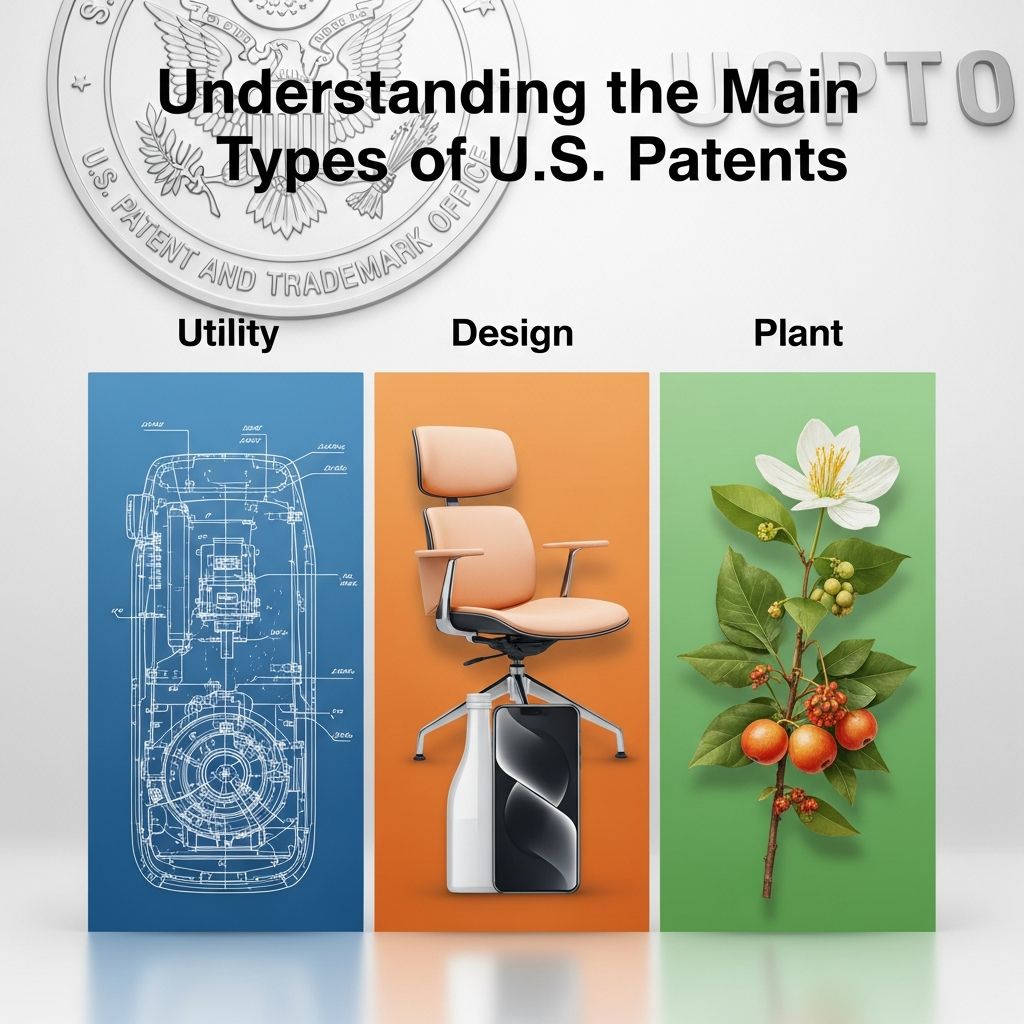
Patents are a core part of intellectual property law in the United States. They give inventors a limited-time right to stop others from making, using, selling, or importing their inventions without permission. Choosing the correct type of patent is critical, because each category protects a different aspect of an invention and follows distinct rules.
This guide explains the three primary patent types recognized by the U.S. Patent and Trademark Office (USPTO)—utility, design, and plant patents—and how they matter for startups, small businesses, and individual inventors.
Patent Protection at a Glance
Under federal law, patents are granted only for inventions that meet specific requirements, such as novelty and nonobviousness. At a high level, patent rights:
- Cover inventions that fall into defined statutory categories, such as processes, machines, or ornamental designs
- Last for a limited term, after which the invention enters the public domain
- Apply only within the jurisdiction where the patent is granted (for example, U.S. patents are enforceable in the United States)
- Require a formal application and examination by the USPTO before they are issued
The table below compares the three main patent types on key features relevant to most inventors.
| Patent Type | What It Protects | Basic Term (U.S.) | Maintenance Fees? | Example Uses |
|---|---|---|---|---|
| Utility patent | Functional inventions: processes, machines, manufactured articles, compositions of matter, or improvements | Generally 20 years from earliest effective nonprovisional filing date, subject to adjustments and extensions | Yes, periodic maintenance fees are required to keep the patent in force | Software systems, mechanical devices, chemical formulations, manufacturing methods |
| Design patent | New, original, ornamental design for an article of manufacture | 15 years from grant for applications filed on or after May 13, 2015 | No maintenance fees after grant for design patents | Product shapes, decorative surface patterns, device housings |
| Plant patent | New and distinct asexually reproduced plant varieties (excluding certain tuber-propagated plants and plants found in the wild) | 20 years from filing date of the application | No maintenance fees after grant for plant patents | New rose cultivars, fruit tree varieties, ornamental plants cloned by cuttings or grafting |
Utility Patents: Protecting How an Invention Works
Utility patents are by far the most common type of patent issued in the United States and cover the vast majority of technological innovations. They are often called “patents for invention” because they protect the functional aspects of a product or process rather than its appearance.
What Utility Patents Can Cover
Under U.S. law, a utility patent may be granted for any new and useful:
- Process — a series of steps or methods for accomplishing a result, such as a manufacturing technique or data processing method.
- Machine — a device with interacting parts, like an engine, medical instrument, or industrial robot.
- Article of manufacture — a tangible product that is made, such as a tool, consumer product, or structural component.
- Composition of matter — a chemical compound, mixture, pharmaceutical formulation, or material.
- Improvement of any of the above — a new way of doing something or a technical refinement that enhances an existing invention.
Many modern innovations, including software implemented inventions, biotechnology tools, electronics, and business-related processes, are pursued as utility patents if they meet the applicable legal standards.
Key Legal Requirements
To obtain a utility patent, an invention must generally satisfy the following criteria:
- Patentable subject matter — It must fall within one of the statutory categories (process, machine, manufacture, composition of matter, or improvement).
- Novelty — The invention cannot have been previously disclosed in prior patents, publications, or public uses.
- Nonobviousness — It must not be an obvious variation of existing technology to a person having ordinary skill in the field.
- Utility — It must have a specific, substantial, and credible use.
- Full and clear description — The application must describe the invention in enough detail that a skilled person can make and use it without undue experimentation.
The application process typically involves a detailed written description, drawings when needed, and carefully drafted patent claims that define the legal scope of protection.
Term Length and Maintenance
For most utility patents filed today, the basic term is approximately 20 years from the earliest effective nonprovisional filing date, subject to certain adjustments for examination delays or regulatory review. To keep a utility patent in force, the owner must pay maintenance fees at prescribed intervals after it is granted.
When a Utility Patent Makes Sense
Utility patents are often well-suited when:
- The competitive advantage of the invention lies in how it works, not just how it looks.
- There is a strong risk that competitors will attempt to replicate the underlying function or method.
- The technology has a long commercial life, making the 20-year term valuable.
- The invention is complex enough that trade secret protection alone may be difficult to maintain.
Design Patents: Protecting How an Article Looks
Whereas utility patents focus on function, design patents protect the visual appearance of an article of manufacture. They are especially important in markets where product aesthetics significantly influence consumer choice.
Scope of Design Patent Protection
The subject of a design patent is a new, original, and ornamental design applied to an article of manufacture. The key points are:
- The design must be ornamental, not purely dictated by function. If a shape is the only way for a device to work, it may be considered functional and not protectable by a design patent.
- The design is inseparable from the article — the patent does not cover the article in the abstract, but the way the article looks.
- Protection is defined mainly by the drawings included in the design patent, which visually depict the claimed design.
Common use cases include distinctive shapes of consumer products, user interface icon layouts, decorative patterns on goods, and ornamental housings for devices.
Term and Maintenance Rules
For design patent applications filed on or after May 13, 2015, the term of protection is 15 years from the date the patent is granted. Unlike utility patents, no maintenance fees are required to keep a design patent in force once issued.
Strategic Uses for Businesses
Design patents can be cost-effective tools when:
- The visual appearance of a product is a key source of brand recognition or consumer appeal.
- There are multiple design variations, and a company wants to protect each version separately.
- A product’s functional aspects may be hard to patent, but its unique styling differentiates it in the marketplace.
- The business wants an additional layer of protection alongside trademarks or trade dress.
Because design patents and utility patents protect different aspects of an invention, they can sometimes be pursued together for the same overall product.
Plant Patents: Protecting New Asexually Reproduced Plants
Plant patents are a more specialized form of protection aimed at plant breeders and agricultural innovators. They cover certain new plant varieties that are reproduced without seed.
Eligible Subject Matter
Under U.S. law, a plant patent may be granted to an inventor who has discovered or invented, and asexually reproduced, a distinct and new plant variety. Key conditions include:
- The plant must be new and distinct from known varieties.
- The variety must be capable of asexual reproduction (for example, by cuttings, grafting, budding, or other methods that do not involve seeds).
- Certain plants, such as those found in an uncultivated state and some tuber-propagated species, are excluded from plant patent protection.
Plant patents are often used for new fruit trees, flowering ornamentals, and other horticultural varieties that can be cloned or propagated vegetatively.
Term and Fees
Similar to utility patents, the basic term of a plant patent is 20 years from the filing date of the application. However, once granted, plant patents do not require maintenance fee payments to remain in force.
Why Plant Patents Matter
For nurseries, agricultural companies, and individual breeders, plant patents can:
- Secure exclusive rights to sell or license high-value plant varieties.
- Help recoup the investment in years of breeding and selection work.
- Support branding and market differentiation of unique cultivars.
Plant patents can also be used in combination with other forms of protection, such as plant variety protection certificates and trademarks for plant variety names, depending on the strategy and jurisdiction.
Provisional vs. Nonprovisional Applications (Utility and Plant)
For utility and plant inventions, the USPTO allows both provisional and nonprovisional applications. Understanding the distinction helps inventors manage timing and costs.
Provisional Applications
A provisional application:
- Is available only for utility and plant inventions (not for design inventions).
- Lets an inventor establish an early filing date with fewer formal requirements.
- Is never examined on its merits and will not itself mature into a granted patent.
- Expires after 12 months; to benefit from its filing date, the inventor must file a corresponding nonprovisional application within that period.
Provisional filings can be useful when an inventor wants to quickly secure a priority date while continuing to refine the invention or seek funding.
Nonprovisional Applications
A nonprovisional application is the standard application that is examined by the USPTO:
- It must meet all formal and substantive requirements, including claims and any required drawings.
- If allowed, it can result in an issued utility or plant patent.
- The patent term for utility and plant patents is measured from the effective filing date of the nonprovisional application, subject to adjustments.
Combining Patent Types for Broader Protection
Because each patent type covers different subject matter, an inventor can sometimes use more than one type of patent to protect different aspects of the same product or innovation. Official and educational resources recognize that utility, design, and plant patents address distinct categories of invention.
- A consumer product may be protected by a utility patent on its internal mechanism and a design patent on its external shape.
- A plant breeder might pursue a plant patent for a new variety and separate intellectual property rights for branding.
- Software-related inventions may be covered by a utility patent if they meet subject-matter and eligibility standards, while the visual layout of icons or interfaces may, where appropriate, be addressed by design protection.
Building a layered strategy often requires careful planning and professional guidance, particularly when international markets are involved.
Frequently Asked Questions About Patent Types
Q: How do I know which type of patent I need?
If your main concern is how a product or process functions, you are likely looking at a utility patent. If the unique value is in the way the product looks, a design patent may be more appropriate. For new plant varieties reproduced asexually, a plant patent is the specific category created by U.S. law. In practice, many products benefit from a combination of these protections.
Q: Can I file both a utility and a design patent for the same invention?
Yes. Because utility and design patents protect different aspects of an invention—function versus appearance—it is possible to pursue both for the same product, provided each application independently meets the legal requirements.
Q: Do all patents last for 20 years?
No. In the U.S., most utility and plant patents have a term of 20 years from the relevant filing date, while design patents for applications filed on or after May 13, 2015, generally last 15 years from grant. Utility patents also require maintenance fees, whereas design and plant patents do not.
Q: Are software inventions covered by a special type of patent?
There is no separate “software patent” category in U.S. law. Software-related inventions are typically pursued as utility patents if they satisfy subject-matter eligibility, novelty, nonobviousness, and other statutory criteria. The claims may focus on the technical process or system implemented by the software.
Q: Do I need a lawyer or patent agent to file a patent application?
The USPTO does not require individuals to use a practitioner, but patent law and examination practice are complex. Official guidance from the USPTO notes that many applicants choose to work with a registered patent attorney or agent who is familiar with legal standards and procedural rules.
References
- Types of Patents Available Under Federal Law — Justia. 2023-03-01. https://www.justia.com/intellectual-property/patents/types-of-patents/
- Applying for Patents — U.S. Patent and Trademark Office (USPTO). 2023-07-24. https://www.uspto.gov/patents/basics/apply
- Description of Patent Types — U.S. Patent and Trademark Office (USPTO). 2022-10-01. https://www.uspto.gov/web/offices/ac/ido/oeip/taf/data/patdesc.htm
- Patents, Trademarks, and Copyright — University of Texas Libraries. 2022-09-15. https://guides.lib.utexas.edu/c.php?g=532337&p=3642135
- Basic Terms and Types of Patents — University of Chicago Library. 2021-11-18. https://guides.lib.uchicago.edu/c.php?g=297338&p=1984816
Similar Articles








Read full bio of Sneha Tete


