
MACRS Depreciation: 6 Property Classes And Key Rules
Master MACRS depreciation: Accelerate tax deductions for business assets and optimize your financial strategy effectively.
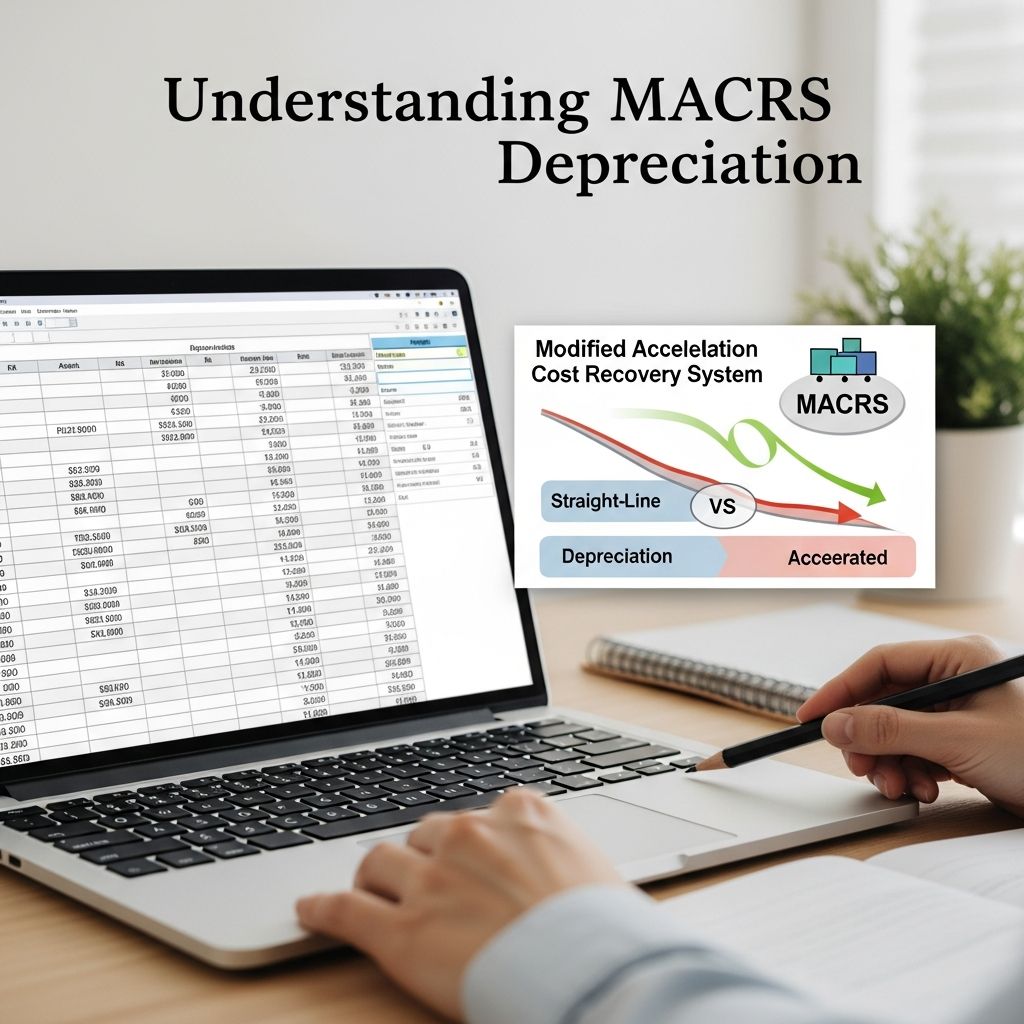
The Modified Accelerated Cost Recovery System (MACRS) serves as the cornerstone of tax depreciation in the United States, enabling businesses to deduct the costs of qualifying tangible assets over predetermined periods. This system prioritizes accelerated deductions, allowing larger write-offs in the initial years of an asset’s life to enhance cash flow and reduce taxable income early on.
Core Principles of MACRS for Business Owners
MACRS replaced earlier depreciation regimes to standardize and accelerate cost recovery for properties placed in service after 1986. Unlike financial accounting methods that align expenses with revenue generation, MACRS focuses purely on tax efficiency, front-loading deductions to provide immediate financial relief.
Businesses recover the ‘basis’ of an asset—typically its purchase price minus any salvage value or incentives like investment tax credits—through annual deductions. For instance, solar energy projects adjust basis post-ITC, enabling deductions on about 85% of the original cost.
Property Classes and Assigned Recovery Periods
Under MACRS, the IRS categorizes assets into recovery periods based on their expected useful life, dictating the depreciation timeline. These classes ensure consistent application across industries.
- 3-year property: Includes specialized tools, small machinery, and certain racehorses, ideal for short-lived equipment.
- 5-year property: Covers computers, automobiles, light trucks, and office machinery, common in tech and transportation sectors.
- 7-year property: Encompasses office furniture, agricultural machinery, and fixtures, suiting most general business needs.
- 15-year property: Applies to land improvements like sidewalks and fencing.
- 27.5-year property: Residential rental buildings, using straight-line method.
- 39-year property: Nonresidential real estate, also straight-line.
Selecting the correct class is critical; misclassification can trigger IRS audits or disallowed deductions. Consult IRS Publication 946 for detailed tables.
Depreciation Systems: GDS vs. ADS
MACRS offers two systems: the General Depreciation System (GDS) for maximum acceleration and the Alternative Depreciation System (ADS) for longer, straight-line recovery. GDS is default for most taxpayers, but ADS is mandatory for certain assets like those used predominantly outside the U.S. or tax-exempt financed property.
| Aspect | GDS | ADS |
|---|---|---|
| Recovery Periods | Shorter (e.g., 5 years for computers) | Longer (e.g., 5-9 years for computers) |
| Methods | 200% DB, 150% DB, Straight-line | Straight-line only |
| Use Case | Standard business assets | Required for specific scenarios |
GDS accelerates recovery, benefiting growing businesses, while ADS provides uniformity for financial reporting alignment.
Calculation Methods in Depth
MACRS employs declining balance methods that apply a fixed rate to the remaining basis each year, switching to straight-line when optimal.
- 200% Declining Balance (DB): Doubles the straight-line rate (e.g., 40% for 5-year property), used for most non-real estate assets under GDS. Switches to straight-line for maximum deductions.
- 150% DB: Applies 1.5 times the straight-line rate, less aggressive, for assets like farm equipment or longer-life property.
- Straight-Line: Even annual deductions, mandatory for real property and optional under GDS/ADS.
IRS tables in Publication 946 simplify this; for 7-year GDS property at 200% DB (half-year convention), Year 1 rate is 14.29%.
Applying Depreciation Conventions
Conventions allocate depreciation within the first and last years to prevent timing manipulation.
- Half-Year Convention: Assumes mid-year placement, granting half a year’s deduction regardless of actual date. Default for most personal property.
- Mid-Quarter Convention: Triggers if over 40% of depreciable assets are placed in service in the final quarter, assigning deductions based on quarter.
- Mid-Month Convention: For real estate, assumes mid-month service start.
These rules ensure equitable treatment across purchase timings.
Step-by-Step MACRS Calculation Process
Computing MACRS deductions involves systematic steps for accuracy.
- Determine Basis: Cost minus trade-ins, incentives (e.g., halve post-ITC basis).
- Classify Asset: Match to IRS recovery period.
- Choose System/Method: GDS 200% DB unless specified otherwise.
- Select Convention: Based on placement timing.
- Apply IRS Table Rate: Multiply basis by percentage.
- Adjust for Bonus/Section 179: Layer on if eligible (e.g., 40% bonus in 2018).
Example: $100,000 farm equipment (7-year GDS, 200% DB, half-year). Year 1: $100,000 × 14.29% = $14,290. Year 2: Remaining basis × 24.49% = higher deduction.
Bonus Depreciation and Section 179 Integration
MACRS pairs with incentives: Bonus depreciation (e.g., 100% expensing pre-2023, phasing down) deducts a percentage immediately post-basis adjustment. Section 179 allows full first-year expensing up to limits for qualifying equipment. Combine strategically: bonus first, then MACRS on remainder.
Advantages of MACRS for Tax Planning
- Boosts early cash flow for reinvestment.
- Reduces current taxable income significantly.
- Standardized IRS tables minimize errors.
- Supports growth via deferred tax liabilities.
Potential Drawbacks and Compliance Risks
- Later-year deductions shrink despite ongoing use.
- Book-tax differences complicate reporting.
- Strict rules demand meticulous records; errors lead to penalties.
- Not applicable pre-1987 property or intangibles.
Real-World Applications Across Industries
Farmers depreciate tractors over 7 years; manufacturers use 5-year for machinery; real estate investors apply 39-year straight-line. Solar firms leverage MACRS post-ITC for 85% basis recovery.
Frequently Asked Questions
What property qualifies for MACRS?
Tangible business or income-producing assets placed in service after 1986, excluding intangibles, pre-1987 property, and certain transferred assets.
Can I switch from GDS to ADS?
Yes, via election, but it’s generally irrevocable; use ADS for longer lives or specific requirements.
How does mid-quarter convention affect deductions?
It reduces first-year deductions if many assets are bought late-year, preventing end-of-year bunching.
Is bonus depreciation still available with MACRS?
Yes, it precedes MACRS; phase-down rates apply post-2022, check current law.
What if I sell an asset mid-recovery?
Recapture excess depreciation as ordinary income; adjust final year via convention.
Best Practices for MACRS Implementation
Track placed-in-service dates rigorously, use tax software for tables, consult professionals for complex assets, and integrate with Section 179/bonus. Annual review ensures compliance amid law changes.
References
- The Modified Accelerated Cost Recovery System (MACRS) — Artisan Electric Inc. 2017-11. https://artisanelectricinc.com/wp-content/uploads/2015/12/MACRS_nov2017.pdf
- Understanding MACRS Depreciation — CSSI Services. Accessed 2026. https://cssiservices.com/understanding-macrs-depreciation/
- MACRS Depreciation – What it is, How it Works, Methods — Corporate Finance Institute. Accessed 2026. https://corporatefinanceinstitute.com/resources/accounting/macrs-depreciation/
- Modified Accelerated Cost Recovery System (MACRS) — CCH AnswerConnect. Accessed 2026. https://answerconnect.cch.com/document/mtg01845307027b581000a06d00237de5959c02e/mastertaxguide/macrs-recovery-methods
- A Simple Guide to Depreciation and MACRS — Ambrook. Accessed 2026. https://ambrook.com/education/taxes/depreciation-and-macrs
- Publication 946 (2024), How To Depreciate Property — Internal Revenue Service. 2024. https://www.irs.gov/publications/p946
Similar Articles








Read full bio of Sneha Tete


