
Understanding Juvenile Curfew Laws in the United States
Learn how juvenile curfew laws work, why cities use them, and what rights, penalties, and exceptions typically apply.
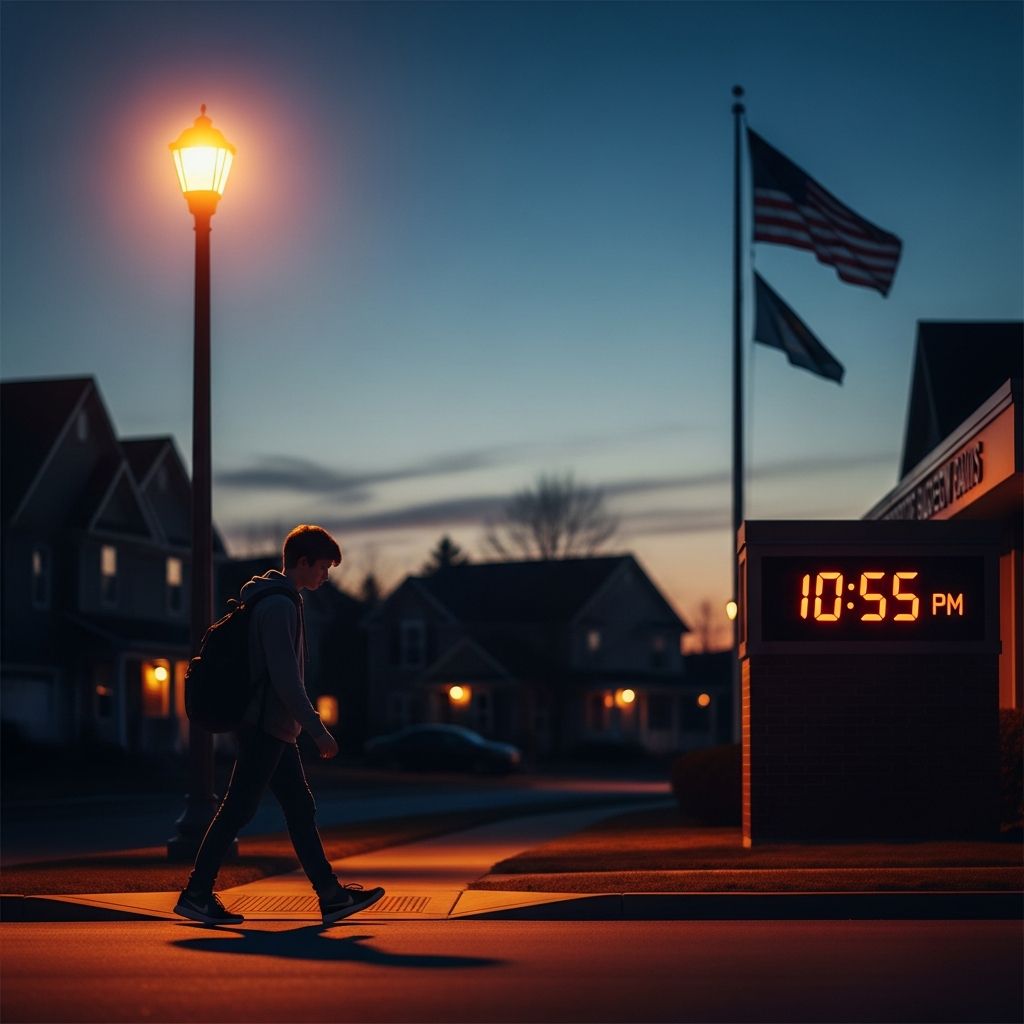
Many cities and counties in the United States limit when minors can be in public places at night through what are commonly called juvenile curfew laws. These rules aim to reduce crime and protect young people, but they also raise questions about parental authority and constitutional rights.
This guide explains how juvenile curfew laws typically work, what they regulate, the usual exceptions and penalties, and how courts have evaluated their legality.
What Is a Juvenile Curfew Law?
In the criminal-law context, a juvenile curfew is usually a local ordinance that restricts the presence of people under a certain age in public places during specified hours, most often at night. These ordinances are typically enacted by cities or counties rather than by the federal government.
Key features often include:
- Age limit: Commonly covers youth under 17 or under 18 years old.
- Restricted hours: Nighttime periods such as 11 p.m. to 5 a.m., or similar ranges, sometimes with later hours on weekends.
- Location: Public streets, parks, sidewalks, and sometimes private businesses that are open to the public.
- Underlying goal: Reduce juvenile crime and protect minors from becoming victims of crime.
Why Do Communities Use Curfew Laws?
Lawmakers promote juvenile curfew ordinances as tools for both crime control and youth protection. Analyses by the U.S. Office of Juvenile Justice and Delinquency Prevention (OJJDP) describe their goals as:
- Preventing juvenile crime by reducing opportunities for youth to commit offenses late at night.
- Protecting minors from becoming crime victims when fewer adults are present in public spaces.
- Supporting parents by reinforcing household rules and giving parents a legal basis for setting limits.
An OJJDP report notes that curfews became widespread in U.S. cities during the 1990s, and a survey by the U.S. Conference of Mayors found that a large majority of responding cities reported having such ordinances in place.
Common Elements of Juvenile Curfew Rules
Although every jurisdiction writes its own ordinance, juvenile curfew laws across the country tend to share several recurring elements.
Typical Age Ranges
Ordinances usually define a minor for curfew purposes as:
- Under 17 years of age, or
- Under 18 years of age, depending on the city or state enabling law.
Some laws also vary the rules by age group, giving older teens slightly later curfew hours than younger minors.
Standard Curfew Hours
Curfew hours vary, but national reviews describe patterns such as:
- Weeknight curfews: Often beginning around 10 or 11 p.m. and ending around 5 or 6 a.m.
- Weekend curfews: Sometimes starting at midnight and ending around 5 or 6 a.m.
- Daytime or truancy curfews: In some cities, separate daytime rules cover school hours (for example, roughly 8:30 a.m. to 1:30 p.m.) to discourage skipping school.
Where Curfew Applies
Curfew laws usually target a minors presence in:
- Public streets and highways
- Parks, playgrounds, and public facilities
- Shopping centers, parking lots, and commercial districts
- Businesses open to the public, such as restaurants, theaters, and arcades
Some ordinances apply citywide, while others impose stricter rules within designated high-crime zones or entertainment districts.
Who Can Be Held Responsible
Many curfew laws do more than regulate minors; they also impose obligations on adults. A typical ordinance may allow penalties for:
- The minor who is out during curfew hours without a valid exception.
- Parents or guardians who knowingly allow or fail to supervise minors who violate the law.
- Business owners or employees who knowingly permit minors to remain on the premises during curfew hours without a lawful exception.
Typical Exceptions to Curfew Laws
Because minors and families often have legitimate reasons to be out at night, most curfew ordinances include multiple exceptions. Government analyses describe common exemptions such as:
- Accompanied by an adult: The minor is with a parent, legal guardian, or an adult authorized by the parent to supervise the child.
- Traveling to or from work: The minor has a job and is going directly to or from the place of employment.
- School, religious, or civic events: The minor is on the way to, attending, or returning directly from a school-sponsored activity, religious service, or organized civic or recreational event.
- Emergencies: The minor is responding to or involved in a bona fide emergency, such as seeking medical assistance.
- First Amendment-related activities: Some ordinances explicitly exempt participation in political protests, rallies, or other constitutionally protected expressive activities.
- Married, emancipated, or with parental permission: Certain laws exempt married or legally emancipated minors, or those carrying written parental permission for specific activities.
Penalties and Legal Consequences
Juvenile curfew violations are ordinarily handled as status offenses or minor infractions rather than serious crimes. OJJDP materials describe sanctions that may include:
- Warnings: Many officers give a verbal warning on a first encounter and escort the minor home or to a safe location.
- Fines or civil penalties: Monetary penalties may be assessed against the minor, the parent, or both, sometimes up to several hundred dollars.
- Court appearances: Youth and parents may be required to appear in juvenile or municipal court.
- Diversion programs: Some ordinances direct first-time offenders to counseling, education programs, or community service instead of immediate fines.
In at least some jurisdictions, fines are imposed only if the youth and parent fail to comply with a court-ordered diversion or educational program. The specific range of penalties and how strictly they are applied depend heavily on local policy.
Curfew Laws and the U.S. Constitution
Because curfew ordinances restrict liberty and movement, they have been challenged in court on constitutional grounds. Federal courts have evaluated these laws under several constitutional provisions, particularly the First Amendment and the Fourteenth Amendment.
Rights Commonly Raised in Curfew Challenges
| Constitutional Right | How Curfew Laws Can Affect It |
|---|---|
| Freedom of speech & assembly (First Amendment) | Restrictions on nighttime presence in public can impact participation in protests, religious services, or political meetings. |
| Freedom of movement & travel (Fourteenth Amendment) | Limiting the ability of minors to be in public places may infringe substantive due process rights if not narrowly tailored. |
| Parental rights (Fourteenth Amendment) | Parents argue that broad curfew laws interfere with their right to direct the upbringing of their children. |
| Equal protection | Because minors are treated differently than adults, courts examine whether the distinction is justified by a compelling governmental interest. |
How Courts Review Curfew Ordinances
Federal appellate decisions show that curfew laws may be upheld or struck down depending on their design. OJJDP summaries of leading cases highlight several recurring principles:
- A curfew can sometimes be upheld if it furthers a compelling governmental interest, such as preventing youth crime and victimization, and uses the least restrictive means available.
- Courts pay close attention to the scope and clarity of exceptions, especially for work, emergencies, and First Amendment activities.
- Vague or overly broad ordinances, or those lacking clear exceptions, are more likely to be found unconstitutional.
Legal scholarship on drafting curfew ordinances emphasizes the need for narrow tailoring, detailed definitions, and clear procedures to reduce the risk of constitutional invalidation.
Effectiveness and Criticisms of Curfew Laws
Government research notes that while curfews are widely used, evidence about their effectiveness is mixed. Evaluations cataloged by CrimeSolutions.gov describe their overall impact on juvenile crime as inconclusive or modest at best in many communities.
Concerns Raised by Critics
Scholars, community advocates, and some parents have raised several concerns about juvenile curfews, including:
- Questionable impact on crime: Some studies find little or no statistically significant reduction in overall juvenile offending associated solely with curfew enforcement.
- Disproportionate enforcement: Advocates worry about unequal enforcement across neighborhoods or racial and ethnic groups.
- Strain on police resources: Critics argue that enforcing curfew violations can divert officers from more serious crimes.
- Interference with family decision-making: Some parents view curfews as undermining their discretion to decide when responsible teens may be out.
Supporters respond that curfews are only one part of broader youth-crime strategies, and that they can be useful when paired with prevention programs, outreach, and community-based services.
How Curfews Are Enforced in Practice
Local law enforcement agencies typically issue internal policies to guide officers on how to apply curfew ordinances. While procedures vary, some recurring practices include:
- Initial contact: Officers may ask the youth’s age, reason for being out, and whether any exceptions apply.
- Verification of exceptions: Minors might be asked to provide employer contact information, event details, or parental authorization.
- Transport or notification: Officers may take minors to a designated curfew center, juvenile facility, or directly home and notify parents or guardians.
- Discretion: Many departments give officers discretion to issue warnings in appropriate cases, especially when the youth appears to be safely engaged in lawful activity.
How strictly a curfew is enforced often depends on local priorities, crime patterns, and community expectations.
Practical Tips for Parents and Teens
Because curfew rules differ widely by city and county, families benefit from confirming what applies in their specific area. To stay informed and prepared, consider the following steps:
- Look up your local ordinance: Check your city or county code—often available through the municipal or state legislature website—to find the applicable age, hours, exceptions, and penalties.
- Discuss expectations at home: Parents can use the legal curfew as a baseline and then decide whether to set stricter household rules.
- Document lawful reasons to be out: Teens who work late or attend evening activities may want to carry contact information for employers, schools, or organizers.
- Know your rights and responsibilities: Understanding when an exception applies and how to speak respectfully with officers can reduce misunderstandings.
Frequently Asked Questions (FAQs)
Q1: Are juvenile curfew laws the same everywhere?
No. Curfew rules are typically created by local governments, so age limits, restricted hours, and penalties can differ significantly from one city or county to another.
Q2: Can a minor be arrested for violating curfew?
In many jurisdictions, curfew violations are treated as minor offenses or civil infractions, and officers may respond with warnings or citations rather than arrest. However, specific procedures depend on local law and policy.
Q3: Do curfews apply if my child is coming home from work?
Most juvenile curfew laws include an exception for minors traveling directly to or from lawful employment, but it is important to review the exact wording of your local ordinance to confirm how the exception works.
Q4: Can curfew laws restrict my child from attending a late religious or school event?
Commonly, ordinances exempt youth who are going to, attending, or returning from school-sponsored, religious, or civic events, especially when they travel directly between the event and home.
Q5: Are daytime curfews legal during school hours?
Some cities have separate daytime or truancy-related curfews that apply during school hours. These raise additional legal and policy questions, but they are generally evaluated under similar constitutional principles of narrow tailoring and legitimate governmental interest.
References
- Curfew — Wikipedia (background reference only; not cited directly for contested propositions). 2024-01-29. https://en.wikipedia.org/wiki/Curfew
- Practice Profile: Juvenile Curfew Laws — CrimeSolutions.gov, U.S. Office of Justice Programs. 2011-09-01. https://crimesolutions.ojp.gov/ratedpractices/juvenile-curfew-laws
- Curfew — Office of Juvenile Justice and Delinquency Prevention (OJJDP), U.S. Department of Justice. 1999-11-01. https://ojjdp.ojp.gov/sites/g/files/xyckuh176/files/pubs/reform2/ch2_c.html
- 720 ILCS 5/12C-60 Curfew — Illinois Compiled Statutes, Illinois General Assembly. Current through Public Acts effective 2024. https://www.ilga.gov/legislation/ilcs/documents/072000050K12C-60.htm
- SEC. 22-1102. Curfew: Imposed Upon Minors — Code of Ordinances, City of Moline, Illinois. 2023-05-01 (last updated). https://codelibrary.amlegal.com/codes/moline/latest/moline_il/0-0-0-9651
- Guidelines for Avoiding Pitfalls When Drafting Juvenile Curfew Laws — Joanna R. Grossman & Evelyn R. Hoke, Saint Louis University Journal of Health Law & Policy, Vol. 8, Issue 2. 2015-01-01. https://www.slu.edu/law/academics/journals/health-law-policy/-pdf/issues/v8-i2/grossman-hoke_article.pdf
Similar Articles








Read full bio of Sneha Tete


