
Instant Runoff Voting: A Clear Guide To Ranked-Choice Elections
Discover how instant runoff voting transforms elections by ensuring majority support and reducing vote splitting.
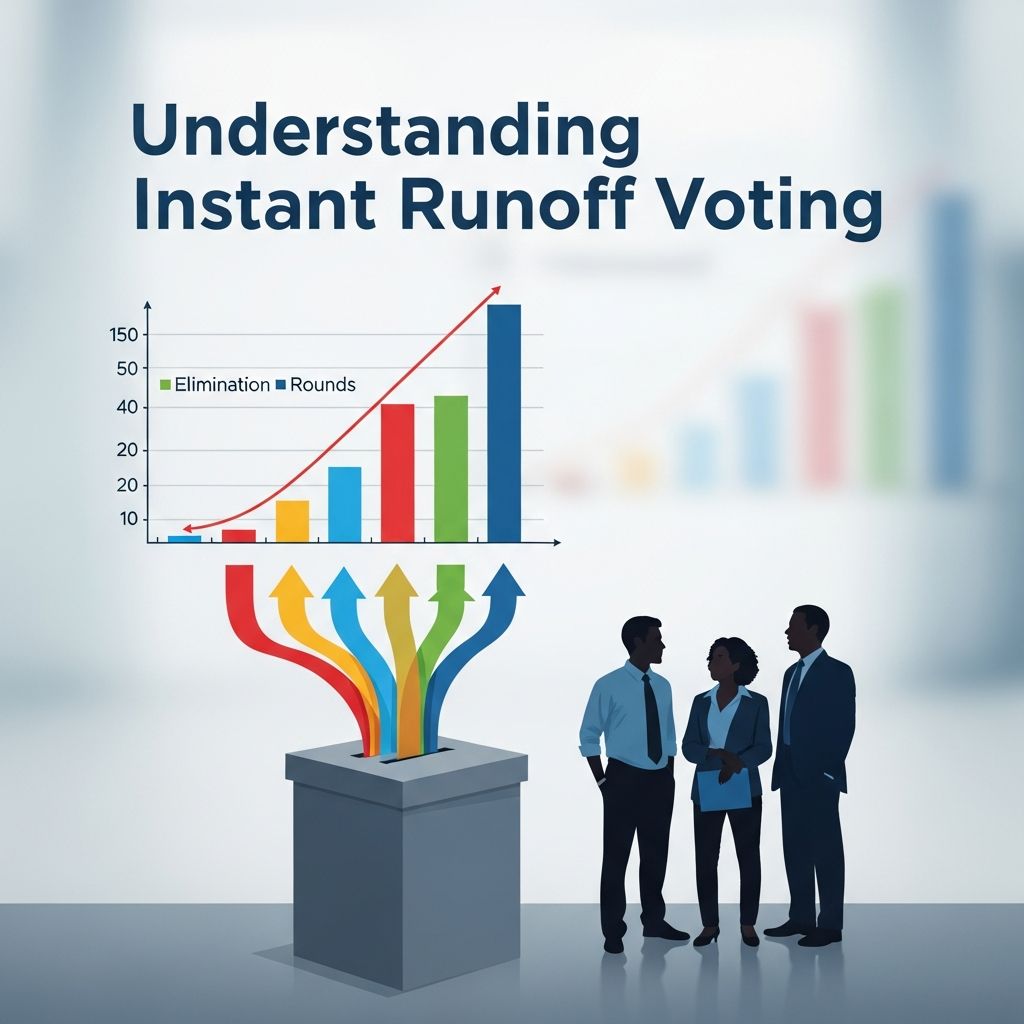
Instant runoff voting (IRV), frequently referred to as ranked-choice voting (RCV), represents a pivotal advancement in electoral methodologies. Unlike traditional plurality systems where the candidate with the most votes prevails—even without majority support—IRV empowers voters to rank candidates by preference. This process systematically eliminates lower-performing contenders and reallocates votes until a single candidate garners over 50% support from active ballots. By mimicking runoff elections in a single ballot, IRV addresses longstanding issues like the spoiler effect and voter dissatisfaction in multi-candidate races.
The Core Mechanics of Ranked-Choice Elections
At its heart, IRV operates through a structured, iterative counting procedure. Voters receive ballots listing all candidates and assign numerical rankings: 1 for their top choice, 2 for the next, and so on. Not all rankings are mandatory; voters can stop at any point, though full rankings maximize ballot utility.
The tabulation unfolds in rounds:
- Initial Count: Tally first-preference votes for each candidate.
- Majority Check: If any candidate exceeds 50% of valid first-choice votes, they win immediately.
- Elimination Phase: The candidate with the fewest first-preference votes is eliminated. Their ballots redistribute to the voters’ next living preference.
- Iteration: Repeat counting and elimination until one candidate achieves a majority of continuing votes or all but one are eliminated.
This method ensures exhaustive preference exploration without multiple voting days. Exhausted ballots—those with no further preferences—do not count in final rounds, but most systems require only a majority of active ballots.
Historical Development and Global Implementation
The roots of IRV trace to the 19th century, with reformers like Thomas Hare and John Stuart Mill advocating ranked systems to enhance representation. Australia adopted it federally in 1918 for its House of Representatives, where it remains a cornerstone of preferential voting. Ireland employs IRV for presidential elections and single-seat parliamentary contests, while Papua New Guinea uses it variably.
In the United States, adoption surged post-2000 amid Florida’s butterfly ballot controversies highlighting plurality flaws. Cities like San Francisco (2004), Portland (2010), and New York City (recently) implemented IRV for local races. Maine pioneered statewide use in 2018 for federal and gubernatorial contests, followed by Alaska’s 2022 ballot initiative success. As of 2023, over 50 U.S. jurisdictions employ some form of RCV.
| Country/Region | Usage | Year Adopted |
|---|---|---|
| Australia | Federal House, Senate (variant) | 1918 |
| Ireland | President, single-seat Dáil | 1922 |
| Maine, USA | Federal, state primaries/generals | 2018 |
| Alaska, USA | Statewide general elections | 2022 |
| San Francisco, USA | Mayor, Board of Supervisors | 2004 |
This table illustrates IRV’s diverse applications, from national parliaments to municipal boards.
Key Benefits: Why IRV Promotes Healthier Democracies
IRV’s primary advantage lies in guaranteeing majority winners. Traditional plurality often crowns candidates with 30-40% support, alienating pluralities. IRV forces consensus-building across preferences, reducing polarization.
- Eliminates Spoilers: Third-party votes no longer ‘waste’ ballots; they transfer, preventing vote-splitting akin to Nader-Bush 2000 dynamics.
- Encourages Positive Campaigning: Candidates seek second-choice rankings, fostering civility over attacks.
- Boosts Turnout and Satisfaction: Voters express full preferences, increasing engagement. MIT studies show higher satisfaction in IRV races.
- Cost Savings: Consolidates runoffs into one election, avoiding separate costly second rounds.
Empirical data from FairVote analyses confirm reduced strategic voting and more diverse candidate pools in IRV systems.
Addressing Common Criticisms and Challenges
Despite merits, IRV faces scrutiny. Critics argue it complicates voting, potentially confusing low-information voters. Ballot exhaustion—where preferences run out—can skew results, though rates remain low (under 5% in most U.S. trials).
Another concern: non-monotonicity, where ranking a candidate higher might lead to their loss. This theoretical flaw rarely manifests practically. Implementation hurdles include software costs and public education, but successes in Australia (century-long use) demonstrate feasibility.
Legal challenges persist; some states ban RCV via statutes, though momentum builds with voter-approved measures.
Practical Example: Simulating an IRV Election
Consider a mayoral race with 100 voters and candidates A, B, C:
| Round | A | B | C | Eliminated |
|---|---|---|---|---|
| 1 (First Choices) | 42 | 30 | 25 | None |
| 2 | 42 | 43 | 0 | C (25→B) |
| 3 | 57 | 43 | – | B; A wins (42+15) |
Here, C’s elimination transfers 20 to B and 5 to A, pushing A to majority without it. Plurality would have elected A with 42%, but IRV confirms broader appeal.
IRV Variants and Related Systems
IRV isn’t monolithic. Some jurisdictions cap rankings (e.g., top 5), while others use batch elimination for efficiency. Contingent voting limits to two rankings; optional preferences allow bullet voting.
Distinct from single transferable vote (STV) for multi-winner races, IRV is single-winner only. Top-two primaries differ by advancing literal top-two without full rankings.
Future Prospects and Reform Momentum
With distrust in plurality peaking—exemplified by 2020’s fractured results—IRV gains traction. Nevada and Colorado ballot measures loom, potentially expanding RCV exponentially. International bodies like the UN note its role in stable governance.
Technological aids, including apps for ranking simulation, ease adoption. As democracies evolve, IRV positions as a pragmatic upgrade ensuring elected leaders reflect true constituent majorities.
Frequently Asked Questions
What if a voter doesn’t rank all candidates?
Their ballot exhausts upon reaching no further preferences but counts fully until then, preserving vote integrity.
Does IRV always produce a majority winner?
Yes, of continuing ballots; absolute majority of cast votes isn’t required due to exhaustion.
Is IRV legal everywhere in the US?
No; about half of states permit it, others restrict via law, though local adoption bypasses bans.
How does IRV differ from a traditional runoff?
Traditional runoffs require revoting; IRV simulates via single ranked ballot, saving time and turnout.
Can IRV elect extremists?
Unlikely; second-choice dynamics favor moderates, as data from Australian and U.S. elections show.
References
- Instant-runoff voting — Wikipedia Contributors. 2023-10-15. https://en.wikipedia.org/wiki/Instant-runoff_voting
- Instant-runoff voting (IRV) — EBSCO Research Starters. Accessed 2023. https://www.ebsco.com/research-starters/political-science/instant-runoff-voting-irv
- Instant runoff voting — MIT Election Data and Science Lab. 2023-04-25. https://electionlab.mit.edu/research/instant-runoff-voting
- Ranked Choice Voting — FairVote. Accessed 2023. https://fairvote.org/our-reforms/ranked-choice-voting/
- Instant Runoffs — Unite America. Accessed 2023. https://www.uniteamerica.org/instant-runoffs
Similar Articles








Read full bio of Sneha Tete


