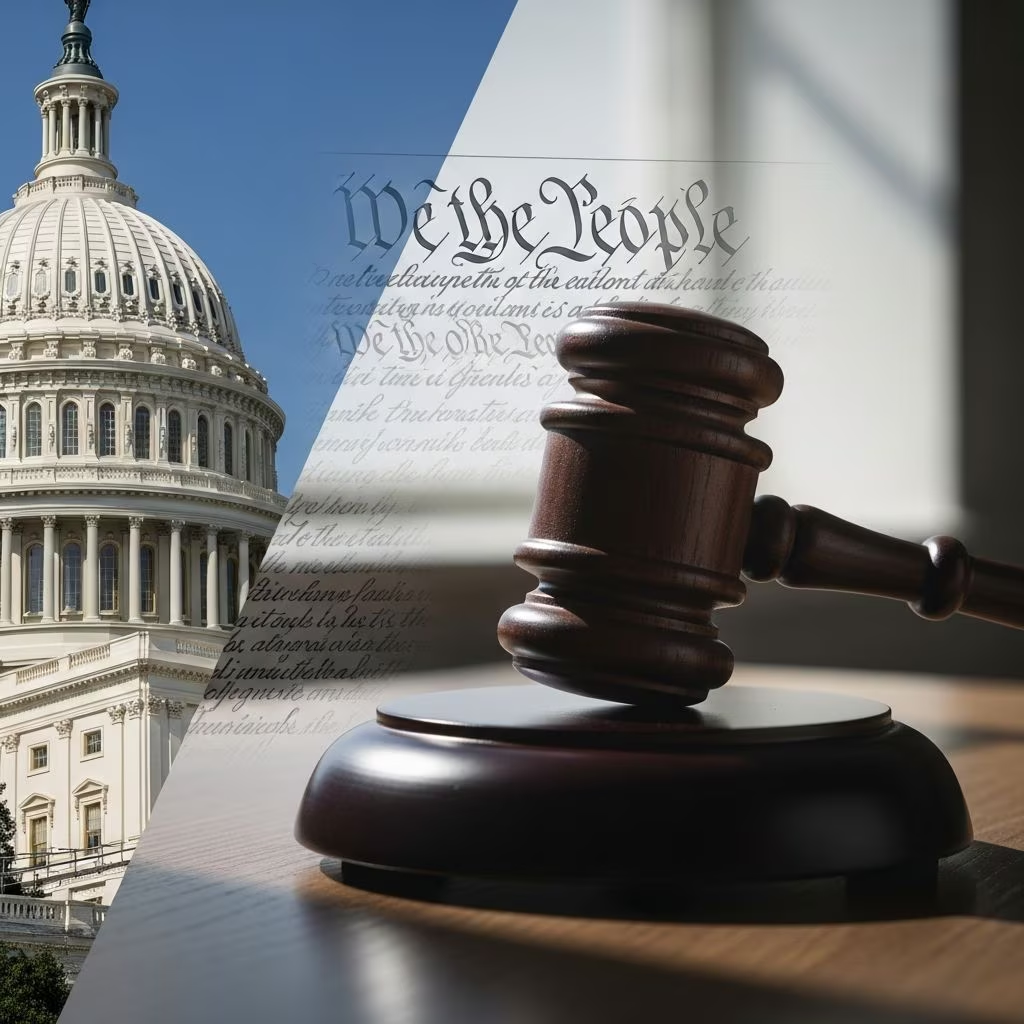
Impeachment is one of the strongest tools Congress has to hold high-level federal officials accountable when they are accused of serious misconduct. It is not a criminal trial, but a constitutional process that can remove an official from office and, in some cases, bar them from future federal service.
What Impeachment Is — And What It Is Not
In the U.S. system, impeachment is the formal charging process that begins in the House of Representatives. If the House approves one or more articles of impeachment, the official is said to be “impeached.”
The next step is a trial in the Senate, where senators decide whether to convict and remove the official from office.
- Impeachment = formal accusation by the House.
- Trial and conviction = Senate decision that can remove the official from office.
- Not the same as criminal guilt = the process is political and constitutional, not a criminal court proceeding.
Because impeachment is a constitutional remedy, normal criminal penalties like prison or fines are not imposed by the Senate. However, the same conduct may still be prosecuted later in the regular court system.
Who Can Be Impeached?
The Constitution specifies that the president, vice president, and all civil officers of the United States may be impeached.
In practice, impeachment has applied to:
- Presidents – for alleged serious abuses of power or other high-level misconduct.
- Federal judges – including Supreme Court and lower court judges, often for ethical or criminal violations that undermine judicial integrity.
- Other civil officers – such as cabinet officials or senior executive branch officers.
Members of Congress are generally disciplined or expelled by their own chamber rather than through impeachment.
Constitutional Grounds: What Counts as an Impeachable Offense?
Article II, Section 4 of the Constitution lists the core grounds for impeachment: treason, bribery, or other high crimes and misdemeanors.
These terms have specific constitutional meanings:
- Treason – defined in Article III as waging war against the United States or giving “aid and comfort” to its enemies.
- Bribery – accepting or offering something of value in exchange for official action.
- High crimes and misdemeanors – serious abuses of public trust; they do not need to be ordinary criminal offenses, but must reflect misconduct incompatible with holding federal office.
Congress has substantial discretion in deciding what conduct qualifies as a “high crime and misdemeanor,” but it is generally understood to include violations of the oath of office, abuses of power, serious corruption, or obstruction of constitutional processes.
Key Players and Their Roles
Several constitutional actors play distinct roles in impeachment proceedings.
| Actor | Main Responsibilities in Impeachment |
|---|---|
| House of Representatives | Initiates impeachment; investigates; drafts and votes on articles of impeachment. A simple majority vote is required to impeach. |
| House Judiciary or other committees | Conduct inquiries, hold hearings, gather evidence, and recommend whether to move forward with articles of impeachment. |
| House managers | Act as prosecutors in the Senate trial, presenting the House’s case for conviction. |
| Senate | Holds the impeachment trial, hears evidence and arguments, and votes whether to convict. A two-thirds vote is required to convict. |
| Chief Justice of the United States | Presides over the Senate trial when the president is the person impeached; otherwise, the usual Senate presiding officer leads. |
| Impeached official | May be represented by legal counsel, present evidence, and mount a defense during the Senate trial. |
Step-by-Step: How the Impeachment Process Works
Although every impeachment is unique, federal practice generally follows a series of stages.
1. Allegations and Initial Calls for Action
The process usually begins when allegations surface that a federal official has committed serious misconduct. These concerns can come from:
- Members of the House of Representatives.
- Judicial bodies, such as the Judicial Conference, in the case of judges.
- Special counsels or prosecutors.
- Public reports, whistleblowers, or other credible sources.
2. House Inquiry and Investigation
House leaders may direct one or more committees to examine whether impeachment is warranted.
Common investigative tools include:
- Subpoenas for documents and testimony.
- Public and closed hearings.
- Depositions and staff interviews.
- Review of prior investigative reports.
The House is not required to follow a single, fixed procedure; it may tailor rules and investigative steps to the particular circumstances.
3. Drafting and Approving Articles of Impeachment
If a committee concludes that grounds for impeachment exist, it may draft one or more articles of impeachment describing the alleged misconduct. These are essentially formal charges.
- The committee debates and votes on each article.
- Approved articles go to the full House for consideration.
- The House votes on each article, usually by a simple majority of members present and voting.
When at least one article passes, the official is impeached and the process moves to the Senate.
4. Transmission to the Senate and Preparation for Trial
After impeachment, the House formally notifies the Senate and appoints a group of representatives, known as House managers, to present the case at trial.
- The House managers deliver the articles of impeachment to the Senate and read them aloud in the chamber.
- The Senate acknowledges receipt and schedules a trial.
- Senators take a special oath to do impartial justice.
5. The Senate Trial
The Senate conducts the impeachment trial in a format similar to a court proceeding, although the Senate sets its own rules.
Typical elements include:
- Pretrial motions and decisions on procedure.
- Presentations by House managers outlining the case for conviction.
- Arguments by the impeached official’s legal team in defense.
- Calling and questioning of witnesses, where permitted by Senate rules.
- Submission and examination of documents and other evidence.
When the president is tried, the Chief Justice of the United States presides; for other officials, the presiding officer is usually the president of the Senate or another designated senator.
6. Deliberation and Voting in the Senate
After both sides finish, the Senate typically deliberates in closed session before voting on each article of impeachment.
- Each senator votes “guilty” or “not guilty” on each article.
- A two-thirds majority of senators present is required to convict on any article.
- If the threshold is not met, the official is acquitted on that article and remains subject to the result of any other articles.
Possible Outcomes and Consequences
Impeachment can lead to several different outcomes, depending on how the House and Senate vote.
Acquittal
If the Senate does not reach the two-thirds threshold on any article, the official is acquitted. In that case:
- The official remains in office.
- No impeachment-specific penalties, such as removal, are imposed.
- Political and historical consequences may still follow, but they fall outside the formal impeachment process.
Conviction and Removal from Office
If at least two-thirds of senators present vote to convict on one or more articles, the official is removed from office as a constitutional consequence.
- Removal takes effect immediately upon the Senate’s judgment.
- The office becomes vacant and is filled according to existing constitutional or statutory rules (for example, presidential succession laws).
Disqualification from Future Office
In addition to removal, the Senate may choose to bar the convicted official from holding federal office in the future.
- This additional penalty typically requires a separate Senate vote, often by a simple majority.
- Disqualification affects federal office only; it does not control state or local positions unless other laws apply.
No Criminal Penalties from Impeachment Itself
The Constitution specifies that judgment in cases of impeachment “shall not extend further than to removal from Office, and disqualification” from certain future offices.
- The Senate does not impose prison, fines, or probation as part of impeachment.
- However, an official who is removed can still be charged and tried in the regular court system for the same conduct, subject to normal criminal procedures.
Impeachment and the Balance of Powers
Impeachment is central to the Constitution’s system of checks and balances. It allows Congress to respond when an official’s conduct threatens the integrity of government or the rule of law.
Its roles within the separation of powers include:
- Accountability for the executive branch – ensuring that presidents and other senior officials remain answerable to the people’s representatives in Congress.
- Protection of judicial independence with safeguards – judges hold lifetime positions, but can be removed if they engage in serious misconduct.
- Preservation of constitutional norms – impeachment can address abuses that may not be neatly captured by criminal law but still violate fundamental public trust.
Because removal of an elected official is such a serious step, impeachment tends to be rare and often politically contentious, reflecting both legal analysis and political judgment.
Common Misconceptions About Impeachment
Public discussions about impeachment often include misunderstandings. Clarifying some frequent myths can help citizens interpret news and official actions more accurately.
- Myth: Impeachment automatically removes an official.
Reality: Impeachment only happens in the House. Removal requires a separate conviction by a two-thirds vote in the Senate. - Myth: Only criminal behavior can be impeached.
Reality: While some impeachments are based on alleged crimes, the constitutional phrase “high crimes and misdemeanors” also covers serious abuses of office that may not be criminal statutes. - Myth: The Supreme Court can overturn an impeachment.
Reality: The Senate’s judgment in impeachment trials is final; there is no appeal to the courts from the Senate’s decision. - Myth: The president can pardon someone to stop impeachment.
Reality: The Constitution explicitly states that the president’s pardon power does not apply in cases of impeachment.
Frequently Asked Questions (FAQs)
Q1: Can a former official be impeached after leaving office?
The Constitution does not explicitly limit impeachment to current officeholders, and there is historical practice of trying officials whose terms have ended. Whether the House chooses to impeach a former official is ultimately a political and constitutional judgment for Congress, and the Senate has previously held trials for officials who had already resigned.
Q2: How many votes are needed to impeach and convict?
In the House, a simple majority of members present and voting is enough to approve each article of impeachment. In the Senate, a two-thirds majority of senators present is required to convict on an article and remove the official from office.
Q3: How often has Congress used impeachment?
Impeachment has been used sparingly since the founding of the United States. The Senate reports that it has conducted a limited number of impeachment trials, many involving federal judges, with about half leading to conviction and removal. Presidential impeachments are particularly rare compared with the total number of presidents who have served.
Q4: Can an impeached official run for office again?
If the Senate convicts but does not impose disqualification, the Constitution does not automatically prevent the person from seeking federal office in the future. When the Senate separately votes to disqualify, that penalty typically blocks the person from holding federal office again.
Q5: Does impeachment replace criminal investigation or prosecution?
No. Impeachment is a constitutional remedy focused on officeholding, not criminal punishment. An official may face impeachment and, separately, criminal investigation or prosecution in the regular court system, either before, during, or after time in office.
References
- About Impeachment — U.S. Senate. 2023-01-10. https://www.senate.gov/about/powers-procedures/impeachment.htm
- Impeachment in the United States — Congressional Research and constitutional text summary via primary sources. 2023-08-01. https://www.congress.gov/crs-product/R45769
- The Delicate Process of Impeachment — Brookings Institution. 2017-05-17. https://www.brookings.edu/articles/the-delicate-process-of-impeachment/
- The Impeachment Process in the House of Representatives — Congressional Research Service. 2019-10-10. https://www.congress.gov/crs-product/R45769
- How Does Impeachment Work? — League of Women Voters. 2019-12-18. https://www.lwv.org/educating-voters/how-does-impeachment-work