
Understanding Illegal U-Turns and Traffic Law Consequences
Learn what makes a U-turn illegal, common restrictions, penalties, and how to avoid dangerous and costly traffic violations.
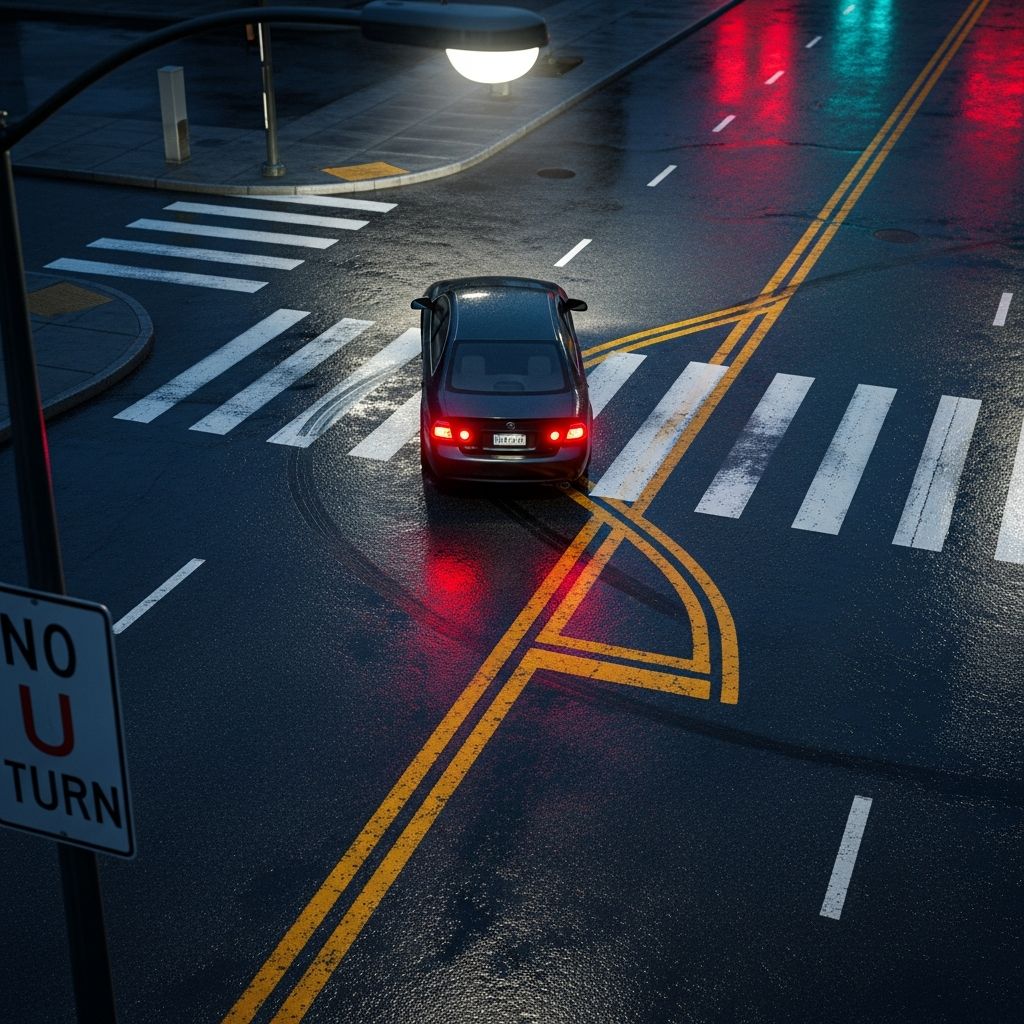
Making a quick U-turn can feel like an easy way to fix a missed turn, but doing it in the wrong place or in the wrong way can lead to serious legal and safety consequences. U-turn laws exist to reduce collisions, prevent traffic confusion, and protect pedestrians and other drivers.
This guide explains what typically makes a U-turn illegal, where these maneuvers are most restricted, what penalties you may face, and how to handle a citation if you receive one.
What Is a U-Turn and When Is It Legal?
A U-turn is a maneuver where a driver turns the vehicle around in roughly a 180-degree arc so that it proceeds in the opposite direction in the same roadway.
In many jurisdictions, U-turns are not automatically illegal. Instead, they are allowed only if they meet specific legal and safety requirements, which often include:
- There is no sign expressly prohibiting U-turns (such as a “No U-Turn” symbol).
- The driver can see far enough ahead to complete the turn without obstructing oncoming traffic.
- The turn is made from an appropriate lane (often the leftmost lane nearest the center line where applicable).
- The maneuver can be completed without causing other drivers to brake suddenly or swerve.
Traffic codes often treat U-turns as a specific type of turn governed by the same general principles as left and right turns, but with additional limitations due to their higher risk profile.
Common Situations Where U-Turns Are Prohibited
Even if state or local law allows U-turns generally, certain locations are almost always off-limits due to visibility, speed, or pedestrian activity.
1. Hills, Curves, and Limited-Visibility Areas
Many traffic codes explicitly ban U-turns on or near:
- Sharp curves
- The crest of a hill
- Any place where oncoming drivers cannot see at least a specified distance ahead (for example, 500 feet in some statutes)
The main concern is that a slow-moving vehicle completing a U-turn might be hidden from approaching traffic until it is too late to stop safely. Some laws specify that U-turns are prohibited where the turning vehicle cannot be seen within a defined distance by drivers coming from either direction.
2. School Zones
Many states forbid U-turns in active school zones because of:
- High pedestrian activity, particularly children crossing the street
- School buses stopping and starting
- Congested drop-off and pick-up traffic
Some laws make U-turns always illegal in designated school zones, even outside school hours, as an added safety measure.
3. Intersections with Restrictive Signs or Markings
Intersections often contain signs or pavement markings that control where and how turns can be made. These may include:
- “No U-Turn” signs
- Signs allowing only certain turns (for example, “Left Turn Only”)
- Lane arrows painted on the pavement indicating required directions of travel
If a sign, marking, or traffic signal forbids U-turns or directs traffic in a different pattern, making a U-turn there is usually considered an improper turn or illegal U-turn.
4. Multi-Lane Roads and Turn Lanes
On multi-lane roads with designated turn lanes, laws often require drivers to:
- Make U-turns only from the lane nearest the center line, if the law permits U-turns at that location.
- Return to the lane nearest the center line in the new direction after completing the turn.
Making a U-turn from the wrong lane, or swinging across multiple lanes, can transform an otherwise legal maneuver into a ticketable improper turn.
5. Areas with Heavy Traffic or High Speeds
Even where U-turns are not explicitly banned, they may be deemed unsafe and therefore illegal if they:
- Interfere with the normal flow of traffic
- Force approaching vehicles to brake sharply or take evasive action
- Occur on roads with high speed limits where stopping distances are long
Some traffic codes grant officers discretion to cite drivers when a U-turn endangers others, even if there is no specific sign at the location.
Improper vs. Illegal U-Turns
The terminology in traffic statutes can be confusing. You may hear references to both improper turns and illegal U-turns. In many jurisdictions, an illegal U-turn is treated as a form of improper turn and punished under the same or closely related laws.
| Concept | Typical Meaning |
|---|---|
| Improper Turn | Any turn (left, right, or U-turn) made from the wrong lane, against signs or markings, or without proper signaling. |
| Illegal U-Turn | A U-turn made where it is explicitly prohibited (e.g., in a school zone, on a curve, at a signed intersection) or in a manner that violates turning rules. |
Because these categories often overlap, a driver cited for an illegal U-turn might see the violation labeled as an “improper turn” on the ticket, depending on the statute used.
Penalties for Illegal U-Turns
Consequences vary widely by state and by the driver’s prior record. However, several common elements appear in many U.S. jurisdictions.
1. Fines and Surcharges
Drivers typically face a base fine, sometimes scaled up for repeat offenses within a set timeframe. In some states, an improper or illegal U-turn can carry a fine of up to roughly $150 for a first offense, increasing for subsequent convictions.
In addition, states may impose mandatory surcharges that are added on top of the base fine. For example, some New York violations add an administrative surcharge of about $88 to $93 depending on the court’s location.
2. Driver’s License Points
Many states use a point system to track driving violations. In New York, for instance:
- Improper or illegal U-turn convictions generally add 2 points to the driver’s record.
- Accumulating too many points within a defined time period—often 18 months—can lead to license suspension. In New York, 11 points in 18 months may result in suspension.
Effective 2026, some states (including New York) have moved to adjust how certain violations contribute to point totals, but U-turn violations commonly remain a moderate, non-trivial offense.
3. Driver Responsibility Assessments or Similar Fees
Some jurisdictions impose additional multi-year fees when drivers accumulate a threshold number of points. In New York, for example, drivers who receive 6 or more points within 18 months must pay a separate Driver Responsibility Assessment (DRA), which is in addition to court fines and surcharges.
These fees are structured to discourage repeated violations and to promote safer driving behavior over time.
4. Insurance Rate Increases
Even a relatively minor moving violation can have outsized financial effects when insurance is factored in. Insurance companies often treat improper turn or illegal U-turn convictions as indicators of risk, because such maneuvers can easily cause collisions.
While each insurer uses its own formulas, it is common for premiums to rise after a moving violation, particularly when there is already a history of prior tickets.
5. Rare but Possible Jail Time
Some statutes technically allow for short jail sentences for repeat or aggravated offenses, especially when combined with other violations or where the maneuver causes an accident or injuries. For example, certain U-turn violations in New York law permit both fines and potential short-term imprisonment in more serious cases.
In practice, jail time for a simple illegal U-turn is unusual, but the possibility underscores how seriously some jurisdictions treat dangerous turning behavior.
Why Illegal U-Turns Are So Dangerous
Lawmakers restrict U-turns not to inconvenience drivers, but because the maneuver can create multiple points of conflict in a short space and time.
- Crossing several lanes at once: A U-turn can require a driver to move across multiple lanes of opposing traffic, increasing collision opportunities.
- Obstructing fast-moving vehicles: Completing a slow 180-degree turn on a high-speed road can leave little reaction time for oncoming traffic.
- Decreased visibility: Hills, curves, parked cars, and roadside objects can hide a turning vehicle from approaching drivers until the last moment.
- Pedestrian conflicts: In downtown or school areas, U-turns may intersect crosswalks, bicycle lanes, and pedestrian flows.
Because of these factors, an otherwise minor misjudgment can lead to multi-vehicle crashes, side-impact collisions, or serious injuries to pedestrians and cyclists.
How Illegal U-Turn Tickets Are Enforced
Police officers may cite a driver for an illegal or improper U-turn after directly observing the maneuver or in the aftermath of a collision. In some cases, an officer may use the U-turn violation as a basis for a traffic stop that can lead to other charges.
In New York and many other states, so-called pretextual stops—where an officer pulls a driver over for a legitimate traffic infraction but also investigates other potential wrongdoing—are legally permissible. An improper U-turn can serve as that initial justification.
Practical Tips to Avoid Illegal U-Turns
Defensive driving means not just following the letter of the law, but anticipating where U-turns are risky or confusing for other road users.
- Plan ahead: If you miss a turn, continue safely to the next intersection or driveway where a legal and safe turn can be made.
- Watch for signs and markings: Look ahead for “No U-Turn” signs, school zone indicators, lane arrows, and other traffic controls.
- Check visibility: Avoid turning on hills or curves where you cannot see far enough ahead to judge oncoming traffic.
- Use the correct lane: On multi-lane roads, use the lane specified by law or pavement markings when U-turns are allowed.
- Be patient: If traffic is heavy or moving quickly, it may be safer to turn into a side street and turn around there rather than forcing a U-turn in the main road.
What to Do If You Receive an Illegal U-Turn Ticket
A ticket does not automatically mean you are guilty. How you respond can affect your record, insurance, and finances.
1. Read the Citation Carefully
Key points to review include:
- The specific statute or code section cited (for example, an improper turn or U-turn provision)
- The location and time of the alleged violation
- Any notes the officer added concerning signs, traffic conditions, or your driving behavior
2. Consider Your Options
Depending on local rules and the facts of your case, you may be able to:
- Plead guilty and pay the fine
- Request a reduction or negotiate with a prosecutor for a lesser offense
- Contest the ticket at a hearing
Contesting might be appropriate if you believe the sign was missing or obscured, visibility was adequate, or you did not actually perform a U-turn at the time alleged.
3. Evaluate Whether to Consult an Attorney
Traffic laws can be technical, and outcomes vary widely by jurisdiction. It may be wise to seek legal advice if:
- You already have several points on your record and risk suspension
- The ticket is combined with other serious charges (such as reckless driving)
- The alleged violation led to a collision with injuries or significant property damage
An experienced traffic lawyer can explain local practices, identify potential defenses, and help negotiate with prosecutors or represent you at a hearing.
Frequently Asked Questions About Illegal U-Turns
Q: Are U-turns always illegal unless a sign says they are allowed?
A: No. In many areas, U-turns are generally allowed unless a sign or specific law forbids them at a particular location, or unless the maneuver is unsafe given traffic and visibility. However, in school zones and on hills or curves, they are often categorically prohibited.
Q: How many points will I get for an improper or illegal U-turn?
A: Point values differ by state. In New York, an improper or illegal U-turn typically results in 2 points on your driving record. Accumulating 11 points in 18 months can lead to license suspension.
Q: Can a single illegal U-turn cause my license to be suspended?
A: A first-time U-turn ticket by itself usually does not result in suspension, but it can contribute to your overall point total. If you already have several violations on your record, one more could push you over the threshold that triggers a suspension or a driver responsibility fee.
Q: Is it still illegal if I make a U-turn safely and there is no traffic?
A: If a statute or sign specifically bans U-turns at that location—such as at a signed intersection, in a school zone, or on a hill or curve—the maneuver can still be illegal even when no other traffic is present. Safety matters, but so does compliance with posted controls and statutory restrictions.
Q: Do I need a lawyer for a simple U-turn ticket?
A: Not always. Many drivers handle single, low-level tickets on their own, especially when they have a clean record. However, if you face possible suspension, have multiple prior violations, or were involved in a crash, consulting a traffic attorney can help you understand the potential long-term consequences and available defenses.
References
- New York Vehicle and Traffic Law § 1161 – U Turns in Certain Areas Prohibited — New York State Legislature. 2024-01-01. https://law.justia.com/codes/new-york/vat/title-7/article-28/1161/
- The New York State Driver Point System — New York State Department of Motor Vehicles. 2023-06-30. https://dmv.ny.gov/points-and-penalties/the-new-york-state-driver-point-system
- Improper Turn Tickets in New York – VTL 1160(a)–1160(e) — Rosenblum Law. 2023-08-15. https://traffictickets.com/new-york/traffic-tickets/improper-turn-vtl-1160a-1160e/
- Where U-Turns Are Always Illegal in New York (And Why It Matters) — New York Traffic Ticket Lawyers. 2022-11-10. https://newyorktrafficticketlawyers.com/where-u-turns-are-always-illegal-in-new-york-and-why-it-matters/
- New York Drivers Will Get More Points on Their License for Breaking Laws in 2026 — FOX 5 New York. 2024-09-05. https://www.fox5ny.com/news/new-york-drivers-will-get-more-points-license-breaking-laws-2026
- Vehicle & Traffic Law § 1160(e) and Improper U-Turns — Benjamin Goldman Law Office. 2023-04-20. https://www.benjamingoldmanlawoffice.com/blog/vtl-1160-e-improper-u-turn.html
- Vehicle & Traffic Law § 1161-a – U-Turn at Grade/Curve — Benjamin Goldman Law Office. 2022-02-14. https://www.benjamingoldmanlawoffice.com/blog/vtl-1161-a-u-turn-at-grade-curve.html
Similar Articles








Read full bio of medha deb


