
Idaho Traffic Laws: Essential Rules Every Driver Must Know Now
A practical guide to Idaho’s rules of the road, right-of-way, speed limits, passing rules, and penalties for drivers and visitors.
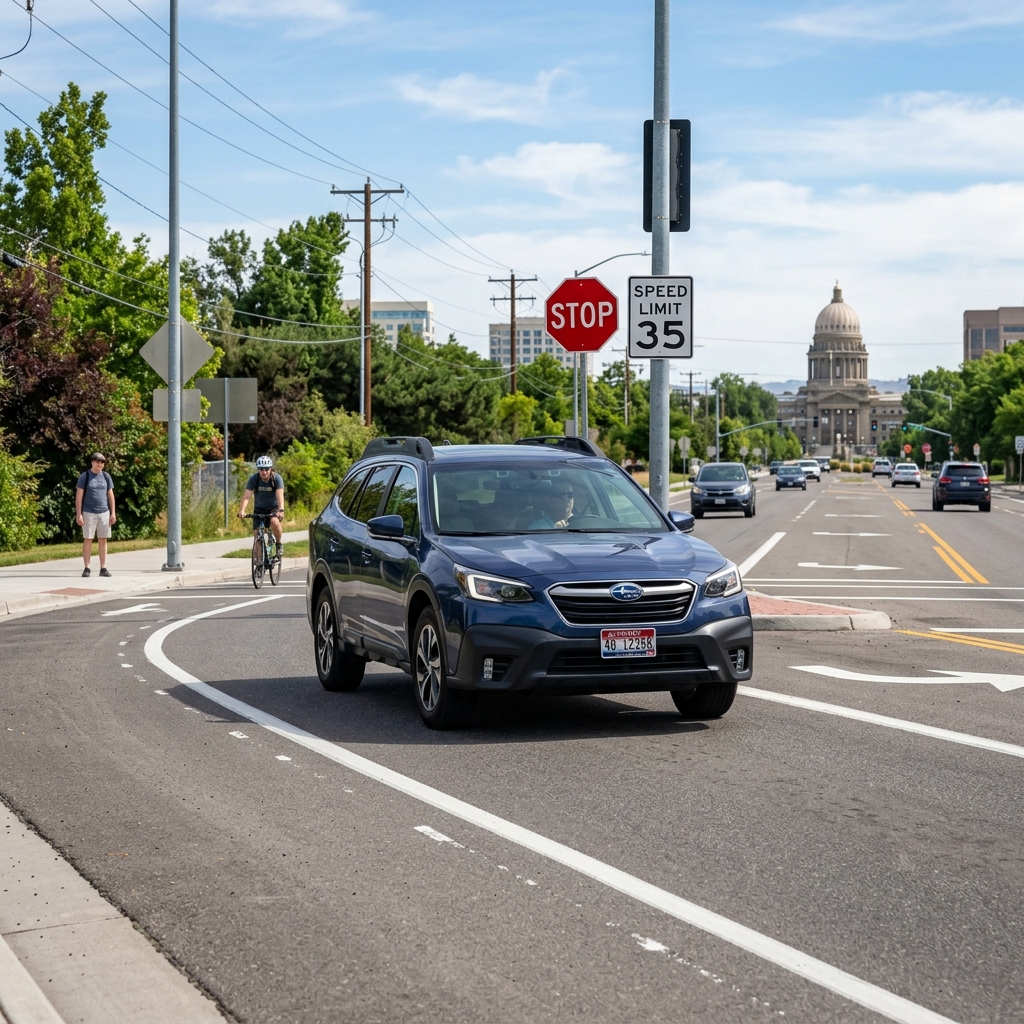
Idaho drivers are subject to a mix of general road rules and state-specific laws that govern how fast you may drive, when you can pass another vehicle, who has the right-of-way, and what happens when you break those rules. Knowing these laws is essential not only to avoid tickets, but also to reduce the risk of collisions and keep all road users safe.
This guide explains the core traffic rules in Idaho in clear, practical terms. It covers speed limits, the special rule that lets drivers briefly exceed the speed limit to pass, right-of-way at intersections, rules in school and construction zones, and typical fines and consequences. While this article is informational and not legal advice, it provides a solid starting point for anyone driving in Idaho—whether you are a resident or just passing through.
Basic Speed Rules in Idaho
Idaho’s speed regulations combine fixed maximum limits with a general duty to drive at a speed that is reasonable and prudent for conditions such as weather, traffic, and road design. Even if you stay under the posted limit, you can still be cited if your speed is unsafe for the situation.
Default Maximum Speed Limits
Unless a different limit is posted, Idaho law establishes maximum speeds for different types of roads.
- City and residential streets: Typically up to 35 mph unless posted otherwise.
- State highways: Commonly up to 65 mph, subject to local adjustments.
- Interstate highways (passenger vehicles): Up to 75 mph in many areas, with some rural segments allowing higher posted speeds.
- Heavy commercial vehicles: Historically lower maximums than passenger cars, though recent changes allow same posted limits on some rural interstates for vehicles over 26,000 pounds.
Local governments may adopt lower speed limits in business districts, dense residential areas, or locations with complex traffic patterns. Always follow the posted sign when it differs from these general rules.
Reasonable and Prudent Speed
Idaho’s general speed law requires drivers to adjust their speed based on conditions, even if that means driving far below the posted limit.
- Slow down in rain, snow, fog, or icy conditions when visibility or traction is reduced.
- Drive more slowly near pedestrians, cyclists, and roadside hazards.
- Reduce speed in heavy traffic, on curves, or where the road surface is uneven.
Driving too fast for conditions can result in a citation, and if your behavior is especially dangerous, you could face reckless driving charges.
Passing and Overtaking Rules
Idaho has detailed rules for when and how you may pass other vehicles. Safe passing is critical on rural highways and two-lane roads, where many serious crashes happen when drivers misjudge distance or ignore markings.
Idaho’s Special Passing Speed Rule
One distinctive Idaho rule allows drivers on certain higher-speed roads to briefly exceed the posted speed limit by up to 15 mph in order to pass a slower vehicle traveling below the limit. This is intended to shorten the time spent in the opposing lane and reduce the risk of head-on collisions.
Key aspects of this rule include:
- The vehicle being overtaken must be traveling below the posted speed limit.
- The passing maneuver must take place where the posted limit is at least 55 mph.
- You may exceed the limit by up to 15 mph only for the time necessary to complete the pass.
- Once you return to your lane, you must immediately reduce speed to the posted limit.
Using this rule does not remove your responsibility to ensure the way ahead is clear and that passing is legally permitted by lane markings and signage.
Safe Passing Practices
Regardless of speed, Idaho law and driver manuals emphasize standard safe passing behavior on multi-lane and two-lane roads.
- Signal lane changes: Use your turn signal before entering and after leaving a passing lane.
- Check mirrors and blind spots: Confirm that no vehicle is occupying the lane you intend to move into.
- Pass on the left: Passing is generally done in the left lane, with limited exceptions.
- Right-lane passing: Allowed only in specific situations, such as overtaking a vehicle turning left or on multi-lane one-way roads.
- Two-lane highways: Use the opposite-direction lane only when road markings permit passing and there is no oncoming traffic.
- Return promptly: Move back into your lane as soon as it is safe after overtaking.
Drivers must also recognize situations where passing is prohibited or unsafe, even if not explicitly marked—such as near hills, curves, intersections, or in limited visibility.
Right-of-Way and Intersection Rules
Right-of-way laws determine who should proceed first at intersections, merges, and other conflict points. Idaho uses familiar rules but adds specific direction for uncontrolled intersections and flashing signals.
Stop Signs and Red Lights
At a stop sign or steady red traffic signal, Idaho law requires drivers to come to a complete stop before the stop line or crosswalk, or before entering the intersection if no markings exist.
- Stop signs: Stop fully, then proceed when the way is clear and after yielding as required.
- Steady red lights: Remain stopped; right turns on red are typically allowed after stopping and yielding, unless a sign prohibits them.
- Flashing red signals: Treat as stop signs—stop, then proceed when safe.
Uncontrolled and Four-Way Intersections
At intersections without signals or with all-way stop control, Idaho applies standard priority rules to prevent confusion.
- When two vehicles arrive at the same time, the driver on the left must yield to the driver on the right.
- At four-way stops, proceed in order of arrival; if arrival is simultaneous, yield to the vehicle on your right.
- At unmarked three-way “T” intersections, drivers entering from the terminating road must yield to traffic on the through road.
Left Turns and Merging
Left-turning vehicles almost always bear the responsibility to yield.
- When turning left at an intersection, yield to oncoming traffic and pedestrians in the crosswalk unless directed differently by a signal.
- When entering a street from an alley, driveway, or private road, yield to all vehicles and pedestrians already on the roadway.
- When merging onto a highway, adjust speed and yield to vehicles already on the main roadway.
Emergency Vehicles
Authorized emergency vehicles with active lights or sirens have priority over all other road users.
- Pull as far to the right as practicable and stop if necessary to let emergency vehicles pass.
- Do not follow closely behind or attempt to pass emergency vehicles responding to a call.
School Zones, Construction Areas, and Special Situations
Certain areas require extra caution because they involve vulnerable road users or workers. Idaho law increases penalties for serious speed violations in these locations.
School Zones
Drivers must slow down and pay close attention in school zones, especially during arrival and dismissal times.
- Observe reduced speed limits posted near schools and crosswalks.
- Watch for children entering the roadway unexpectedly.
- Follow crossing guard instructions and yield at marked school crosswalks.
Idaho law classifies driving 20 mph or more over the posted limit in school zones as reckless driving, a criminal misdemeanor that can carry fines up to $1,000 and up to six months in jail for a first offense, with higher penalties for repeat violations.
Construction Zones
Road construction areas often have narrowed lanes, temporary signs, and workers close to traffic. Idaho has updated rules to better protect these workers and provide guidance for designing safer projects.
- Follow temporary speed limits and lane restrictions.
- Obey flaggers and any portable traffic signals.
- Avoid sudden lane changes and maintain a safe following distance.
Similar to school zones, traveling 20 mph or more above the limit in a construction zone can be treated as reckless driving, exposing drivers to misdemeanor penalties.
School Buses
Drivers must take special care near school buses, particularly when buses are stopped to load or unload children.
- When a bus displays flashing red lights and an extended stop arm, stop before reaching the bus and remain stopped until the signals cease.
- In most situations, traffic in both directions must stop on undivided roads.
- Consider whether you must yield instead of attempting to pass a bus, even if the law technically allows passing in rare scenarios.
Slow-Moving and Heavy Vehicles
Rural Idaho roads see significant use by farm equipment, heavy trucks, and other slow-moving vehicles. State rules address how these vehicles should operate and how faster drivers must interact with them.
Slow-Moving Vehicle Identification
Vehicles designed to travel at 25 mph or less may operate on many roads but must meet certain safety requirements.
- Use a slow-moving vehicle emblem to alert other drivers.
- Maintain functional brakes and turn signals where required.
- Ensure lights and reflective markings are in good condition for low visibility.
Obligations of Slow Drivers
On rural roads, a vehicle traveling well below the normal flow of traffic may be required to pull off the road to let faster vehicles pass after a queue develops. This helps prevent risky passing maneuvers and reduces driver frustration.
Heavy Trucks and Rural Interstates
Recent Idaho legislation has changed speed rules for heavy vehicles on some rural interstate segments. Vehicles over 26,000 pounds are now allowed to follow the same posted maximum speed limit as passenger cars on designated stretches, which may be up to 80 mph. However, these vehicles still must adjust speed for load, braking distance, and road conditions.
Common Infractions, Fines, and Consequences
Idaho treats most routine traffic violations as infractions, but more serious behavior can result in misdemeanors or worse. Understanding typical penalties may encourage safer driving and prompt timely compliance with registration and licensing rules.
Speeding Tickets
Speeding is one of the most frequent infractions on Idaho roads. Potential fines vary based on how far over the limit you were driving and where the violation occurred.
- Typical speeding fines often range roughly from about $90 to more than $150 for many standard violations.
- Higher fines and additional sanctions may apply in school zones, construction zones, or for very excessive speeds.
Reckless Driving
Reckless driving covers particularly dangerous conduct, such as extreme speeding or driving that shows a willful disregard for safety. Idaho treats reckless driving as a misdemeanor criminal offense.
- First offense: Up to $1,000 in fines and up to six months in county jail.
- Subsequent offenses: Maximum penalties may double to a $2,000 fine and up to one year in jail.
- Convictions can also affect your driving record and insurance rates.
Vehicle Registration and Tag Violations
Beyond moving violations, Idaho enforces compliance with registration rules.
- Driving with expired registration tags is a traffic infraction, with common fines around $101.
- Providing false information during vehicle registration can result in fines of roughly $156.50 or more.
Recent changes have eliminated certain color-coded stickers as a cost-saving measure, but registration must still be renewed on schedule.
Quick Reference Table: Key Idaho Traffic Rules
The table below summarizes some of the most important Idaho rules discussed in this guide.
| Topic | General Idaho Rule |
|---|---|
| Default speed limits | Up to 35 mph on city streets, 65 mph on state highways, 75 mph on interstates (unless posted otherwise). |
| Passing speed exception | On roads with limits ≥ 55 mph, you may exceed the limit by up to 15 mph briefly to pass a slower vehicle. |
| Right-of-way at uncontrolled intersections | When arrival is simultaneous, the driver on the left yields to the driver on the right. |
| School and construction zones | Driving 20 mph or more over the posted limit can be charged as reckless driving, a misdemeanor. |
| Expired registration tags | Traffic infraction; typical fine around $101 for expired tags. |
| Common speeding fines | Often range from about $90 to more than $150 for standard violations. |
Frequently Asked Questions About Idaho Traffic Laws
Can I always drive at the posted speed limit in Idaho?
No. Idaho’s general speed law requires you to drive at a speed that is safe and reasonable for current conditions, even if that means driving below the posted limit. If conditions make the posted limit unsafe, you must slow down.
Is it legal to exceed the speed limit to pass another car?
In limited circumstances, yes. On roads with a posted limit of at least 55 mph, Idaho allows drivers to exceed the limit by up to 15 mph temporarily while passing a slower vehicle that is traveling under the limit. After passing, you must return to the posted speed as soon as possible.
Who has the right-of-way at an intersection without stop signs or signals?
At uncontrolled intersections, if two vehicles arrive at roughly the same time, the vehicle on the left must yield to the vehicle on the right. Drivers should still approach cautiously and be prepared for unexpected actions from others.
What happens if I speed in a school zone in Idaho?
Standard speeding fines apply for minor violations, but traveling 20 mph or more above the posted school zone limit can be treated as reckless driving—an offense that may carry fines up to $1,000 and possible jail time for a first conviction.
Do I have to stop for a school bus on rural roads?
Generally, yes. When a school bus displays flashing red lights and a stop arm, traffic in most situations must stop and remain stopped until the signals are turned off. This applies particularly on undivided highways and local roads where children may cross the entire roadway.
Are expired registration tags a criminal offense?
Driving with expired tags is normally treated as a traffic infraction, not a criminal misdemeanor. However, it still carries a fine—commonly around $101—and repeated noncompliance can lead to additional consequences.
References
- Chapter 2, Idaho Traffic Laws – Drivers Manual Master — Idaho Transportation Department. 2022-01-01. https://apps.itd.idaho.gov/apps/dmv-audio/documents/DLChapter2.pdf
- Idaho Traffic Laws – FindLaw — FindLaw. 2024-01-01. https://www.findlaw.com/state/idaho-law/idaho-traffic-laws.html
- Idaho Driver’s Handbook — Idaho Transportation Department (via ePermitTest). 2022-01-01. https://static.epermittest.com/media/filer_public/c1/db/c1db43b9-45c5-4cb8-8b1b-6b28a1dbf780/idaho-drivers-manual-2022.pdf
- 2025 Idaho Code Title 49 – Motor Vehicles — Justia Law. 2025-01-01. https://law.justia.com/codes/idaho/title-49/
- 5 new Idaho traffic laws take effect today. What’s changing for drivers? — Idaho Statesman. 2020-07-01. https://www.idahostatesman.com/news/politics-government/state-politics/article316327279.html
Similar Articles








Read full bio of medha deb


