
Indemnity Clause: Construction Risks, Review Checklist For Pros
Learn how indemnity clauses shift risk, allocate liability, and shape construction contracts.
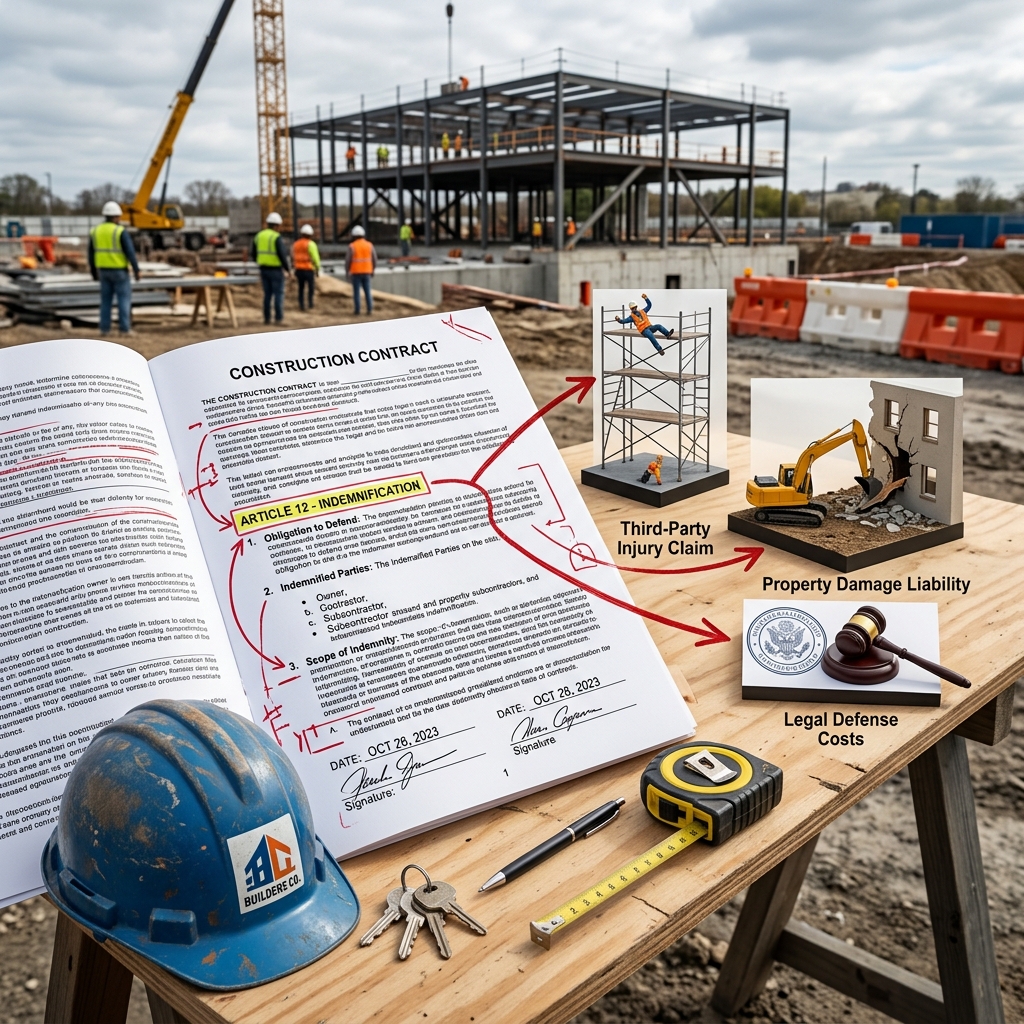
Construction projects bring together owners, contractors, subcontractors, architects, and insurers, all of whom face different kinds of project risk. An indemnity clause is one of the main tools used to decide who pays when a claim, loss, or injury occurs during the job. In simple terms, the clause shifts financial responsibility from one party to another, usually based on who caused the problem or who agreed to assume the risk.
These provisions matter because construction work often involves third-party injury claims, property damage, defects, delays, and disputes over who was responsible. A well-drafted clause can clarify expectations and reduce uncertainty. A poorly written clause can produce litigation, insurance disputes, or a provision that is unenforceable under state law.
What an indemnity clause actually does
An indemnity clause is a contractual promise by one party, the indemnitor, to compensate another party, the indemnitee, for certain losses. In construction, that usually means one party agrees to cover damages, judgments, settlements, or legal costs tied to specific project-related events. The clause is not limited to direct payment; it may also include a duty to defend or to hold the other party harmless from claims brought by third parties.
In practice, the clause acts as a risk-allocation device. The party with the most control over the work is often the one asked to bear the related risk, especially where a subcontractor’s conduct may create exposure for the owner or general contractor.
Why these clauses are common in construction
Construction contracts use indemnity language because a single project can generate overlapping liabilities. A fall on the worksite may lead to an injury claim, a defect in the work may trigger repair costs, and a third-party property owner may sue for damage caused by the project. Rather than leaving those consequences unresolved, parties use contract language to assign responsibility in advance.
Indemnity clauses are also closely tied to insurance planning. Many construction contracts are written so the indemnity obligation matches available liability coverage. That alignment matters because a contractual duty is only useful if the party promising indemnity has the financial ability to perform.
Main forms of indemnity language
Construction lawyers often describe indemnity clauses as broad, intermediate, or limited. The classification depends on how much responsibility the indemnitor accepts and whether the indemnitee’s own negligence is included.
| Type | Basic effect | Typical risk level |
|---|---|---|
| Broad form | The indemnitor may cover losses even when the indemnitee is partly or entirely at fault. | Highest for the indemnitor |
| Intermediate form | The indemnitor covers losses unless the indemnitee is solely responsible. | Moderate to high |
| Limited form | The indemnitor covers losses only to the extent caused by the indemnitor’s own actions. | Lowest and most fault-based |
Broad form clauses are the most aggressive because they can require one party to pay even when the other party’s negligence contributed to the loss. Intermediate clauses are somewhat narrower but still shift substantial risk. Limited clauses are the most closely tied to actual fault and are usually easier to justify as a fair allocation of responsibility.
Common words that signal risk-shifting
Indemnity language is often identified by recurring phrases rather than by the label of the clause itself. Words such as “defend,” “indemnify,” and “hold harmless” frequently appear together, but each phrase can carry a slightly different function. “Indemnify” usually refers to compensation for loss, while “hold harmless” focuses on protecting the other party from liability. A “duty to defend” may require one party to step in and handle the claim itself, not just reimburse the end result.
Other phrases, including “arising out of,” “in whole or in part,” and “to the extent caused by,” are especially important. They tell the reader how far the clause reaches and whether the triggering event must be directly linked to the indemnitor’s work.
What losses are usually covered
In construction settings, indemnity clauses often focus on bodily injury, death, property damage, and third-party claims connected to the project. Some clauses also address defense costs, settlement payments, and attorneys’ fees. The exact scope depends on the wording, and small changes in phrasing can make a large difference in how far the obligation extends.
- Third-party injury claims at the jobsite
- Damage to adjacent property
- Claims arising from subcontractor conduct
- Defense expenses and legal fees
- Settlement amounts or court-awarded damages
Some clauses are limited to losses arising from the contractor’s performance of the work, while others extend more broadly to any claim connected to the project. The broader the wording, the more care is needed when reviewing enforceability and insurance coverage.
How state law can limit enforcement
Even if the parties agree to a broad clause, state law may narrow or void part of it. Several jurisdictions restrict indemnity for a party’s own negligence, especially in construction contracts. California and Texas, for example, both place limits on how far risk can be shifted by contract, and public works rules in some states can be even stricter.
These rules matter because an indemnity clause is only as strong as the law allows. A provision that seems clear on paper may be partially unenforceable if it tries to require payment for conduct that state law excludes. For that reason, the same clause can function differently depending on the project location.
How courts tend to read these clauses
Courts generally start with the contract language itself. If the wording is clear, specific, and consistent with applicable law, a court is more likely to enforce it. If the clause is vague or overbroad, a judge may read it narrowly or strike the offending language.
Courts also pay attention to whether the agreement clearly says that one party is being asked to cover the other party’s negligence. In many jurisdictions, that intent must be stated in unmistakable terms. General or boilerplate wording may not be enough when the clause tries to shift liability for the indemnitee’s own fault.
Connection between indemnity and insurance
Indemnity obligations are often paired with insurance requirements. A contract may require a contractor or subcontractor to carry commercial general liability insurance, name another party as an additional insured, or provide proof of coverage before work begins. This pairing is important because an indemnity clause without matching insurance can leave the indemnitor exposed to a risk it cannot realistically absorb.
Insurance, however, does not automatically cover every contractual promise. Some policies limit coverage for assumed liability that goes beyond what the law would impose without a contract. That makes coordination between the indemnity clause and the policy language essential.
Drafting issues that often lead to disputes
Many disputes arise not from the existence of an indemnity clause, but from its wording. Ambiguous scope, conflicting definitions, and poorly matched insurance requirements can all create uncertainty. A clause may also become problematic if it is copied from a different project or jurisdiction without adjustment for local law.
- Using broad wording without checking local anti-indemnity rules
- Failing to define whether defense costs are included
- Leaving the phrase “arising out of” undefined
- Not matching the clause to available insurance
- Using the same clause for owners, contractors, and subcontractors without tailoring it
Clear drafting reduces the chance that a court will have to guess what the parties meant. It also helps each participant understand where the financial risk begins and ends.
Practical points for owners, contractors, and subcontractors
Owners usually want strong protection from claims connected to the work, especially third-party injury and property damage. Contractors often try to limit exposure to losses actually caused by their own work. Subcontractors may seek even narrower language because they have less control over the overall site and more limited ability to manage upstream risks.
Because these interests differ, indemnity clauses are often heavily negotiated. A fair clause usually reflects the party’s role, the degree of control it has over the jobsite, and the scope of insurance that can reasonably be obtained.
Checklist for reviewing an indemnity clause
Before signing, it helps to review the clause against a simple checklist. The goal is to understand both the legal and financial consequences of the provision, not just its title.
- Identify who is the indemnitor and who is the indemnitee
- Check whether the clause covers negligence, partial fault, or only direct causation
- Look for defense obligations, not just reimbursement language
- Confirm whether the clause covers third-party claims, attorneys’ fees, and settlements
- Compare the clause with the project’s insurance requirements
- Verify that the language complies with the law of the project state
This kind of review is especially important in multi-state work, where a clause that is acceptable in one jurisdiction may be restricted in another.
When legal advice is especially useful
Legal review is valuable when the contract is high-value, the project is complex, or the clause attempts to shift responsibility for negligence. Counsel can help determine whether the wording is enforceable, whether it aligns with insurance, and whether state anti-indemnity statutes limit the obligation. That review can prevent a party from signing a provision it cannot actually satisfy if a claim arises.
In construction contracting, indemnity language is not just boilerplate. It is a key part of the project’s liability structure, and it can materially affect the outcome of a dispute long after the work is finished.
Frequently asked questions
What is the main purpose of an indemnity clause?
Its main purpose is to allocate risk by making one party responsible for specified losses, claims, or expenses connected to the project.
Does an indemnity clause always cover negligence?
No. Some clauses cover only the indemnitor’s own fault, while others attempt to include shared or even sole negligence, subject to state law limits.
Is “hold harmless” the same as indemnify?
They are related but not identical. “Indemnify” usually means to compensate for loss, while “hold harmless” focuses on protecting the other party from liability.
Can an indemnity clause be unenforceable?
Yes. A clause may be limited by anti-indemnity statutes, public policy, or poor drafting that fails to clearly express the intended risk transfer.
Why do construction contracts often connect indemnity to insurance?
Because insurance gives the indemnitor a practical way to fund the obligation, and the contract is more workable when the risk allocation matches the available coverage.
References
- Understanding Indemnity Clauses in California Construction Contracts — PB Construction Law. 2024. https://pbconstructionlaw.com/understanding-indemnity-clauses-in-california-construction-contracts/
- Ask an Attorney: Understanding Indemnity Clauses in Construction Contracts — Cohen Seglias. 2024. https://www.cohenseglias.com/news-article/ask-an-attorney-understanding-indemnity-clauses-in-construction-contracts/
- What Does the Indemnity Clause Cover and When Does the Claim Accrue? — Construction Seyt. 2019-01-24. https://www.constructionseyt.com/2019/01/indemnity-clause-cover-claim-accrue/
- Texas Construction Indemnity Clauses — Ryan G Cole Law PLLC. 2024. https://thecolefirm.com/indemnity-clauses-in-construction-contracts-what-texas-builders-need-to-know/
- Construction Law Alert: Understanding Indemnification Clauses — Maynard Nexsen. 2024. https://www.maynardnexsen.com/publication-understanding-indemnification-clauses
Similar Articles








Read full bio of medha deb


