
Understanding Fair Use: The Four Key Factors
Master the essentials of fair use doctrine: Explore the four statutory factors that determine if your use of copyrighted material is legal and protected.
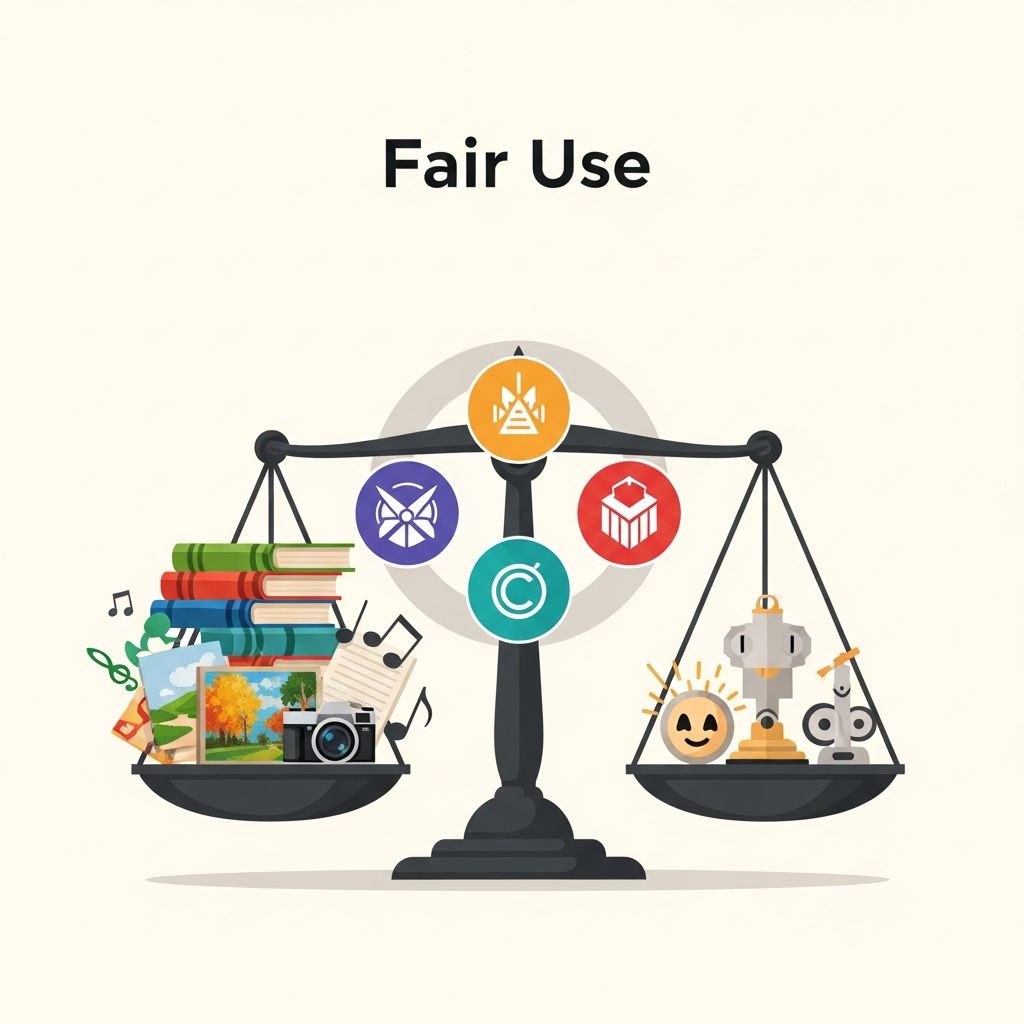
Fair use is a critical exception to U.S. copyright law that allows limited use of protected materials without permission from the rights holder. Codified in 17 U.S.C. § 107, it balances creators’ rights with public interests in education, commentary, and innovation. Courts evaluate fair use through four statutory factors, applied case-by-case to promote free expression while protecting incentives for original works.
Historical Roots and Legal Foundation of Fair Use
The fair use doctrine emerged in the 18th and 19th centuries as a judicial tool to prevent overly rigid copyright enforcement from stifling creativity. It transitioned from common law to statute in the 1976 Copyright Act, explicitly listing purposes like criticism, news reporting, teaching, scholarship, and research as potential fair uses. Unlike narrower ‘fair dealing’ in other countries, U.S. fair use is flexible, covering diverse works and applications through a proportionality test.
Importantly, fair use functions as an authorized right, not just a defense. In Lenz v. Universal Music Corp. (2015), the Ninth Circuit ruled it exempts certain uses from infringement liability under the DMCA, requiring copyright holders to consider fair use before issuing takedown notices. This underscores its role in fostering public access to knowledge.
Factor 1: Purpose and Character of the Use
The first factor examines the reason for using the material, prioritizing transformative uses that add new expression, meaning, or message—such as parody, criticism, or commentary—over mere reproduction. Transformative nature strongly favors fair use, as seen in Campbell v. Acuff-Rose Music, Inc., where the Supreme Court upheld 2 Live Crew’s parody of ‘Oh, Pretty Woman’ for altering the original’s purpose.
- Commercial vs. Nonprofit: Nonprofit educational uses weigh in favor, but commercial exploitation does not automatically disqualify fair use if transformative. For instance, a profit-making review video quoting a film clip may qualify if it critiques rather than substitutes.
- Bad Faith: Uses involving deception or undue advantage tilt against fair use.
Courts often give this factor significant weight, especially when paired with others. Educational photocopying for classroom discussion, for example, typically aligns here if limited.
Factor 2: Nature of the Copyrighted Work
This factor assesses the original work’s characteristics. Creative, fictional works (e.g., novels, songs) receive stronger protection than factual ones (e.g., news articles, biographies), as copyright primarily safeguards expression, not facts.
| Work Type | Fair Use Favorability | Examples |
|---|---|---|
| Factual/Informational | Strongly Favors | Scientific data, news reports |
| Creative/Fictional | Disfavors | Poetry, artwork, films |
| Published vs. Unpublished | Published Favors | Unpublished works get more protection |
Even for creative works, substantial transformation can overcome this factor. The U.S. Copyright Office notes this evaluates creativity level, not just genre.
Factor 3: Amount and Substantiality of the Portion Used
Courts scrutinize both the quantity and quality of the borrowed material relative to the whole. Using small amounts favors fair use, but even brief excerpts can infringe if they capture the ‘heart’ or most expressive core.
- Quantitative Limit: No fixed percentage exists; a 10% clip from a short poem might exceed fair use, while more from a lengthy book could qualify.
- Qualitative Essence: Copying a song’s iconic chorus weighs against, regardless of length.
- Necessity Test: Borrow only what’s needed for the purpose.
Multiple copies for classroom use may be fair if reasonable under all factors.
Factor 4: Effect on the Potential Market
The most influential factor probes whether the use harms the original’s market value or potential licensing revenue. If it acts as a substitute, harming sales, it disfavors fair use; supplementary uses that drive demand favor it.
Consider time-shifting (e.g., recording TV for later viewing), once deemed fair pre-digital streaming. Courts assess current and future markets, including derivative works. Non-commercial educational uses rarely supplant markets.
Weighing the Factors in Practice
No single factor dominates; courts balance them holistically. Favorable outcomes often involve transformative, nonprofit uses of minimal factual portions with no market harm. Tools like the Fair Use Index aid analysis.
In education, guidelines like the Agreement on Guidelines for Classroom Copying support limited reproductions. Always document your reasoning to demonstrate good faith.
Common Myths and Realities
- Myth: 10% or 400 words is always fair. Reality: No bright-line rules; case-specific.
- Myth: Attribution makes it fair. Reality: Credit doesn’t excuse infringement.
- Myth: Personal use is exempt. Reality: Sharing or distributing isn’t automatically fair.
Practical Tips for Invoking Fair Use
- Document analysis of all four factors.
- Prioritize transformation and minimal use.
- Seek permissions when uncertain.
- Consult legal experts for high-stakes scenarios.
Frequently Asked Questions
Is fair use only for non-profits?
No, commercial uses can qualify if highly transformative and non-substitutive.
Does fair use apply internationally?
No, it’s U.S.-specific; other countries use fair dealing with fixed categories.
Can I use fair use for memes or social media?
Possibly, if parody or commentary with minimal portions and no market harm.
What if I’m wrong about fair use?
You may face infringement claims; good-faith belief can mitigate damages.
Does AI training data qualify as fair use?
Ongoing litigation; courts apply the four factors case-by-case.
Navigating Fair Use in the Digital Age
Digital tools amplify fair use challenges, from AI-generated content to streaming clips. Platforms’ DMCA policies require fair use consideration to avoid wrongful removals. Emerging cases test boundaries, like thumbnails in search engines ruled fair. Stay informed via official resources.
Fair use empowers innovation: teachers excerpt texts, reviewers quote books, researchers analyze data. Yet, overreliance risks litigation. Balance is key.
References
- Fair use – Wikipedia — Wikipedia contributors. 2026. https://en.wikipedia.org/wiki/Fair_use
- What Is Fair Use? – Copyright Overview by Rich Stim — Stanford University Libraries. 2026. https://fairuse.stanford.edu/overview/fair-use/what-is-fair-use/
- What Is Fair Use – Copyright Alliance — Copyright Alliance. 2026. https://copyrightalliance.org/faqs/what-is-fair-use/
- Fair Use and The Four Factors Explained – Copyright — Mount Holyoke College. 2026. https://guides.mtholyoke.edu/copyright/fair-use
- U.S. Copyright Office Fair Use Index — U.S. Copyright Office. 2026. https://www.copyright.gov/fair-use/
- 17 U.S. Code § 107 – Limitations on exclusive rights: Fair use — U.S. House of Representatives, Office of the Law Revision Counsel. 2026. https://www.law.cornell.edu/uscode/text/17/107
Similar Articles








Read full bio of medha deb


