
Understanding the Core Elements of a Negligence Claim
Learn how duty, breach, causation, and damages work together to make or break a negligence case in personal injury law.
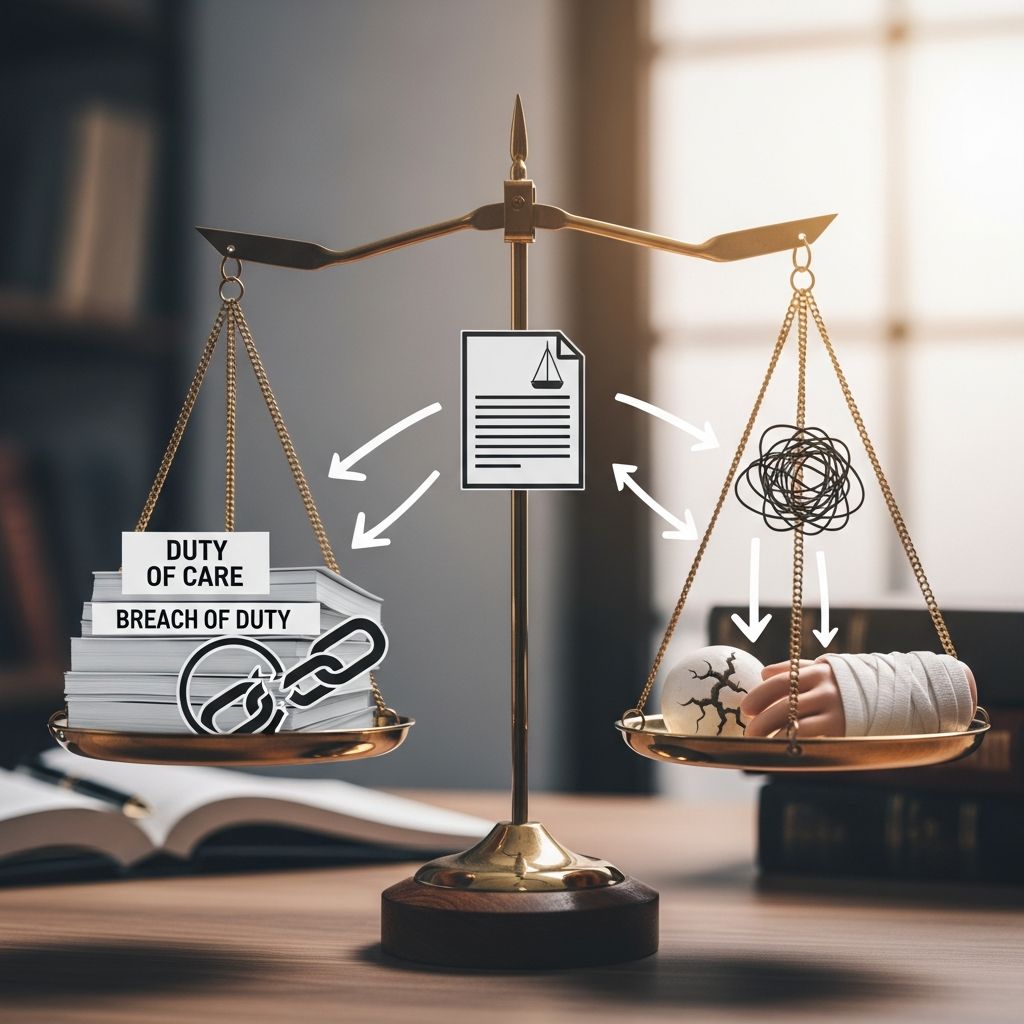
Negligence is at the heart of most personal injury lawsuits. To succeed in court or in settlement negotiations, an injured person must do more than simply show that they were hurt. They must connect their injury to someone else’s legal fault through a set of specific building blocks known as the elements of negligence.
This guide breaks down those elements in plain language, explains how they fit together, and offers practical insight into what courts look for when deciding whether a defendant is legally responsible for someone else’s harm.
What Is Negligence in Personal Injury Law?
In legal terms, negligence means a failure to use the level of care that a reasonably careful person would use in similar circumstances. When that lack of reasonable care causes injury, the law can require the negligent party to compensate the person who was harmed.
Negligence usually focuses on:
- What risks were reasonably foreseeable
- How serious the potential harm could be
- How burdensome or easy it would have been to take precautions to avoid that harm
Most jurisdictions in the United States require a plaintiff to establish four core elements to prove negligence:
- Duty of care
- Breach of that duty
- Causation (linking the breach to the injury)
- Damages (actual, legally recognized harm)
The Four Essential Elements of a Negligence Case
Each element must be proven. If any one is missing, the negligence claim usually fails, even if the defendant behaved poorly or the plaintiff suffered serious harm.
1. Duty of Care: Was There a Legal Obligation?
Duty of care asks whether the defendant owed the plaintiff a legal responsibility to act with reasonable care under the circumstances. Not every unfortunate event gives rise to this duty; the law recognizes duties in certain relationships and situations.
How Courts Determine Duty
Courts typically look at:
- Relationship-based duties – for example, doctor–patient, business owner–customer, landowner–visitor, or driver–other road users.
- Creation of risk – when a person’s conduct creates a risk of harm to others, they generally owe a duty to act with reasonable care to avoid or minimize that risk.
- Voluntary undertakings – if someone voluntarily takes on the role of protecting or helping another, the law may impose a duty to act reasonably in carrying out that role.
- Foreseeability – whether a reasonable person in the defendant’s position could anticipate that their conduct might harm someone like the plaintiff.
Common Examples of Duty of Care
- A motorist must drive with reasonable care and follow traffic laws to avoid injuring other drivers, passengers, cyclists, and pedestrians.
- A property owner must take reasonable steps to keep the premises safe for lawful visitors or to warn them of hidden dangers.
- A medical professional must meet the professional standard of care in diagnosing and treating patients.
If the court decides there was no duty, the negligence claim generally ends there.
2. Breach of Duty: Did the Defendant Fall Below the Standard of Care?
Once a duty of care is established, the next question is whether the defendant breached that duty. A breach occurs when the defendant’s conduct falls below what a reasonably careful person (or professional, where applicable) would have done in the same situation.
How Breach Is Evaluated
Breach is typically a fact question for a jury or judge. They consider whether an ordinary person, knowing what the defendant knew at the time, would have acted differently to avoid harming others.
Key considerations include:
- Did the defendant ignore clear, known risks?
- Were simple, low-cost precautions available but not taken?
- Did the defendant violate a safety statute or regulation (such as a traffic law)?
Illustrative Types of Breach
- Driving behaviors – speeding, distracted driving, or failing to yield may all be evidence of a breach of duty toward other road users.
- Premises conditions – ignoring repeated reports of spills, broken handrails, or poor lighting could support a finding of breach by a property owner.
- Professional errors – providing treatment that falls below the accepted medical standard of care can be a breach in a malpractice claim.
Not every mistake or accident is a legal breach. The focus is on what is reasonable, not perfect, behavior.
3. Causation: Linking the Breach to the Injury
Even if a defendant owed a duty and breached it, the plaintiff must also show that this breach caused their injury. Causation has two related components: cause in fact and proximate cause.
| Type of Causation | Core Question | Focus |
|---|---|---|
| Cause in fact | Would the injury have occurred but for the defendant’s conduct? | Direct, factual link between breach and harm. |
| Proximate cause | Was the type of harm a reasonably foreseeable result of the breach? | Limits liability to reasonably predictable consequences. |
Cause in Fact
Cause in fact asks whether the plaintiff’s injury would have happened without the defendant’s negligent conduct. This is often called the “but for” test: but for the defendant’s breach, would the plaintiff have been injured?
In some situations involving multiple contributing factors, courts may use slightly different tests, but the basic idea remains the same: there must be a meaningful, factual connection between what the defendant did (or failed to do) and what happened to the plaintiff.
Proximate Cause and Foreseeability
Proximate cause limits negligence liability to harms that bear a reasonable relationship to the defendant’s conduct. The central idea is foreseeability: could a reasonably careful person foresee that this kind of behavior might cause this general type of harm to someone in the plaintiff’s position?
If a highly unusual, unforeseeable chain of events intervenes—such as an extraordinary natural disaster or independent criminal act—courts may find that the defendant’s breach was not the legal, or “proximate,” cause of the injury, even if it was a factual cause.
4. Damages: Proving Actual, Compensable Harm
The final element of negligence is damages. The plaintiff must demonstrate that they suffered real, legally recognizable harm as a result of the defendant’s breach. If there is no injury or loss, there is generally no negligence claim, even if the defendant acted carelessly.
Types of Damages in Negligence Cases
Courts commonly divide damages into two broad categories: economic and non-economic.
- Economic damages (sometimes called special damages) may include:
- Medical bills and rehabilitation costs
- Lost income or reduced earning capacity
- Property damage (for example, vehicle repairs)
- Non-economic damages (sometimes called general damages) may include:
- Pain and suffering
- Emotional distress or mental anguish
- Loss of enjoyment of life
- Loss of companionship or consortium for close family members
Some jurisdictions cap certain categories of damages, particularly non-economic damages or punitive damages, and rules differ widely by state.
How the Elements Work Together in a Negligence Case
Negligence is like a chain; each link must hold for the claim to succeed. A typical analysis follows this sequence:
- Identify a duty – Did the law impose a duty of care on the defendant under the circumstances?
- Assess conduct – Did the defendant’s behavior fall below the standard expected of a reasonably careful person (or professional) in that situation?
- Connect conduct and harm – Did the breach of duty cause the plaintiff’s injury in both a factual and legal sense?
- Measure loss – What specific economic and non-economic damages did the plaintiff suffer as a result?
If any of these steps fails—for example, there is no duty, no breach, no causal link, or no damages—the negligence claim may not be legally viable.
Common Challenges in Proving Negligence
Even when the elements appear straightforward, negligence cases often involve disputes over evidence, expert opinions, and legal standards.
- Disagreement over the standard of care – In professional negligence (such as medical malpractice), experts may disagree about what a reasonably prudent professional would have done.
- Complex causation issues – Multiple accidents, pre-existing health conditions, or intervening events can make it difficult to show that the defendant’s conduct caused the specific injuries alleged.
- Contested damages – Defendants frequently argue that the plaintiff is exaggerating their losses, that some treatment was unnecessary, or that symptoms come from unrelated causes.
- Comparative or contributory fault – In many states, if the plaintiff’s own negligence contributed to the accident, their recovery may be reduced or, in some jurisdictions, barred altogether.
Negligence vs. Other Types of Liability
Not all injury claims are based solely on negligence. It is useful to distinguish negligence from other theories of liability:
- Intentional torts – These involve deliberate acts, such as assault or battery. The focus is on intent to cause contact or harm, not on lack of reasonable care.
- Strict liability – In certain contexts, such as some product liability or abnormally dangerous activities, a defendant may be liable regardless of how carefully they acted. The plaintiff often does not need to prove breach of a duty of care, only that a qualifying activity or product caused the injury.
Understanding which theory applies is important because the elements and the evidence required can differ significantly.
Practical Tips for Building a Negligence Claim
While negligence law can be technical, some practical steps commonly strengthen a potential claim:
- Document the scene – Photographs, videos, and contemporaneous notes can help establish how the incident occurred and whether a breach likely occurred.
- Seek medical evaluation promptly – Early medical records help link injuries to the event and demonstrate damages.
- Preserve records – Keep bills, wage statements, correspondence with insurers, and any repair estimates related to the incident.
- Identify witnesses – Contact information for people who saw the event, or who can speak to unsafe conditions or prior complaints, can be critical in proving breach and causation.
- Be mindful of time limits – Each state has a statute of limitations that sets a deadline for filing negligence claims, and missing it can completely bar recovery.
Frequently Asked Questions About Negligence
Q: Do I have a negligence case if I was hurt but no one did anything “wrong” on purpose?
Yes. Negligence does not require intentional wrongdoing. The core question is whether someone failed to exercise the care that a reasonably careful person would have used under similar circumstances, and whether that failure caused your injury.
Q: Is it enough to show that the defendant broke a law or rule?
Violating a safety law or regulation can be strong evidence of breach of duty, but courts will still look at whether the violation caused your injury and whether you suffered legally recognized damages. All four negligence elements must still be met.
Q: What if more than one person contributed to my injury?
Many states allow you to pursue claims against multiple negligent parties. Courts may apportion fault among them, and in comparative fault systems they may also consider whether your own conduct played a role in causing your injuries.
Q: Can I sue if I had a “near miss” but was not physically injured?
Generally, you must show actual damages to recover in a negligence action. A frightening incident without physical injury or legally recognized emotional harm usually does not support a claim, although there are limited exceptions in some jurisdictions.
Q: Why do some people talk about a fifth element, “proximate cause”?
Some legal sources treat proximate cause as part of the causation element, while others list it separately as a fifth element. In either approach, the function is the same: to limit liability to harms that are reasonably foreseeable results of the defendant’s conduct.
References
- Negligence — Legal Information Institute, Cornell Law School. 2022-06-27. https://www.law.cornell.edu/wex/negligence
- Four Elements Required to Prove Negligence — The Carlson Law Firm. 2021-08-10. https://www.carlsonattorneys.com/four-elements-negligence/
- What is Negligence in Personal Injury Law? — The Krist Law Firm, P.C. 2023-03-15. https://www.houstoninjurylawyer.com/what-is-negligence/
- Proving Negligence – 4 Elements You Need to Establish — Rafi Law Firm. 2022-04-05. https://www.rafilawfirm.com/georgia/atlanta-wrongful-death-lawyer/understanding-negligence/
- What Are the Four Elements of Negligence? — Marks & Harrison. 2022-09-21. https://www.marksandharrison.com/blog/what-are-the-four-elements-of-negligence/
- 4 Elements of a Negligence Claim — Griffiths Law PC. 2021-11-02. https://www.griffithslawpc.com/resources/elements-negligence-claim/
- What Are the Four Elements of Negligence? — Benson & Bingham Accident Injury Lawyers, LLC. 2023-01-09. https://www.bbga.com/articles/auto/what-are-the-elements-of-negligence/
Similar Articles








Read full bio of medha deb


