
Understanding Drug Possession Laws and Penalties
Learn how U.S. drug possession laws work, what prosecutors must prove, and which factors can sharply increase penalties or offer relief.
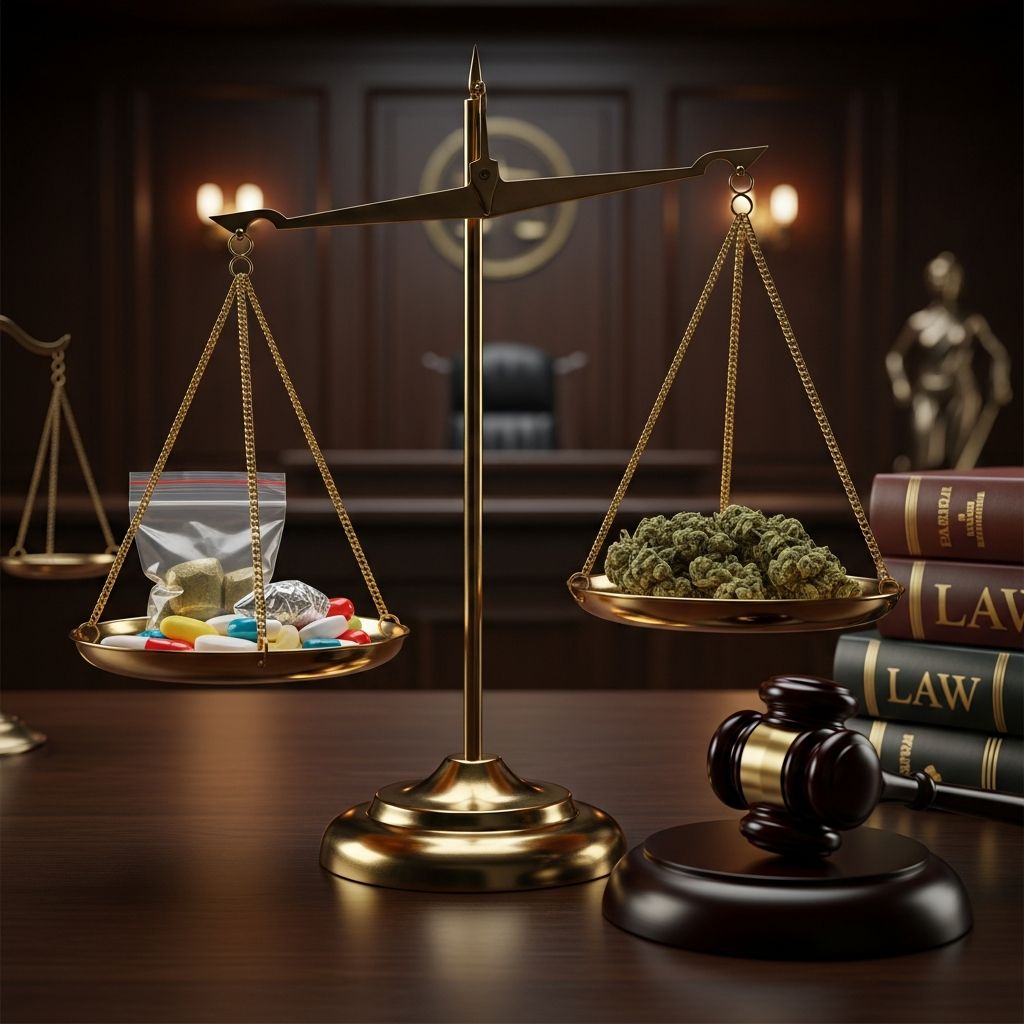
Drug possession laws touch millions of people every year in the United States. Although each state has its own criminal code, drug policy is also strongly shaped by federal law, especially the Controlled Substances Act (CSA), which classifies and regulates many drugs nationwide. Understanding how possession charges work, what prosecutors must prove, and what penalties you might face is critical if you or someone you know is dealing with a drug case.
This guide explains the core concepts behind drug possession charges in accessible language, while also highlighting how details like drug schedule, quantity, and prior record can dramatically change the outcome of a case.
1. What Counts as a “Controlled Substance”?
In most U.S. jurisdictions, possession laws focus on controlled substances. These are drugs and chemicals whose manufacture, distribution, and possession are regulated by law.
The primary federal framework is the Controlled Substances Act (CSA), which divides drugs into five schedules based on three main criteria:
- Accepted medical use in the United States.
- Potential for abuse.
- Risk of physical or psychological dependence.
| Schedule | General Characteristics | Common Examples |
|---|---|---|
| Schedule I | High abuse potential, no accepted medical use, lack of accepted safety. | Heroin, LSD, MDMA, federally classified marijuana (THC). |
| Schedule II | High abuse potential, accepted (often restricted) medical use, severe dependence risk. | Cocaine (medical use), oxycodone, methamphetamine. |
| Schedule III | Moderate to low physical dependence or high psychological dependence. | Some anabolic steroids, combination products with lower amounts of opioids. |
| Schedule IV | Lower abuse and dependence risk than Schedule III. | Many benzodiazepines (e.g., diazepam), some sleep medications. |
| Schedule V | Lowest abuse potential; often small quantities of controlled substances. | Cough syrups with very low doses of codeine. |
Most state drug laws track, or at least refer to, these federal schedules when defining which substances are illegal to possess and how serious the penalties should be.
2. Core Elements of a Drug Possession Charge
While the language of statutes varies, prosecutors usually must prove several core elements beyond a reasonable doubt to secure a drug possession conviction.
2.1 Knowing and Intentional Possession
Generally, the government must show the defendant:
- Knowingly possessed the substance; and
- Did so intentionally, not by mistake or accident.
In practice, this means a person who unknowingly carries a package containing drugs—without any reason to suspect what is inside—may have a potential defense, because the required mental state could be missing.
2.2 Actual vs. Constructive Possession
Possession does not always mean having drugs in a pocket or hand. Courts recognize two common forms of possession:
- Actual possession: The drugs are directly on the person, such as in a pocket, backpack being worn, or hand.
- Constructive possession: The person does not physically hold the drugs but has the power and intent to control them, such as substances hidden in a bedroom or vehicle over which the person has control.
In constructive possession cases, disputes often focus on whether the defendant truly had control or knew the drugs were there, especially if multiple people had access to the area.
2.3 Knowledge of the Substance’s Nature
Beyond knowing that an item exists, the prosecution usually must show the defendant knew, or should have reasonably known, that the substance was illegal or a controlled drug rather than an innocuous item.
3. Simple Possession vs. Intent to Distribute
Drug possession cases are not all the same. Laws often distinguish between:
- Simple possession – having drugs for personal use.
- Possession with intent to distribute – suggesting plans to sell, share, or otherwise deliver drugs to others.
3.1 Simple Possession
Simple possession is typically charged when only small quantities are involved and there is no significant evidence of sales activity, such as packaging or scales. Many states treat minor first-time simple possession as a misdemeanor and may offer diversion or treatment-oriented alternatives.
3.2 Possession with Intent to Distribute
Authorities may file more serious charges of possession with intent to distribute when certain factors are present, such as:
- Larger quantities inconsistent with personal use.
- Packaging materials, scales, or ledger books indicating sales.
- Significant amounts of cash or communications about dealing.
At the federal level, 21 U.S.C. § 841 criminalizes possession with intent to distribute as one of the most commonly prosecuted drug offenses, with penalties that rise sharply based on drug type and quantity.
4. How Quantity and Drug Type Affect Penalties
Two of the most important drivers of penalty severity are how much of a controlled substance is involved and which schedule it falls under.
4.1 Thresholds and Sentencing Ranges
Many states, as well as federal law, use quantity thresholds to distinguish:
- Misdemeanor vs. felony possession.
- Simple possession vs. intent to distribute.
- Possession vs. trafficking or high-level distribution.
For example, state surveys show that possessing a small amount of certain drugs may be a misdemeanor, but surpassing specific gram or pill thresholds can automatically reclassify the offense as a felony or even trafficking, often triggering mandatory minimum prison terms.
4.2 Federal Mandatory Minimums
Under federal law, mandatory minimum sentences apply to some drug offenses based on the substance and its weight. The U.S. Sentencing Commission notes that commonly prosecuted federal drug crimes, such as those under 21 U.S.C. §§ 841 and 960, tie penalties to drug type and quantity, with 5- or 10-year mandatory minimums at certain thresholds.
4.3 Aggravating and Mitigating Factors
Penalties can be enhanced or reduced based on additional circumstances, including:
- Prior convictions for drug or violent offenses.
- Possession near schools, parks, or youth centers.
- Possession with firearms or other weapons.
- Cooperation with law enforcement or acceptance of responsibility.
- Demonstrated substance use disorder and engagement in treatment.
5. State Differences, Marijuana Laws, and Decriminalization
Although federal law is uniform, state drug laws differ widely. This is particularly true for marijuana and for states exploring decriminalization of some possession offenses.
5.1 Marijuana: Federal vs. State Conflict
Federally, marijuana remains a Schedule I drug under the CSA, meaning it is considered to have no accepted medical use and a high potential for abuse. Possession, cultivation, and distribution are prohibited under federal law.
At the same time, many states have legalized or decriminalized marijuana for medical or recreational use. Federal authorities historically have focused enforcement on larger or more sophisticated operations, but the legal conflict creates ongoing uncertainty.
5.2 State-by-State Variations
A 50-state survey of drug possession laws shows significant variation in how states classify and punish possession, including:
- Different threshold amounts that separate misdemeanors from felonies.
- Special rules for certain drugs (for example, stronger penalties for fentanyl in some states).
- Alternative sentencing options such as drug courts, probation, or deferred adjudication for first-time offenders.
5.3 Decriminalization and Diversion
Several jurisdictions have adopted policies that reduce or eliminate criminal penalties for small-scale possession of certain drugs, often treating them more as public health issues than purely criminal matters. These changes can include:
- Reclassifying low-level possession as a civil infraction or non-jailable offense.
- Creating diversion programs that prioritize treatment and monitoring over incarceration.
- Establishing specialized drug courts that oversee structured treatment in lieu of prison time.
6. Common Defenses in Drug Possession Cases
The right defense strategy depends on the specific facts of a case and applicable state or federal law. Still, several categories of defenses appear frequently in possession prosecutions.
6.1 Challenging the Search and Seizure
One of the most important areas in drug cases is whether law enforcement officers conducted a lawful search. Possible issues include:
- Whether police had reasonable suspicion or probable cause.
- Whether a warrant was required and properly obtained.
- Whether any consent to search was voluntary and informed.
If the search violated constitutional protections, evidence—including the drugs—may be suppressed, which can lead to dismissal or significant reduction of charges.
6.2 Lack of Possession or Knowledge
Defendants may argue that:
- The drugs did not belong to them.
- They did not know the drugs were present.
- They did not realize the substance was an illegal drug.
This kind of defense arises frequently in constructive possession cases, shared vehicles, or homes with multiple occupants.
6.3 Problems with Identification and Lab Testing
The prosecution must prove that the substance is in fact a controlled drug, usually through chemical analysis. Defense counsel can sometimes challenge:
- The methods used in the laboratory.
- Chain of custody for the seized evidence.
- Compliance with accreditation or testing protocols.
If the lab work is unreliable or poorly documented, the case may be weakened.
6.4 Entrapment and Police Misconduct
In rare situations, defendants argue that police induced them to commit a crime they were not otherwise predisposed to commit (entrapment) or that officers engaged in serious misconduct affecting the fairness of the case. These complex defenses generally require careful factual and legal analysis.
7. Sentencing Options, Alternatives, and Long-Term Consequences
Even when a conviction is likely, important questions remain about how a sentence will be structured and what long-term impact it will have.
7.1 Typical Sentencing Ranges
States and the federal system often have structured sentencing schemes that specify ranges for each offense level. Factors that influence the outcome include:
- The drug’s schedule and quantity.
- Whether the offense is a misdemeanor or felony.
- Criminal history score or prior convictions.
- Presence of weapons, minors, or protected locations.
7.2 Diversion, Treatment, and Specialized Courts
Recognizing the connection between drug use and criminal behavior, many jurisdictions offer alternatives to standard incarceration, such as:
- Drug courts that supervise treatment, testing, and compliance.
- Deferred adjudication or probation, with charges dismissed if all conditions are met.
- Residential or outpatient treatment programs as a condition of probation.
Research and policy discussions increasingly emphasize that treatment and support can be more effective than lengthy incarceration for individuals whose crimes are closely linked to addiction.
7.3 Collateral and Long-Term Consequences
A drug possession conviction can have ripple effects beyond immediate penalties, including:
- Difficulty obtaining employment or professional licenses.
- Limitations on housing opportunities.
- Immigration consequences for non-citizens.
- Restrictions on firearm ownership and voting, depending on jurisdiction.
Some states allow expungement, record sealing, or set-aside of certain possession convictions after successful completion of probation or treatment, which can help mitigate long-term harm.
8. Frequently Asked Questions About Drug Possession
Q1: Is simple drug possession always a felony?
No. In many states, simple possession of small amounts is charged as a misdemeanor, especially for first-time offenders. However, possession of certain drugs (such as Schedule I or II substances) or larger amounts can lead to felony charges, and federal prosecutions may carry severe penalties.
Q2: Can I be charged if drugs are found in a shared car or home?
Yes, but the prosecution must still prove you had possession—actual or constructive—and knew about the drugs. In shared spaces, defense lawyers often challenge whether the state can show that any particular person had control or knowledge of the substances.
Q3: Does a medical or recreational marijuana law protect me from all charges?
Not necessarily. Even in states that allow medical or recreational marijuana, there are limits on quantity, age, location of use, and licensing. In addition, marijuana remains illegal under federal law, and certain activities—particularly large-scale operations or conduct on federal property—can still lead to federal charges.
Q4: What should I do if I am arrested for drug possession?
You generally have the right to remain silent and to consult a defense attorney before answering questions. Because drug laws vary by jurisdiction and penalties can be severe, speaking with a qualified criminal defense lawyer as early as possible is critical to understanding your options and protecting your rights.
Q5: Are there national trends toward decriminalizing possession?
Yes. Several states and localities have reduced or eliminated criminal penalties for low-level possession of some substances, particularly marijuana, and some have implemented broader decriminalization or diversion models that emphasize treatment over incarceration. However, federal law and many state laws still impose significant penalties, so outcomes vary widely by location.
References
- Drug Possession Laws: 50-State Survey — Justia. 2023-07-01. https://www.justia.com/criminal/offenses/drug-crimes/drug-possession-laws-50-state-survey/
- Drug Policy — U.S. Drug Enforcement Administration (DEA). 2024-01-10. https://www.dea.gov/drug-information/drug-policy
- Overview of Controlled Substances and Precursor Chemicals — University of Southern California, Environmental Health & Safety. 2022-05-16. https://ehs.usc.edu/research/cspc/chemicals/
- The Controlled Substances Act (CSA): A Legal Overview for the 118th Congress — Congressional Research Service. 2023-11-21. https://www.congress.gov/crs/product/R45948
- Primer on Drug Offenses — United States Sentencing Commission. 2024-04-01. https://www.ussc.gov/sites/default/files/pdf/training/primers/2024_Primer_Drugs.pdf
- Drug Decriminalization Laws Dataset — PDAPS, Temple University Center for Public Health Law Research. 2023-07-01. https://pdaps.org/datasets/fore-drug-decriminalization-laws
- Possessing Drugs: A Legal Overview — Edward R. Brown, Attorney at Law. 2023-03-10. https://fedwardbrownattorney.com/blog-1/f/possessing-drugs-a-legal-overview
Similar Articles








Read full bio of Sneha Tete




