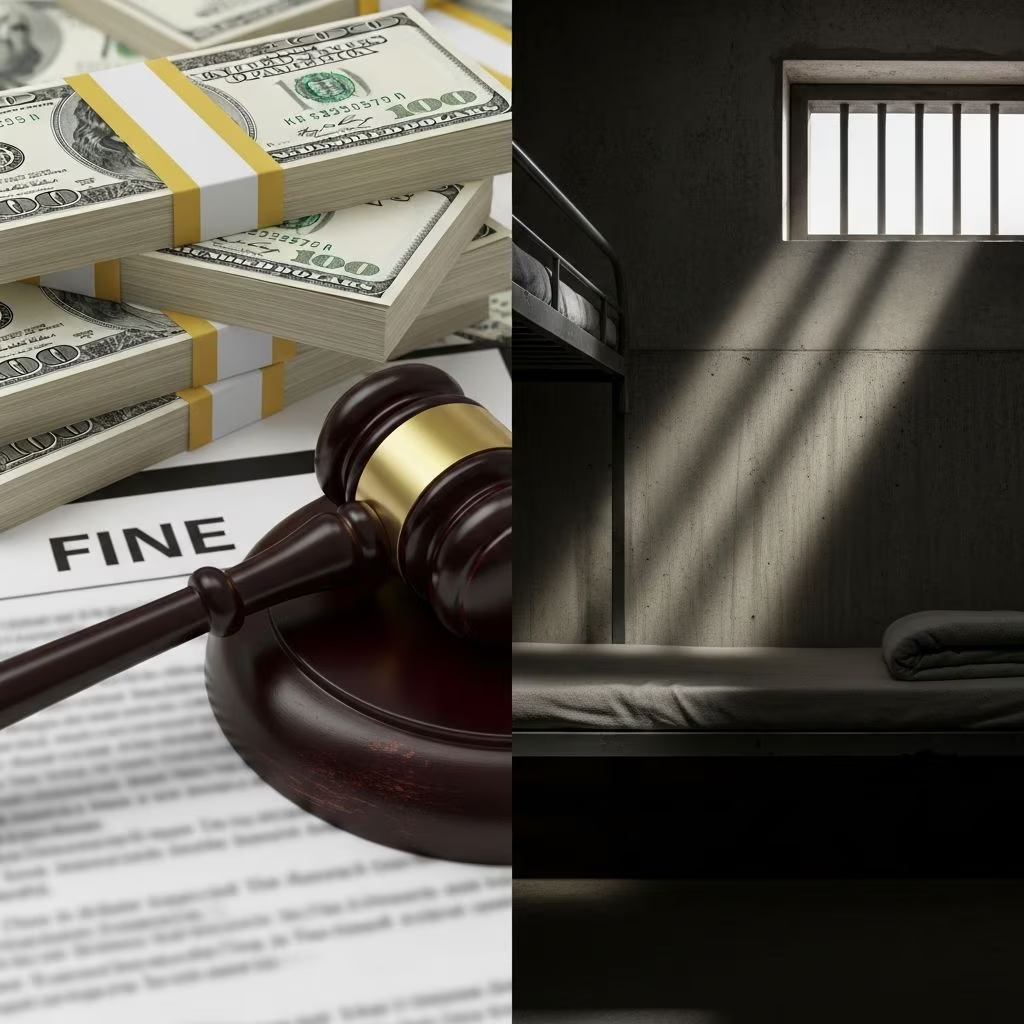
After a criminal conviction, the court must decide what punishment is fair, lawful, and appropriate. Sentencing is more than simply choosing a number of years in prison; judges often weigh a wide range of options, from fines and community-based penalties to lengthy incarceration and life sentences. This guide explains the major types of criminal sentences, how they differ, and what factors usually influence a judge’s decision.
Why Sentencing Matters in Criminal Law
Sentencing is the stage of a criminal case where the court translates a guilty plea or conviction into a concrete consequence. According to legal standards, sentencing typically pursues several key goals:
- Proportionality – punishment should reflect the seriousness of the offense and the offender’s blameworthiness.
- Deterrence – discouraging the offender and the public from committing crime in the future.
- Rehabilitation – helping offenders address underlying problems, such as addiction or mental health needs.
- Retribution – expressing society’s condemnation of harmful conduct.
- Public protection – preventing dangerous individuals from harming others, often through restrictions or imprisonment.
Most modern systems require judges to balance these purposes while operating within statutory limits set by legislatures.
Overview of Common Sentencing Options
Across many jurisdictions, judges generally choose among several broad categories of sentences:
- Financial penalties (fines and fees)
- Community-based sanctions (probation, community service, treatment programs)
- Restrictions on liberty without full custody (home detention, electronic monitoring)
- Imprisonment for a fixed or variable term
- Life imprisonment, with or without the possibility of release
- In rare cases, capital punishment for the most serious crimes
These options may be combined. For example, an offender might receive a jail term plus probation and an order to pay restitution to the victim.
Financial Penalties: Fines and Restitution
For less serious offenses, courts often rely on financial sanctions rather than incarceration.
Fines
A fine is a sum of money paid to the government as punishment. The amount typically depends on:
- The maximum fine allowed by statute
- The seriousness of the offense
- The offender’s ability to pay
Fines are frequently imposed for traffic violations, regulatory offenses, and minor criminal conduct, but may also supplement prison terms for more serious crimes.
Restitution
Restitution orders require offenders to compensate victims for economic losses, such as medical bills or property damage. Restitution is often combined with probation or supervised release and is intended to repair some of the harm caused by the crime.
Community-Based Sentences
Community-based sentences allow offenders to remain in the community under conditions, rather than being incarcerated. These options are important for lower-level offenses and for individuals who can be safely supervised outside custody.
Probation
Probation is a court-ordered period of supervision in the community. Conditions may include:
- Regular reporting to a probation officer
- Maintaining employment or education
- Participating in treatment (for example, substance use counseling)
- Avoiding new criminal activity
- Staying away from certain people or locations
Violating probation conditions can lead to stricter conditions, extension of supervision, or incarceration.
Community Service and Rehabilitation Programs
Court-ordered community service requires an offender to work for a set number of hours on approved projects benefiting the community. In some systems, judges may also order participation in:
- Drug or alcohol treatment programs
- Anger management or behavioral counseling
- Educational or vocational training
These sentences are designed to address the causes of offending and reinforce accountability without imposing full-time custody.
Restrictions on Liberty Short of Prison
Some sentences restrict movement and daily life while still allowing the offender to work or live at home. Examples include:
- Home detention – the offender must remain at their residence except for approved activities.
- Electronic monitoring – a device tracks the offender’s location to ensure compliance with curfews or exclusion zones.
- Community confinement – residence in a halfway house or similar facility instead of a traditional prison.
These sanctions may appear as stand-alone sentences or as conditions of probation or supervised release.
Imprisonment: Fixed and Variable Terms
Imprisonment is the most severe non-capital punishment and can take different legal forms depending on how long the person must serve and how much discretion exists to modify the term.
| Type of sentence | Key feature | Typical purpose |
|---|---|---|
| Determinate (fixed) | Single, fixed term with limited scope for change | Predictability, uniformity, deterrence |
| Indeterminate | Minimum and/or maximum term, with release decided later | Rehabilitation, flexible risk management |
| Mandatory minimum | Law requires at least a specified term | Severity for particular offenses, limit judicial leniency |
| Life (with or without parole) | Custody for life, sometimes with eligibility for release | Public protection, denunciation of very serious crime |
Determinate or Fixed-Term Sentences
A determinate sentence is a fixed period of imprisonment, such as five years, usually defined by statute and sentencing guidelines. The offender generally knows the maximum time they will serve, although good-time credits or early release rules may affect the actual release date.
Indeterminate Sentences
Under an indeterminate sentence, the court sets a range (for example, not less than five years and not more than ten years), and a parole board or similar authority later determines the release date within that range. This model gives decision-makers flexibility to consider rehabilitation progress and public safety over time.
Mandatory Minimum Sentences
Mandatory minimum statutes require judges to impose at least a certain period of imprisonment for specified crimes, such as some drug or firearm offenses. Judicial discretion to go below the minimum is extremely limited, which has sparked significant policy debate about fairness and proportionality.
Life Sentences and Capital Punishment
For the most serious crimes—such as homicide or other extreme violence—courts may impose life imprisonment or, in a shrinking number of jurisdictions, the death penalty.
Life Imprisonment
A life sentence requires the offender to spend the rest of their life under the sentence of the court. In many systems, the judge sets a minimum period that must be served before the offender can be considered for parole. Factors influencing eligibility often include:
- The gravity of the crime and harm caused
- The offender’s criminal history
- Evidence of rehabilitation and risk to the public
In some cases, legislatures authorize life without parole, which removes the possibility of conditional release for certain offenses.
Capital Punishment
Capital punishment, or the death penalty, may only be imposed for designated capital offenses, such as certain forms of murder, treason, or genocide. In the United States, for example, the Supreme Court has held that executing individuals who were under 18 at the time of the crime or who are intellectually disabled violates constitutional protections against cruel and unusual punishment. Globally, many jurisdictions have abolished the death penalty or limited its use to exceptional circumstances.
Concurrent and Consecutive Sentences
When a person is convicted of multiple offenses, the court must decide how the resulting sentences should interact.
- Concurrent sentences – multiple terms run at the same time, so the offender effectively serves only the longest term.
- Consecutive sentences – the offender serves one term after another, increasing the total time in custody.
Sentencing rules or guidelines may direct when concurrent or consecutive structures are appropriate, often based on whether the offenses arose from the same incident or from separate events.
Suspended, Deferred, and Conditional Sentences
In some circumstances, a court may decide it is appropriate to impose a sentence but delay or suspend its execution to give the offender a chance to demonstrate law-abiding behavior.
Suspended Sentences
Under a suspended sentence, the court pronounces a penalty (often a term of imprisonment) but delays sending the offender to custody, usually on conditions such as good behavior, probation compliance, or completion of treatment. If the offender satisfies the conditions, the custodial part may never be enforced.
Deferred Sentences
A deferred sentence postpones sentencing, or the start of a sentence, to allow the offender to complete a period of supervision or specific obligations. Successful completion can sometimes result in a reduced penalty or, in limited circumstances, the opportunity to avoid a formal conviction.
Factors That Influence Sentencing Outcomes
Although statutes and guidelines frame what is possible, individual sentencing decisions typically depend on a mix of case-specific factors.
- Nature and seriousness of the offense – including the level of violence, planning, and harm caused.
- Defendant’s criminal history – repeat offenders often face harsher sentences.
- Mitigating circumstances – such as youth, lack of prior record, remorse, cooperation, or significant personal hardship.
- Aggravating circumstances – including targeting vulnerable victims, use of weapons, or hate motivation.
- Victim impact – courts may consider statements detailing emotional, physical, or financial effects on victims.
- Sentencing guidelines and statutory limits – which may provide starting points or ranges.
Judges must also ensure that similar cases are treated consistently, while still tailoring sentences to the facts of each case.
Sentencing Guidelines and Judicial Discretion
Many jurisdictions use sentencing guidelines—frameworks that suggest typical sentence ranges based on offense severity and criminal history—to promote proportionality and reduce disparity. These guidelines may be:
- Advisory – judges must consider them but may depart with reasons.
- Presumptive – the recommended range applies unless specific factors justify moving up or down.
- Mandatory – little or no room for deviation.
Even with guidelines, judicial discretion remains important in weighing individual circumstances, victim impact, and the competing aims of punishment.
Frequently Asked Questions (FAQs)
Q: What is the difference between probation and parole?
Probation is an alternative to incarceration ordered at sentencing, allowing the offender to remain in the community under conditions. Parole is a form of supervised release that occurs after part of a prison sentence has been served, subject to rules and oversight in the community.
Q: Can a judge ignore mandatory minimum sentencing laws?
In most systems, judges must follow mandatory minimum statutes and cannot impose a lower sentence unless specific legal mechanisms apply, such as statutory safety valves or cooperation provisions. Otherwise, the minimum term is binding.
Q: Do all serious crimes result in prison sentences?
Not always. While many serious offenses carry presumptive or mandatory custody, judges may sometimes impose community-based or suspended sentences in light of strong mitigating factors, where the law allows. However, for the gravest offenses, imprisonment—sometimes for life—is common.
Q: How do victim impact statements affect sentencing?
Victim impact statements inform the court about the emotional, physical, and financial effects of the crime, helping judges understand the full harm caused. They can influence the choice and severity of sentence within the legal range, though they do not replace statutory limits or guidelines.
Q: Can a sentence be changed after it is imposed?
Sentences may sometimes be modified through appeals, post-conviction motions, or administrative processes like clemency and parole review. However, once a lawful final sentence is imposed, courts generally have limited authority to alter it, and strict deadlines often apply.
References
- Sentencing — United States Department of Justice, Office of the U.S. Attorneys. 2020-09-28. https://www.justice.gov/usao/justice-101/sentencing
- Glossary of Terms — United States Sentencing Commission. 2023-01-01. https://www.ussc.gov/education/glossary
- Types of Sentence — Sentencing Council for England and Wales. 2022-06-15. https://sentencingcouncil.org.uk/about-sentencing/types-of-sentence/
- Sentencing in Criminal Law — Thomson Reuters Legal. 2021-11-10. https://legal.thomsonreuters.com/blog/criminal-law-sentencing/
- Sentencing — Judiciaries Worldwide, Federal Judicial Center. 2016-05-01. http://judiciariesworldwide.fjc.gov/sentencing