
Understanding Criminal Evidence in the U.S. Legal System
A comprehensive guide to how evidence is gathered, used, and challenged in criminal cases.
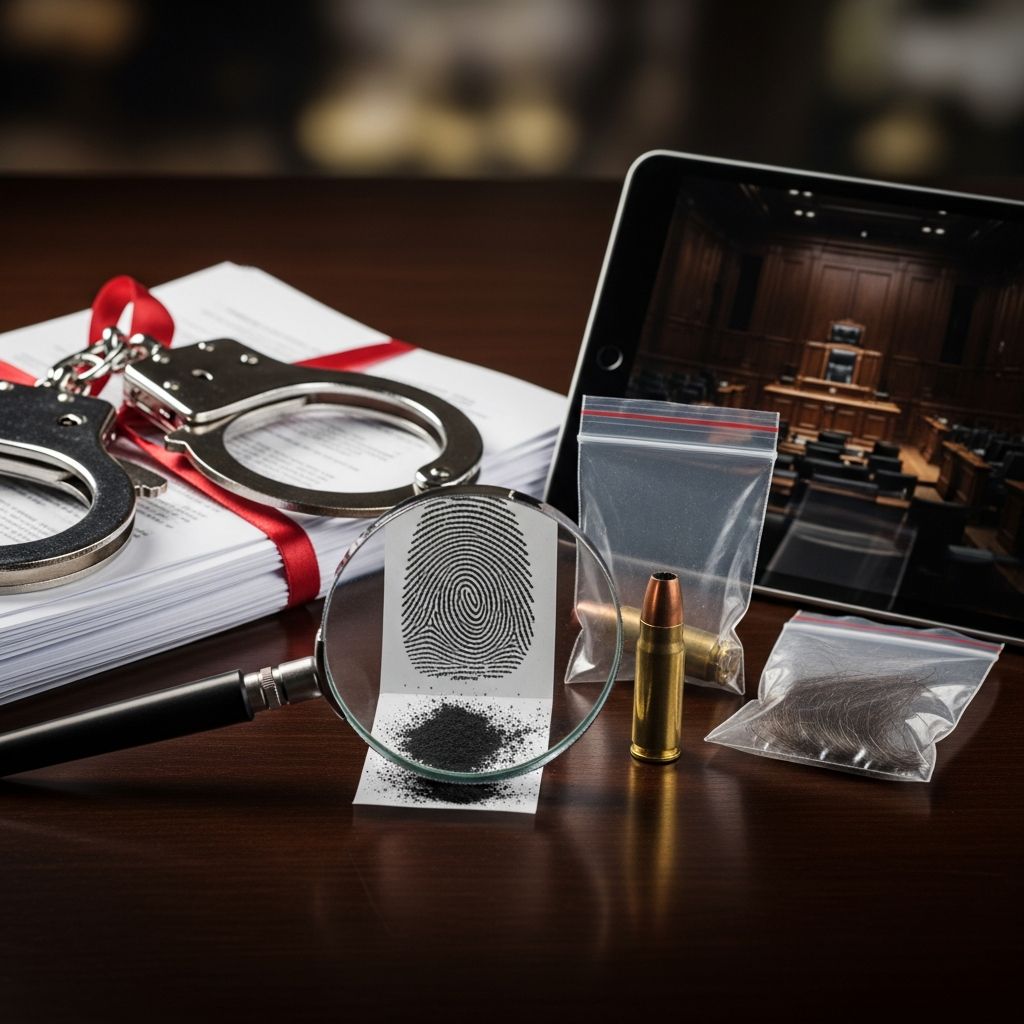
The Role of Evidence in Criminal Justice
In any criminal case, the outcome often hinges not on moral judgment or public opinion, but on what can be proven in court. Evidence is the foundation upon which guilt or innocence is determined. It is the collection of facts, objects, statements, and data that either support the prosecution’s claim that a defendant committed a crime or back the defense’s argument that they did not.
The legal system does not accept every piece of information as valid proof. Instead, it operates under a structured framework that governs what counts as evidence, how it must be obtained, and when it can be presented to a judge or jury. These rules exist to protect individual rights, ensure fair trials, and prevent wrongful convictions.
What Counts as Evidence?
Evidence in criminal law comes in many forms, each serving a different purpose in building a case. Broadly, it can be grouped into several categories:
- Testimonial evidence: Statements made under oath by witnesses, including victims, bystanders, law enforcement officers, and experts.
- Physical evidence: Tangible items such as weapons, clothing, drugs, fingerprints, or DNA samples collected from a crime scene or person.
- Documentary evidence: Written or recorded materials like contracts, emails, text messages, medical records, or surveillance logs.
- Digital evidence: Data from computers, smartphones, social media accounts, GPS devices, and other electronic sources.
- Demonstrative evidence: Visual aids such as diagrams, maps, timelines, or models used to help explain complex facts to the court.
- Scientific and expert evidence: Opinions and findings from qualified professionals in fields like forensics, medicine, or ballistics.
While all of these can be powerful tools in court, their usefulness depends on whether they are legally obtained and properly admitted under the rules of evidence.
How Evidence Is Collected and Preserved
The process of gathering evidence begins with law enforcement and investigators. They respond to crime scenes, interview witnesses, seize relevant items, and collect digital data. This work must follow strict procedures to maintain the integrity of the evidence and respect constitutional rights.
Key principles in evidence collection include:
- Chain of custody: A documented record showing who handled the evidence, when, and for what purpose. This helps prove that the item presented in court is the same one collected at the scene and has not been tampered with.
- Proper handling: Physical and digital evidence must be stored and transported in ways that prevent contamination, loss, or alteration.
- Legal authority: Officers generally need a warrant, consent, or an applicable exception (such as exigent circumstances) to search a person, home, or electronic device.
Failure to follow these standards can lead to serious consequences, including the exclusion of evidence from trial.
When Is Evidence Allowed in Court?
Not every fact or object related to a crime can be used in court. For evidence to be admitted, it must meet two main criteria: relevance and legality.
Relevance: Does It Matter to the Case?
Relevant evidence is any information that makes a fact more or less likely than it would be without that evidence. For example:
- A fingerprint at the scene of a burglary is relevant because it may link a suspect to the crime.
- A video recording of the defendant near the location at the time of the offense is relevant to presence.
- A threatening message sent by the defendant to the victim may be relevant to motive.
However, even relevant evidence can be excluded if its potential to mislead the jury, cause unfair prejudice, or confuse the issues outweighs its value in proving a key fact. Courts must balance these concerns carefully.
Legality: Was It Obtained Properly?
Even if evidence is highly relevant, it may still be thrown out if it was obtained in violation of the defendant’s constitutional rights. The most important protections come from the Fourth, Fifth, and Sixth Amendments to the U.S. Constitution.
- Fourth Amendment: Protects against unreasonable searches and seizures. Evidence obtained without a valid warrant or legal justification may be excluded under the exclusionary rule.
- Fifth Amendment: Protects against self-incrimination. Statements made by a suspect without proper Miranda warnings may not be used against them.
- Sixth Amendment: Guarantees the right to counsel. If police interrogate a suspect after they have requested a lawyer, any resulting statements may be inadmissible.
The exclusionary rule is a powerful tool for defendants. It prevents the prosecution from using illegally obtained evidence, even if that evidence clearly shows guilt.
The Exclusionary Rule and Its Limits
The exclusionary rule is a judicial doctrine that bars the use of evidence obtained in violation of the Constitution. It applies primarily to searches and seizures conducted without a warrant or without a recognized exception.
For example:
- If police search a home without a warrant and find drugs, those drugs may be excluded from trial.
- If a suspect is questioned without being read their Miranda rights, any confession may be suppressed.
However, the rule is not absolute. Courts have recognized several exceptions, such as:
- Good faith exception: If officers reasonably relied on a warrant they believed to be valid, even if it later turns out to be defective, the evidence may still be admissible.
- Inevitable discovery: If the evidence would have been found legally anyway, it may be allowed even if initially obtained improperly.
- Independent source: If the same evidence is later obtained through a lawful, independent investigation, it can be used in court.
There is also the related fruit of the poisonous tree doctrine, which extends the exclusionary rule to evidence that is indirectly derived from an illegal search or interrogation. For instance, if an illegal confession leads police to a hidden weapon, that weapon may also be excluded.
Types of Evidence and How They Are Used
Different kinds of evidence serve different roles in a criminal trial. Understanding these distinctions helps clarify how cases are built and challenged.
Direct vs. Circumstantial Evidence
Direct evidence directly proves a fact without requiring inference. Examples include:
- An eyewitness saying, “I saw the defendant stab the victim.”
- A video recording of the defendant committing the act.
- A confession in which the defendant admits to the crime.
Circumstantial evidence, on the other hand, requires the jury to draw a logical conclusion. It does not directly prove guilt but supports it indirectly. Examples include:
- The defendant’s fingerprints on a weapon found at the scene.
- Cell phone location data placing the defendant near the crime at the time it occurred.
- Financial records showing a sudden influx of money after a robbery.
Contrary to popular belief, circumstantial evidence can be very strong and is often the backbone of many criminal convictions.
Inculpatory vs. Exculpatory Evidence
Inculpatory evidence tends to show that the defendant committed the crime. This includes confessions, eyewitness identifications, forensic matches, and incriminating statements.
Exculpatory evidence, by contrast, supports the defendant’s innocence or raises doubt about guilt. Examples include:
- Alibi witnesses who place the defendant elsewhere.
- Surveillance footage that does not show the defendant at the scene.
- Forensic results that exclude the defendant as a suspect.
Prosecutors have a constitutional duty under Brady v. Maryland to disclose known exculpatory evidence to the defense. Failure to do so can result in a mistrial, overturned conviction, or disciplinary action.
The Burden of Proof in Criminal Cases
One of the most important concepts in criminal law is the burden of proof. In the United States, the prosecution bears the full burden of proving the defendant’s guilt.
The standard in criminal cases is “beyond a reasonable doubt.” This is the highest standard in the legal system and means that the evidence must be so convincing that there is no reasonable doubt about the defendant’s guilt.
To illustrate:
- In a civil case, the standard is usually “preponderance of the evidence,” meaning it is more likely than not that the claim is true.
- In a criminal case, the bar is much higher: the jury must be firmly convinced of guilt before returning a guilty verdict.
The defense does not have to prove innocence. Instead, they can challenge the prosecution’s evidence, present alternative explanations, or introduce reasonable doubt. If the jury has any reasonable doubt after considering all the evidence, they must acquit.
Who Is Responsible for Evidence?
Multiple parties play a role in how evidence is handled in a criminal case:
- Law enforcement: Responsible for initial collection, documentation, and preservation of evidence.
- Prosecutors: Must ensure that evidence is legally obtained, properly disclosed to the defense, and presented in a way that complies with court rules.
- Defense attorneys: Have the duty to review all evidence, challenge its admissibility, and use it to build a defense strategy.
- Judges: Decide whether evidence meets legal standards for admission and instruct the jury on how to evaluate it.
- Juries: Ultimately decide what evidence to believe and whether it proves guilt beyond a reasonable doubt.
Each of these roles is essential to maintaining a fair and balanced process.
Common Challenges to Evidence in Criminal Cases
Defense attorneys routinely challenge the prosecution’s evidence on several grounds:
- Constitutional violations: Arguing that evidence was obtained through an illegal search, seizure, or interrogation.
- Chain of custody issues: Showing that evidence may have been lost, contaminated, or altered between collection and trial.
- Reliability of witnesses: Questioning the accuracy of eyewitness identifications, memory, or motives to testify.
- Scientific validity: Challenging forensic methods, lab procedures, or expert opinions, especially in areas like DNA analysis or ballistics.
- Authentication: Arguing that documents, recordings, or digital data have not been properly verified as genuine.
Successful challenges can lead to evidence being excluded, weakening the prosecution’s case or even resulting in dismissal of charges.
How Evidence Shapes Trial Strategy
Both prosecutors and defense attorneys build their entire trial strategy around the available evidence. Prosecutors must decide which charges to file, which witnesses to call, and how to present the story of the crime. Defense attorneys must assess the strength of the evidence, identify weaknesses, and determine whether to negotiate a plea or go to trial.
Key strategic considerations include:
- Whether there is enough admissible evidence to meet the burden of proof.
- Whether key witnesses are credible and available.
- Whether exculpatory evidence creates a strong basis for reasonable doubt.
- Whether the case relies heavily on circumstantial evidence that can be explained in alternative ways.
In many cases, the outcome is determined long before the trial begins, based on motions to suppress evidence, plea negotiations, and pretrial rulings.
Frequently Asked Questions (FAQs)
Q: What happens if police find evidence during an illegal search?
A: Evidence obtained in violation of the Fourth Amendment may be excluded from trial under the exclusionary rule. If the evidence is critical to the prosecution’s case, this can significantly weaken or even end the case.
Q: Can a defendant be convicted based only on circumstantial evidence?
A: Yes. Circumstantial evidence can be sufficient for a conviction if it proves guilt beyond a reasonable doubt. Many criminal convictions are based entirely on circumstantial evidence, such as DNA, fingerprints, and digital records.
Q: What is the difference between direct and circumstantial evidence?
A: Direct evidence directly proves a fact (e.g., an eyewitness account). Circumstantial evidence requires inference (e.g., fingerprints at the scene). Both types are valid and can be powerful in court.
Q: Do prosecutors have to share all evidence with the defense?
A: Yes. Prosecutors must disclose all exculpatory evidence and any information that could help the defense, as required by the Constitution and court rules. Failure to do so can result in serious consequences for the case.
Q: What is the burden of proof in a criminal case?
A: The prosecution must prove the defendant’s guilt beyond a reasonable doubt. This is the highest standard in the legal system and reflects the serious consequences of a criminal conviction.
Q: Can a defendant be forced to testify?
A: No. The Fifth Amendment protects against self-incrimination. A defendant has the right to remain silent and cannot be compelled to testify. The jury is not allowed to draw any negative inference from the defendant’s decision not to testify.
References
- Federal Rules of Evidence — Legal Information Institute, Cornell Law School. 2023. https://www.law.cornell.edu/rules/fre
- Brady v. Maryland, 373 U.S. 83 (1963) — Supreme Court of the United States. 1963. https://supreme.justia.com/cases/federal/us/373/83/
- California Evidence Code — California Legislative Information. 2023. https://leginfo.legislature.ca.gov/faces/codes_displayText.xhtml?lawCode=EVID
Similar Articles








Read full bio of medha deb




