
Understanding Courts: How Judges Resolve Disputes
Discover what courts are, how they are structured, and the key steps and people involved in resolving legal disputes.
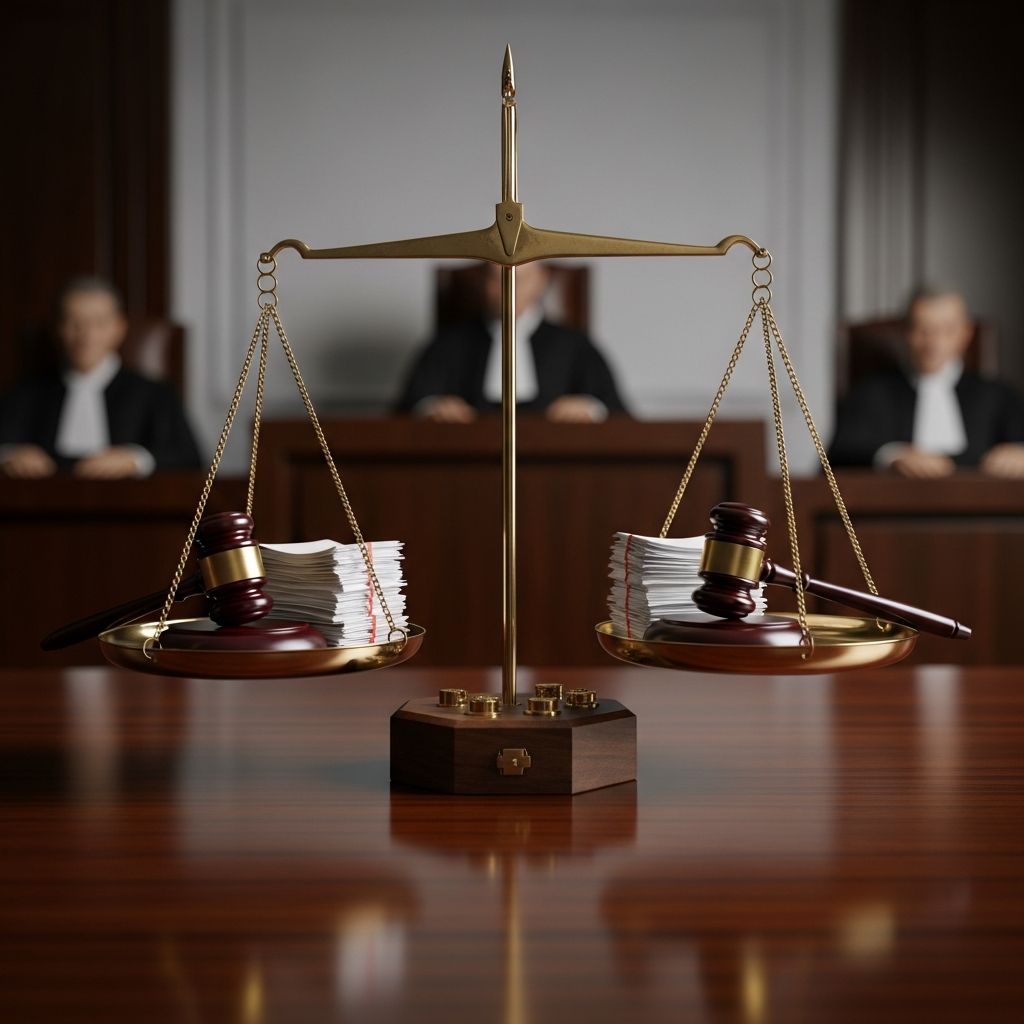
Courts sit at the heart of the legal system. They provide an orderly, peaceful way to resolve conflicts, apply laws, and protect rights, instead of leaving people to settle disputes on their own. Courts are part of the judicial branch of government, working alongside the legislative and executive branches as part of a system of checks and balances.
This guide explains what a court is, the major types of courts, who works inside a courtroom, and what typically happens as a case moves through the court system.
1. What Is a Court?
In law, a court is a person or group of people with official authority to hear disputes and make binding decisions. Courts decide both criminal and civil cases, interpret constitutions and statutes, and ensure that government actions comply with the law.
1.1 Core purposes of courts
Across different legal systems, courts tend to perform a few basic functions:
- Peacefully resolve disputes between individuals, businesses, and governments.
- Determine guilt or innocence in criminal cases and impose lawful penalties where appropriate.
- Interpret and apply laws, including constitutions, statutes, and regulations.
- Review government actions to ensure they follow legal and constitutional limits.
- Develop legal rules over time through judicial decisions, especially in common-law systems.
1.2 Courts within a constitutional framework
In many countries, including the United States, courts are established or recognized in a constitution. For example, Article III of the U.S. Constitution creates the federal judiciary and authorizes a supreme court and lower courts that Congress may establish. This constitutional foundation helps preserve courts’ independence from political pressure.
2. Levels and Types of Courts
Most modern legal systems use a hierarchical court structure. Lower courts hear and decide cases first, while higher courts mainly review those decisions.
2.1 Trial courts, appellate courts, and courts of last resort
| Court level | Main role | Key features |
|---|---|---|
| Trial courts | First place where cases are filed and facts are established. | Hear evidence and witness testimony; may use juries; issue initial judgments. |
| Intermediate appellate courts | Review trial court decisions for legal errors. | No new evidence; judges decide by reading records and legal briefs, sometimes with oral argument. |
| Courts of last resort (often called supreme courts) | Final review of important or unsettled legal questions. | Select a small number of cases; establish binding precedent for lower courts. |
2.2 Federal and state court systems
In federal systems, such as the United States, there are usually two parallel court systems:
- National (federal) courts handle cases arising under federal law, the national constitution, and certain disputes involving different states or foreign parties.
- State or provincial courts decide most everyday matters, including family law, contracts, property, and most criminal cases.
This arrangement reflects the principle of federalism, which divides power between national and regional governments.
2.3 Courts of general and limited jurisdiction
Within each system, courts are often further grouped by the kinds of cases they may hear, a concept known as jurisdiction:
- Court of general jurisdiction: Can hear most types of civil and criminal cases that are not specifically reserved for another court.
- Court of limited jurisdiction: Restricted to particular topics (such as family or probate matters), dollar amounts, or types of offenses (such as traffic or small claims).
2.4 Examples of specialized courts
Some systems create specialized courts to handle certain types of disputes more efficiently or with greater expertise:
- Family courts — divorce, child custody, child support, and related matters.
- Juvenile courts — cases involving minors accused of offenses or in need of protection.
- Probate courts — wills, estates, and guardianships.
- Small claims courts — low-value civil disputes, often with simplified procedures.
- Special federal courts — for example, courts handling tax, patent, or international trade matters.
3. How Courts Exercise Authority
Courts can only act where they have lawful authority. That authority depends on both the subject matter of the dispute and the connection of the parties or events to the court’s territory.
3.1 Subject-matter and personal jurisdiction
- Subject-matter jurisdiction refers to the categories of cases a court is allowed to hear. For example, some courts can decide only criminal cases, others only civil disputes, and some both.
- Personal jurisdiction concerns the court’s power over the people or entities involved. Courts generally need a geographic or legal connection, such as where a party lives or where an event occurred.
3.2 Judicial review and constitutional questions
Higher courts often have the power to decide whether laws or government actions violate a constitution. This function, commonly called judicial review, allows courts to invalidate laws or executive acts that conflict with constitutional guarantees. In the United States, this role is central to the Supreme Court, which has the final word on questions of federal constitutional law.
3.3 Precedent and consistency
In many common-law systems, earlier decisions of higher courts create precedent that lower courts must follow in similar cases. This practice promotes consistency and predictability, helping people and organizations understand how the law is likely to apply to their conduct.
4. Who Works in a Courtroom?
Although courts differ from place to place, many courtrooms include a similar set of key participants, each with a distinct role in ensuring fair proceedings.
4.1 Judges
Judges preside over court proceedings and are responsible for ensuring that trials follow the law and rules of procedure. Their duties typically include:
- Explaining and enforcing courtroom rules.
- Ruling on motions and objections raised by the parties.
- Interpreting and applying laws and constitutions to the facts of a case.
- Deciding cases without a jury (bench trials) and, in jury trials, instructing the jury on the law.
- Imposing sentences in criminal cases within legal limits.
4.2 Juries
In some systems and for certain types of cases, a jury of community members decides disputed facts.
- In criminal cases, juries may determine whether the prosecution has proven guilt beyond a reasonable doubt.
- In civil cases, juries may decide liability and, sometimes, the amount of damages.
Judges handle legal questions, while juries focus on credibility of witnesses and the weight of evidence.
4.3 Lawyers
Lawyers (also called attorneys or counsel) represent the parties and are responsible for presenting legal and factual arguments to the court.
- Prosecutors act on behalf of the government in criminal cases, seeking to prove that a defendant committed a crime.
- Defense lawyers represent people or organizations accused of crimes or sued in civil cases, protecting their rights and challenging the opposing side’s arguments.
- Civil lawyers represent plaintiffs (those bringing a lawsuit) and defendants in non-criminal disputes.
4.4 Court staff and support personnel
Court systems rely on many professionals behind the scenes:
- Clerks of court manage the official court record, filings, and scheduling.
- Court reporters create verbatim records of hearings and trials.
- Bailiffs or court security officers maintain order and safety in the courtroom.
- Interpreters assist participants who do not speak the court’s primary language.
5. Life Cycle of a Typical Case
While every case is unique, most formal disputes follow a similar path through the court system.
5.1 Beginning a case
- Civil cases usually start when a plaintiff files a complaint outlining the claim and the relief sought.
- Criminal cases generally begin with charges filed by a prosecutor, sometimes after a grand jury issues an indictment, depending on the jurisdiction and seriousness of the offense.
The defendant is notified and given a chance to respond to the allegations, either by answering a civil complaint or entering a plea in a criminal case.
5.2 Pretrial procedures
Before a trial, the parties and the court focus on clarifying issues, exchanging information, and attempting resolution:
- Discovery — exchanging documents, taking depositions, and requesting information to prepare for trial.
- Motions — asking the court to decide specific legal questions or, in some cases, to resolve the entire case without trial.
- Settlement or plea negotiations — many civil disputes settle, and many criminal cases end in plea agreements rather than full trials.
5.3 Trial
If a dispute is not resolved earlier, it proceeds to trial in a court with appropriate jurisdiction.
- Bench trial — the judge serves as the fact-finder and decision maker.
- Jury trial — a jury decides key facts, while the judge manages legal rulings and instructs the jury on the law.
Trials typically include opening statements, presentation of evidence and witnesses, cross-examination, closing arguments, and then a verdict or judgment.
5.4 Appeal
A party dissatisfied with a trial court’s final decision may seek review in an appellate court, usually within strict deadlines.
- Appellate judges review the record for legal errors, not to re-try the facts.
- They may affirm the decision, reverse it, or send the case back to the lower court for further proceedings.
- In some systems, a further appeal to a court of last resort is possible, especially when issues of broad public importance or constitutional interpretation are involved.
6. Why Courts Matter
Courts play a critical role in maintaining the rule of law and public trust in government.
- Protecting rights: Courts enforce constitutional and legal rights, including due process and equal protection.
- Providing stability: Clear, consistent decisions allow people and organizations to plan their affairs with more certainty.
- Checking other branches: By reviewing legislation and executive actions, courts help maintain the balance of power.
- Offering peaceful resolution: By giving parties a formal process to resolve disputes, courts reduce the likelihood of private violence or self-help.
Frequently Asked Questions About Courts
Q: What is the difference between a civil court and a criminal court?
Civil courts handle disputes between private parties or between individuals and governments over rights, responsibilities, or money, such as contract or injury claims. Criminal courts deal with offenses against the community, where the government prosecutes a person or entity for violating criminal laws and may seek penalties like fines, probation, or imprisonment.
Q: Do all cases go to trial?
No. Many cases end before trial through settlement in civil matters or plea agreements in criminal matters, or when judges decide legal issues that make a trial unnecessary. Only a relatively small percentage of filed cases result in full trials.
Q: Can every decision be appealed?
Most final judgments can be appealed, but the right to appeal, the scope of review, and the number of appeal levels vary by jurisdiction and case type. Highest courts often select only a small portion of cases that raise important or unsettled legal questions.
Q: Are court proceedings always public?
Many court hearings, especially in criminal cases, are open to the public to promote transparency and accountability. However, some proceedings, such as certain juvenile or family matters, may be closed or partially restricted to protect privacy, safety, or other important interests.
Q: Do all legal systems use juries?
No. While jury trials are common in some common-law countries, many civil-law systems rely primarily on professional judges or mixed panels of judges and lay participants. The availability and scope of jury trials depend on the country, the type of case, and constitutional or statutory provisions.
References
- Court Role and Structure — Administrative Office of the U.S. Courts. 2024-01-01. https://www.uscourts.gov/about-federal-courts/court-role-and-structure
- Court: Definition, Functions, Structure, & Facts — Encyclopaedia Britannica. 2023-10-01. https://www.britannica.com/topic/court-law
- Courts 101: An Understanding of the Court System — Federal Judicial Center. 2015-01-01. https://www.fjc.gov/sites/default/files/2015/Courts%20101%20An%20Understanding%20of%20the%20Court%20System.pdf
- Structure of the Courts — North Carolina Judicial Branch. 2022-06-01. https://www.nccourts.gov/learn/structure-of-the-courts
- The U.S. Court System, Explained — Democracy Docket. 2023-08-15. https://www.democracydocket.com/analysis/the-u-s-court-system-explained/
- How Courts Work — Judicial Council of California. 2023-05-01. https://selfhelp.courts.ca.gov/court-basics/how-courts-work
- Introduction to the Federal Court System — U.S. Department of Justice. 2015-01-01. https://www.justice.gov/usao/justice-101/federal-courts
Similar Articles








Read full bio of medha deb


