
Understanding Court-Ordered Community Service
Learn how court-ordered community service works, what judges can require, and how to successfully complete your hours.
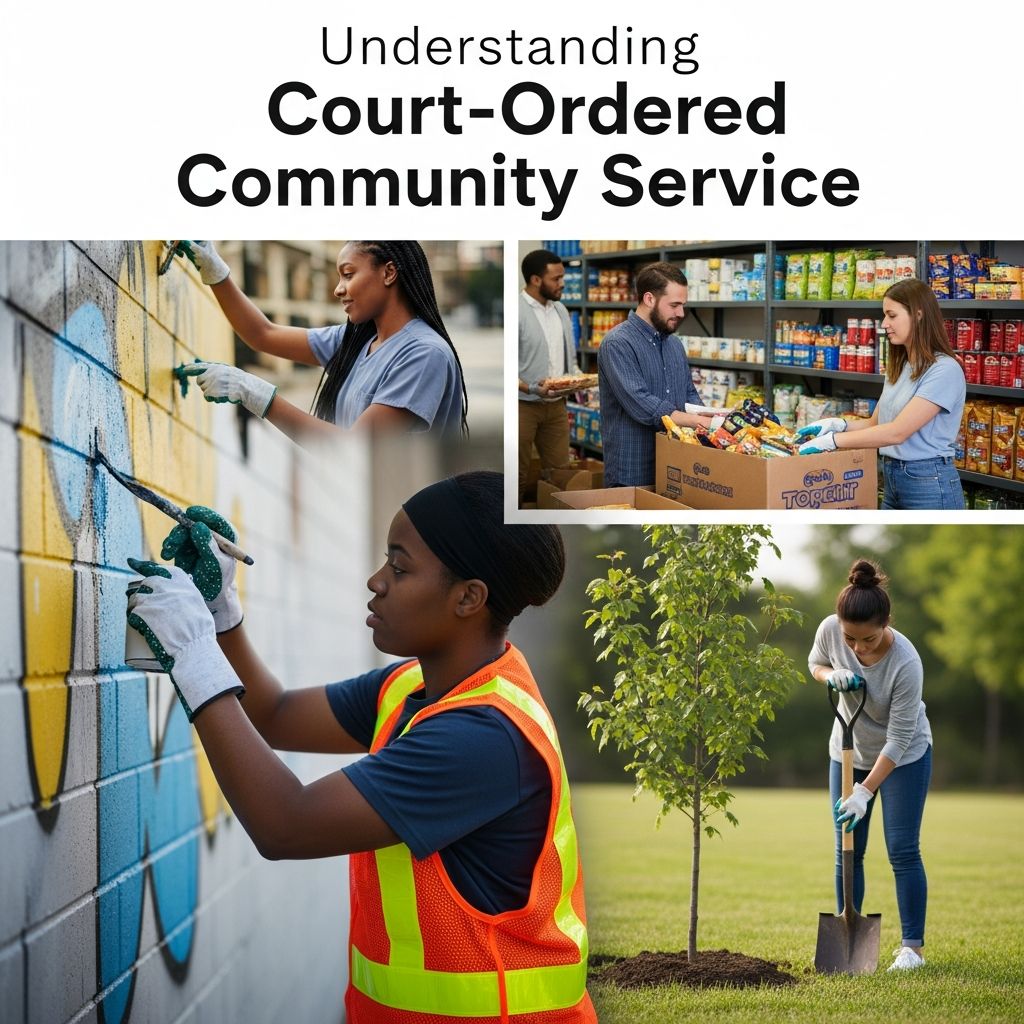
Court-ordered community service is a common sentencing tool in criminal and traffic cases, especially for less serious offenses. It allows courts to require unpaid work that both benefits the public and is intended to help rehabilitate the person who committed the offense. This guide explains how community service fits into the criminal justice system, what judges can require, and how to protect yourself by complying with every part of the order.
What Is Court-Ordered Community Service?
Court-ordered community service is unpaid work that a judge requires a defendant to perform for the benefit of the community as part of a criminal case. It is usually performed for qualified nonprofits or government-related programs and must meet specific conditions set out in the sentence.
Key features include:
- It is imposed by a judge as part of a criminal or traffic case.
- The work is unpaid and must be performed for approved organizations.
- Completion is usually proven with signed timesheets or letters from the organization, according to court rules.
- Failure to comply can lead to additional penalties, including jail time or probation violations.
When Do Courts Use Community Service?
Community service is one of many sentencing options available to criminal courts in the United States. Judges often turn to it in cases where they want a consequence that is less harsh than incarceration but still meaningful.
Common situations where it is imposed
- Misdemeanors and minor offenses such as traffic violations, disorderly conduct, or minor theft.
- Nonviolent felonies where the defendant does not pose a high risk to public safety.
- First-time offenders who may benefit from an alternative to jail and a chance to demonstrate responsibility.
- Cases involving fines, where service is allowed “in lieu of” paying some or all of the fine, particularly for defendants with limited ability to pay.
By contrast, defendants with histories of violent, sexual, or serious animal-related offenses are often excluded from many volunteer placements due to safety and policy considerations.
How it fits into a sentence
Community service can appear in a criminal sentence in several ways:
- As a condition of probation (for example, “complete 80 hours within 6 months”).
- As part of a diversion or deferred prosecution program, often in exchange for a charge being dismissed upon successful completion.
- As a substitute or supplement to fines or short jail terms, especially in minor cases.
Typical Terms of a Community Service Order
While the exact language varies by court and jurisdiction, most written orders answer four central questions.
| Issue | What the Order Usually Specifies |
|---|---|
| Hours | Total number of hours, and sometimes minimum hours per week or month. |
| Location | Whether you may choose any approved nonprofit or must use a specific agency or referral program. |
| Verification | What documentation is required (signed timesheets, official letters, or specific forms) and who must sign them. |
| Deadline | Exact date by which proof of completion must reach the court or probation office. |
Before you begin any service, carefully review your paperwork and, if possible, discuss it with a lawyer or probation officer so you do not invest time in work that will not count.
Who Decides the Type of Work?
Judges have wide discretion in shaping community service orders, but they must still respect legal limits such as proportionality (the punishment must not be unduly harsh compared to the offense) and statutory boundaries set by state law.
Judicial discretion and “fitting the crime”
Some judges simply order a specific number of hours and allow the defendant to find any approved placement. Others match the work to the nature of the offense—for example, ordering work with a road safety campaign after a serious traffic violation. In either case, the order must be reasonably related to the goals of sentencing, such as rehabilitation, deterrence, and community protection.
Role of probation and referral agencies
In many jurisdictions, the court relies on a community service referral agency or a probation department to manage placements and monitor compliance.
- The court issues the order and, sometimes, a list or directory of approved agencies.
- The referral agency or probation officer screens you, discusses your schedule, and assigns you to a partner organization.
- The service provider then reports hours back to the referring program through signed time logs, electronic submissions, or official letters.
What Kinds of Work Usually Count?
Approved community service generally must be for a nonprofit, charity, public agency, or similar organization, and must be appropriate to the court’s rules and the nature of the offense.
Common types of community service assignments
- Helping at food banks or meal programs (packing food, serving meals, cleaning).
- Working with environmental or parks programs (litter cleanup, trail maintenance, gardening).
- Supporting animal shelters or humane societies (cleaning, laundry, basic animal care), subject to eligibility rules.
- Assisting at thrift stores or donation centers linked to recognized charities (sorting, stocking, organizing).
- Office support for nonprofit agencies (filing, answering phones, data entry).
Some organizations that commonly rely on volunteers—including certain political groups, religious institutions, or student-led events—may not qualify for court-ordered hours due to court or program policies. Always get explicit approval before you begin.
Restrictions and disqualifications
Service providers and courts often impose restrictions such as:
- Only allowing work for registered nonprofits or designated government-related programs.
- Refusing to accept individuals with violent, sexual, or animal cruelty histories for certain placements.
- Prohibiting service at organizations where the defendant has a close personal or economic interest (for example, a family business).
- Requiring that any out-of-county or out-of-state placement receive written court approval in advance.
How to Start and Complete Your Hours
Successfully completing court-ordered community service requires planning, documentation, and attention to deadlines. The following steps reflect common practices in many jurisdictions.
1. Read your order and ask questions early
- Confirm the total number of hours required.
- Identify any restrictions on where you may serve.
- Note the exact deadline and any interim progress dates.
- Clarify what documents the court will accept as proof.
If you are unsure, speak with your lawyer, probation officer, or the clerk’s office before choosing a placement.
2. Contact an approved agency or program
Depending on your court’s rules, you might:
- Choose from a list of approved community service referral agencies that will place you with a suitable nonprofit.
- Work directly with a probation or community corrections department, which assigns you to a partner organization.
- Search for court-approved opportunities through a regional volunteer clearinghouse.
Be honest about your schedule, transportation, and any physical limitations so the placement can be realistic and sustainable.
3. Track your hours carefully
Standard practices for verification include:
- Signing in and out for each shift on an official timesheet.
- Having a supervisor sign or initial each entry.
- Requesting an official letter on organizational letterhead after completing all hours, if your court requires it.
- Keeping copies of all documents in case anything is lost.
Many agencies will only provide a final letter after you have satisfied all scheduled hours, so do not wait until the last day to confirm what they need.
4. Submit proof before the deadline
Your order should explain where and how to submit documentation—for example, directly to the court clerk, to probation, or through an online portal. Courts often require that proof arrive by a specific date, not simply that you have worked the hours by that date.
What Happens If You Cannot Complete the Hours?
Life events such as illness, job loss, or family emergencies can interfere with your ability to complete service. Courts typically expect you to act early if you foresee trouble meeting the deadline.
Requesting more time or a change in placement
Common options include:
- Asking the court for an extension of time before the deadline passes.
- Requesting permission to switch to another approved organization that fits your schedule or location better.
- Seeking a modification of the sentence through your attorney if circumstances have significantly changed.
There is no guarantee a judge will grant any of these requests, but you are generally in a stronger position if you raise the issue early and can show what you have already completed.
Consequences of noncompliance
If you simply fail to complete the required hours, potential outcomes include:
- A finding that you violated probation or the terms of your diversion program.
- Imposition of a suspended jail sentence or additional fines.
- Revocation of a diversion agreement, resulting in a conviction being entered.
- Additional court costs or more restrictive conditions going forward.
Courts may consider your efforts, any partial completion, and your explanation before deciding on consequences, but they are not required to excuse noncompliance.
Legal Rights and Practical Tips
While community service is less severe than incarceration, it is still a criminal penalty and should be taken seriously. You retain important legal rights and can benefit from thoughtful planning.
Your legal protections
- You have the right to be represented by an attorney in criminal proceedings where community service may be imposed.
- The sentence must fall within the limits authorized by state law and court rules.
- The order should be clear enough that you can understand what is required; ambiguous terms can often be clarified through counsel or by asking the court.
- You are generally entitled to a hearing and due process protections if the court seeks to punish you for not completing service.
Practical strategies for success
- Start early: Beginning your hours soon after sentencing leaves room for schedule changes or emergencies.
- Keep records: Maintain your own log of dates, hours, and tasks, in addition to agency forms.
- Communicate: Stay in contact with supervisors and your attorney or probation officer about any problems.
- Choose wisely: When you have a choice of placement, look for work that is realistic, accessible, and safe for you.
- Be professional: Treat the service like a job; poor behavior or missed shifts can be reported back to the court.
Frequently Asked Questions about Court-Ordered Community Service
Q1: Can I do my community service at any nonprofit I choose?
Not necessarily. Many courts require you to work through an approved community service referral agency or a list of pre-screened nonprofits. If your order does not specify, ask the court or your lawyer before you begin.
Q2: Do religious or political organizations count for court-ordered hours?
Some courts will not accept hours for primarily religious or political activities, even if the group is a nonprofit. Check your court’s rules, and obtain written approval if you want to serve at such an organization.
Q3: What if I live in a different county or state than the court?
You may need written permission to perform service outside the county or state where you were sentenced. Many courts allow this through approved agencies, but they usually want advance notice and documentation.
Q4: Will my employer be notified about my community service?
Courts and agencies generally do not contact your employer unless employment is directly related to the case or required by specific conditions. However, scheduling may require you to inform your employer about time off for service, and criminal cases are often matters of public record.
Q5: Can voluntary community service help my case before sentencing?
In some jurisdictions, defendants complete voluntary service before their court date to show good faith, and judges may take this into account at sentencing. You should only do this after consulting with your lawyer, who can advise you on whether and how it may be presented to the court.
References
- What Types of Community Service Can a Judge Order? — Nolo. 2022-10-01. https://www.nolo.com/legal-encyclopedia/what-kind-community-service-can-judge-order.html
- Community Service (CRCS) Program — County of Los Angeles. 2023-05-10. https://www.lacommunityservice.com
- Community Service For Your Virginia Criminal Or Traffic Case — Riley & Wells, PLLC. 2023-04-01. https://www.rileywellslaw.com/community-service/
- Court-Ordered Community Service Policy — Food Bank of Contra Costa & Solano. 2022-09-15. https://volunteer.foodbankccs.org/court
- Court Ordered & Pre-Court Date Community Service — City of Norfolk, VA. 2024-01-05. https://www.norfolk.gov/5106/Court-Ordered-Pre-Court-Date-Community-S
- Community Service – Legal Information for Students — Penn State Student Affairs. 2023-02-20. https://studentaffairs.psu.edu/student-services/legal-services/legal-information-students/community-service
- Court Ordered Community Service — Volunteer Hampton Roads. 2023-06-30. https://www.volunteerhr.org/courtordered
Similar Articles








Read full bio of medha deb


