
Understanding and Comparing DUI Laws Across U.S. States
A practical guide to how drunk and drugged driving laws differ across U.S. states and what those differences mean for drivers.
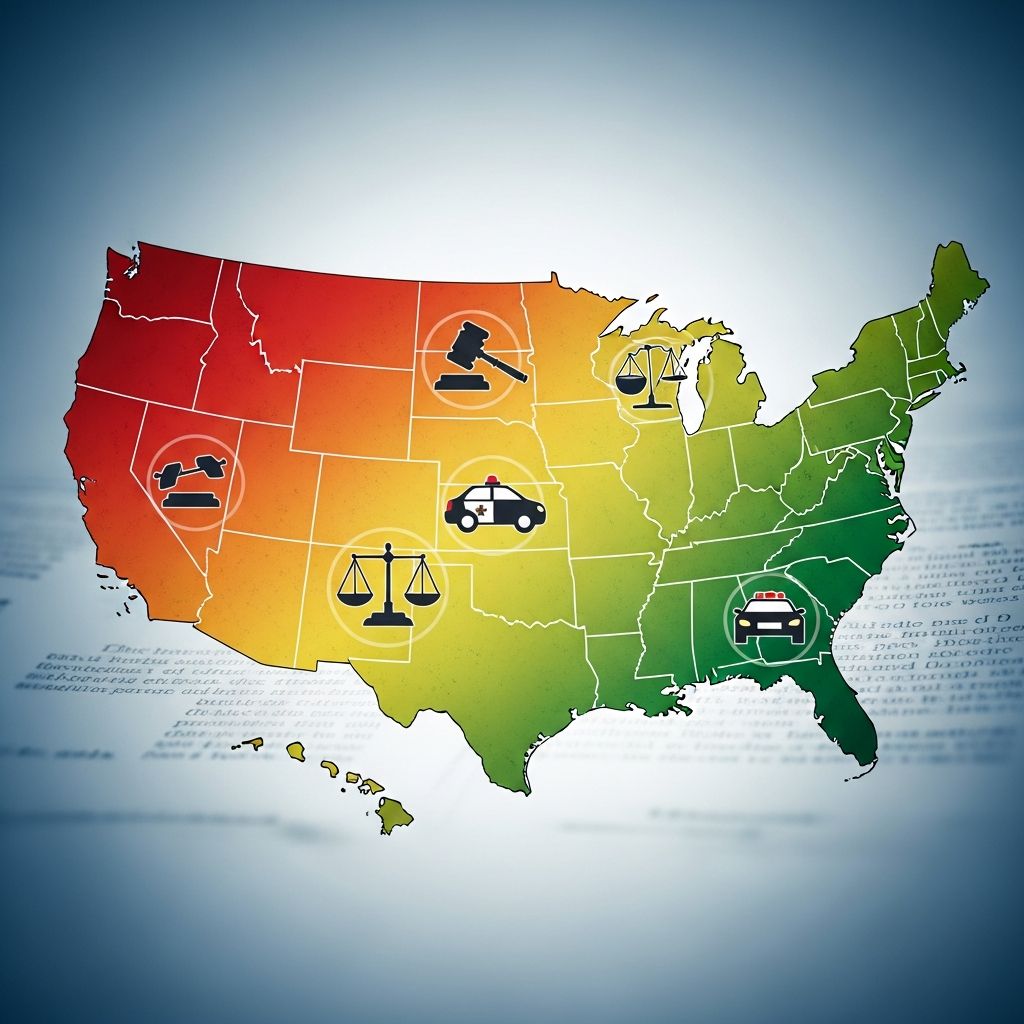
Driving under the influence (DUI) is illegal in every U.S. state, but the exact rules, terminology, and penalties vary widely from one jurisdiction to another. Anyone who drives, travels, or holds a license in more than one state should understand these differences, because a decision made in a few minutes can carry consequences that last for years.
Why State DUI Laws Are Not All the Same
Although federal agencies promote national safety standards, each state controls its own traffic and criminal laws. As a result, DUI statutes differ in several important ways:
- Terminology for impaired driving offenses
- Blood alcohol concentration (BAC) thresholds
- Criminal classification (misdemeanor vs. felony)
- Minimum and maximum penalties such as fines and jail
- Administrative license actions imposed by motor vehicle agencies
Despite these variations, all states prohibit operating a vehicle while impaired by alcohol, drugs, or a combination of substances, and nearly all have a per se BAC limit of 0.08 for standard adult drivers.
Different Names for Similar Impaired Driving Offenses
States use a mix of terms to describe drunk or drugged driving. The terms often overlap in meaning but may involve different elements or penalties.
Common Legal Labels
- DUI (Driving Under the Influence) – The most widely used phrase, covering alcohol, drugs, or both.
- DWI (Driving While Intoxicated or Impaired) – Used in some states interchangeably with DUI, in others as a more serious form of impaired driving.
- OUI (Operating Under the Influence) – Used in states such as Massachusetts, Maine, and Rhode Island, emphasizing “operation” rather than just driving.
- OWI / OVI – Other variants like Operating While Intoxicated or Operating a Vehicle Impaired appear in a handful of states.
These labels matter because they can reflect different proof standards, available defenses, and collateral consequences, even when the underlying conduct looks similar across state lines.
Core Elements Shared by Most State DUI Laws
Despite the differences in wording, certain features appear in nearly every state’s impaired driving framework:
- A per se BAC limit for adult drivers, usually 0.08.
- A separate offense for impairment based on behavior or test results, even if the BAC is below 0.08.
- Zero tolerance BAC limits (typically 0.02 or less) for drivers under the legal drinking age.
- Administrative license suspension or revocation imposed quickly when a driver fails or refuses a chemical test.
- Enhanced penalties for repeat convictions, high BAC, or crashes causing injury or death.
Comparing Key Legal Thresholds Across States
Several legal thresholds shape how tough a state’s DUI regime feels in practice. The following table highlights some of the most important comparisons.
| Legal Feature | Typical Rule in Most States | Examples of Stricter or Distinct Approaches |
|---|---|---|
| Standard adult BAC limit | 0.08 BAC per se limit for DUI. | Utah sets a 0.05 BAC limit, the lowest in the nation. |
| Underage BAC limit | Zero tolerance, usually BAC of 0.02 or lower. | Some states impose immediate license suspension even for small amounts of alcohol in a minor’s system. |
| High BAC / aggravated DUI | Enhanced penalties above a threshold (often 0.15 or higher). | Certain states label these as “extreme” or “aggravated” DUI with mandatory jail and longer ignition interlock requirements. |
| Impairment below 0.08 | Some states allow charges based on observable impairment even if BAC is under 0.08. | Colorado’s DWAI law permits prosecution at BAC levels as low as 0.05 when ability to drive is affected. |
Criminal Classification: Misdemeanor vs. Felony
How a DUI is classified strongly influences potential punishment, future background checks, and long-term consequences.
- First non-injury offenses are commonly treated as misdemeanors, with maximum jail terms typically under one year.
- Injury-related offenses often start as misdemeanors for early offenses but become felonies if a driver accumulates multiple injury DUIs.
- Repeat non-injury offenses can be upgraded to felonies after a certain number of prior convictions, depending on state law.
In many states, a felony DUI can lead to a prison sentence, multi-year license revocation, and long-term consequences for employment, housing, and professional licensing.
Penalties That Differ Widely by State
States balance deterrence, punishment, and rehabilitation in different ways. As a result, the severity of penalties can change drastically when you cross a border.
Typical Components of DUI Sentencing
- Fines and court costs – Ranging from hundreds to several thousand dollars for a first offense.
- Jail or prison time – Some states impose mandatory minimum jail even for first-time offenders, while others allow suspended sentences.
- Probation – Often includes regular reporting, alcohol or drug testing, and compliance with treatment or education.
- Community service – Frequently mandated to emphasize accountability and public safety.
- Treatment or education programs – Many states require alcohol or substance use assessment and participation in classes or counseling.
License Suspensions and Revocations
Driver’s license penalties are among the most immediate consequences of a DUI arrest. State motor vehicle agencies may act even before a criminal case is resolved.
- Administrative suspension occurs upon failing or refusing a chemical test, often within days of arrest.
- Court-ordered suspensions are imposed upon conviction and can be longer than administrative actions.
- Some states issue hard suspensions with no driving at all for a set period, followed by restricted privileges only.
Ignition Interlock Devices and Other Safety Tools
Modern DUI policy often focuses on preventing repeat offenses through technology and monitoring.
Ignition Interlock Devices (IID)
An ignition interlock device is a breath-testing system installed in a vehicle that prevents it from starting if the driver has alcohol in their system. Many states now rely on these devices to allow limited driving while still protecting the public.
- Dozens of states require IIDs for some or all offenders, including many first-time convictions.
- Research cited by safety organizations indicates that broad IID use can substantially reduce repeat offenses while the device is installed.
- IID programs may involve installation fees, monthly monitoring costs, and data reporting to courts or licensing agencies.
Other Monitoring and Conditions
- SCRAM or continuous alcohol monitoring devices for high-risk or repeat offenders.
- Random alcohol and drug tests as part of probation.
- Requirement to complete treatment before full restoration of driving privileges.
Special Categories: Drugs, Prescription Medications, and Polydrug Use
DUI laws are not limited to alcohol. Every state also addresses driving while impaired by illegal drugs, prescription medications, or combinations of substances.
- Some states adopt per se limits for certain drugs, while others focus on observed impairment and toxicology results.
- Even lawful prescription use can lead to charges if it significantly impairs driving ability.
- Combination use (for example, alcohol plus sedative medication) often increases the risk of a serious charge or enhanced penalties.
How States Differ in Overall Toughness
Advocacy groups periodically rate states on the strength of their impaired driving laws, using criteria such as all-offender interlock requirements, high-BAC penalties, child endangerment provisions, and sobriety checkpoints.
- States with comprehensive interlock programs, strong repeat-offender laws, and robust enforcement tend to rank among the strictest.
- States with limited use of IIDs, shorter license suspensions, and fewer enhancements are often viewed as more lenient.
- Utah’s 0.05 BAC limit makes it stand out for having the nation’s lowest per se threshold for adult drivers.
Multi-State Issues: When Your DUI Follows You
Modern licensing systems mean that a DUI rarely stays confined to a single state. Many jurisdictions share conviction and suspension information through interstate compacts.
- A DUI from one state may trigger penalties in your home state, such as matching suspensions or adding points to your record.
- Commercial drivers are subject to federal regulations and can face disqualification even when an offense occurs in a personal vehicle.
- Prior convictions from a different state may still count as priors for sentencing if you are later charged elsewhere, depending on statutory definitions.
Practical Tips for Navigating State DUI Differences
Because state DUI laws are detailed and change regularly, a careful approach can reduce risk and confusion.
- Check current law in your state before relying on assumptions or older information.
- Understand that thresholds differ: What is legal in one state might lead to arrest in another, especially around lower BAC standards or DWAI-style offenses.
- If charged, consult a qualified local attorney who practices in DUI or criminal defense and understands that state’s procedures.
- Be aware that administrative deadlines for challenging license suspensions can arrive quickly, sometimes within days of arrest.
Frequently Asked Questions (FAQs)
Q: Is DUI always based on a BAC of 0.08?
A: No. While 0.08 is the standard per se limit for adult drivers in most states, several jurisdictions also prosecute drivers with lower BAC levels if there is evidence of impairment, and Utah uses a 0.05 BAC limit for its primary DUI offense.
Q: Do all states treat a first DUI as a misdemeanor?
A: A first non-injury DUI is commonly a misdemeanor, but serious injury or death can result in felony charges even for a first offense in many states, and repeat violations can also be upgraded to felonies.
Q: How long can my driver’s license be suspended after a DUI?
A: Suspension length depends on the state, prior record, BAC level, and whether a chemical test was refused. Administrative suspensions can start shortly after arrest, and court-ordered suspensions may last from months to years for repeat or aggravated offenses.
Q: Are drug-related DUIs treated differently than alcohol DUIs?
A: All states prohibit driving while impaired by drugs, but approaches vary. Some use specific per se limits for particular substances, while others focus on observed impairment and toxicology reports; penalties are often similar to alcohol-based DUIs.
Q: Can a DUI in one state affect my license in another?
A: Yes. Many states share information through national databases and interstate agreements. Your home state’s motor vehicle agency may impose its own suspension or other actions based on an out-of-state DUI conviction.
References
- A State-by-State Analysis of Laws Dealing With Driving Under the Influence, Driving While Intoxicated, or Other Related Offenses — National Highway Traffic Safety Administration. 2010-03-01. https://www.nhtsa.gov/sites/nhtsa.gov/files/811236.pdf
- Criminal Status of State Drunken Driving Laws — National Conference of State Legislatures. 2020-12-15. https://www.ncsl.org/transportation/criminal-status-of-state-drunken-driving-laws
- MADD Rates All 50 States on Drunk Driving Laws — Mothers Against Drunk Driving. 2020-01-01. https://madd.org/madd-rates-all-50-states-on-drunk-driving-laws/
- State-by-State DUI Law Comparison: Toughest Enforcement 2025 — 1800DUILaws. 2025-01-10. https://1800duilaws.com/what-state-has-the-toughest-dui-laws/
- Comparative Analysis of DUI-Related Laws Across the States — Cornerstone Healing Center. 2023-06-01. https://www.cornerstonehealingcenter.com/resource/dui-related-laws-across-states/
Similar Articles








Read full bio of Sneha Tete




